The best cycling routes around Longone Sabino
4.6
(175)
2,119
riders
133
rides
Touring cycling around Longone Sabino offers routes through the picturesque province of Rieti, characterized by its position between the Valle del Salto and Valle del Turano. The terrain features significant elevation changes, with the comune itself at 800 meters above sea level, and includes thick woodlands and scenic lake areas. Cyclists can expect a mix of asphalted roads around lakes and more challenging paths through mountainous regions.
Best touring cycling routes around Longone Sabino
- The most popular touring cycling route…
Last updated: October 9, 2026
5.0
(3)
26
riders
30.8km
03:03
1,020m
1,020m
Hard bike ride. Very good fitness required. Some segments of this route may be unpaved and difficult to ride.
5.0
(6)
44
riders
34.0km
02:11
440m
440m
Moderate bike ride. Good fitness required. Mostly paved surfaces. Suitable for all skill levels.

4.0
(2)
30
riders
47.2km
05:00
1,430m
1,430m
Hard bike ride. Very good fitness required. Mostly paved surfaces. Suitable for all skill levels.
5.0
(3)
25
riders
69.7km
06:47
1,770m
1,770m
Hard bike ride. Very good fitness required. Mostly paved surfaces. Suitable for all skill levels.
12
riders
128km
08:28
1,480m
1,480m
Hard bike ride. Very good fitness required. Mostly paved surfaces. Suitable for all skill levels.
Get access to more routes and recommendations from other explorers.
Already have an account?
Our route recommendations are based on thousands of hikes, rides, and runs completed by other people on komoot.
Start today with a free account
Your next adventure awaits.

Tips from the Community

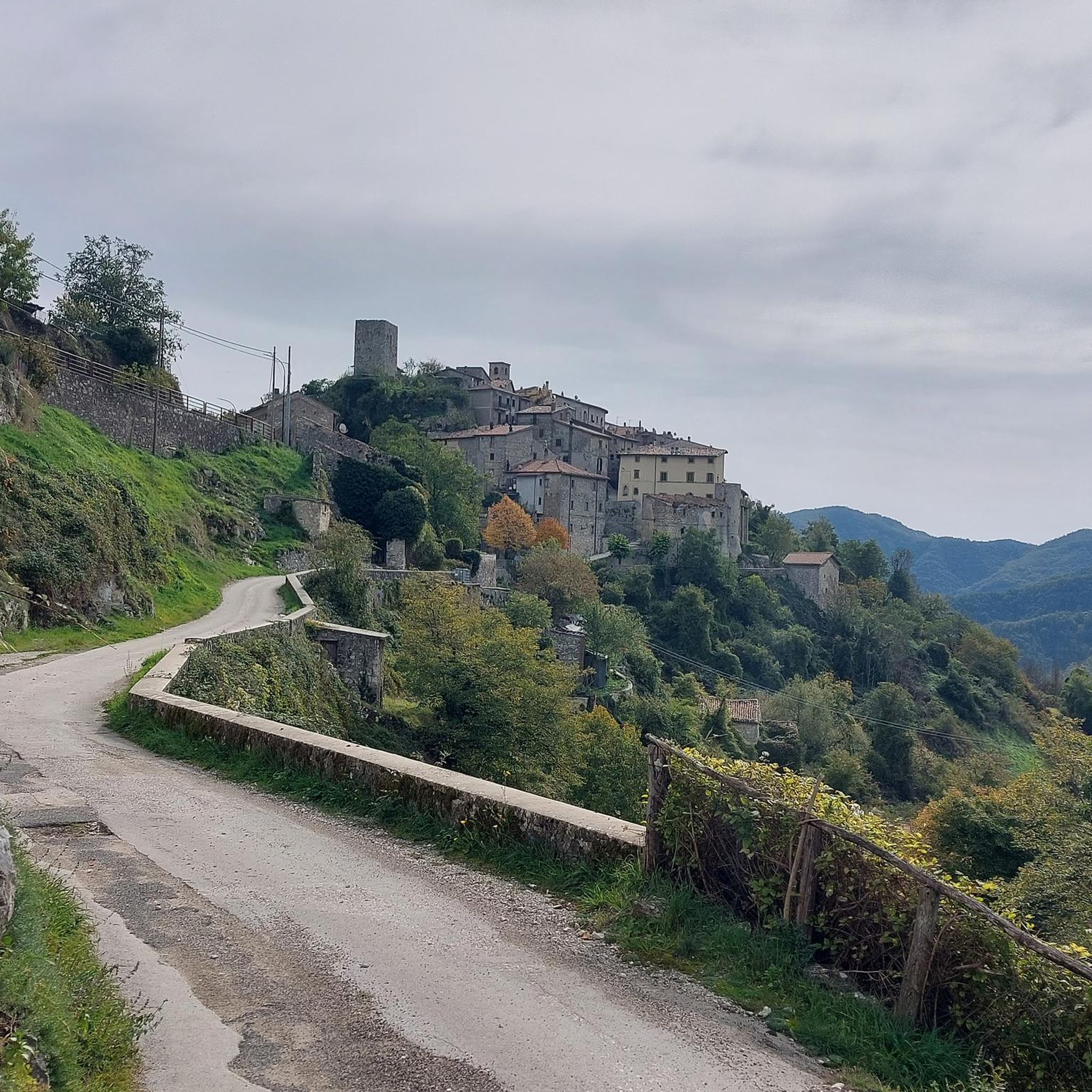
view of Borgo Antuni (for guided tours www.camminandocon.org)
0
0

In L'Aquila, a rich medieval past effortlessly merges with admirable modern resilience. The proud capital of Abruzzo rises in full glory and is best discovered on foot. Wandering through the atmospheric streets, you'll encounter one architectural treasure after another. For example, start at the iconic Fontana delle 99 Cannelle, where 99 mystical stone masks continuously spout water. Climbing further up, you'll reach the massive 16th-century Forte Spagnolo. From this impressive fortress, you can enjoy a sweeping view of the rugged, often snow-capped peaks of the Gran Sasso massif. The city's rich history is also palpable in the many beautifully restored palazzi and churches. For instance, the Basilica di San Bernardino overwhelms every visitor with a breathtaking baroque ceiling adorned with gold leaf. After all the cultural immersion, lively squares like Piazza del Duomo invite you for a well-deserved break. It's the perfect place to enjoy the local cuisine and a good glass of Abruzzese wine at an outdoor cafe. As a grand finale, the Basilica di Santa Maria di Collemaggio should not be missed. This striking, pink-and-white checkered church houses a true world first: the very first Holy Door in the world. Thanks to the central, free parking facilities just outside the city walls, this compact art city is the ideal destination for a carefree and inspiring cultural walking holiday.
4
0
The monumental Scalinata di San Bernardino in L'Aquila is one of the most characteristic and photogenic urban elements of the city. This wide, stately staircase connects the lower Via Fortebraccio with the higher Piazza di San Bernardino. Origin and architecture (16th century) Simultaneous construction: the staircase was built in the 16th century, at the same time as the Renaissance facade of the Basilica di San Bernardino (designed by architect Cola dell'Amatrice between 1525 and 1542). It served as the perfect extension of the religious complex. Urban planning purpose: the staircase had two functions. Practically, it was intended to connect the lower districts around the city walls with the centre. Aesthetically, it created a theatrical and baroque visual axis; pilgrims coming from below saw the monumental church facade slowly tower above them. Imposing dimensions: The staircase is no less than 30 metres wide and 68 metres long. The steps were deliberately designed to be very low and deep, so that large groups of worshippers and processions could comfortably ascend the slope. Striking features and details. The watchtowers: at the beginning (bottom) and end (top) of the staircase are a total of four small, robust turrets (torrette) that flank the staircase and give it a slightly military or monumental character. The edicolae: along the sides of the staircase are three stone niches or chapels (edicole) per side. These historically served during religious festivals and processions.
5
0
Fontana Luminosa – the icon of L'Aquila The Fontana Luminosa is one of L'Aquila's most famous sights and a beloved photo stop. This monumental fountain, designed in 1934 by local sculptor Nicola D'Antino, stands in Piazza Battaglione Alpini. The artwork depicts two imposing bronze female figures who together carry a traditional Abruzzese water basin (conca), from which the water flows. Especially when the fountain is atmospherically illuminated in the evening, it truly lives up to its name – Luminous Fountain. A beautiful place to pause and admire one of L'Aquila's iconic symbols up close.
5
0
Basilica di San Bernardino – a Renaissance pearl of L’Aquila The Basilica di San Bernardino is one of the most beautiful Renaissance monuments in Abruzzo and tells the story of faith, art, and resilience. The impressive facade, designed by Cola dell'Amatrice, is inspired by classical Greek and Roman architecture. The three layers show the different styles: Doric at the bottom, Ionic above it, and Corinthian at the top. On the facade and in the interior, the golden IHS monogram shines with sunbeams, a symbol that Bernardino of Siena used during his sermons to reconcile rival families. Inside is the beautiful marble mausoleum of Saint Bernardino, created by Silvestro dell'Aquila. After his death in 1444, L’Aquila grew into an important pilgrimage site around his tomb. The basilica also symbolizes the city's reconstruction. The 2009 earthquake caused severe damage, including the collapse of part of the bell tower. After a six-year restoration, the church was reopened in 2015 and shines again as one of L’Aquila's major attractions.
5
0

The Amiternum amphitheater is a solemn testament to Abruzzo's glorious Roman past, located on the San Vittorino plain a few kilometers from L'Aquila. Built in the 1st century AD on the edge of the ancient Sabine city, it still retains its imposing elliptical structure with two tiers of arches that once accommodated up to six thousand spectators. Today, it offers a striking blend of the austere monumentality of ancient brickwork and the rural tranquility of the Aterno Valley.
0
0

The bar looks good with the two tarts. Last stop before reaching the top
0
0

At this site, you can see the ancient ruins of Amiternum, a city founded by the Sabines. Also in the area, in addition to the theater, amphitheater, and remains of a domus, you can see the remains of the ancient Via Cecilia, which connected Rome with the Abruzzo colonies in the present-day province of Teramo.
0
0
Frequently Asked Questions
How many touring cycling routes are available around Longone Sabino?
There are over 120 touring cycling routes in the Longone Sabino area, offering a wide range of options for cyclists. The majority, about 96 routes, are classified as difficult, with 26 moderate and 6 easy routes also available.
What kind of terrain can I expect on touring cycling routes near Longone Sabino?
The terrain around Longone Sabino is diverse, characterized by significant elevation changes due to its location at 800 meters above sea level and proximity to mountainous regions like Mount Terminillo. You'll find a mix of asphalted roads, particularly around Lake Salto and Lake Turano, and more challenging paths through thick woodlands and valleys. The area is often called 'little Switzerland' due to its natural features.
Are there any family-friendly touring cycling routes in the Longone Sabino area?
While many routes are challenging, the area around Lake Salto offers mostly flat, asphalted roads suitable for various bicycle types, including city bikes, making it a good option for families. These routes provide beautiful natural views and often include rest areas. For specific easy routes, komoot lists 6 options in the region.
What are some notable natural features or viewpoints along the cycling routes?
Cyclists can enjoy stunning natural features, including the scenic Valle del Salto and Valle del Turano, both featuring beautiful lakes. The thick woodlands, especially around Monte Aquilone, offer numerous panoramic points. You can find breathtaking views, such as the View of Lake Turano and Lake Salto from Monte Navegna, or explore the Monte Navegna Summit Cross.
What historical or cultural landmarks can I visit while cycling near Longone Sabino?
Longone Sabino and its surrounding hamlets offer several historical and cultural points of interest. The village itself retains a medieval structure with narrow cobblestone streets. Notable sites include the 6th-7th century Church of SS. Cosma and Damiano, and the Abbey of San Salvatore Maggiore. You might also encounter the Salto Dam or the Ponte Vecchio of Posticciola.
What is the best time of year for touring cycling in Longone Sabino?
The region's climate makes spring and autumn ideal for touring cycling, offering pleasant temperatures and vibrant landscapes. Summer can also be enjoyable, especially at higher altitudes, though some lower-lying areas might be warm. Winter cycling is possible but requires appropriate gear due to the altitude and potential for colder weather.
Are there any long-distance touring cycling routes for experienced riders?
Yes, for experienced riders seeking longer distances and significant climbs, routes like the Amiternum Archaeological Site – L'Aquila loop from Cittaducale, spanning over 128 km, or the Ancient Baths of Vespasian – Canetra Old Town loop from Cittaducale, at over 106 km, offer challenging and rewarding experiences with substantial elevation gain.
What do other touring cyclists say about the routes in Longone Sabino?
The touring cycling routes around Longone Sabino are highly regarded by the komoot community, holding an average rating of 4.6 stars from over 150 reviews. Cyclists often praise the diverse landscapes, from serene lake views to challenging mountain ascents, and the rich historical context of the region.
Are there any circular touring cycling routes around Longone Sabino?
Yes, many touring cycling routes in the area are designed as loops, allowing you to start and end at the same point. An example is the Gravel on Lake Turano in the Monti Navegna e Cervia Nature Reserve — loop tour, which takes you around the scenic Lake Turano.
Can I find places to eat or stay along the touring cycling routes?
Longone Sabino and its surrounding villages offer various options for refreshments and accommodation. While specific cafes or pubs on every route segment are not guaranteed, you'll find places in the towns and villages. The area around Lake Salto, for instance, has a bar with panoramic views near the dam. For more general information on the region, you can visit visitlazio.com.
Are there any particularly challenging touring cycling routes for advanced riders?
Absolutely. For those seeking a significant challenge, routes like the Pian de' Valli, Terminillo – Angelo Sebastiani Hut loop from Cittaducale, covering over 73 km with substantial climbs towards Mount Terminillo, provide a demanding experience. Another option is the Pian de' Valli, Terminillo – Refreshment stop on Mount Terminillo loop from Cittaducale, also featuring significant ascents.
Most popular attractions around Longone Sabino

Get inspired with the komoot mobile app


Explore more
Browse the best Cycling routes in other regions.
