Top 20 Castles around Ouffet
Best castles around Ouffet are found in the heart of the Condroz Liégeois region of Belgium. This charming commune offers a glimpse into its rich past through various historical sites. The area features a mix of privately owned châteaux and historical farm complexes, contributing to its historical landscape. Visitors can explore these structures, many of which are set amidst expansive grounds and natural settings.
Best castles around Ouffet
- The most popular castles is Modave Castle, a castle that dominates…
Last updated: August 16, 2026
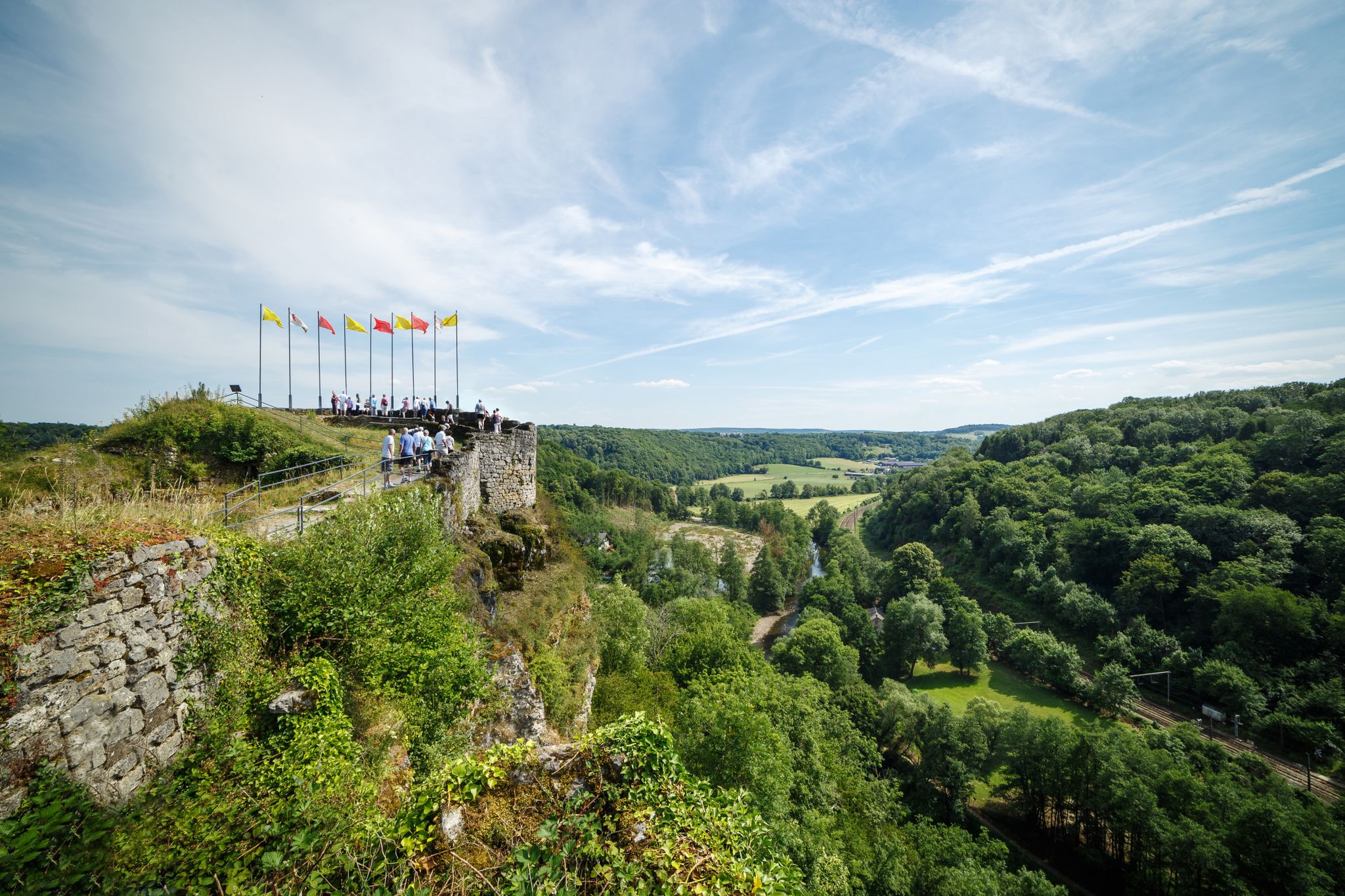
Durbuy — Old Town and Castle
Highlight • Settlement
Translated by Google •
Tip by

Modave Castle
Highlight • Castle
Translated by Google •
Tip by
Sign up now to discover places like this
Get recommendations on the best single tracks, peaks, & plenty of other exciting outdoor places.
Sign up for free
Bomal-sur-Ourthe Castle
Highlight • Castle
Info: durbuytourisme.be/hades_offre/le-chateau-de-bomal/?l=fr
Translated by Google •
Tip by

Palogne Estate
Highlight • Rest Area
Translated by Google •
Tip by

Chateau Radhadesh (Petite Somme)
Highlight • Castle
Translated by Google •
Tip by

Sign up for free to discover even more castles around Ouffet.
Sign up for free
Already have an account?
Start today with a free account
Your next adventure awaits.
Login or Signup


Other adventures around Ouffet

Tips from the Community

Ideal resting place during a longer hike.
0
0

Today, the castle is part of the Radhadesh estate, which also includes a more recent residential center and several even more recent agricultural buildings. Openbaar Kunstbezit Vlaanderen (Flanders Public Art Agency) calls it a spiritual community, where the new residents have thoroughly restored the castle and transformed it into a true spiritual oasis where you can explore the colorful culture of Indian traditions. Specifically, the International Society for Krishna Consciousness (formerly the Hare Krishna movement) has a base and residential community there. There's also a vegan restaurant, a shop, a museum of sacred art (MOSA), and you can take a paid tour. The temple is accessible without payment. There's also a 2.8-kilometer "spiritual" walking trail. More at https://www.okv.be/museum/radhadesh-kasteel-van-petite-somme I'm not mentioning the domain's website because of a virus alert on my computer.
7
0
Built in 1888 and now in its neo-Gothic style, the castle served as a field hospital during the First World War, where the Jourda family cared for wounded and also sheltered local residents whose homes had been destroyed. During the Second World War, it housed American soldiers during the Rundstedt Offensive. From 1946 onwards, it became a holiday center, a school for people with intellectual disabilities, a youth hostel, a campsite, and a hotel-restaurant, all under the initiative of mayors Jean Andrieu of Herstal and Denis Deghaye of Oupeye. After the initiative's bankruptcy, a Brussels real estate agent, Serge Frankovich, bought the property in 1975, leaving it vacant for five years and plundering it. The Hare Krishna movement then purchased it and turned it into the Radhadesh estate. Sources: - https://www.castles.nl/petite-somme-castle - https://www.burchten-kastelen.be/provincies/luxemburg/002%20Kasteel%20van%20Petite%20Somme/Kasteel%20van%20Petite%20Somme.html - https://nl.wikipedia.org/wiki/Petite-Somme
7
0
Since 1980, the castle of Petite-Somme has housed a temple of the Hare Krishna movement, which today operates as the International Society for Krishna Consciousness. The dilapidated castle, of course, has a longer history. The current castle is also not the original and dates from 1888. The first mention of a castle on this site dates back to the eleventh century, when a certain Gozélonde Montaigu owned it. He was also the first Count of Montaigu. The County of Montaigu was quite influential for a time. It included the County of Duras in the Sint-Truiden region, the County of Clermont-sous-Huy, the Lordship of Jodoigne, and the village of Marcourt. The Counts of Montaigu were also vice-patrons of the Abbey of Sint-Truiden. Ecclesiastically, it belonged to the diocese of Liège. The castle was reportedly donated to the Abbey of Saint Hubert by the wife of Gozélon de Montaigu as penance for his husband's alleged plundering of the abbey's property. In the fourteenth century, a certain Jean de Bohême was said to have owned it, adding a tower to the castle, which became part of Luxembourg's defensive line. In 1461, the castle became the property of the de Hamal family, a Dutch-Belgian noble family that also appears in the histories of several Limburg villages and lordships (including 's Herenelderen, Grevenbroek, and the land of Vogelsanck). The de Hamal family held the lordship and castle of Petite Somme until 1774. Several noble families then succeeded one another. First came Albert Joseph de Favereau, born in 1750. De Favereau demolished the house that had served as the Hamal family's residence and built a brick manor house on its foundations. The new castle remained in the family's possession until 1877. Other sources claim that the demolition was carried out by the Count de Vaux, Aimable-Alexis de Jourda. What is certain is that the de Favereau family building was also demolished by a certain Louise Marie Eulalie, a relative of Baron Victor Albert de Favereau. And whatever the exact details are: it is certain that the current neo-Gothic castle stood there in 1888. Sources: - https://www.castles.nl/petite-somme-castle - https://www.burchten-kastelen.be/provincies/luxemburg/002%20Kasteel%20van%20Petite%20Somme/Kasteel%20van%20Petite%20Somme.html - https://nl.wikipedia.org/wiki/Petite-Somme
7
0

Built in the Middle Ages, only the keep and a few architectural elements remain from that period. After its partial destruction in the mid-17th century, it was restored and transformed into an elegant pleasure palace. The French-style park and gardens, redesigned in the 19th century, are part of the Parks and Gardens of Wallonia, designated as an exceptional cultural heritage site. They are free to enter during the castle's opening hours. Magnificent rose beds adorn the grounds. To learn more about the park and its grounds, you can download audio guides at https://www.modave-castle.be/les_jardins. Source: https://visitwallonia.de/de/content/ausergewohnlichen-garten-das-schloss-von-modave
33
1
Opening Hours: From March 30 to November 15 Daily from 10:00 AM to 6:00 PM (last admission at 4:45 PM) Closed on Mondays (except public holidays and July/August) Special opening at Christmas Further information can be found on the Modave Castle website: https://www.modave-castle.be/infos_pratiques
58
0
This neoclassical castle, perched on terraces, was built in 1776 by Jean-Baptiste de Hayme, the mayor of Liège several times. With its magnificent park, it has been part of a renovation project since 2009. Source: https://www.mini-ardenne.be/poi.card.php?language=fr&id=4350
2
0

ample parking here, several options for walking.
0
0
Frequently Asked Questions
What are some notable castles to visit around Ouffet?
The region offers a variety of historical structures. You can visit Modave Castle, known for its medieval keep and extensive gardens. Another popular spot is Durbuy — Old Town and Castle, often called the smallest town in the world, with its well-preserved architecture. The Palogne Estate combines nature, adventure, and history under the walls of an authentic fortified castle.
Are there any castles in Ouffet itself that I can visit?
In Ouffet, the Château d'Ouffet functions as a large capacity gîte, or holiday rental, offering a unique blend of history and modern comfort. While it's primarily an accommodation, its oldest part dates back to 1540, and it features historical architecture and expansive grounds. The Château Ferme d'Ouffet is another historical farm complex with defensive elements, showcasing centuries of architectural evolution.
What kind of historical architecture can I expect to see in the castles around Ouffet?
The castles around Ouffet display a range of historical architecture. For instance, Modave Castle features a medieval keep. The Château d'Ouffet combines noble materials like oak parquet flooring and natural stone within its historic framework, with parts dating back to 1540. The Château Ferme d'Ouffet shows defensive elements like a keep and construction from the 14th to 18th centuries using sandstone and limestone rubble. The Castle (Petite-Somme) is a neo-Gothic structure from 1888.
Are there family-friendly castles or activities near Ouffet?
Yes, several castles and estates offer family-friendly experiences. Durbuy — Old Town and Castle is great for strolling through medieval alleys. Modave Castle and its gardens are open for visits. The Palogne Estate, situated under a fortified castle, offers various outdoor activities, a tavern, mini-golf, and falconry shows, making it ideal for families.
What outdoor activities can I do near these castles?
The area around Ouffet is excellent for outdoor activities. You can find numerous routes for cycling, mountain biking, and running. For example, there are cycling routes like the 'Hoyoux Castle – Small hidden estates loop' and mountain biking trails such as the 'Himbe Castle – Hamoir Bridge loop'. You can explore more options on the Cycling around Ouffet, MTB Trails around Ouffet, and Running Trails around Ouffet guide pages.
Can I visit the Château de Himbe?
The Château de Himbe, located two kilometers south of Ouffet, is notable for its 17th-century foundation and consistent limestone masonry. While the interior cannot be visited, its historical architecture, surrounding park, chapel, and farm buildings make it a picturesque point of interest to see from the exterior during a walk in the region.
What natural features can I see around the castles in Ouffet?
Many castles are set amidst beautiful natural landscapes. Modave Castle is located in the heart of a nature reserve, dominating the Hoyoux valley. The Château d'Ouffet boasts an enclosed park with century-old trees and unobstructed views. Bomal-sur-Ourthe Castle overlooks the Ourthe river, and the Palogne Estate is nestled at the confluence of the Ourthe and Lembrée rivers.
What is the best time of year to visit the castles around Ouffet?
The period from April to mid-November is generally ideal for visiting castles like Modave Castle, as it is open daily during these months (except Mondays, with some exceptions). Visiting during spring or autumn can offer pleasant weather for exploring the castle grounds and nearby natural areas, with changing foliage adding to the scenic beauty.
Are there any castles with unique modern uses or cultural significance?
Yes, the Castle (Petite-Somme), a neo-Gothic structure from 1888, now houses a temple of the Hare Krishna movement and operates as the International Society for Krishna Consciousness. It's part of the Radhadesh estate, which includes a vegan restaurant, a shop, a museum of sacred art, and a spiritual walking trail. The temple itself is accessible without payment.
What do visitors enjoy most about the castles around Ouffet?
Visitors appreciate the rich history and well-preserved architecture of the castles, often set in picturesque natural surroundings. The blend of historical exploration with opportunities for outdoor activities like hiking and cycling is a significant draw. Many enjoy the immersive experience of stepping back in time while also having access to modern amenities or natural beauty.
Can I find cafes or pubs near the castles in the Ouffet region?
While specific cafes or pubs directly adjacent to every castle are not detailed, the Palogne Estate includes a tavern-restaurant. For other locations, exploring the nearby towns and villages like Ouffet or Durbuy will likely offer options for refreshments and dining.
Is public transport available to reach castles around Ouffet?
Information on specific public transport routes to each castle is limited. However, for the Palogne Estate, a bus service is mentioned for kayak trip departures, suggesting some local transport options might exist. For most castles in rural areas, driving or cycling might be the most convenient way to access them.
Most popular routes around Ouffet
Most popular attractions around Ouffet

Get inspired with the komoot mobile app


Explore more
Looking for the best castles somewhere else? Discover other guides around Ouffet:
