Attractions and Places To See around Civita Castellana - Top 20
Best attractions and places to see around Civita Castellana. Civita Castellana is a historic town in Lazio, Italy, situated on high tufa spurs and cliffs overlooking deep ravines carved by rivers. The area is characterized by ancient Etruscan and Faliscan history, Renaissance architecture, and natural landscapes including gorges, the Tiber Valley, and Monte Soratte. Visitors can explore a variety of sites, from imposing fortresses to ancient archaeological areas.
Best attractions and places to see around Civita Castellana
- The most popular…
Last updated: October 9, 2026
Hermitage of Saint Sylvester
Highlight • Religious Site
Translated by Google •
Tip by

Nazzano Tevere-Farfa Nature Reserve
Highlight • Natural
Translated by Google •
Tip by

Sign up now to discover places like this
Get recommendations on the best single tracks, peaks, & plenty of other exciting outdoor places.
Monte Soratte Bunker
Highlight • Monument
Translated by Google •
Tip by

Corchiano Historic Village and Gorges
Highlight • Settlement
Translated by Google •
Tip by

Calcata Vecchia
Highlight • Settlement
Translated by Google •
Tip by

Sign up for free to discover even more attractions around Civita Castellana.
Already have an account?
Start today with a free account
Your next adventure awaits.

Tips from the Community

For those arriving at Calcata Vecchia and wanting to descend into the Treja Valley, I strongly advise against taking the marked path that is not on the road: it is a pedestrian descent that can only be done with a bike in hand, and not even easily. Descend following the main asphalt road.
0
0

An open-air museum, recommended
1
0

Corchiano is a small town in the province of Viterbo, apparently similar to many others, a little modest... and yet, it has become famous for some events, such as the infiorata, which is held at the end of May and sees the entire town involved in decorating a good part of the streets of the town with flower petals, colored sawdust, coffee grounds and in general any material that can be colored and applied in designs of great beauty. Then, in December, the living nativity scene takes place in a natural setting of great suggestion, finally, the exploration on foot of the ravines should not be overlooked, a true natural monument and archaeological site of great interest... in short, a place that is worth visiting. The difficulty in walking the paths, all equipped, is generally T (tourist) and suitable for all age levels.
1
0

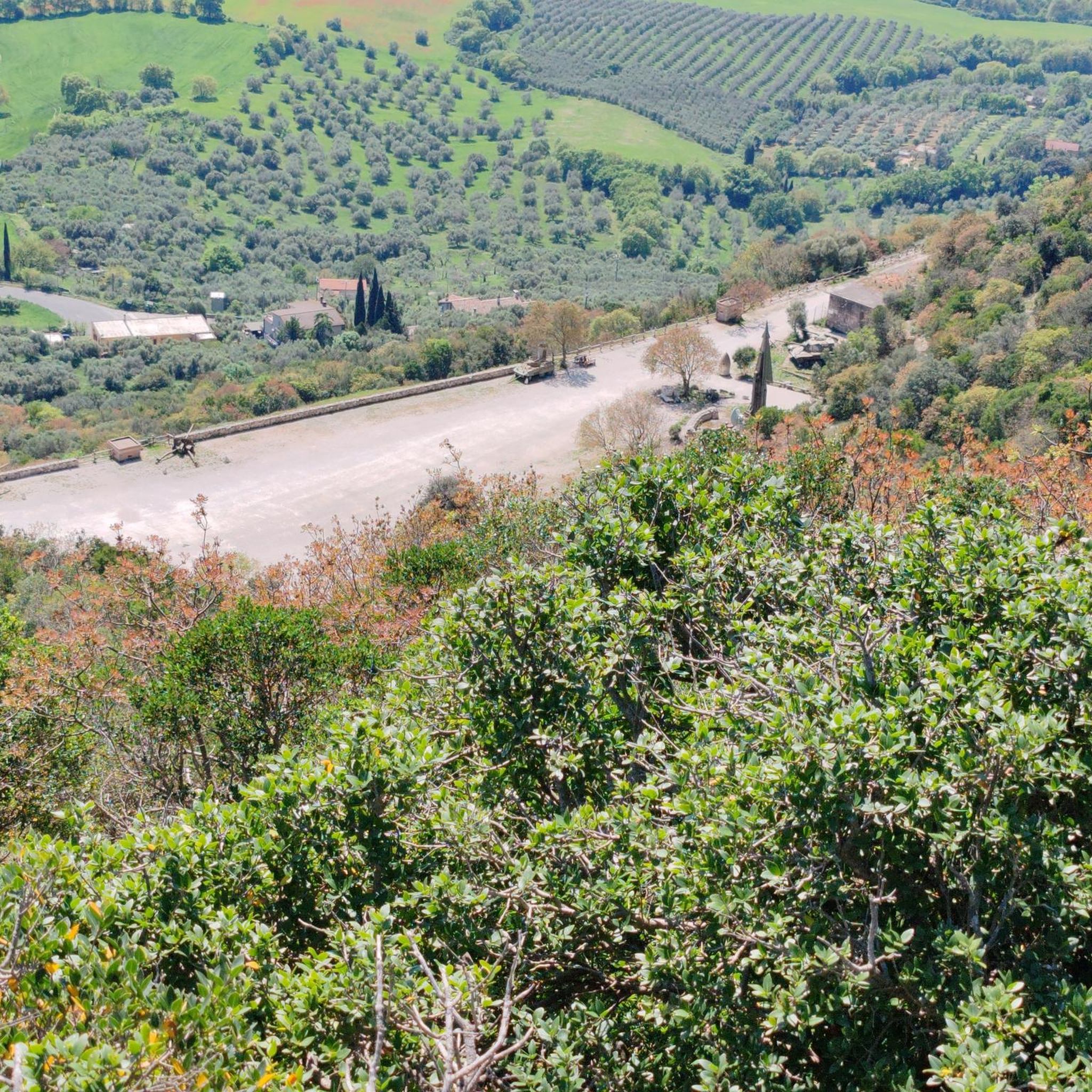
Short panoramic walk with an exhibition of military vehicles.
0
0

The Nazzano Tevere - Farfa Regional Nature Reserve extends upstream of the Enel hydroelectric power plant in Nazzano, and includes the stretch of the Tiber river that goes from the power plant itself to the Poggio Mirteto mountain and along the course of the Farfa river up to the Granica bridge .
0
0

On the way to the top of Soratte, just before the San Silvestro hermitage, you can take the path on the left that leads to the small San Sebastiano hermitage, of which modest wall traces remain. The latter was home to hermits in the 16th and 17th centuries, after which it began to be abandoned and fell into ruin. In the rock there is a cavity used to collect water. Short trail but to be followed with care.
0
1

This hermitage has a patronal name that is truly on everyone's lips, but only a few will know the person behind it: the feast day of Saint Sylvester (San Silvestro) is December 31st. He lived at the end of the third or beginning of the fourth century and was Bishop of Rome when Emperor Constantine - later generations gave him the nickname "the Great" - recognized Christianity as a religion with the so-called "Edict of Toleration" of Milan, thus ending - at least temporarily - the period of bloody persecution of Christians.
1
2

For the landscapes and also the roads, which however, at least for the part of the Province of Rome, should be maintained a little more (asphalt at times too ruined).
1
0
Frequently Asked Questions
What historical sites can I explore in and around Civita Castellana?
Civita Castellana is rich in history, from ancient Etruscan roots to Renaissance architecture. You can visit the imposing Forte Sangallo, which now houses an archaeological museum with artifacts from the Faliscan civilization. The stunning Cathedral of Santa Maria Maggiore, with its Cosmatesque façade and 13th-century floor, is another must-see. The area also features numerous ancient Etruscan necropolises and the well-preserved Roman city walls of Falerii Novi, approximately 6 km away.
Are there any natural attractions or viewpoints near Civita Castellana?
Yes, the region offers dramatic natural beauty. The town itself is situated on high tufa spurs overlooking deep ravines. For panoramic views, visit the Hermitage of Saint Sylvester at the top of Mount Soratte, offering vistas of the Tiber Valley. You can also explore the Corchiano Historic Village and Gorges, a natural monument with equipped paths suitable for all ages. The Nazzano Tevere-Farfa Nature Reserve is another protected area characterized by the Tiber River and an artificial lake.
What kind of outdoor activities can I do around Civita Castellana?
The area around Civita Castellana is excellent for outdoor activities. You can find various hiking trails, including routes that explore ancient Etruscan necropolises and the Via Amerina. For more specific options, check out the Hiking around Civita Castellana guide, which includes routes like 'Civita di Castellana towards the Necropolis and the via Amerina Nepi'. There are also numerous options for running and road cycling, such as those found in the Running Trails around Civita Castellana and Road Cycling Routes around Civita Castellana guides.
Are there family-friendly attractions in the Civita Castellana area?
Absolutely. The Nazzano Tevere-Farfa Nature Reserve is a great option for families, offering a natural and peaceful setting along the Tiber River with flat, easy paths. The Corchiano Historic Village and Gorges also provides equipped paths suitable for all age levels, making it an engaging exploration for families. The historic center of Civita Castellana itself, with its medieval alleys and squares, can be an interesting walk for all.
What is the best time of year to visit Civita Castellana for outdoor activities?
The best time to visit Civita Castellana for outdoor activities is typically during the spring (April to June) and autumn (September to October) months. During these periods, the weather is generally mild and pleasant, ideal for hiking, cycling, and exploring historical sites without the intense heat of summer or the chill of winter. The natural landscapes are also particularly beautiful with spring blooms or autumn foliage.
Can I visit ancient Roman or Etruscan ruins near Civita Castellana?
Yes, Civita Castellana is built on the site of the ancient Faliscan capital, Falerii Veteres. You can explore numerous Etruscan necropolises in the surrounding area. Additionally, about 6 km away, you'll find Falerii Novi, a Roman-built city with extensive and well-preserved Etruscan/Roman city walls. The Via Amerina, an ancient road lined with rock-carved burial chambers, also offers a unique historical exploration.
What is the Monte Soratte Bunker and can I visit it?
The Monte Soratte Bunker is a significant man-made monument consisting of a network of tunnels inside Mount Soratte, originally built in 1937 as an air-raid shelter. It served as a German military headquarters during WWII. The area outside the bunker is free to access. For information on visiting the interior, you may need to check local tour availability, as it often requires guided tours.
Are there any unique cultural traditions or crafts in Civita Castellana?
Civita Castellana has a long-standing tradition of ceramics production, dating back to the Faliscan era. You can learn more about this important cultural and industrial heritage at the Museo della Ceramica. The town's historic center also features places like Bottega di Mastro Cencio, where you can explore local artisan traditions.
What are some less-known or 'hidden gem' attractions in the area?
Beyond the main highlights, consider exploring the medieval layout of the Corchiano Historic Village, which hosts unique events like the 'infiorata' and a living nativity scene in its natural setting. The ancient churches within Civita Castellana, such as the Church of San Pietro with its early medieval origins, or the Church of Saint Francis with its 16th-century artworks, offer deeper dives into the town's rich past.
Where can I find easy walking routes near Civita Castellana?
For easy walking, the Nazzano Tevere-Farfa Nature Reserve offers flat, gravel paths along the Tiber River, suitable for a relaxed stroll. Additionally, the Hiking around Civita Castellana guide includes routes like 'Trail Along the Fosso Maggiore – Via Amerina Near Nepi loop from Falerii Novi' which is rated as easy.
What is the significance of the Faliscan civilization in Civita Castellana?
Civita Castellana stands on the site of Falerii Veteres, the capital of the Faliscans, an ancient Italic tribe culturally close to the Etruscans. Their legacy is evident throughout the region, particularly in the numerous Etruscan necropolises and artifacts displayed in the archaeological museum within Forte Sangallo. The Faliscan civilization is a cornerstone of the area's deep historical identity.
Most popular routes around Civita Castellana
Most popular attractions around Civita Castellana

Get inspired with the komoot mobile app


Explore more
Still not found the Highlight you’re looking for? See guides of the top attractions in other regions:
