The best traffic-free bike rides around Oświęcim
4.4
(19)
148
riders
23
rides
Gravel biking around Oświęcim offers predominantly flat landscapes, shaped by the Vistula and Soła rivers, providing extensive unpaved paths. The region features expansive river valleys, flood embankments, and numerous fishponds, creating serene environments for cycling. The Dziećkowice Reservoir also contributes to the scenic routes available. This terrain is well-suited for long-distance rides with minimal elevation changes.
Best no traffic gravel bike trails around Oświęcim
- The most popular no traffic gravel bike trail is Dulowska Forest – gravel pleasure loop from…
Last updated: September 2, 2026
4.0
(1)
19
riders
44.6km
02:30
120m
120m
Moderate gravel ride. Good fitness required. Mostly paved surfaces. Suitable for all skill levels.
8
riders
51.5km
02:52
150m
150m
Moderate gravel ride. Good fitness required. Mostly paved surfaces. Suitable for all skill levels.

Sign up for free
5
riders
37.0km
02:06
90m
90m
Moderate gravel ride. Good fitness required. Mostly paved surfaces. Suitable for all skill levels.
7
riders
17.8km
01:02
60m
60m
Easy gravel ride. Great for any fitness level. Mostly paved surfaces. Suitable for all skill levels.
3
riders
Hard gravel ride. Great for any fitness level. You may need to push your bike for some segments of this route.
Get access to more routes and recommendations from other explorers.
Sign up for free
Already have an account?
Our route recommendations are based on thousands of hikes, rides, and runs completed by other people on komoot.
Start today with a free account
Your next adventure awaits.
Login or Signup


Other adventures around Oświęcim

Tips from the Community

The path around the reservoir is mostly paved with concrete slabs, so it's not a cyclist's dream... Fortunately, large sections are laid in such a way that there is a strip of bare earth/sand between the slabs in the middle, so you can stubbornly ride there, avoiding the slabs.
0
0

The Castle in Oświęcim is a medieval defensive stronghold located on a hill on the right bank of the Soła River. Currently, the site is home to the Museum of the Castle in Oświęcim, which presents the rich history of the city, the former Duchy of Oświęcim, and valuable historical and archaeological collections. It was here that a great diplomatic turning point occurred: in 1454, the last Piast duke of this region, Jan IV, bowed to the might of Poland and ceded the castle and his entire duchy as a fief to King Casimir Jagiellon. Three years later (in 1457), he completely sold these lands to him. The castle ceased to be a Silesian borderland and became Polish royal property for centuries. It is worth taking a look at the mighty, 13th-century Gothic tower, which remembers those events and that agreement! The history of the castle in Oświęcim dates back to the 11th century, when there was an early medieval agricultural settlement on the hill above the Soła. After it burned down, a fortified castellany stronghold was erected here. The first official documentary mention of it dates from 1179. It was then that King Casimir the Just transferred these lands to the Duke of Opole, Mieszko Plątonogi. Early Gothic tower – dates from the end of the 13th century, it is a defensive building type (bergfried) and is one of the oldest preserved brick structures in Lesser Poland. Royal history – the castle hosted prominent historical figures, including the future Queen of Poland, Bona Sforza. Underground tunnels – there are two corridors under the castle, including an air-raid shelter built by the Germans during World War II. Address: ul. Zamkowa 1, 32-600 Oświęcim Opening hours: Tuesday to Sunday from 10:00 AM to 6:00 PM (the museum is closed on Mondays).
1
0
The Park Mgieł is a modern attraction located in the newly modernized Park Bulwary nad Sołą in Oświęcim at ul. Parkowa 5. The installation creates an atmospheric water mist floating above wooden footbridges, which provides pleasant cooling on hot days. Mist show schedule The mist effect is activated at specific times during the day: Monday – Friday: at 2:00 PM, 4:00 PM, and 6:00 PM. Saturdays, Sundays, and holidays: at 2:00 PM, 3:00 PM, 4:00 PM, 5:00 PM, 6:00 PM, and 8:00 PM.
3
0

Surface: Natural, dirt-and-gravel path running along embankments and dikes. In places, it can be muddy or overgrown with grass after rainfall. Gravel / MTB / trekking tires will work best. Number and names of reservoirs: Officially, it is a complex of 9 ponds (Krzemieńczyk Duży, Adam Duży, Średni, Górny, Zimowy, Letni, Malinowski, and the Kościelecki I and II, divided by a dike). In the terrain, considering small hydrological cutoffs, up to 10 can be counted. Nature and protection: Natura 2000 protected area (Dolina Dolnej Soły) and a natural-landscape complex. Breeding ground for rare birds, including the white-winged tern. Beautiful views of the water surfaces and reed beds can be seen from the dikes. Route connection: The complex borders the Soła river embankments to the west and smoothly transitions into the Grojeckie Ponds area to the south. It offers an excellent, car-free connection between the southern districts of Oświęcim and Zaborze and Grojec.
2
0
Stawy Adofińskie An exceptionally picturesque, flat gravel section leading through the dikes of a historic complex of 9-10 carp ponds in the Soła Valley. A refuge for wild birds, ideal for a peaceful ride on a trekking or gravel bike, or for a hike away from car traffic.
1
0
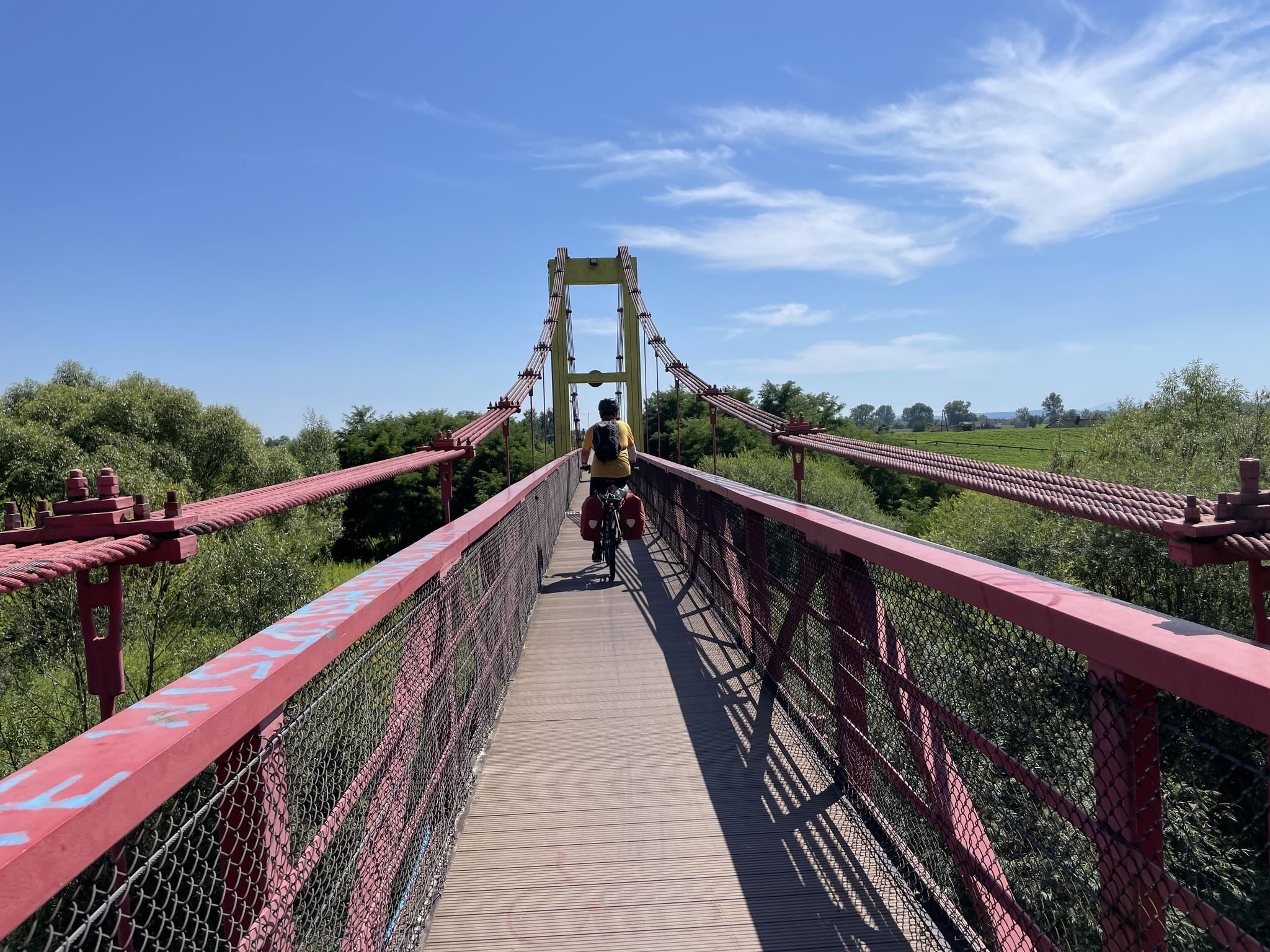
A pleasant crossing between two bridges. You can't ride onto this footbridge, but there are guide rails. Nice view from the top of the river and the boulevards.
1
0

Nice market square. Currently under renovation.
0
0
Alternative route from Oświęcim to Poręba Wielka and a bit of gravel along the way.
1
0
Frequently Asked Questions
How many traffic-free gravel bike trails are available around Oświęcim?
There are over 15 dedicated traffic-free gravel bike trails around Oświęcim, offering a variety of distances and difficulty levels. These routes are designed to keep you away from vehicular traffic, providing a serene cycling experience.
What kind of terrain can I expect on gravel bike trails near Oświęcim?
The terrain around Oświęcim is predominantly flat, shaped by the Vistula and Soła river valleys. You'll find expansive flood embankments, quiet paths through numerous fishponds in the 'Carp Valley' region, and trails around the Dziećkowice Reservoir. These conditions are ideal for long-distance rides and offer a mix of unpaved and well-maintained surfaces.
Are there any easy, traffic-free gravel routes suitable for beginners in Oświęcim?
Yes, Oświęcim offers several easy gravel routes perfect for beginners or those looking for a relaxed ride. For example, the "Oświęcim Castle – Double Bassists Mural loop from Oświęcim" is an easy option that keeps you away from heavy traffic.
What do other gravel bikers enjoy most about the trails in Oświęcim?
The komoot community highly rates the gravel biking experience in Oświęcim, with an average score of 4.5 stars. Reviewers often praise the tranquil riverine landscapes, the extensive network of cycling paths, and the peaceful, traffic-free environment that allows for immersive exploration of the region's natural beauty.
Are there any scenic viewpoints or natural features to explore on these routes?
Absolutely. Many routes follow the scenic Vistula and Soła river valleys, offering open views and tranquil green environments. The Dziećkowice Reservoir provides beautiful waterside views, and the numerous fishponds in the 'Carp Valley' add to the picturesque scenery. While primarily a hiking reserve, the Bukowica Nature Reserve, with its Carpathian beech forest and rock formations, offers a quiet, charming corner that aligns with gravel biking preferences, though specific cycling paths may vary. For more information on the reserve, you can visit visitmalopolska.pl.
Can I find any historical landmarks or points of interest along the gravel trails?
Yes, you can combine your gravel biking with cultural exploration. The Oświęcim Castle, perched on a hill overlooking the Soła River, and the charming Old Town with its Main Market Square, are accessible and make for interesting points of interest. The Boulevards along the Soła River also offer pleasant recreational areas for cyclists.
Are there any circular gravel bike routes around Oświęcim?
Many of the gravel routes around Oświęcim are designed as loops, allowing you to start and end in the same location without retracing your steps. For instance, the "Dziećkowice Reservoir – Dziećkowice Reservoir loop from Oświęcim" is a great example of a circular route that explores the reservoir's surroundings.
Is it possible to access these gravel trails using public transport?
Oświęcim has public transport connections, and some routes are accessible from the town center, which is served by local buses and trains. While specific bike carriage policies vary, it's advisable to check with local transport providers for their rules regarding bicycles on board. Many trails start directly from the town or its immediate vicinity.
Where can I park my car when starting a gravel bike ride in Oświęcim?
Parking is generally available in and around Oświęcim town center, as well as at various starting points for longer routes. Look for designated parking areas near popular trailheads or public parking lots within the town. Specific parking information for individual routes can often be found in the route descriptions on komoot.
Are the gravel bike trails in Oświęcim suitable for families with children?
Many of the traffic-free gravel paths, especially those along the river embankments and around the fishponds, are relatively flat and well-suited for families. Routes with an 'easy' difficulty rating, like the one around Oświęcim Castle, are generally good choices for family outings, offering a safe and enjoyable experience away from car traffic.
Can I bring my dog on the gravel bike trails in Oświęcim?
Generally, dogs are welcome on most public trails in the Oświęcim region, provided they are kept on a leash and you clean up after them. Always be mindful of local regulations, especially in nature reserves or protected areas. The wide-open spaces along the river valleys and around the fishponds are often popular choices for cycling with canine companions.
What is the best season for gravel biking in Oświęcim?
The best seasons for gravel biking in Oświęcim are spring (April-May) and autumn (September-October). During these months, the weather is typically mild, and the natural scenery is at its most beautiful. Summer can also be pleasant, but be prepared for warmer temperatures, especially in July and August. Winter cycling is possible, but trails may be muddy or icy.
Most popular routes around Oświęcim
Most popular attractions around Oświęcim

Get inspired with the komoot mobile app


