Top 20 Castles around Niederheimbach
Best castles around Niederheimbach are situated along the Rhine River in Germany, offering a glimpse into centuries of history. This picturesque village is known for its historic castles, which showcase architectural evolution and cultural significance. The region provides a natural landscape for exploring these structures.
Best castles around Niederheimbach
- The most popular castles is Rheinstein Castle, a castle that features a museum and an adjoining restaurant. The castle's picturesque location offers views down to the Rhine Valley.
- Another must-see…
Last updated: August 16, 2026
View of Burg Reichenstein
Highlight • Castle
Translated by Google •
Tip by

Rossel Ruins
Highlight • Castle
Translated by Google •
Tip by

Sign up now to discover places like this
Get recommendations on the best single tracks, peaks, & plenty of other exciting outdoor places.
Sign up for free
Pfalzgrafenstein Castle
Highlight • Castle
Translated by Google •
Tip by
Rheinstein Castle
Highlight • Castle
Translated by Google •
Tip by

View of Rheinstein Castle and the Rhine from the Kleine Bastei
Highlight • Viewpoint
Translated by Google •
Tip by

Sign up for free to discover even more castles around Niederheimbach.
Sign up for free
Already have an account?
Start today with a free account
Your next adventure awaits.
Login or Signup

Other adventures around Niederheimbach

Tips from the Community

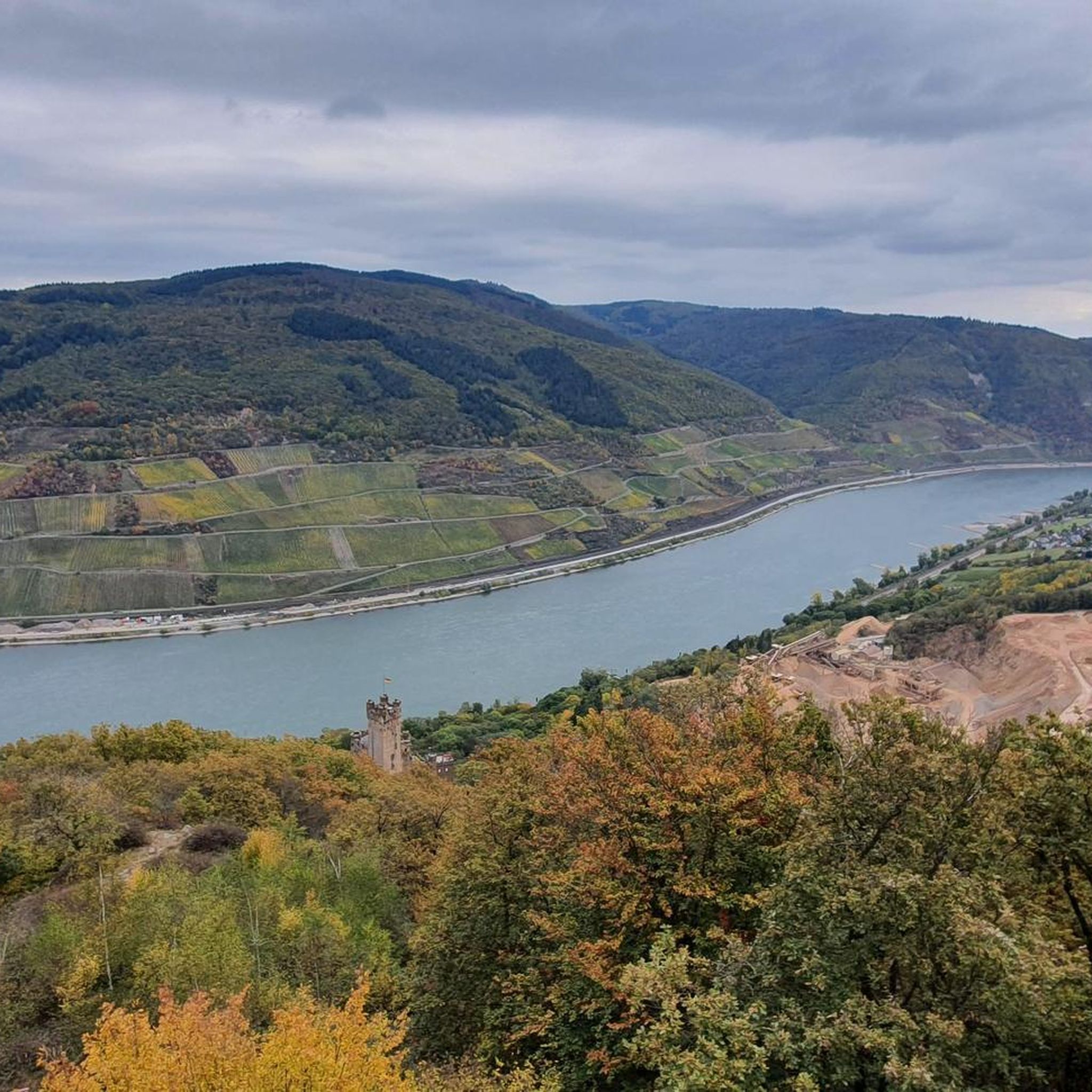
The first documented mention of the hilltop castle dates back to 1213, when the Imperial Abbey of Kornelimünster near Aachen appointed Philipp III von Bolanden as "castellanus" and governor. Experts partly doubt or reject the first conquest in 1253. What is certain is the siege, conquest and destruction by King Rudolph of Habsburg in 1282. The castle was banned from being rebuilt. From 1290 onwards, the ruins were owned by the Counts Palatine, who gave them up in favour of the Electorate of Mainz in 1344. A new building was then quickly constructed. A double ring wall enclosed a rectangular residential tower and an inner courtyard of the main castle. A forecourt was located to the north. In 1397, after the Pope had appointed John II of Nassau Archbishop of Mainz, ignoring the election of the Mainz Cathedral Chapter the previous year, Archbishop Gottfried von Leiningen, elected in 1396, barricaded himself in the castle. Only after tough negotiations did he give up the bishop's seat and was instead given the office of provost of Mainz Cathedral. His concession prevented another attack on the castle and possible further destruction. The castle had been left to decay since the 16th century. The remains were blown up in 1689 during the War of the Palatinate Succession. In 1834 Franz Wilhelm von Barfus bought the ruins and converted a tower into his residence. His heirs sold the castle to Baron von Rehfuß in 1877 and he sold it to Consul Chosodowsky in 1889. The castle was given its current appearance by Baron Nikolaus von Kirsch-Puricelli, a wealthy industrialist and owner of the Rheinböllerhütte. From 1899 to 1902, Kirsch-Puricelli had the castle rebuilt into a neo-Gothic residential castle in the Tudor style according to plans by the Regensburg architect Strebel. Additional residential buildings and an observation tower were built on the site of the outer castle. Reichenstein was the last castle in the Upper Middle Rhine Valley to be rebuilt in the spirit of Rhine Romanticism. After the castle was sold by the family in the 1990s, media entrepreneur Lambert Lensing-Wolff, a descendant of the Kirsch-Puricelli family, acquired Reichenstein Castle in 2014 as a weekend residence and also runs a museum and a hotel with a restaurant here.
5
0

Beautiful view from the bike path up to the castle
7
1

Great view of the castle which is still well preserved.
4
0

The castle has its origins in the early 14th century. With its towers and battlements, it really looks like you would imagine a medieval castle to be - a fairytale view directly over the Rhine.
9
0

A very impressive castle complex. Reichenstein Castle, also known as Falkenburg, is a castle in the UNESCO World Heritage Upper Middle Rhine Valley. It stands on a ledge on the eastern slope of the Binger Forest above the Rhineland-Palatinate municipality of Trechtingshausen.
8
0

from the castle battlements you always have a great view of the Rhine
15
0
the small bastion is reached via a narrow path, where the world heritage trail and tree spirit tour also goes along
15
1
The view from the small bastion is just great
13
0
Frequently Asked Questions
Which castles around Niederheimbach offer the most immersive historical experience?
For a deep dive into history, Rheinstein Castle is a romanticized residential castle with a museum showcasing its past. Burg Sooneck, originally built in 1271 and later restored by Prussian royals, operates as a museum with antique furniture, paintings, and weapons. Burg Reichenstein, with its tumultuous past as a 'nest of robber barons,' now houses a museum with extensive collections of historical weapons, armor, and hunting trophies, and offers an audio guide to enhance the experience.
Are there family-friendly castles to visit near Niederheimbach?
Yes, several castles cater to families. Burg Sooneck offers guided tours with English handouts and a 'treasure hunt' for children, making history engaging for younger visitors. Rheinstein Castle is also listed as family-friendly in the komoot community, and Pfalzgrafenstein Castle, located on a Rhine island and accessible by ferry, provides a unique adventure for all ages.
What are the best viewpoints to see the castles and the Rhine Valley?
Many castles offer stunning views. Burg Sooneck provides breathtaking panoramic views of the Rhine Valley. Burg Reichenstein's terraces also offer wide views over the beautiful Rhine Valley. For dedicated viewpoints, the View of Rheinstein Castle and the Rhine from the Kleine Bastei offers a perfect perspective of Rheinstein Castle, while Rossel Ruins is known for its wonderful view of the Nahe estuary and the Binger Loch.
Can I find food and drink options at or near the castles?
Yes, Rheinstein Castle features an adjoining restaurant and a café. Burg Reichenstein also operates as a hotel and restaurant, providing dining options for visitors. For other castles, it's advisable to check local establishments in nearby villages like Niederheimbach or Trechtingshausen.
What outdoor activities can I do near the castles around Niederheimbach?
The region around Niederheimbach is excellent for outdoor activities. You can find numerous hiking trails, such as the 'Little Sea of Rocks loop' or the 'Wurschberg Viewpoint – Speierbaum loop.' Cycling is also popular, with routes like the 'View of Burg Reichenstein – View of the Niederwalddenkmal loop.' For mountain biking, consider the 'Rheinstein Castle – Rhine-Nahe-Eck loop.' You can explore more options on the Hiking around Niederheimbach, Cycling around Niederheimbach, and MTB Trails around Niederheimbach guide pages.
Are there any castles that are privately owned and not open to the public?
Yes, Burg Heimburg, also known as Burg Hohneck, is privately owned and generally not open for public tours. However, its impressive architecture, including a mighty shield wall and a 26-meter-high keep, can be admired from the Rhine River, particularly from cruise boats.
What is the best time of year to visit the castles in Niederheimbach?
The castles are beautiful year-round, but spring and autumn offer pleasant weather for exploring and hiking, with fewer crowds than peak summer. Spring brings blooming rose gardens, especially at Burg Sooneck, while autumn showcases vibrant fall foliage along the Rhine. Winter visits can be magical, though some facilities might have reduced hours.
How long should I plan for a visit to one of the castles?
The duration of your visit depends on the castle and your interest. For castles like Burg Sooneck or Burg Reichenstein, which offer museums and guided tours, you might want to allocate 2-3 hours to fully explore the interiors and grounds. For viewpoints or external admiration of castles like Burg Heimburg, a shorter stop of 30-60 minutes might suffice. If you plan to combine a castle visit with hiking or dining, allow more time.
Is public transport available to reach the castles?
While specific public transport details for each castle can vary, the Rhine Valley is well-served by regional trains and boat services. Many castles are accessible via a combination of train to a nearby town and then a walk or local bus. For example, Burg Reichenstein is near Trechtingshausen. It's recommended to check local transport schedules for the most up-to-date information for your chosen castle.
What makes <a href="https://www.komoot.com/highlight/270014" target="_blank" rel="noopener">Pfalzgrafenstein Castle</a> unique?
Pfalzgrafenstein Castle is unique because it stands on a small island in the middle of the Rhine River, near the wine village of Kaub. This former toll castle (Zollburg) is only accessible by passenger ferry, offering a distinctive and memorable visitor experience.
What kind of history does Burg Reichenstein have?
Burg Reichenstein has a rich and tumultuous history, dating back to the early 13th century. It was once infamous as a 'nest of robber barons' and was destroyed multiple times, notably in 1290 by King Rudolf of Habsburg. It underwent a comprehensive neo-Gothic reconstruction in the late 19th century and now serves as a museum, hotel, and restaurant, showcasing its past through extensive collections.
Most popular routes around Niederheimbach
Most popular attractions around Niederheimbach

Get inspired with the komoot mobile app


Explore more
Looking for the best castles somewhere else? Discover other guides around Niederheimbach:
