The best road cycling routes around Sargé-Sur-Braye
4.0
(15)
393
riders
156
rides
Road cycling routes around Sargé-Sur-Braye traverse a diverse landscape characterized by cultivated hillsides, river valleys, and rich forests. The region's topography includes varied terrain, offering both gentle stretches along waterways and more challenging ascents through its undulating countryside. This mix of natural features provides a range of road cycling experiences, from scenic leisure rides to routes with notable elevation gains.
Best road cycling routes around Sargé-Sur-Braye
- The most popular road cycling route is Saint-Denis Church – Saint John the Baptist…
Last updated: July 2, 2026
8
riders
45.4km
01:58
350m
350m
Moderate road ride. Good fitness required. Mostly well-paved surfaces and easy to ride.
5
riders
70.8km
02:57
360m
360m
Moderate road ride. Good fitness required. Mostly well-paved surfaces and easy to ride.

Sign up for free
4
riders
57.2km
02:18
310m
310m
Moderate road ride. Good fitness required. Mostly well-paved surfaces and easy to ride.
4
riders
66.8km
02:47
410m
410m
Moderate road ride. Good fitness required. Mostly well-paved surfaces and easy to ride.
3
riders
71.2km
02:54
390m
390m
Moderate road ride. Good fitness required. Mostly well-paved surfaces and easy to ride.
Get access to more routes and recommendations from other explorers.
Sign up for free
Already have an account?
Our route recommendations are based on thousands of hikes, rides, and runs completed by other people on komoot.
Start today with a free account
Your next adventure awaits.
Login or Signup

Tips from the Community

The church dates from the 12th century and was remodeled in the 15th or 16th century, its buttresses and bell tower date from the 19th century. It houses a wrought iron communion table from the 18th century.
0
0
This church contains 14th century wall paintings. These paintings were discovered in 1895. They formerly occupied the entire width of the western wall of the nave. The central part was destroyed following the renovation of the door. The left side represented paradise. Of the bust of Christ, in a trilobed medallion, which occupied the center, there remains only a fragment of the cruciform halo. The rest of the composition is divided into rectangular compartments, each enclosing, in the surviving part, a figure of a crowned chosen one. On the right, hell is represented by a cauldron in which several characters are immersed, including a pope, a bishop, a monk, a king, a queen. Above, a woman with her legs apart. On the right, an enormous horned demon sticks out its tongue. On the left, another carries a basket filled with the damned and is about to plunge a woman into the cauldron. Construction periods: 14th century
0
0
This church was originally supposed to be a simple chapel of the commandery, founded in the 12th century by the Templars, forming one side of the courtyard that groups the buildings. The monumental 15th century porch is flanked by two brick towers. The nave ends with a semi-circular apse covered in a cul-de-four. Construction periods: 12th century, 13th century, 15th century
0
0

The 12th century church of Saint Jean-Baptiste de Courtalain, already repaired in 1592, was rebuilt in 1809, increased by an aisle in 1838, then by a remarkable porch bell tower topped with a twelve meter spire. height, thanks to the generosity of the Montmorency family, owner of the castle. It is to Guillaume Davaugour and Perette de Baïf, his wife, that we attribute the erection of the Courtalain chapel into a parish church; The church is located in the immediate perimeter of the castle. The entire building is partly covered with flat tiles for the roof of the nave, the bell tower, the staircase turret; the three cut sides of the apse and the lower north side are covered in natural slate. Inside the nave is a Mutin Cavaillé Coll organ dating from 1936. It contains several interesting paintings.
0
0
The parish church of Saint-Pellerin, whose oriented plan is reduced to a simple rectangle, only retains a few vestiges of the Romanesque period: part of the southern wall, itself repaired several times. The building, which was struck by lightning, was restored in 1821 with the reconstruction of a beautiful molded frame with tie beams. On the north side a chapel opens onto the nave through two arcades which rest on cylindrical columns. The flat bedside is pierced by a large window with three lancets topped with flamboyant tracery. The western facade is dominated by a triangular gable whose slopes are decorated with kale and dogs sitting on piles of loads, the Renaissance style portal is decorated with a large shell surmounted by a sculpted base of a angel holding a shield. On the north and south sides, thick glaciated buttresses support the gutter walls. The Safeguarding of French Art granted aid of 25,000 F in 1993 to restore the flat tile roof and the slate bell tower.
0
0
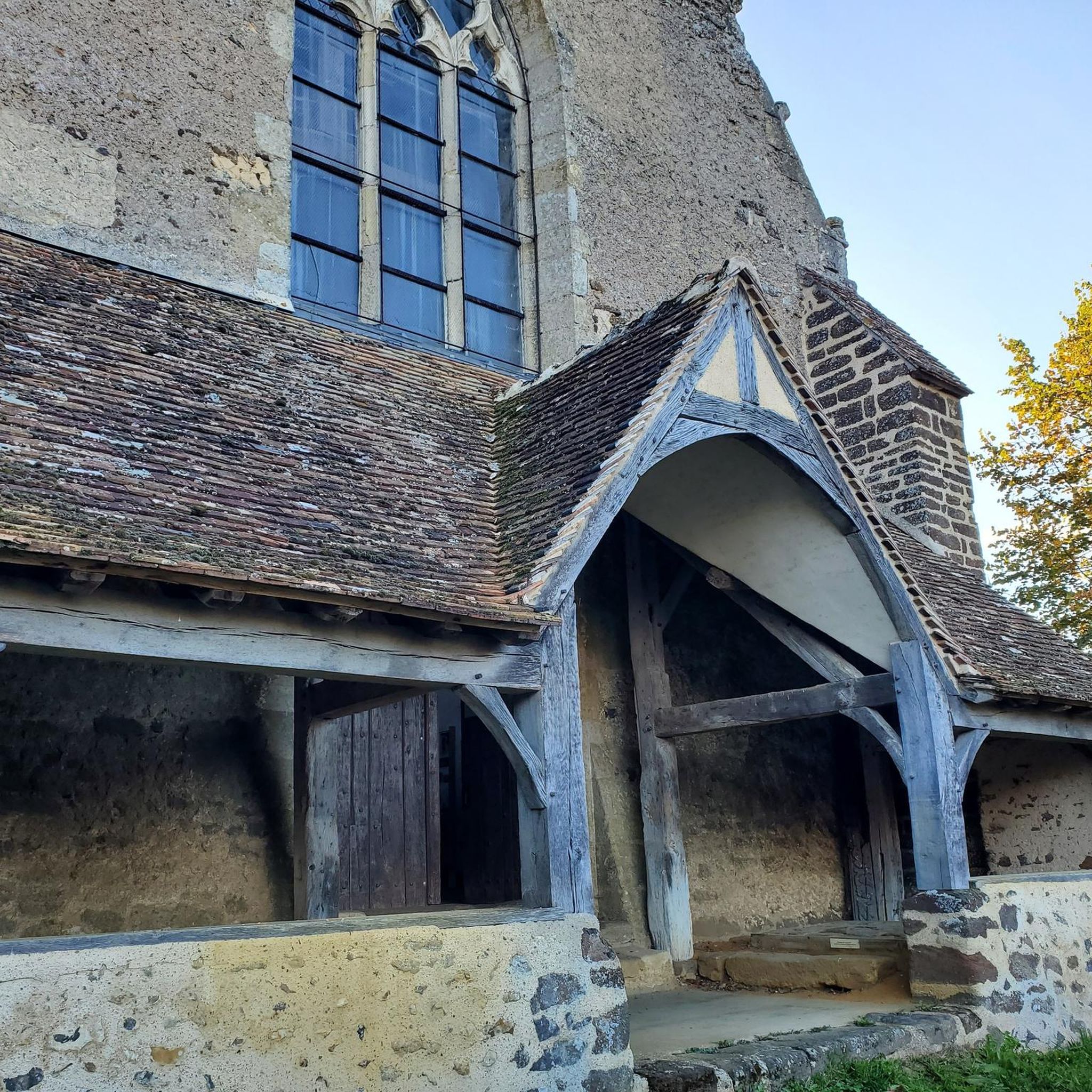
The village is located five kilometers south of Courtalain, in Perche-Gouët, southern part of the department close to Loir-et-Cher and Sarthe. An ancient Roman road, called “Caesar’s path”, crosses the country. The old, picturesque cemetery extended to the south of the church, the new cemetery developing to the east. The history of the building has been marked by two fires which ravaged the bell tower, the first in 1739, the second in the 19th century: after this last disaster, the bell tower was rebuilt on the first bay of the nave (and not on the middle), which led to significant modifications to the framework in place in the western part. The current bell tower, of hexagonal section, which leaned towards the southwest, was straightened during the latest work. The nave, elongated in shape, is extended to the east by a semi-circular apse. Two sacristies were built, one in the 18th century. to the north, the second to the east, later, was recently removed to free up the apse of the church. The church is built of coated flint rubble, grison was used for certain bay frames, as well as for buttresses. The presence of semi-circular openings in the upper part of the walls explains the very old dating (11th century) sometimes attributed to the building. The middle bay of the rounded apse was removed to allow the installation of an altarpiece. The door which, to the south, opened towards the cemetery is today condemned, the entrance is made either through another door also located in the south gutter wall, or through the western facade preceded by a caquetoire. The interior of the building is covered with a paneled framework with joint covers whose punches and molded tie beams are visible. Unfortunately, in the 1930s the north and south walls were lined in the western part with a cement block wall. the entrance to the church remains a baptismal font; the church also has a statue of a saint holding a column. For the urgent work consisting of straightening the bell tower and removing the cement coatings in the lower part of the exterior walls, the Safeguarding of French Art granted aid of €7,000 in 2004.
0
0
The Langey church, built under the name of Saint Pierre, dates back to the 11th century. This rectangular building, without side aisles, 32m50 long and 8m80 wide, is finished on the west side by a gable with sloped cut stones, pierced by two pretty Romanesque windows, and on the east side by a semi-circular apse. Inside, it houses two polychrome wooden statues representing a 17th century bishop and Saint James. The octagonal bell tower, straddling the roof, is a frame resting on six posts and covered with slates. Its spire is certainly the most beautiful and highest in the region. The bell was cast on site, in the village itself in 1811.
0
0
Frequently Asked Questions
How many road cycling routes are available around Sargé-sur-Braye?
There are over 150 road cycling routes in the Sargé-sur-Braye area, offering a wide range of options for different skill levels and preferences.
What kind of terrain can I expect on road cycling routes in Sargé-sur-Braye?
The region around Sargé-sur-Braye offers a diverse landscape for road cyclists. You can expect routes that traverse cultivated hillsides, follow along rivers like the Braye and Grenne, and wind through rich forests. This mix provides both gentle stretches and more challenging ascents through undulating countryside.
Are there road cycling routes suitable for beginners or those seeking an easier ride?
Yes, the network of routes around Sargé-sur-Braye includes options for all ability levels. There are 36 designated easy routes, perfect for beginners or those looking for a more relaxed ride through the scenic landscape.
What are some notable landmarks or points of interest I might see while cycling?
Many routes pass by historical and cultural sites. For instance, you might encounter the Ruins of Guériteau Chapel, or various churches such as Saint Fiacre Church, Saint Peter's Church, and Notre-Dame Church. The region's quality heritage, including castles and dwellings built from local 'roussard' sandstone, adds a historical dimension to your ride.
Are there any circular road cycling routes in the area?
Yes, many of the road cycling routes around Sargé-sur-Braye are designed as loops. For example, the Saint-Denis Church – Saint John the Baptist Church loop from Mondoubleau is a popular moderate route, and the Saint-Maurice Church – Notre-Dame Church loop from Cormenon offers a longer exploration of the regional landscape.
What is the best time of year to go road cycling in Sargé-sur-Braye?
The Loir Valley region generally offers pleasant conditions for cycling during spring, summer, and early autumn. Summer provides warm weather, ideal for enjoying the cultivated hillsides and river valleys. However, spring and autumn can offer cooler temperatures and beautiful seasonal foliage, making for a very scenic ride.
Are there any road cycling routes that are particularly scenic or offer great viewpoints?
The entire region is known for its beautiful surroundings and breathtaking views. Routes that follow the Braye and Grenne rivers offer tranquil, picturesque scenery. Additionally, rides through the cultivated hillsides and rich forests provide constantly changing vistas, from open agricultural lands to shaded woodland paths, ensuring a scenic experience.
What do other road cyclists enjoy most about cycling in Sargé-sur-Braye?
The road cycling routes around Sargé-sur-Braye are highly rated by the komoot community, with an average score of 4.2 stars from 14 reviews. Cyclists often praise the diverse landscape, which includes cultivated hillsides, river valleys, and rich forests, providing a varied and engaging riding experience.
Are there options for more challenging road cycling routes with significant elevation gains?
Yes, while there are many moderate routes, the region's undulating countryside and cultivated hillsides also offer more challenging ascents. There are 4 difficult routes available for experienced cyclists seeking greater elevation gains and a more demanding ride.
Can I find cafes or places to stop for refreshments along the road cycling routes?
While specific cafes on every route are not detailed, the presence of towns and villages throughout the Loir Valley, including Sargé-sur-Braye itself, suggests opportunities for refreshments. The region's historical and cultural charm often means local establishments are available for cyclists to stop and refuel.
Is there parking available for cyclists near the starting points of routes?
While specific parking locations for each route are not listed, towns like Mondoubleau and Cormenon, which serve as common starting points for many routes, typically offer public parking facilities suitable for cyclists. It's advisable to check local parking options in these areas.
Are there any less crowded road cycling routes in Sargé-sur-Braye?
With over 150 routes available, it's possible to find less crowded options, especially outside of peak tourist seasons. Exploring some of the less popular, yet equally scenic, routes can offer a more tranquil cycling experience through the region's diverse landscapes.
Most popular attractions around Sargé-Sur-Braye

Get inspired with the komoot mobile app


Explore more
Browse the best Road cycling routes in other regions.
