The best cycling routes around Soulaires
4.6
(458)
2,595
riders
122
rides
Touring cycling routes around Soulaires are situated in a region characterized by generally flat terrain, making it accessible for various cycling abilities. The landscape features verdant countrysides, extensive vineyards, and numerous forests. This area offers a mix of open plains and river valleys, providing diverse scenery for cyclists.
Best touring cycling routes around Soulaires
- The most popular touring cycling route is Domaine de Rambouillet – The finish line in Chartres loop from Jouy, a 97.9 miles (157.6 km) trail…
Last updated: July 2, 2026
4.5
(54)
311
riders
Moderate bike ride. Good fitness required. Mostly paved surfaces. Suitable for all skill levels.
4.8
(13)
78
riders
58.9km
03:24
260m
260m
Moderate bike ride. Good fitness required. Mostly paved surfaces. Suitable for all skill levels.

Sign up for free
4.0
(4)
23
riders
21.3km
01:15
90m
90m
Easy bike ride. Great for any fitness level. Mostly paved surfaces. Suitable for all skill levels.
3.0
(1)
6
riders
Hard bike ride. Very good fitness required. Mostly paved surfaces. Suitable for all skill levels.
1
riders
35.1km
02:07
250m
250m
Moderate bike ride. Good fitness required. Mostly paved surfaces. Suitable for all skill levels.
Get access to more routes and recommendations from other explorers.
Sign up for free
Already have an account?
Our route recommendations are based on thousands of hikes, rides, and runs completed by other people on komoot.
Start today with a free account
Your next adventure awaits.
Login or Signup


Tips from the Community

There were once two parishes in Maintenon: "St. Nicholas," a parish serving the castle and its dependent houses. The church of St. Nicholas, adjoining the castle, now deconsecrated, still stands on Maintenon's main square. "St. Peter," a parish covered by the surveys in this table, is a current parish in the commune. In addition, there was a priory, founded in 1220 under the name of the Priory of Our Lady of Maintenon. The church of Saint-Pierre in Maintenon is mentioned at the beginning of the 12th century, but nothing appears to have survived from this period. Indeed, the Count of Montgomery, a Huguenot, passed through Maintenon in 1567 and ruined the church. In 1692, Madame de Maintenon rebuilt the church of Saint-Pierre, which had fallen into ruin and had become too small for a population that had grown from 700 to 1,100 with the arrival of labor for the construction of the aqueduct. However, there is no evidence that the new church was built on the site of the old one. The foundation stone of the new church of Saint-Pierre was laid on June 4, 1692, by the Vicar General. The blessing took place on July 17, 1694. Bishop Godet des Marais subsequently consecrated the building. In 1736, the large "Henriette" bell was blessed by Mr. Jean François DEREYROLES, parish priest, in the presence of "the Most High and Most Powerful Lord, Monsignor Jean Paul François de NOAILLES, Count of AYEN" and by "the Most High and Most Powerful Lady, Madame Henriette Louise DAGUESSEAU de FRESNE, Countess of AYEN." From 1805 to 1813, Duke Jean-Paul de NOAILLES and his wife refurnished and decorated the Saint-Pierre church (the woodwork, credenzas, and pews were redone). The church's embellishment continued until 1899. The church's architecture is unremarkable. However, it is listed as one of the few Baroque churches in the department. The choir is flanked on one side by a sacristy and on the other by a room called "the vault." This is because, until the 1990s, it contained the bodies of some members of the Noailles family, who were buried there in stacked boxes that are still visible, but disused. The organ, installed in the gallery, is no longer in use. It had been partially dismantled for a renovation that proved too expensive, and some of the pipes were stolen. During the 1939-1945 war, almost all of the old stained-glass windows were destroyed and replaced with modern ones, the work of a master glassmaker from the region: Victor Cot-Dezan.
0
0
According to tradition, the church choir covers the remains of an older building, possibly dating back to the 6th century, which was built to house the saint's body. According to current knowledge, the commune of Saint-Piat (Sanctus Piatus in Latin) officially appeared in 1087, mentioned in a charter of the Nottonville Priory (Eure-et-Loir), on which it depended. The current building was rebuilt during the time of Francis I, as suggested by the date 1535 engraved on two buttresses of the apse and the date 1542 engraved on a piece of wood from the vault. This is according to a study by the SAEL (Eure-et-Loir Archaeological Society). The three-sided apses, the dripstone towers (horizontal members projecting from a wall), and the sculpted roof structures are a testament to the importance of the reconstructions carried out in the department during the 16th century. The church of Saint-Piat is one of them. While the church has not been officially recognized, it nevertheless contains objects that have attracted attention both for their antiquity and quality, but not always for good reason. Their artistic value, far from attracting only religious or aesthetic interest, has also aroused a covetousness that, unfortunately, remains for some of them. Fortunately, those still in place are carefully cared for and offer the curious a story to discover, a beauty to slowly ponder as they progress toward the choir.
0
0

Many centuries ago, our ancestors discovered the possibility of harnessing the power of the elements—which, while helpful and useful on the one hand, could also be a threat as untamed forces of nature—for various purposes, thus eliminating the need for human or animal muscle power. Mills like these are a good example of the human engineering skills of earlier generations: The heavy millstones used to grind grain or press oil, for example, could be powered by wind or—as in this case—water.
0
0


Situated on the banks of the Eure River, the village of Maintenon boasts a peaceful atmosphere and rich heritage. Dominated by its Renaissance castle and famous for its unfinished aqueduct designed by Vauban, the town invites you to stroll. The ancient streets, the banks of the Eure River, and the Louis XIV Canal provide an ideal setting for a break in the footsteps of history.
0
0

Rambouillet Castle A former medieval fortress, Rambouillet Castle was gradually transformed into a pleasure residence by its illustrious owners and adorned with elegant decorations.
0
0

Beautiful greenway. We need lots of them like this!
0
0
[In Advent] "we hear in the Gospel the beginning of the ministry of Saint JEAN BAPTIST. He appears in the desert and calls people to conversion so that they may prepare for the coming of the Lord. His call reminds us that Advent is not only a time of waiting, but also of interior preparation. "Prepare the way of the Lord, make straight his paths" (Luke 3:4). John's message challenges us to examine our lives. What "rough paths" and "crooked roads" are there in our hearts? Where have we perhaps distanced ourselves from God or lost sight of our fellow human beings? John invites us to remove these obstacles and reorient our lives. But his call has not only a personal dimension, but also a social one: the way of the Lord is a way of justice, peace and reconciliation. When we pave the way of the Lord, we bring light into the darkness of the world and hope into the hearts of people." (Text: Michael Inden, Diocesan President of the KAB in the Archdiocese of Cologne)
0
0
Frequently Asked Questions
What are the difficulty levels of touring cycling routes around Soulaires?
Soulaires offers a diverse range of touring cycling routes suitable for various abilities. The terrain is generally flat, making it accessible. You'll find approximately 64 easy routes, 37 moderate routes, and 13 more challenging routes for experienced cyclists. This variety ensures there's something for everyone, from leisurely rides along riverbanks to longer, more demanding journeys.
Are there easy touring cycling routes suitable for beginners or families?
Yes, Soulaires is an excellent destination for beginners and families. Many routes feature mostly flat terrain, especially those along the Loire à Vélo path and its tributaries. An easy option is the Chartres – the Guillaume Gate loop from Saint-Prest, which is a 14.8-mile (23.8 km) path providing a shorter loop around the historic city of Chartres. Another family-friendly choice is the Maintenon Castle – Maintenon Castle loop from Saint-Piat, an easy 16.4-kilometer route.
What kind of landscapes can I expect to see on a touring cycling route in Soulaires?
Touring cycling routes in Soulaires showcase the picturesque beauty of the Loire Valley. You'll cycle through verdant countrysides, extensive vineyards, and numerous forests. The region is characterized by its river valleys, including the Sarthe, Mayenne, and the wild Loire itself. Expect scenic views of the Beauce Plains on routes like the View of the Beauce Plains – Saint-Piat Mill loop from Saint-Piat.
Are there any long-distance touring cycling routes for experienced riders?
Yes, for experienced touring cyclists seeking a challenge, Soulaires offers longer routes. One notable difficult route is the Domaine de Rambouillet – The finish line in Chartres loop from Jouy. This extensive trail spans 97.9 miles (157.6 km) and typically takes over 9 hours to complete, offering a long-distance journey through varied landscapes.
What historical sites or landmarks can I visit while cycling in Soulaires?
The region around Soulaires is rich in history and culture. While cycling, you can explore significant landmarks such as the magnificent Chartres Cathedral, a UNESCO World Heritage site. Other points of interest include the historic city of Chartres itself, and the charming Guillaume Gate. The broader Loire Valley is also dotted with famous châteaux like Angers Castle and Plessis Bourré, many of which are accessible by bike.
Are there natural attractions to explore on touring cycling routes?
Absolutely. The natural beauty of the region is a highlight for touring cyclists. You can explore areas like Étang Saint-Nicolas, an artificial lake with wooded paths and diverse ecosystems. The Low Valleys of Anjou, classified as a Natura 2000 zone, offer rich flora and fauna. The rivers Loire, Sarthe, and Mayenne provide scenic routes along their banks, allowing you to experience Europe's last great wild river.
When is the best time of year for touring cycling in Soulaires?
The Loire Valley generally enjoys a mild climate, making spring (April-May) and autumn (September-October) ideal for touring cycling. During these seasons, the weather is pleasant, and the landscapes are particularly beautiful with blooming flowers or vibrant autumn colors. Summer can also be enjoyable, though it can get warmer, especially in July and August.
Are there circular touring cycling routes available?
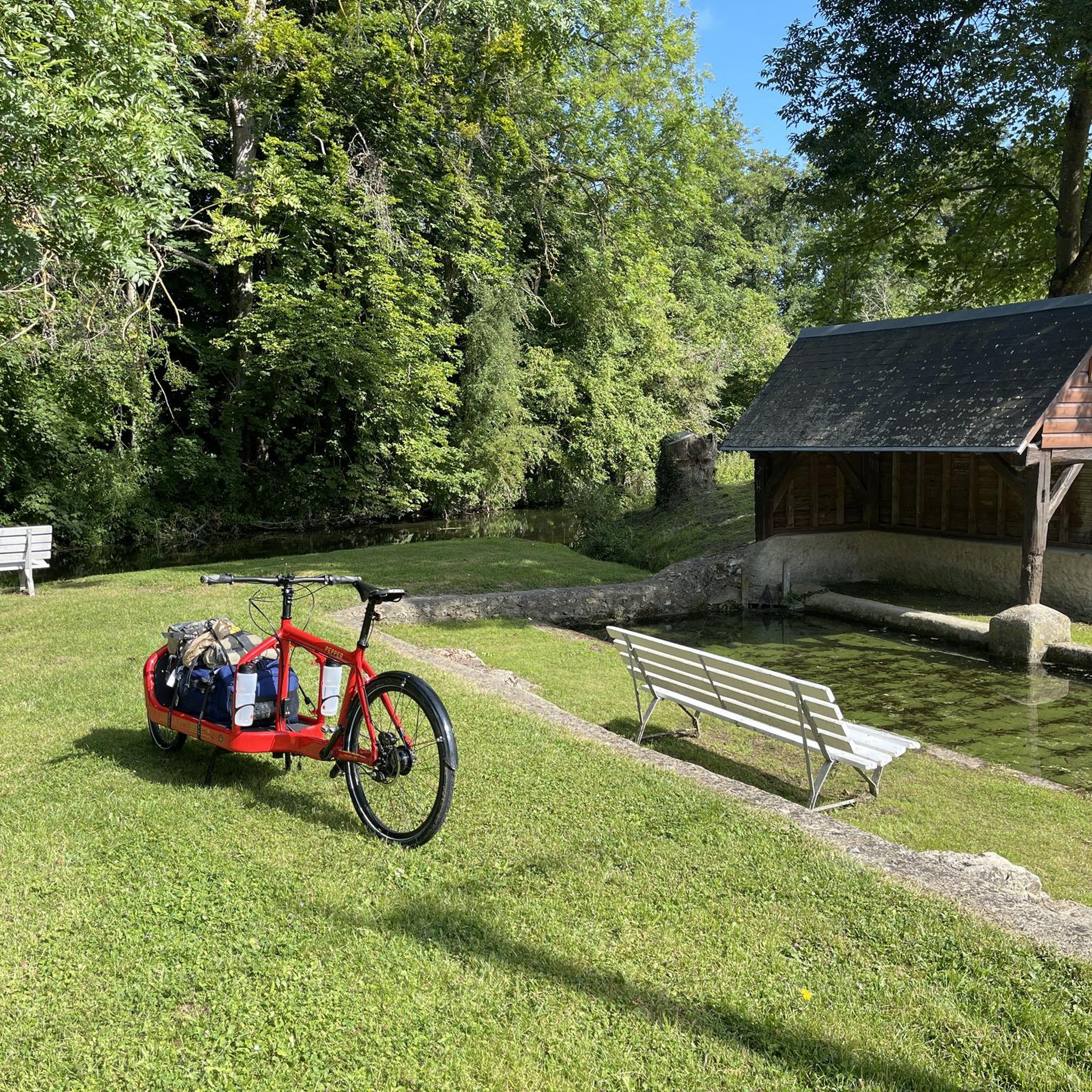
Yes, many touring cycling routes around Soulaires are designed as loops, allowing you to start and finish at the same point. Examples include the Chartres – the Guillaume Gate loop from Saint-Prest and the Lavoir de Soulaires – Saint-Piat Mill loop from Saint-Piat. These circular routes are convenient for day trips and exploring specific areas.
What do other touring cyclists enjoy the most about touring cycling in Soulaires?
The touring cycling routes in Soulaires are highly rated by the komoot community, with an average score of 4.5 stars from over 400 reviews. Reviewers often praise the region's generally flat terrain, making it accessible for various skill levels, and the picturesque landscapes featuring river valleys, vineyards, and charming villages. The well-maintained paths and the opportunity to discover historical sites are also frequently highlighted.
Can I find places to eat or rest along the cycling routes?
The Loire Valley is well-equipped to welcome cyclists. Many towns and villages along the routes offer cafes, restaurants, and picnic spots. Look for 'Accueil Vélo' labeled businesses, which are cyclist-friendly establishments providing services like bike repair, luggage transfer, and suitable accommodation, ensuring you have comfortable stops during your tour.
Are there any specific routes that offer scenic viewpoints?
Many routes provide beautiful scenic viewpoints, especially those traversing the river valleys and vineyards. The View of the Beauce Plains – Saint-Piat Mill loop from Saint-Piat, for instance, offers expansive views of the open countryside. Cycling along the Loire and its tributaries also provides stunning vistas of the river and its surrounding natural beauty.
Is it possible to combine cycling with other outdoor activities in the area?
Absolutely! Soulaires and the wider Loire Valley offer a wealth of outdoor activities. You can easily combine cycling with hiking through vineyards or forests, or enjoy water activities like canoeing, paddleboarding, or traditional boat trips on the Loire. The region also has opportunities for horse riding and exploring historical châteaux and gardens.
Most popular routes around Soulaires
Most popular attractions around Soulaires

Get inspired with the komoot mobile app


Explore more
Browse the best Cycling routes in other regions.
