The best road cycling routes around L'Hosmes
4.7
(54)
489
riders
178
rides
Road cycling around L'Hosmes offers access to the diverse landscapes of the Eure region, characterized by lush forests, meandering rivers, and varied terrain. The area features an extensive network of cycle paths, including greenways and major routes like the Veloscenic. Cyclists can encounter the rolling hills of the Perche, providing varied terrain for road cycling. Routes often run alongside waterways such as the River Eure and the Seine, presenting tranquil views.
Best road cycling routes around L'Hosmes
- The most popular…
Last updated: July 2, 2026
4.0
(3)
7
riders
28.1km
01:22
170m
170m
Easy road ride. Great for any fitness level. Mostly well-paved surfaces and easy to ride.
7
riders
32.6km
01:25
260m
260m
Easy road ride. Great for any fitness level. Mostly well-paved surfaces and easy to ride.

Sign up for free
3
riders
32.5km
01:20
130m
130m
Easy road ride. Great for any fitness level. Mostly well-paved surfaces and easy to ride.
3
riders
42.3km
01:55
360m
360m
Moderate road ride. Good fitness required. Mostly well-paved surfaces and easy to ride.
5.0
(2)
5
riders
58.2km
02:26
340m
340m
Moderate road ride. Good fitness required. Mostly well-paved surfaces and easy to ride.
Get access to more routes and recommendations from other explorers.
Sign up for free
Already have an account?
Our route recommendations are based on thousands of hikes, rides, and runs completed by other people on komoot.
Start today with a free account
Your next adventure awaits.
Login or Signup


Tips from the Community

The first mention of the existence of the Church of Saint-Martin de Nonancourt is a 12th-century charter, but the original building probably dates back to the 7th or 8th century. The bell tower that now occupies the middle of the façade dates from the reconstructions of 1204. During the Hundred Years' War, the church was largely destroyed, like many buildings in the region. The side aisles, nave, and choir were rebuilt in the 16th century. The Chapel of the Virgin, also known as the Chapel of the Rosary, was also added. The Church of Saint-Martin contains numerous works of art, some of which are listed: neo-Gothic and Renaissance furnishings, including the centerpiece, the pulpit, a veritable wooden lacework; a variety of statuary, a 16th-century organ case and finally an enigmatic fresco discovered during recent works in 2001. The stained-glass windows of the church constitute a truly remarkable collection, both in terms of their number (26 in total) and their quality. The lower windows of the nave are the oldest pieces, dating from the 1500s, while the upper windows date from the 1520s and 1530s.
0
0
Located 5 km northeast of La Ferté-Vidame, the Saint-Denis de Morvilliers church stands in the very center of the village. The rectory was the abbot of Saint-Père de Chartres, whose monks owned the church from the beginning of the 12th century. Two charters, dated 1126 and 1127, attest to this. This building comprises a single nave ending in a semicircular chevet. A timber-framed bell tower has crowned the western part of the roof since the 18th century. The west portal through which one enters this building is made of gray stone, unfortunately cemented with a decoration of false stones. The south wall is pierced by five narrow bays, probably from the 12th century. Four windows were installed in the 15th century on the north facade. A fifth, now blocked, was pierced in the apse at the same time. Inside, despite alterations, the church retains an exposed rafter frame forming a medieval truss. Curiously independent of the church structure, it rests on two rows of posts along the drip walls. The vault is paneled. The presence of frescoes could be detected under the plasterwork of the north wall. For the restoration of the apse's frame and roof, the Sauvegarde de l'Art Français (French Art Protection Agency) awarded a grant of €16,769 in 2001.
0
0
Built in the 15th century on the foundations of a chapel whose origins can be traced back to a papal bull from Pope Alexander in 1142, Saint Apollonia was worshipped there.
0
0
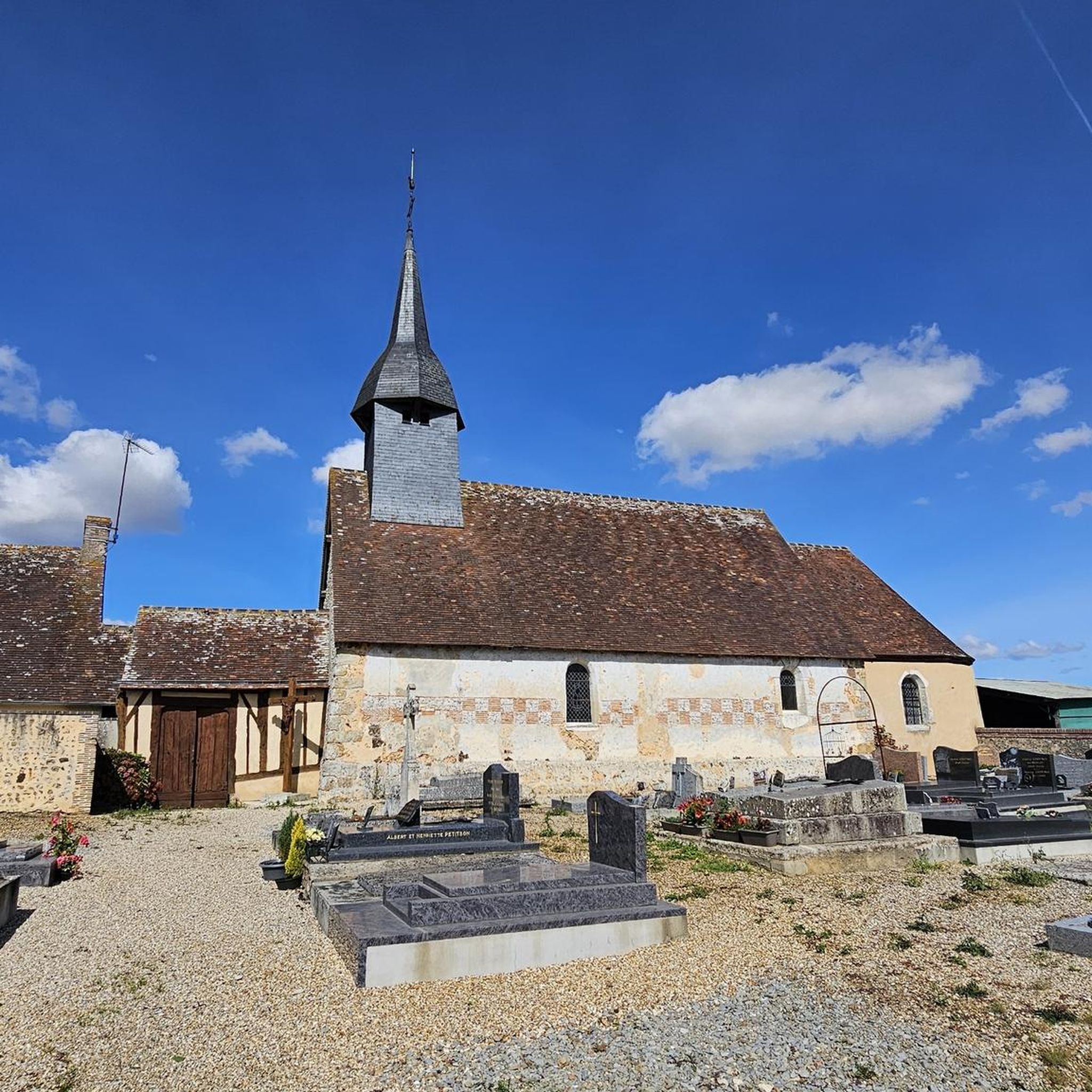
The church is located near a departmental road and is surrounded by a cemetery. Church oriented with a longitudinal plan composed of a single nave. The entrance to the building is via a porch body. An annex building is attached to the north side of the choir. The western facade of the porch body rises on two levels delimited by a projecting cornice. It is pierced by a low-arched door as well as a rose window in the upper part. The bell tower, of polygonal plan, is positioned on the ridge of the roof. It is covered with a polygonal spire surmounted by a ridge cross and has two roof eaves. The building is covered with a gable roof. That of the annex building ends in a hip. The side walls are pierced with arched bays and supported by buttresses. The annex building is pierced by a quadrangular window and door. The buttresses of the choir bear witness to the Romanesque origins of the church. The nave, built in the 16th century, was enlarged in the 19th century by a bay to the west. The bays of the building were re-pierced around 1822.
0
0
Notre-Dame-des-Puits Chapel. This Marian chapel, the foundation of which is the subject of a legend, dates back to the 12th century: while digging a well, a villager is said to have found a statue of the Virgin that he took to the parish church of Droisy, but which returned to the well three times at night, a miracle that reflected the Virgin's desire to see a chapel dedicated to her in this place. The building seems to have suffered heavy damage during the wars of the 15th century, like the surrounding villages, but, rebuilt in the following century, it was invoked against plague epidemics and was the site of new miracles. A brotherhood, created in the 18th century, ensured the organization of festivals and pilgrimages, and contributed to the purchase of the furniture: it is to them that we owe the order for the altar and its altarpiece, as well as the stained glass windows. Confiscated during the Revolution, the chapel was bought back by the faithful who reconstituted a brotherhood. In contemporary times, it was enlarged to the west by the construction of a porch, probably to facilitate access to the building on pilgrimage days, and two doors were opened there, one to the west, the other to the south. It is a building with a quadrangular plan of fairly large dimensions, with a modest wooden bell tower which has kept its bell from 1775. On the almost blind north facade, a small sacristy was added at the level of the choir. From its origins, it has retained, at the chevet, only fragments of masonry in grison and the trace of two bays. Renovations in the 15th and 16th centuries date several openings, including a pointed window with a trilobed network in the southern wall and a thick buttress halfway up the chevet. The interior of the building is covered with a wooden vault that was in poor condition. The church has a large amount of furniture, the masterpiece of which is undoubtedly the magnificent altarpiece, dated 1644, the work of Jean Racine, a painter and sculptor from Rouen; the iconography of the whole is dedicated to the Holy Family and the painting represents the Nativity. The work is set between two fluted columns and two pilasters, under a broken pediment and a niche in which a Virgin and Child, adored by two angels, has been placed. In front of each pilaster, two monumental statues have been placed, on the right Saint Anne and the Virgin, on the left Saint Joseph and the Child Jesus. The main altar is framed by two side altars, placed slightly back and at an angle and connected to each other by paneling; two doors were opened on the right and left in this woodwork to allow access, behind the altar, to the miraculous well which was located slightly below the apse For the repair of the covering paneling, the Sauvegarde de l’Art français granted aid of €10,000 in 2008.
0
0
The Saint-Rémy church in Saint-Rémy-sur-Avre is dedicated to Saint Remi of Reims, Bishop of Reims who baptized Clovis in 496 in the Notre-Dame Cathedral of Reims. In the 12th century, it marked the border between the Duchy of Normandy and the French royal domain on which Saint-Rémy-sur-Avre depends. It is a flamboyant Gothic church from the 15th century, probably rebuilt since we have mention of its existence since the end of the 11th century.
0
0

Église Saint Madeleine is a church where beautiful various statues of Saints, famous and less famous. The reason for so many different statues is that the school of sculpture was established here.
0
0
church with special bell tower: octagonal on a square base
0
0
Frequently Asked Questions
How many road cycling routes are available around L'Hosmes?
There are over 180 road cycling routes available around L'Hosmes, catering to various skill levels. You'll find options ranging from easy loops to more challenging moderate rides.
What is the typical terrain like for road cycling in the L'Hosmes area?
The terrain around L'Hosmes is diverse, characterized by lush forests, varied valleys, and rolling hills, particularly the Perche region. Many routes also follow meandering rivers like the Eure and Seine, offering tranquil views. You can expect a mix of flat sections and gentle climbs.
Are there any easy road cycling routes suitable for beginners or families?
Yes, L'Hosmes offers several easy road cycling routes. For instance, the Saint-Hilaire Church – Le Trianon Cinema loop from Tillières is an easy 17.5-mile (28.1 km) ride, perfect for a pleasant spin through the local countryside. Another easy option is the Chambray Castle – Wide long road - perfect! loop from Dame-Marie, which is 20.0 miles (32.2 km) long.
What kind of natural features can I expect to see along the routes?
Road cycling routes in the L'Hosmes area often showcase the region's natural beauty, including lush forests, picturesque valleys, and meandering rivers like the Eure and Seine. You might also encounter lakes such as Lac du Mesnil and Lac des Deux Amants, and enjoy the scenic backdrop of the rolling hills of the Perche.
Are there any cultural or historical landmarks to visit while cycling?
Absolutely. The region is rich in history and culture. You can cycle past historic towns like Louviers and Pont-de-l'Arche, or incorporate stops at impressive châteaux. For example, the Château de Saint-Simon 🏰✨⚜️ – Ferté-Vidame Castle loop from Tillières includes a visit to historic châteaux. Other notable attractions include Château de Condé-sur-Iton and Chambray Castle.
What do other road cyclists enjoy most about cycling in L'Hosmes?
The area is highly rated by the komoot community, with an average score of 4.6 stars from over 45 reviews. Cyclists often praise the diverse landscapes, from quiet woodlands to scenic riverbanks, and the well-maintained network of cycle paths that cater to various abilities.
Are there any longer or more challenging routes for experienced cyclists?
Yes, for those seeking a longer ride, the Route des Roches – Sollerot lighthouse loop from Tillières is a moderate 81.8 km (50.8 miles) route. The region also features the rolling hills of the Perche, which offer varied terrain and more challenging sections for experienced road cyclists.
When is the best time of year to go road cycling in L'Hosmes?
The Eure region, including L'Hosmes, is generally pleasant for cycling from spring through autumn. The weather is typically mild, and the landscapes are vibrant. Summer offers longer daylight hours, while spring and autumn provide cooler temperatures and beautiful scenery.
Are there dedicated cycle paths or greenways in the L'Hosmes area?
Yes, the Eure region, where L'Hosmes is located, is known for its extensive network of cycle paths, including over 50 kilometers of greenways and clearly signposted routes. These include traffic-free trails and major routes like the Veloscenic or the Vallée du Loir, making for safe and enjoyable cycling.
Can I find circular road cycling routes around L'Hosmes?
Many of the routes available around L'Hosmes are designed as loops, allowing you to start and finish in the same location. Examples include the Saint-Hilaire Church – Bridge over the Avre loop from Tillières and the Château de Saint-Simon 🏰✨⚜️ – Ferté-Vidame Castle loop from Tillières, providing convenient options for your ride.
Where can I find information about bike-friendly services or facilities in the region?
The Eure region is recognized as bike-friendly. For more detailed information on services, facilities, and additional routes, you can consult regional tourism resources such as Tourisme Seine-Eure or Tourisme 28, which highlight the cycling infrastructure and offerings in the wider area.
Most popular attractions around L'Hosmes

Get inspired with the komoot mobile app


Explore more
Browse the best Road cycling routes in other regions.
