Attractions and Places To See around Prasco - Top 20
Best attractions and places to see around Prasco, Italy, a comune in the Province of Alessandria, Piedmont, offers a blend of historical landmarks and natural landscapes within the Monferrato region. The area is characterized by its historic castle and surrounding hills, providing insights into local history and natural beauty. Prasco serves as a starting point for exploring the Monferrato hills, with options for walks and treks. Visitors can discover ancient structures, natural springs, and scenic viewpoints.
Best attractions and places to see around Prasco
- The most popular attractions is Roman Aqueduct of Acqui Terme, a historical site that features remains of an ancient Roman aqueduct. Dating back to the 1st century AD, this aqueduct was approximately 13 km long and transported water from the Erro stream.
- Another must-see spot is La Bollente Hot Spring Fountain, a natural monument and historical site. This octagonal shrine-temple, inaugurated in 1879, is known for its sulphurous-salty-bromine-iodine water that emerges at a temperature of 74.5°C.
- Visitors also love Viewpoint of Alice Bel Colle, a viewpoint offering historical and cultural insights. Despite its small size, this village holds a history dating back to the Middle Ages and features a Museum of Contemporary Art and historical churches.
- Prasco is known for its historical sites, natural features, and scenic viewpoints. The region offers a variety of attractions to see and explore, from ancient Roman structures to thermal springs and panoramic vistas.
- The attractions around Prasco are appreciated by the komoot community, with over 100 upvotes and 46 photos shared by visitors.
Last updated: June 24, 2026
Roman Aqueduct of Acqui Terme
Highlight • Historical Site
Translated by Google •
Tip by

La Bollente Hot Spring Fountain
Highlight • Natural Monument
Translated by Google •
Tip by

Sign up now to discover places like this
Get recommendations on the best single tracks, peaks, & plenty of other exciting outdoor places.
Sign up for free
Viewpoint of Alice Bel Colle
Highlight • Viewpoint
The smallness that distinguishes Alice Bel Colle, however, does not detract from its beauty and uniqueness. Indeed, despite being a small village of 700 inhabitants, it holds a veritable treasure trove of history, culture, and traditions. Examples include the Museum of Contemporary Art, which houses interesting works by renowned artists, the Parish of San Giovanni Battista, and the Church of the Madonna della Fraschetta, which not only serves as a place of worship but is also a focal point during local festivals and demonstrates a strong connection with its inhabitants.
Among the culinary traditions, we find the ever-present amaretti biscuits; as for wine, however, there are renowned wines such as Brachetto, Infernotto Barolo, and Moscato. (Quote from the website granmonferrato.it: hill towns, Alice Bel Colle)
Translated by Google •
Tip by

Church of Our Lady of Sorrows, Acqui Terme
Highlight • Religious Site
cittaecattedrali.it/it/bces/165-chiesa-dell-addolorata-acqui-terme-al
Translated by Google •
Tip by

Grognardo Bell Tower
Highlight • Monument
Grognardo is dominated from above by the ruins of the ancient thousand-year-old castle.
There is information that in the sixteenth century, around the fortified building, a cluster of houses joined together with three doors at intervals, allowed, in case of danger, an easy defense of the village and its inhabitants.
In the 11th century, San Guido, bishop of Acqui, had the first church built, S. Felice, a parish church built to affirm Christianity in the countryside.
Grognardo, probably born for defensive reasons on the hill called Poggio, in the Renaissance era, by virtue of its very favorable position for trade, saw the flourishing of the current settlement mentioned in various notarial deeds as Villa del Piano.
Translated by Google •
Tip by

Sign up for free to discover even more attractions around Prasco.
Sign up for free
Already have an account?
Start today with a free account
Your next adventure awaits.
Login or Signup

Tips from the Community

Thermal spring in the city center
0
0

To discover its origins, we must step back in time to the Middle Ages, a period when Alice Bel Colle was a possession of the Counts of Acquesana, later passing under the rule of the Gonzaga family of Mantua, and finally to the House of Savoy. The smallness that distinguishes Alice Bel Colle, however, does not detract from its beauty and uniqueness. Indeed, despite being a small village of 700 inhabitants, it holds a veritable treasure trove of history, culture, and traditions. Examples include the Museum of Contemporary Art, which houses interesting works by renowned artists, the Parish of San Giovanni Battista, and the Church of the Madonna della Fraschetta, which not only serves as a place of worship but is also a focal point during local festivals and demonstrates a strong connection with its inhabitants. Among the culinary traditions, we find the ever-present amaretti biscuits; as for wine, however, there are renowned wines such as Brachetto, Infernotto Barolo, and Moscato. (Quote from the website granmonferrato.it: hill towns, Alice Bel Colle)
2
0

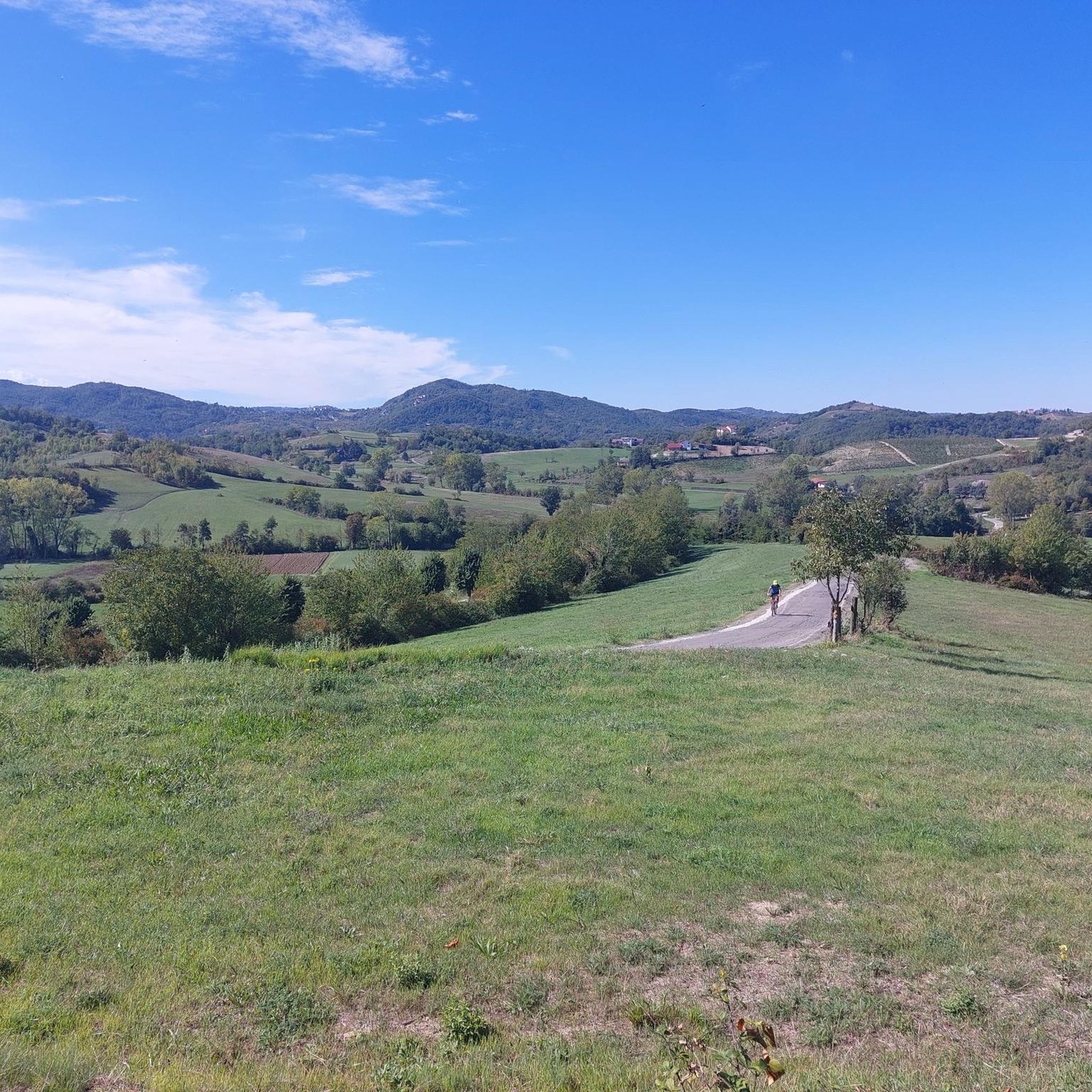
Cycle path out of the city
1
0

Thermal water fountain located in the center of an elegant square that well represents the nature of the city's waters
1
0

Remains of an ancient Roman aqueduct that ennoble our city, rich in history of the distant civilization of the Roman Empire. Many other remains scattered in the area testify to the importance of the spa since ancient times. In addition, the barbarism exercised over the decades by the various questionable thematic administrations has reduced it to a minimum, leaving the ancient splendor to total decay.
2
1

In the middle of downtown Acqui Terme, Piazza Bollente is probably the main attraction of the beautiful city. Here stands the small Greek fountain temple, Fontana della Bollente, built in 1879, from which 74.5 degree hot, sulphurous water gushes. In addition to sulphur, it also contains iodine, salt and bromine and is healing for the respiratory tract and bloodstream.
2
0

The name of the town is mentioned for the first time in the deed of foundation and donation of the abbey of San Quintino in Spigno (year 991) with the toponym of Ragnando. Grognardo is dominated from above by the ruins of the ancient thousand-year-old castle. There is information that in the sixteenth century, around the fortified building, a cluster of houses joined together with three doors at intervals, allowed, in case of danger, an easy defense of the village and its inhabitants. In the 11th century, San Guido, bishop of Acqui, had the first church built, S. Felice, a parish church built to affirm Christianity in the countryside. Grognardo, probably born for defensive reasons on the hill called Poggio, in the Renaissance era, by virtue of its very favorable position for trade, saw the flourishing of the current settlement mentioned in various notarial deeds as Villa del Piano.
0
0

Roman arches, 15011 Acqui Terme AL
2
0
Frequently Asked Questions
What historical landmarks can I visit in Prasco itself?
In Prasco, the most prominent historical landmark is the Prasco Castle, a medieval structure dating back to the 12th century. While privately owned, it occasionally opens for visits and houses a museum focused on winemaking and beekeeping tools. You can also see the 11th-century Pieve dei Santi Nazario e Maurizio in the village cemetery and the 17th-century Parrocchiale di San Defendente near the castle, restored to its original Baroque style.
Are there any ancient Roman sites near Prasco?
Yes, approximately 6.5 km from Prasco, you can visit the Roman Aqueduct of Acqui Terme. These are the remains of an ancient Roman aqueduct, dating back to the 1st century AD, which was about 13 km long and transported water from the Erro stream.
What natural attractions are there to explore around Prasco?
Beyond the historic sites, Prasco offers several natural attractions. The Hanging Gardens of Prasco Castle feature a 17th-century ice hut and ancient fruit tree cultivars. In the Mongiut area, the Botanical Garden of Mandorli spans 15,000 square meters with nearly 1500 plant species. The entire region is immersed in the scenic Monferrato Hills, perfect for walks and treks.
Where can I find a scenic viewpoint in the Prasco area?
For panoramic views, head to the Viewpoint of Alice Bel Colle. This small village offers not only historical and cultural insights but also beautiful vistas of the surrounding Monferrato landscape.
Are there any family-friendly activities or attractions near Prasco?
Many attractions around Prasco are suitable for families. The Roman Aqueduct of Acqui Terme and the La Bollente Hot Spring Fountain are both listed as family-friendly. Exploring the Botanical Garden of Mandorli or taking an easy walk in the Monferrato Hills can also be enjoyable for all ages.
What outdoor activities can I do near Prasco?
The Monferrato Hills surrounding Prasco are ideal for outdoor activities. You can enjoy various routes for gravel biking, mountain biking, and running. For specific routes, check out the guides for Gravel biking around Prasco, MTB Trails around Prasco, and Running Trails around Prasco.
Are there any unique natural phenomena to see?
Yes, a unique natural phenomenon is the La Bollente Hot Spring Fountain in Acqui Terme. This octagonal shrine-temple is famous for its sulphurous-salty-bromine-iodine water that gushes out at a temperature of 74.5°C.
What is the best time of year to visit Prasco and its attractions?
The Monferrato region, including Prasco, is generally pleasant from spring through early autumn (April to October). Spring offers blooming landscapes, while summer allows for warmer outdoor activities. Autumn brings beautiful fall colors and is ideal for exploring the vineyards. Winters are cooler and quieter, with fewer attractions open.
What kind of historical churches can be found in the vicinity of Prasco?
Beyond Prasco's local churches, you can visit the Church of Our Lady of Sorrows, Acqui Terme, which is an ancient early Christian cemetery basilica. Another notable historical religious site is the Grognardo Bell Tower, part of a village with roots dating back to the 11th century.
Are there any hidden gems or less-known spots worth discovering near Prasco?
While not entirely hidden, the Botanical Garden of Mandorli in the Mongiut area is a lesser-known gem, offering a vast collection of nearly 1500 plant species across 15,000 square meters of hilly terrain. It's a tranquil spot for nature lovers.
What do visitors enjoy most about the attractions around Prasco?
Visitors particularly appreciate the blend of historical significance and natural beauty. The ancient Roman structures like the Roman Aqueduct and the unique La Bollente Hot Spring Fountain are highly rated. The scenic Viewpoint of Alice Bel Colle is also a favorite for its historical context and panoramic vistas.
Most popular attractions around Prasco

Get inspired with the komoot mobile app


Explore more
Still not found the Highlight you’re looking for? See guides of the top attractions in other regions:
