The best walks and hikes around Albignasego
4.4
(608)
3,092
hikers
20
hikes
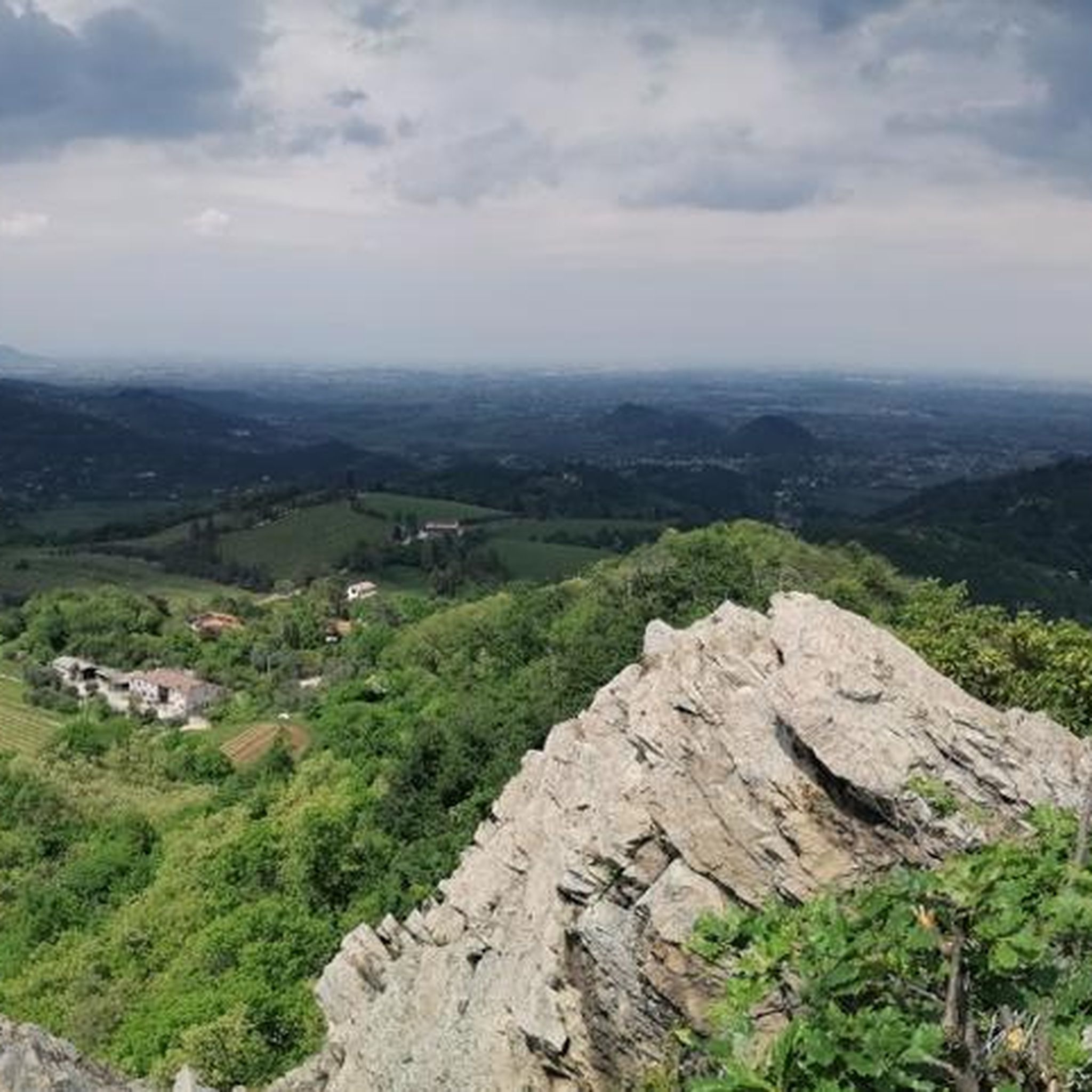
Hiking around Albignasego offers diverse landscapes, from flat canal-side paths to the more challenging terrain of the nearby Euganean Hills. The region is characterized by its countryside, with trails often running alongside canals such as the Brentella Canal. Green spaces like Constitution Park provide accessible routes within the town, featuring groves and meadows. The proximity to the Euganean Hills, a volcanic range, introduces varied elevation and scenic viewpoints.
Best hiking trails around Albignasego
- The most popular hiking route is Oratory…
Last updated: June 18, 2026
5.0
(2)
44
hikers
Moderate hike. Good fitness required. Easily-accessible paths. Suitable for all skill levels.
5.0
(2)
27
hikers
7.55km
01:54
10m
10m
Easy hike. Great for any fitness level. Easily-accessible paths. Suitable for all skill levels.

Sign up for free
15
hikers
Moderate hike. Good fitness required. Easily-accessible paths. Suitable for all skill levels.
5.0
(2)
18
hikers
14.1km
03:34
20m
20m
Moderate hike. Good fitness required. Easily-accessible paths. Suitable for all skill levels.
9
hikers
9.18km
02:19
10m
10m
Moderate hike. Good fitness required. Easily-accessible paths. Suitable for all skill levels.
Get access to more routes and recommendations from other explorers.
Sign up for free
Already have an account?
Our route recommendations are based on thousands of hikes, rides, and runs completed by other people on komoot.
Start today with a free account
Your next adventure awaits.
Login or Signup
Tips from the Community

The Basilica Cathedral of Saint Mary of the Assumption (known to the people of Padua simply as the Duomo) is the main Catholic place of worship in Padua and the episcopal see of the homonymous diocese since at least the 4th century. Dedicated to the Assumption of Mary, it has the dignity of a minor basilica[2] and is also a parish seat. Inside, the bodies of Saint Daniel, Saint Leonino, and Saint Gregorio Barbarigo are venerated. The current building dates back to the 16th century and Michelangelo Buonarroti was involved in its construction. It overlooks Piazza Duomo. Next to it stands the complex of the Bishop's Palace. The rectories of San Clemente and San Pietro depend on the cathedral. It is an Italian national monument.
0
0

The Benito Daga Bridge is a cycle-pedestrian bridge located in Padua, in a strategic river area near the headquarters of Canottieri Padova (south-west area of the city). The structure is named after Benito Daga (who passed away in 1991), a respected figure in Paduan and national sports, known for being an instructor and coach for the Italian national swimming team at the Paralympics. From a logistical point of view, the bridge represents a fundamental hub for the city's sustainable mobility: it connects the riverbanks of Brusegana and Bassanello, serving as a mandatory passage for runners, walkers, and cycle tourists. It is a key point for those who travel the famous river loops of Padua or join the cycle paths leading towards the Euganean Hills and along the Brentella Canal.
0
0

Turning point for those who want to go to the pitch
0
0

Caffè Pedrocchi, Italy's most famous coffee house (historically, architecturally, and socially of greatest importance. Used to be open day and night, hence "caffè senza porte = without doors"). See description on my Padua visit (Komoot March 25, 2026).
0
0

Ferrara Piazza del Mercato (Pizza delle erbe)
0
0

Basilica Cattedrale di Santa Maria Assunta, Padova Padua Cathedral | Cathedral of Santa Maria Assunta Despite its unfinished façade, the interior is large and monumental. The transept houses important Renaissance funerary monuments, while the choir, raised above the crypt, is the work of the Tuscan sculptor Giuliano Vangi, who redesigned the sacred space in 1997. Ancient sources attest to the existence of an early Christian cathedral that stood on the site of the present churchyard; the next one, consecrated in 1075, was damaged by the earthquake of 1117. In the sixteenth century, a competition was held to enlarge the cathedral: Michelangelo won, but the execution of the work was entrusted to Andrea da Valle, who made significant changes to the original design. The cathedral was not completed until 1754, although the magnificent façade, designed by Frigimelica with three portals and two rose windows, was never finished and, along with the dome, was severely damaged in the bombings of 1917 and 1918. The harmonious and bright interior is in the shape of a Latin cross, divided into three naves and marked by columns. With the new presbytery, the altar was moved closer to the nave, thus enhancing the 16th-century choir, which was adorned with statues by Giuliano Vangi depicting the city's patron saints. Down in the crypt, one can admire the altar of San Daniele and the chapel where many bishops are buried. According to tradition, the icon of the Virgin and Child, located in the right transept, belonged to Francesco Petrarch, who was very devoted to Mary and believed it to have been painted by Giotto. Text / Source: Turismo Padova https://www.turismopadova.it/luogo/duomo-di-padova-cattedrale-di-s-maria-assunta/
14
0
Piazza dei Signori, Padua For the people of Padua, a stroll to the squares of the historic center, such as Piazza della Frutta, Piazza delle Erbe, and Piazza dei Signori, means immersing oneself in the markets that traditionally enliven the city every morning. Shopping is simultaneously a pleasure, a social occasion, a kind of daily ritual. But it's also worthwhile to look up and admire the architecture of the houses, balconies, and historic buildings that frame them. Piazza dei Signori is surrounded on its two main sides by two wings with colonnades, elegantly enhanced by terraces with antique wrought-iron balconies. The two shorter sides are bordered by the Church of San Clemente and the Palazzo del Capitanio with its clock tower, whose colonnade leads to the Corte Capitaniato and the nearby square of the same name. Here once stood the Castello dei Carraresi, which today houses the University of Padua with its Faculty of Literature and Philosophy and the rooms painted by Altichiero. On the south side of the square stands the elegant Loggia del Consiglio, or Gran Guardia, the 16th-century building where the city's Maggior Consiglio (Great Council) used to meet. The wide staircase leading to the loggia and the council chamber on the main floor are particularly worth seeing. Text / Source: Turismo Padova https://www.turismopadova.it/de/orte/piazza-dei-signori/
17
0
Palazzo della Ragione, Padua The Salòn, or Palazzo della Ragione, the former seat of Padua's municipal courts, is one of the largest column-free halls in Europe. Considered one of the most famous civic monuments in Europe from the time of the Communes, the building was begun in 1218. Between 1306 and 1308, Fra Giovanni degli Eremitani transformed the three large rooms into a single hall and designed a roof in the shape of an inverted ship's hull. Giotto and his workshop were commissioned to paint the walls with frescoes; however, the cycle was destroyed by fire in 1420. The frescoes were restored by the Paduan Nicolo’ Miretto in collaboration with Stefano da Ferrara and other painters, based on the studies of Pietro d’Abano, a wealthy scholar of his time. The fresco cycle is one of the very few medieval astrological cycles to have survived to this day. The connection between the paintings and the function of the place explains the presence of animal figures representing the insignia of the courts, whose function is also linked to the allegories of Justice, Law, the Community in Rule, and the frescoes depicting the Judgment of Solomon and the court scene. In the great hall is the "Pietra del Vituperio," or Stone of Shame, upon which insolvent debtors, clad only in a shirt, had to sit three times (the custom is the origin of the expression "to stay in one's shirt"), while repeating the Latin phrase "cedo bonis" (roughly translated as "I will pay the bill"). Also located there is the large wooden horse, crafted by Annibale Capodilista for a tournament and donated to the city by the family. Today, the great hall serves as a venue for exhibitions and cultural events. Not to mention that "Sotto il salone" is the oldest cooperative in the world, dating back 700 years. Text / Source: Turismo Padova https://www.turismopadova.it/en/the-palazzo-della-ragione/
14
0
Frequently Asked Questions
How many hiking trails are available around Albignasego?
There are over 19 hiking trails around Albignasego, offering a variety of experiences from easy strolls to more moderate treks. The komoot community has explored these routes over 2900 times, providing an average rating of 4.4 stars.
Are there easy or beginner-friendly hiking trails in Albignasego?
Yes, Albignasego offers several easy trails suitable for beginners. For example, the Barcari Embankment – Ipercity Shopping Center loop from Sant'Agostino is an easy 4.9-mile (7.8 km) path that follows flat, accessible canal-side routes. Overall, 8 of the 19 available tours are rated as easy.
What kind of landscapes and natural features can I expect on hikes near Albignasego?
Hikes near Albignasego feature diverse landscapes. You'll find tranquil countryside paths often running alongside canals like the Brentella Canal and the Battaglia Terme Canal. The Constitution Park within Albignasego also offers green spaces with groves and meadows. For more varied terrain, the nearby Euganean Hills provide volcanic landscapes with scenic viewpoints and unique rock formations.
Are there any historical landmarks or attractions to see while hiking?
Yes, the region is rich in history. While hiking, you might encounter sites like the imposing Praglia Abbey, visible from some dirt cycle paths. In the nearby Euganean Hills, trails lead to ruins of ancient monasteries, such as the Olivetani monastery on Monte Venda, and remnants of fortresses like on Monte Cecilia. You can also explore nearby castles such as San Pelagio Castle and Museum of Flight or the Carrarese Castle.
Are the hiking trails around Albignasego suitable for families?
Many trails around Albignasego are suitable for families, especially the flatter canal-side paths and those within local parks. The Constitution Park, for instance, has playgrounds and pedestrian paths. When venturing into the Euganean Hills, some trails are easy walks, but others may require more fitness, so checking the difficulty grade is recommended.
Are dogs allowed on the hiking trails in Albignasego?
Generally, dogs are welcome on many of the outdoor trails in the Albignasego area, particularly on the countryside and canal-side paths. However, it's always advisable to keep them on a leash and check for any specific local regulations, especially within protected areas or private properties.
What is the best time of year to go hiking in Albignasego?
Albignasego offers pleasant hiking conditions throughout much of the year. Spring and autumn are particularly ideal, with mild temperatures and beautiful scenery. Summer can be warm, making early morning or late afternoon hikes preferable. The flat canal-side paths can also be enjoyable in winter, though some higher trails in the Euganean Hills might require more preparation.
Are there options for parking or public transport access to the trailheads?
Albignasego is well-connected, and many trailheads, especially those starting within the town or nearby villages, offer accessible parking. For routes further afield, particularly in the Euganean Hills, public transport options might be available, but it's best to check local bus schedules for specific starting points.
What do other hikers say about the trails in Albignasego?
The hiking trails in Albignasego are highly rated by the komoot community, with an average score of 4.4 stars from over 580 reviews. Hikers often praise the diverse landscapes, from tranquil canal paths to the more challenging and scenic routes in the Euganean Hills, as well as the well-maintained park facilities.
Can I find circular hiking routes in the Albignasego area?
Yes, there are several circular hiking routes available. An example is the Oratory of the Angel loop from Albignasego, which is a moderate 6.1-mile (9.8 km) trail exploring the local countryside. Many other routes are designed as loops, offering varied scenery without retracing your steps.
Are there any longer hiking options for more experienced hikers?
While many routes are moderate, the region offers options for longer hikes. For instance, the Benito Daga Bridge – Brentella Canal loop from Padua Airport is a 9.7-mile (15.6 km) trail. For more challenging terrain and elevation, exploring trails within the nearby Euganean Hills, such as those leading to Monte Venda, will provide a more strenuous experience.
Can I combine hiking with other outdoor activities in Albignasego?
Absolutely. The flat canal-side paths are popular for both hiking and cycling. The Constitution Park in Albignasego also features a pump track and outdoor fitness areas. For mountain biking enthusiasts, the Euganean Hills offer varied terrain, including the Horse Trail (Brenta River Trail), which is suitable for both mountain biking and hiking.
What are some notable natural features in the Euganean Hills near Albignasego?
The Euganean Hills, a volcanic range close to Albignasego, boast several notable natural features. You can find trails with unique volcanic rock formations, such as on Monte Cecilia. The area is also known for its beautiful views, almond and cypress trees, and panoramic vistas from higher points like Monte Venda, the highest peak in the range.
Most popular routes around Albignasego
Most popular attractions around Albignasego

Get inspired with the komoot mobile app


Explore more
Browse the best Hikes in other regions.
