The best traffic-free bike rides around Gennes-Sur-Glaize
4.3
(57)
2,014
riders
253
rides
No traffic road cycling routes around Gennes-Sur-Glaize are primarily defined by the Mayenne River, offering serene, traffic-free paths along its towpaths. The terrain is largely flat, making it accessible for various fitness levels. Cyclists can explore unspoilt landscapes, flower-filled fields, and lush forests that create a tranquil atmosphere. The region also features historical landmarks and charming villages directly along the routes.
Best no traffic road cycling routes around Gennes-Sur-Glaize
- The most popular no traffic road cycling route is Château-Gontier Castle…
Last updated: July 5, 2026
9
riders
89.2km
03:49
570m
570m
Moderate road ride. Good fitness required. Mostly well-paved surfaces and easy to ride.
6
riders
32.3km
01:28
270m
270m
Easy road ride. Great for any fitness level. Mostly well-paved surfaces and easy to ride.

Sign up for free
7
riders
54.9km
02:16
380m
380m
Moderate road ride. Good fitness required. Mostly well-paved surfaces and easy to ride.
4
riders
39.8km
01:48
310m
310m
Moderate road ride. Good fitness required. Mostly well-paved surfaces and easy to ride.
3
riders
92.1km
04:07
570m
570m
Moderate road ride. Good fitness required. Some segments of this route may be unpaved and difficult to ride.
Get access to more routes and recommendations from other explorers.
Sign up for free
Already have an account?
Our route recommendations are based on thousands of hikes, rides, and runs completed by other people on komoot.
Start today with a free account
Your next adventure awaits.
Login or Signup
Popular around Gennes-Sur-Glaize

Tips from the Community

Parish Church of Saints Peter and Paul. The parish was once part of the archdeaconry of Sablé and was under the jurisdiction of the bishopric of Le Mans. It is only mentioned in texts from the 12th century onwards. The construction of the building, however, predates these first mentions and dates back to the first half of the 11th century. Most of the nave survives from this early church, whose south wall features a narrow, semicircular bay, dressed in red sandstone. The north wall partially collapsed in 1558 and was rebuilt shortly after. To the south, at the junction of the nave and the choir, the bell tower was added in the 12th century. It is a massive tower supported at the corners by buttresses; it is quadrangular in plan and built outside the building. At its summit, this tower features two levels of openings on each side: first, a relatively wide, double-arched bay, surmounted by two narrower, semicircular openings. It is covered with a saddleback roof, a feature found in several surrounding churches. Its eastern face is flanked by an apse housing a chapel dedicated to Saint Louis. A doorway in the tower's west wall, with a lintel carved with an ogee (opened in the late 15th or early 16th century), provides access from the outside. The choir, whose drip walls are built in line with the nave walls, was built in the 13th century on the site of a more modest choir. It features a flat chevet pierced by two narrow pointed-arch windows (blocked during the construction of the altarpiece). The same type of openings are found on its side walls. As with the nave, the main structure is made of sandstone rubble, but for this part, the walls are supported by buttresses with dressed stone glacis. These are joined at their summit by a very crude modillioned cornice, which is particularly visible on the north face. Internally, the building forms an elongated volume, with the choir and nave separated by a thick wall pierced by a double-rolled pointed arch: the nave and choir occupy two-thirds and one-third of the space, respectively. Despite some modest later alterations, the church retains its ancient appearance. The furnishings were largely renewed in the second half of the 18th century. The three limestone altarpieces, built in 1766 at the initiative of the priest Jacques-René Guitton de l'Écluse, are the work of an architect from Précigné (Sarthe) named Lalande. The main altarpiece, placed against the apse wall, is concave in shape. It comprises three bays and retains its ancient statuary: Saint Peter and Saint Paul, patron saints of the church, in the side niches, and Saint Anne and the Virgin Mary in the upper one. The center is occupied by a painting depicting the Adoration of the Magi, a copy after Rubens. The side altars, located at the entrance to the choir, are dedicated to the Virgin and Saint Julian. A wrought iron arch serves as a beam of glory: it is the work of a local marshal, Château. A few years later, in 1785, a new baptismal font was installed, as was a pulpit (Perret, carpenter). In 2004, the Sauvegarde de l'Art français (French Art Protection Agency) granted €4,000 in aid for the repair of the roof and the installation of a lightning rod.
0
0
The Church of Our Lady of Sablé-sur-Sarthe is believed to have been built in the 15th century. Extensively restored over the centuries, it now boasts a late 18th-century neo-Gothic style, which has helped to highlight its medieval architecture. During the third quarter of the 17th century, the church's high altar was restored, and at the end of the first quarter of the 18th century, three new bells were cast by workshops in Le Mans. Finally, in the mid-18th century, the bell tower was rebuilt, as we can still see it today.
0
0

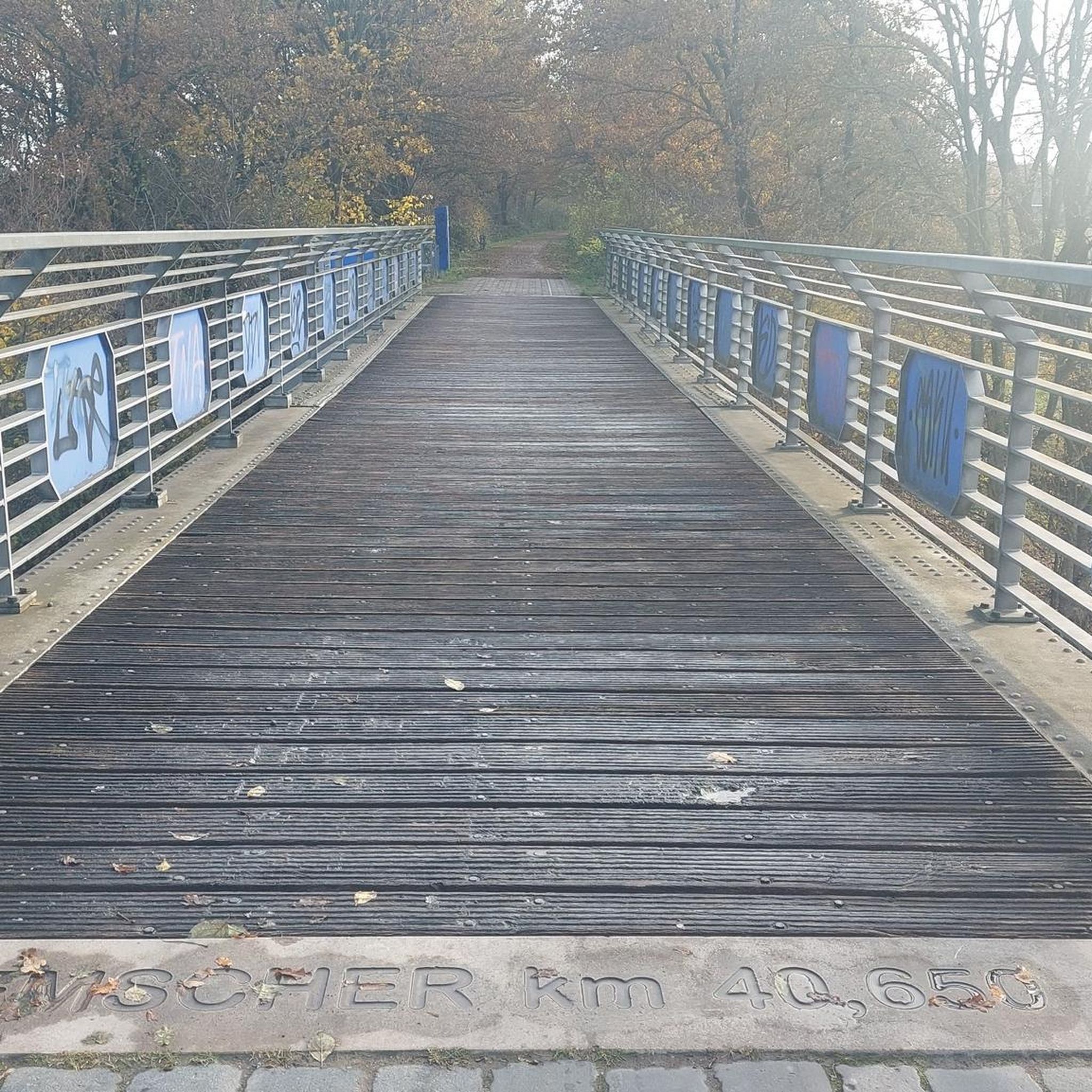
Magnificent viaduct, the largest in Mayenne, blends in very well with the landscape.
0
0

Atypical work of art (a little special all the same in this green setting on the banks of the Mayenne) with a staircase under the deck which allows you to cross the Mayenne.
0
0

Grez-Neuville is a charming village on the banks of the Mayenne. The port has been a base for river tourism in Anjou since the 80s, and you can watch the boats coming and going on the river.
0
0

It is the castle which gave its name to the town. Only the fortifications remain. These ramparts are more than a thousand years old and were built in the 11th century.
0
0
The port of Grez-Neuville is a charming village located on the banks of the Mayenne, where you can enjoy a relaxing hike along the water. You can admire old stone buildings there, such as the old Château du Port, which today houses the town hall, and the Grand Moulin, a fortified water mill. The port of Grez-Neuville is an ideal place to discover the natural and cultural heritage of Anjou.
2
0
The Montreuil-sur-Maine cave is a replica of the famous Lourdes cave in the Pyrenees. The cave was built in 1898 by five young girls inspired by the beauty of the site and the apparitions of the Virgin Mary to Bernadette Soubirous. The cave is located on the banks of the Mayenne, where you can also admire the old mill and the lock which regulate the flow of water. The cave is surrounded by a wooded hillside, where you can follow a path with 14 stations of the cross that depict the passion of Christ. The cave is open to visitors all year round.
2
0
Frequently Asked Questions
How many no-traffic road cycling routes are available around Gennes-Sur-Glaize?
There are over 250 no-traffic road cycling routes around Gennes-Sur-Glaize, offering a wide variety of options for different skill levels and preferences. Many of these routes utilize the serene towpaths along the Mayenne River.
What is the typical terrain like for no-traffic road cycling in this region?
The region is known for its largely flat and accessible terrain, especially along the Mayenne River's towpaths. These routes provide a relaxed cycling experience through unspoilt landscapes, flower-filled fields, and lush forests, making them ideal for road cyclists seeking smooth, car-free surfaces.
Are there routes suitable for beginners or those looking for an easy ride?
Yes, Gennes-Sur-Glaize offers 37 easy no-traffic road cycling routes. These often follow the flat riverside paths, such as sections of La Vélo Francette, providing a gentle introduction to the area's beautiful scenery without significant elevation changes. An example is the Roadbike loop from Château-Gontier-sur-Mayenne.
What historical sites or landmarks can I see along these no-traffic routes?
Many routes pass by significant historical features. You can encounter the impressive Mayenne Viaduct, the 19th-century Lock Keeper's House of La Rongère and Former Mill, or the ancient Château-Gontier Castle. The Mirwault Lock is another notable man-made structure along the river.
Are there any circular no-traffic road cycling routes available?
Yes, several no-traffic routes in the area are circular, allowing you to start and end in the same location. Examples include the Château-Gontier Castle – The Mayenne at Daon loop from Château-Gontier-sur-Mayenne and the The Mayenne at Daon – Mayenne Viaduct loop from Fromentières.
What is the best time of year to enjoy traffic-free road cycling in Gennes-Sur-Glaize?
The spring and summer months are generally ideal for cycling in Gennes-Sur-Glaize, offering pleasant weather and vibrant natural scenery with flower-filled fields. The towpaths are accessible year-round, but warmer months provide the most comfortable conditions for enjoying the riverside routes.
Are the no-traffic routes suitable for families?
Absolutely. The flat, traffic-free towpaths along the Mayenne River are very family-friendly. Their gentle gradients and safe environment make them perfect for cyclists of all ages, including children. Many routes offer scenic stopping points for picnics or breaks.
Can I bring my dog on these cycling routes?
Many of the riverside paths and greenways in the Mayenne Valley are dog-friendly, provided your dog is kept on a leash. It's always a good idea to check specific route details or local signage for any restrictions, especially in nature reserves or protected areas.
Where can I find parking for these no-traffic road cycling routes?
Parking is often available in the towns and villages that serve as starting points for these routes, such as Château-Gontier-sur-Mayenne or Gennes-Longuefuye. Look for designated parking areas near the Mayenne River or close to town centers, which typically provide easy access to the towpaths.
Are there cafes or places to stop for refreshments along the routes?
Yes, you'll find charming villages and towns along the Mayenne River that offer cafes, restaurants, and other amenities. For instance, the Ménil riverside café is a popular spot for cyclists to take a break and enjoy the views.
What do other cyclists say about the no-traffic road cycling experience in Gennes-Sur-Glaize?
The no-traffic road cycling routes in Gennes-Sur-Glaize are highly rated by the komoot community, with an average score of 4.38 stars. Reviewers often praise the tranquil riverside paths, the beautiful natural scenery, and the opportunity to explore historical sites in a peaceful, car-free environment.
What is the longest no-traffic road cycling route available?
One of the longer no-traffic road cycling routes is the Notre Dame Church – Solesmes Abbey loop from Gennes-Longuefuye, which spans approximately 89 kilometers. This route offers an extensive ride through the region's scenic landscapes.
Most popular routes around Gennes-Sur-Glaize
Most popular attractions around Gennes-Sur-Glaize

Get inspired with the komoot mobile app


Explore more
Browse the best Road cycling routes in other regions.
