The best traffic-free bike rides around Fontaines-D'Ozillac
4.1
(49)
275
riders
19
rides
No traffic touring cycling routes around Fontaines-D'Ozillac traverse a tranquil rural setting in the Charente-Maritime department of France. The landscape is characterized by rolling countryside, extensive vineyards, and open fields, interspersed with forests and charming villages. The region features a network of quiet back roads and dedicated cycle paths, providing varied terrain for cyclists. Elevations are generally gentle, with hills rather than mountains, making it suitable for touring.
Best no traffic touring cycling routes around Fontaines-D'Ozillac
- The most popular no…
Last updated: July 4, 2026
4.0
(2)
22
riders
34.4km
02:28
210m
210m
Moderate bike ride. Good fitness required. Mostly paved surfaces. Suitable for all skill levels.
5.0
(1)
4
riders
38.6km
02:20
280m
280m
Moderate bike ride. Good fitness required. Mostly paved surfaces. Suitable for all skill levels.

Sign up for free
3.0
(3)
4
riders
10.9km
00:42
70m
70m
Easy bike ride. Great for any fitness level. Mostly paved surfaces. Suitable for all skill levels.
3
riders
36.4km
02:11
280m
280m
Moderate bike ride. Good fitness required. Mostly paved surfaces. Suitable for all skill levels.
5.0
(1)
3
riders
14.2km
00:51
100m
100m
Easy bike ride. Great for any fitness level. Mostly paved surfaces. Suitable for all skill levels.
Get access to more routes and recommendations from other explorers.
Sign up for free
Already have an account?
Our route recommendations are based on thousands of hikes, rides, and runs completed by other people on komoot.
Start today with a free account
Your next adventure awaits.
Login or Signup
Popular around Fontaines-D'Ozillac
Tips from the Community

The high octagonal tower of the bell tower consists of two floors. The first is embellished on each side with two high blind bays. The second finished in the Gothic period is added by eight large windows. The inner curve of each is cut into small lobes reminiscent of the Moorish style. During the construction of the facade, the nave was shortened by one bay. In the 14th century ogival style, the arched portal with arches is accompanied by a trefoil window underlined by a checkered cornice. The square chevet has preserved in the masonry old parts of the semi-circular chevet of Romanesque origin: remains of arcades on columns with capitals, remains of cornices and windows. The old bay in front of the choir is remarkable for the quality of the sculptures of the Romanesque capitals. One represents a shrine on an altar guarded by two figures. According to C. Connoué, it is an original subject for Saintonge which would have its similar in the church of Notre-Dame-de-Soulac (Gironde). The shrine represents a church whose two-storey bell tower has a conical roof like that of the Abbaye aux Dames in Saintes or closer to Rouffignac, Nieul-Ie-Virouil. The scene is framed by two large chandeliers, furniture that is rarely represented in Saintonge sculpture. On another capital, Adam and Eve are represented after the original sin in silly niches drawn by small trees, including that of Good and Evil. Another shows birds in leaves, a subject that is also treated in the church of Grézac or in that of Jarnac-Champagne. Outside, the Romanesque chevet is punctuated by engaged columns of decreasing section.
0
0

There is a great children's park
0
0
The church of Saint-Pierre depended in the 14th century on the abbey of La Couronne (Charente). Of Romanesque origin (12th and 13th centuries), it has suffered numerous damages and many restorations have taken place. The gable facade is pierced in its central axis by an early 16th century portal with a grooved arch, framed by prismatic tori and flanked by two blind bays. The whole is surmounted by a rose window. The side walls are perforated with narrow openings, some of which are underlined with a diamond-point cord. The 12th century building has a single nave with a trefoil choir. The semi-circular chevet is decorated with a chamfered cornice decorated with zigzags on brackets engraved with various subjects. Many engraved names accompanied by dates from the 18th century are visible on the bedside wall. The interior of the nave is covered with a semi-circular barrel vault. On the south side, a 16th century crypt is occupied by a tomb decorated in the flamboyant style. The two apsidioles vaulted in cul-de-four give the church a trefoil plan. The square of the transept supported the old bell tower. All that remains are back-to-back columns adorned with claw bases and worked grooves. The sculptures accompanying the pilasters are modern. The bell tower was redone in concrete with an external staircase in place of the previous one, which itself replaced the original bell tower, which fell in the 1950s. Under the modern, octagonal bell tower, there is a mass of columns with ornate capitals and bases (foliage, animals, colorful characters). The choir is barrel-vaulted with a semi-circular arch. The chancel columns are also adorned with claw bases on the north side and flutes on the south side. The cul-de-four apse is openworked with three similar windows with small columns. Paintings of Saint-Pierre and Saint-Paul. Tomb with recumbent in the habit of an ecclesiastic whose head and hands have been destroyed. The Saint-Pierre church was classified as a historical monument in 1970.
0
0
The church, built in the shape of a Latin cross, the first construction elements of which date from the 11th and 12th centuries, with later additions and alterations (15th and 19th centuries to the beginning of the 13th century then modified in the 15th and 16th centuries, is dedicated to Saint Séverin, alias Seurin, bishop of Bordeaux in the 5th century, and whose feast day takes place on October 21. However, the solemn patronal feast is that of Saint Blaise, martyr bishop of the 4th century, fixed on February 3, and for which there is great veneration in the country. The main portal of the church, as well as the two false doors, are crowned by ogival arcades with a few rare ornaments borrowed from the Romanesque period, such as saw teeth, diamond points, etc. These gantries have been the subject of a subconstruction. The nave is made up of three recently vaulted bays in brick and plaster, without ribs; each span is separated by groups of four small columns, only two meters and fifty high, and appearing to date from the 14th century. The apse has two bays in the 15th century ogival style. The Saint-Joseph chapel, to the north, has kept its original Romanesque style; it is dominated by a semi-circular vault, and offers the example of an apsidion of which no advantage is currently being taken. It is adorned with a small apse which housed the baptismal font. The chapel of the Virgin, to the south, was remodeled in the 17th century; it has the character of a 15th century restorer; it was then lengthened, and consists of three spans. There is, it is said, an ossuary under the choir. The bell tower with a cone or "pine cone" spire, placed above the transept, and about 24 meters high (54 steps lead to its summit), is worthy of attention. This is the oldest part of the church. It is covered with a stone dome carved in tortoiseshell called the pine cone bell tower, similar examples of which can be found in Saintonge (Abbaye aux Dames de Saintes, Notre-Dame-de-l'Assomption church in Fenioux)3 but which recalls above all the domes of Byzantine inspiration observed in Poitou, Angoumois and Périgord (church of N.-D.-la-Grande in Poitiers, cathedral of Saint-Pierre in Angoulême, cathedral of Saint-Front in Périgueux). The foreground includes five Romanesque windows on each side, oriented as usual, on the upper level there are only two; the tower ends in a cut of stone, formed of small somewhat deformed cubes and forming a slightly rounded cone, but deformed by time. Inside, this bell tower offers a quadrangular vault, with cut sides, of very good taste. The bell, weighing 430 kilograms, was cast by Guillaume Besson, from Angers, and blessed in 1859, under the name of Marie. The godfather was Mr. Blanc Fontenille, former lawyer and notary, mayor of Nieul, and the godmother Mrs. Marie Belloteau, born Babin; parish priest M.Antoine Lanson.
1
0
Hilaire de Poitiers (in Latin Hilarius Pictaviensis) is the first bishop of Poitiers actually attested, born around 315 and died in 367. He is also one of the first Latin Christian writers. A fourth-century theologian, he was a great defender of Nicene orthodoxy against Arianism and Sabellianism. He was designated by the title of "Athanasius of the West" because of his energetic and pastoral action in the promotion of Christian orthodoxy. It is a pretty little church that bears his name, and which is in the heart of the village. It presents a most interesting example of a primitive novel. The facade is a tripartite composition with two superimposed registers, without any sculpture, except for the two herringbone cords which frame the second register. At ground level, the 2 blind side bays are narrow and higher than the gate. The upper arcade has five arches resting on columns with bare capitals. The central arch is pierced by a small bay. The simple nave leads to the square under the bell tower. Barrel vaulted, it has a most archaic Romanesque base. The side walls are composed of two levels of arcades of equal height. The lower register is made of two arches on columns, the upper register of three, of which the middle one is pierced by a bay. Some colonens have disappeared. The bell tower is supported on its north face by a staircase. Each side of the staircase is pierced with twin trilobed bays. The whole is topped with a slate spire. The flat chevet is surmounted by a very steep gable rebuilt in the 19th century. It includes an ogival bay, walled from the inside, underlined by a sculpted cordon. Its perimeter is highlighted by a cornice decorated with a frieze with geometric patterns reminiscent of the arches of Guitinières, a neighboring town. As for the modillions that accompany it, some are not lacking in originality, others are very refined. The choir, rebuilt in the Gothic period, occupies two bays with ogival vaults with formers and keys. The ribs fall on groups of small columns with capitals adorned with large ivy leaves. We will notice on the perimeter of the church some old stones engraved with escutcheons and a boat.
0
0
The parish church of Saint-Pierre in Mérignac, a former dependency of the cathedral chapter, is not dated by any text. It has been revised at various times. The old part of the church, with geometric decoration, was built during the third quarter of the 12th century. Various additions and restorations were carried out in 1578, 1644 and 1734. The nave is vaulted with three equal bays which would have been raised in 1733-1734. The fourth bay, much longer, has a vault of roughly the same date. Note the remains of two Romanesque columns and their sculpted capitals. The entire eastern part of the building dates from 1578. The bays of the nave have windows with columns and capitals in the shape of a telescope on both sides. The square choir, in warheads, is lit to the east by a window with a flamboyant network. To the south, a small barrel-vaulted chapel was built and to the north, the ground floor of the bell tower forms the transept arm. It is surmounted by a dome on pendentives. The facade is very deformed by two oblique buttresses applied to its corners in the 16th century. The apse is surmounted by a gable. The rectangular bell tower has a first floor whose Gothic bays have been blocked and a second with three twin bays, the center one of which is wider. This floor was added in the 18th century. The church has been listed as a historic monument since 1925.
0
0
The city gate, called 'Porte de ville vieille', which gives access to the old town was built between the 13th and 15th centuries and allows you to reach the very typical houses of the town center of Jonzac. It was classified as a historical monument in 1926.
1
0
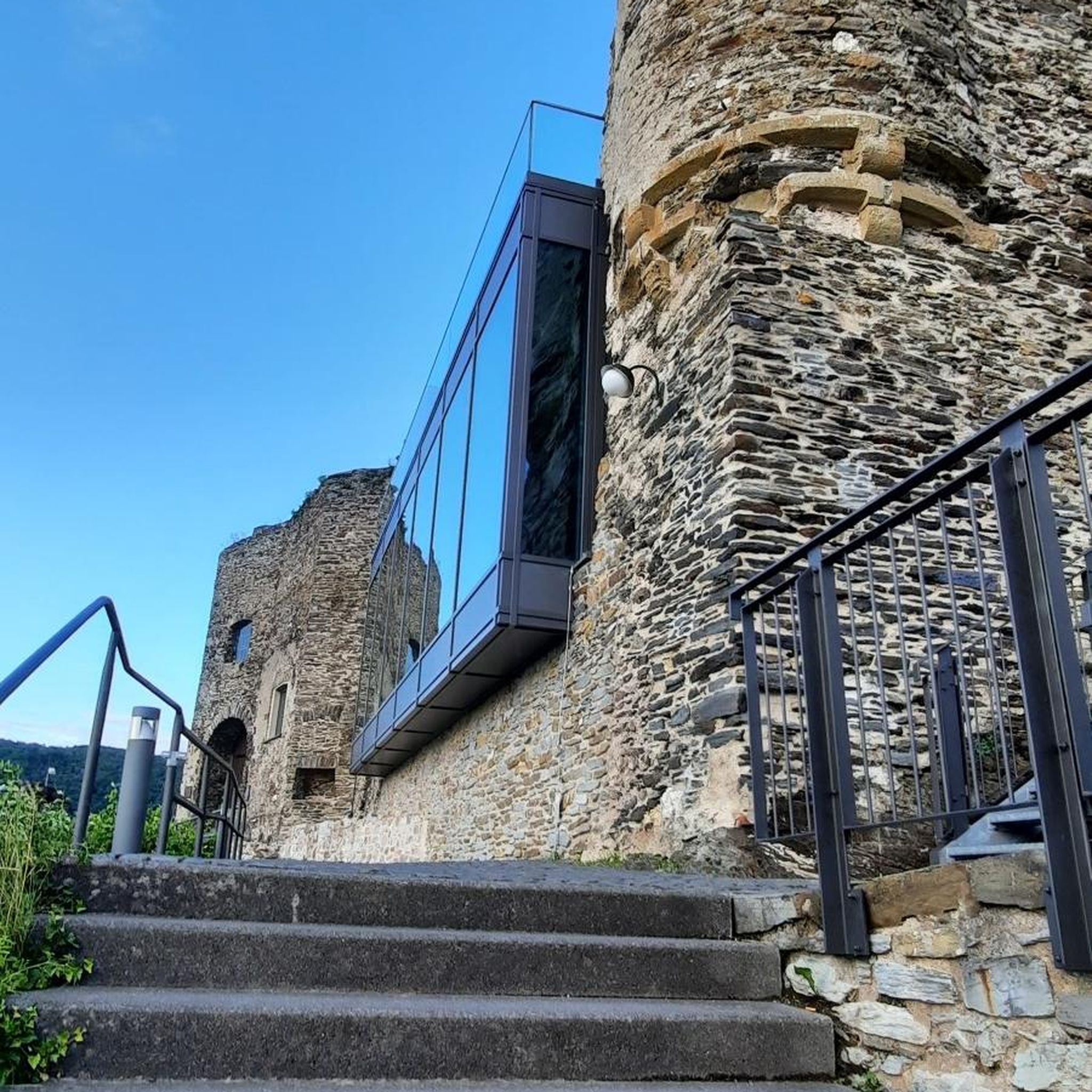
In 1073, the castle already exists; the first known lord was Guillaume de la Rochandry at the beginning of the 12th century. The 1449 inscription on the castle attests to its reconstruction following the destruction caused by the Hundred Years War. In 1505, Jean de Sainte-Maure, lord of Jonzac, founded the Carmelite monastery on the remains of an old chapel dedicated to Saint Nicolas. The cloister was built in 1657. The young Louis XIV, the Queen Mother and Mazarin stayed at the castle in 1659. The castle remained at Sainte-Maure until the end of the 17th century, then passed through marriage to Espardes de Lussan, which transformed the fortress in beautiful stately home with neat ornamentation and guard until the Revolution. Currently the north wing of the castle houses the buildings of the Town Hall (restored in the 19th century), and the south wing, those of the sub-prefecture. The cloister was restored between 1976 and 1978, and now houses a cultural center, with exhibition halls and an archaeological museum. The towers, postern and fountain in the basement date from the 12th century. Of the old feudal castle, only the postern and an isolated tower remain, connected to the main body by a large hall. The moat in front of the drawbridge was filled was filled in the 19th century. It was reopened at the beginning of the 21st century. The imposing gatehouse is marked 1549 and therefore dates from the 16th century, a period of work including the north-west tower, while the south-west tower, of a smaller diameter, is from the 17th century. The towers flanking the postern have retained their defenses. At each, the loopholes have been retained or enlarged. Stone stairs serve each floor and access the walkway. This passage seems to have been discovered, as evidenced by the gargoyles. The crenellation includes machicolations with archers in the middle of the merlons. The slate roofs are high pepperboxes on the towers, and a curious set with two sides connecting two pepperboxes for the gatehouse The fountain located in the basement of the sub-prefecture, has a niche and a niche frame decorated with sculptures imitating stalactites. Carved mask. The fountain was probably built by Léon de Sainte-Maure, Count of Jonzac, who enlarged and embellished the castle in the middle of the 12th century. In a former courtyard of the castle, a theater was built in the 19th century. It is a round building with approximately 300 seats.
0
0
Frequently Asked Questions
How many no traffic touring cycling routes are available around Fontaines-D'Ozillac?
There are over 20 dedicated no traffic touring cycling routes in the Fontaines-D'Ozillac area. These routes cater to various skill levels, with 11 easy, 10 moderate, and 3 more challenging options to explore the tranquil Charente countryside.
What kind of landscapes can I expect on these traffic-free cycling routes?
The routes around Fontaines-D'Ozillac traverse a picturesque and tranquil rural setting. You'll cycle through rolling countryside dotted with fields of sunflowers, ripening wheat, and vineyards, interspersed with charming villages and impressive French architecture. Expect a mosaic of forests and prairies, particularly in the Coteaux du Montmorélien, offering a truly scenic experience.
Are there any family-friendly traffic-free cycling routes?
Yes, the region is excellent for families. The "La Voie Verte" (The Green Way) is a notable 35 km paved cycle path, perfect for a peaceful cycling experience away from cars. Additionally, many of the 11 easy routes, such as the Bike loop from Saint-Germain-de-Lusignan, are suitable for families looking for shorter, less strenuous rides.
What historical sites or attractions can I see along the no traffic touring cycling routes?
The area is rich in history and culture. You can cycle past the 12th-century Romanesque Saint Martin Church of Fontaine-d'Ozillac in the village itself. Nearby, the spa town of Jonzac (just 8 km away) features a historic Jonzac Castle and the Old Town Gate of Jonzac. Many routes, like the Jonzac Castle – guter vibe loop from Salignac-de-Mirambeau, offer opportunities to discover these historical gems.
What is the best time of year to enjoy traffic-free cycling in Fontaines-D'Ozillac?
The Charente region is known as the second "sunniest" in France, making spring, summer, and early autumn ideal. Spring offers vibrant greenery and blooming wildflowers, while summer provides warm, sunny days perfect for cycling through sunflower fields. Early autumn brings pleasant temperatures and beautiful fall colors, with fewer crowds.
Are there any circular no traffic bike routes available?
Yes, many of the routes are designed as circular loops, allowing you to start and finish at the same point. For example, the Bike loop from Jonzac is a moderate 34 km circular route that takes you through the scenic countryside without retracing your steps.
What do other touring cyclists enjoy most about cycling in Fontaines-D'Ozillac?
The area is highly rated by the komoot community, with an average score of 4.1 stars. Reviewers often praise the region's peaceful, car-free roads, the beautiful rural scenery with vineyards and forests, and the charming villages. The well-maintained paths and the opportunity to discover historical sites are also frequently highlighted.
Are there any longer, more challenging traffic-free routes for experienced cyclists?
While the region is known for its tranquil, easy-to-moderate routes, there are options for more experienced cyclists. The broader Charente region offers "exploration circuits" ranging from 40-70 km. Within our selection, routes like the Guter vibe loop from Jonzac, at nearly 40 km with over 300 meters of elevation gain, provide a good challenge while remaining largely traffic-free.
Can I find routes that pass through forests or natural areas?
Absolutely. The region boasts a rich natural environment. Many routes will take you through or near natural features like the Forêt de la Lande and Forêt de Pons, offering shaded sections and a different kind of scenery. The "La Galope Chopine" greenway, for instance, is known for its shaded path through forests and vineyards.
Are there any specific greenways or dedicated cycle paths in the area?
Yes, the region is well-equipped with greenways. "La Voie Verte" is a prominent 35 km paved cycle path, and "La Galope Chopine" is an easy 21 km greenway built on a former railway line, offering a shaded route through forests, vineyards, and villages. These provide excellent traffic-free cycling experiences.
Are there routes that connect to other towns or points of interest?
Many routes are designed to connect charming villages and points of interest. For example, the Church of Rouffignac – Saint-Michel Church of Ozillac loop from Jonzac links several local churches and villages, allowing you to explore the cultural fabric of the area while enjoying a traffic-free ride.
Most popular attractions around Fontaines-D'Ozillac

Get inspired with the komoot mobile app


Explore more
Browse the best Cycling routes in other regions.
