The best traffic-free bike rides around Tervuren
4.3
(25)
666
riders
10
rides
No traffic road cycling routes around Tervuren traverse a diverse landscape, characterized by the expansive Sonian Forest, open agricultural areas, and the historic Voer Valley. The region features a mix of well-maintained paths, alternating steep slopes, and gentle gradients, providing varied terrain for road cyclists. This area, part of the Flemish Brabant cycling network, offers routes through ancient woodlands and past panoramic viewpoints.
Best no traffic road cycling routes around Tervuren
- The most popular no traffic road cycling route is Scenic Countryside Road – Cycle Path Through the Fields loop from Duisburg, a 44.2 miles (71.1 km) trail that takes 3 hours 30 minutes to complete. This route offers extensive views across open landscapes and agricultural fields.
- Another top favourite among local road cyclists is Kampenhout Lock – Leuven Town Hall loop from Vossem, a moderate 30.1 miles (48.4 km) path. This route guides cyclists through varied scenery, including sections along waterways and towards historic towns.
- Local road cyclists also love the Rural Path Near Huldenberg – Top of the Smeysberg climb loop from Duisburg, a 21.6 miles (34.7 km) trail leading through rural areas with notable climbs, often completed in about 1 hour 49 minutes.
- Road cycling around Tervuren is defined by dense woodlands of the Sonian Forest, open landscapes with panoramic views, and the scenic Voer Valley. The network offers options for different ability levels, from moderate to more challenging routes.
- The routes in Tervuren are highly rated by the komoot community with an average score of 4.2 stars from more than 20 reviews. More than 1,000 road cyclists have used komoot to explore Tervuren's varied terrain.
Last updated: July 14, 2026
4.9
(7)
209
riders
48.6km
02:06
170m
170m
Moderate road ride. Good fitness required. Mostly well-paved surfaces and easy to ride.
4.5
(2)
41
riders
Moderate road ride. Good fitness required. Some segments of this route may be unpaved and difficult to ride.

Sign up for free
23
riders
56.4km
02:36
260m
260m
Moderate road ride. Good fitness required. Some segments of this route may be unpaved and difficult to ride.
5.0
(1)
16
riders
20.2km
01:03
160m
160m
Moderate road ride. Great for any fitness level. Some segments of this route may be unpaved and difficult to ride.
9
riders
64.3km
03:01
380m
380m
Moderate road ride. Good fitness required. Mostly well-paved surfaces and easy to ride.
Get access to more routes and recommendations from other explorers.
Sign up for free
Already have an account?
Our route recommendations are based on thousands of hikes, rides, and runs completed by other people on komoot.
Start today with a free account
Your next adventure awaits.
Login or Signup


Other adventures around Tervuren


Tips from the Community

01/19 is a full-fledged runway that can be used in both directions. Heading 01 = heading around 010°; Heading 19 = heading around 190° It crosses the two parallel runways 07L/25R and 07R/25L, giving it an operationally flexible role in wind conditions that are not compatible with the parallel runways. Zaventem has 3 runways, together they form a Z-configuration.
6
0

Tervuren Church has been standing here for several hours, always ready to be observed...
6
0

This entire stretch just got a new layer of concrete and asphalt. So you can blaze through it easily from now on, no more potholes or bumps!
0
0

The church is a cruciform church, built in the Gothic style, but retaining part of the Romanesque tower. This section is the oldest, dating from the thirteenth century. The west facade is Classical and dates from 1779. During the same period, the dilapidated western tower was also demolished. Originally, the church contained the mausoleums of three important Brabantine dukes: Anthony of Burgundy and his sons John and Philip. However, these were destroyed during the religious unrest.
4
0


watch out for fast cyclists along the path along the Dijle and canal.
0
0


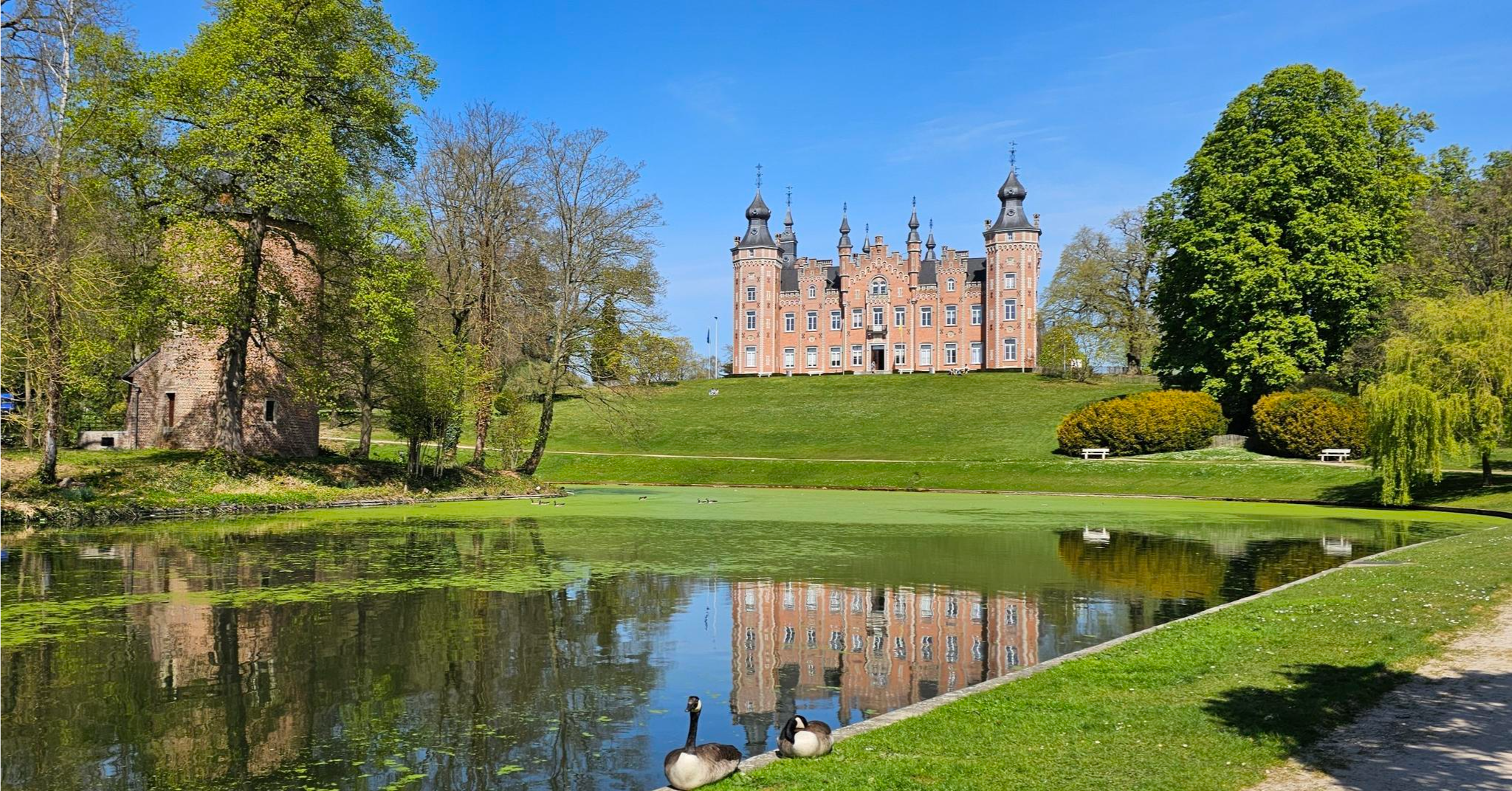
The core of Horst Castle probably dates back to the 13th century and is characterised by a square keep. The keep probably belonged to the oldest core that was further expanded into a fortified castle in the 15th century. During the troubles under Maximilian of Austria in 1489, the castle of Horst was taken by the people of Leuven and set on fire. According to literary sources, only the keep, part of the entrance gate and a defensive wall remained standing. The residential and east wing were renovated and expanded in the 16th century. The round tower also dates from this period. The outer wall was provided with a rectangular bay window. The castle lost its military character and became more of a pleasant residential area with a view of the moat, the ponds and the inner courtyard. Brick construction with sandstone layers characterise these buildings. In 1587, however, the castle was set on fire again during the raids of the Geuzen. It was not until the beginning of the 17th century that restoration work began. It is difficult to deduce from the available sources to what extent this involved restoration or an embellishing conversion of the castle complex. Presumably nothing changed in the internal structure, but only after the structurally necessary repairs were the interiors completely refinished. Maria-Anna Van den Tympel had a new chapel built against the keep in the 17th century. At the beginning of the 19th century, the complex must have been damaged by plundering and neglect, and it is possible that it also suffered from plundering during the Brabant Revolution of 1830. Around 1850, the castle must have been habitable again, but the castle buildings only served as a farm. In the land registry, the site around the castle is called "De Notelaren Boomgaerd". Around that time, the most dilapidated part must have been demolished, namely the southern part and the superstructure of the gate. The rest of the complex was probably restored with reused demolition material and in traditional style. The castle was divided in 1880, with one part being registered as a school house. In 1897, a further division followed, with two plots being designated as houses. Several restoration campaigns followed in the 20th century. Inventory of Immovable Heritage: Horst Castle, https://id.erfgoed.net/erfgoedobjecten/43619
6
0
Frequently Asked Questions
How many no-traffic road cycling routes are available in Tervuren?
There are over a dozen dedicated no-traffic road cycling routes around Tervuren, offering a variety of distances and difficulty levels. These routes are designed to provide a serene cycling experience away from vehicular traffic.
What kind of landscapes can I expect on these no-traffic routes?
You'll experience a diverse range of landscapes. Many routes traverse the ancient Sonian Forest, a UNESCO World Heritage site, with its stately beech trees and serene paths. Other routes offer open countryside, splendid panoramas towards areas like Neerijse and Leefdaal, and even agricultural landscapes in the 'Grape Region'.
Are there any easy no-traffic road cycling routes suitable for beginners?
Yes, there is at least one easy route specifically designed for a relaxed pace, perfect for beginners or those looking for a less strenuous ride. Most routes are moderate, offering a good balance of challenge and accessibility.
What are some notable natural features or landmarks I can see along the routes?
Many routes pass through or near the beautiful Ponds of Tervuren Park, offering picturesque views. You might also encounter historical sites like the remains of the palace of the Dukes of Brabant. The Sonian Forest itself is a major natural highlight, and some routes venture into the scenic Voer Valley, dotted with castles and historic churches.
Can I find routes that offer a good workout with some elevation?
Absolutely. While focused on no-traffic, many routes incorporate the region's rolling terrain. For example, the Rue de Pécrot Climb – Weg Naar Nethen loop from Tervuren features significant elevation gain, and the Rural Path Near Huldenberg – Top of the Smeysberg climb loop from Duisburg includes the notable Smeysberg climb, providing a good challenge.
What do other cyclists enjoy most about no-traffic road cycling in Tervuren?
The area is highly rated by the komoot community, with an average score of 4.2 stars. Reviewers often praise the tranquility of the Sonian Forest, the well-maintained paths, and the variety of scenic routes that allow for peaceful cycling away from cars.
Are there any circular no-traffic road cycling routes?
Yes, many of the no-traffic routes are designed as loops, allowing you to start and end at the same point. An example is the Scenic Countryside Road – Cycle Path Through the Fields loop from Duisburg, which offers a substantial circular ride through varied terrain.
Is public transport accessible to reach these cycling routes?
Tervuren is well-connected by public transport, making it easy to access the starting points of many routes. The town itself serves as a gateway to the Sonian Forest and the wider cycling network, with bus connections to nearby cities like Brussels and Leuven.
Are there specific visitor centers or facilities along the routes?
Yes, within the Sonian Forest, you can find visitor centers like De Warandepoort in Tervuren, which can provide information and amenities. The Park of Tervuren also offers facilities and serves as a beautiful starting point for many rides.
What is the best time of year to enjoy no-traffic road cycling in Tervuren?
Spring and autumn are particularly beautiful for cycling in Tervuren, with pleasant temperatures and stunning natural scenery as the forest changes colors. Summer also offers great conditions, especially for rides through the shaded Sonian Forest. Winter cycling is possible, but be prepared for colder weather and potentially wet conditions.
Are there any routes that combine natural beauty with historical sites?
Many routes offer a blend of nature and history. For instance, the Kampenhout Lock – Leuven Town Hall loop from Vossem takes you through scenic landscapes while also passing by historical towns and landmarks, providing a rich cultural experience alongside your ride.
Most popular routes around Tervuren
Most popular attractions around Tervuren

Get inspired with the komoot mobile app


Explore more
Browse the best Road cycling routes in other regions.
