The best traffic-free bike rides around Ciney
4.5
(184)
1,618
riders
77
rides
No traffic touring cycling routes around Ciney traverse the Condroz-Famenne region, characterized by rolling landscapes, picturesque villages, and a mix of open fields and dense woodlands. The area features varied terrain, including the deep valleys of the Bocq and Lesse rivers, and offers both gentle paths and more challenging climbs. Limestone formations and natural reserves contribute to the diverse environment for cycling.
Best no traffic touring cycling routes around Ciney
- The most popular no traffic touring cycling route is Les…
Last updated: August 24, 2026
4.9
(12)
78
riders
39.2km
02:24
290m
290m
Moderate bike ride. Good fitness required. Mostly paved surfaces. Suitable for all skill levels.
5.0
(4)
75
riders
14.1km
00:48
60m
60m
Easy bike ride. Great for any fitness level. Mostly paved surfaces. Suitable for all skill levels.

Sign up for free
4.9
(13)
69
riders
33.2km
01:57
200m
200m
Moderate bike ride. Good fitness required. Mostly paved surfaces. Suitable for all skill levels.
4.3
(10)
72
riders
36.6km
02:18
400m
400m
Moderate bike ride. Good fitness required. Mostly paved surfaces. Suitable for all skill levels.
4.9
(7)
46
riders
108km
06:51
1,170m
1,170m
Hard bike ride. Very good fitness required. Mostly paved surfaces. Suitable for all skill levels.
Get access to more routes and recommendations from other explorers.
Sign up for free
Already have an account?
Our route recommendations are based on thousands of hikes, rides, and runs completed by other people on komoot.
Start today with a free account
Your next adventure awaits.
Login or Signup


Other adventures around Ciney

Tips from the Community

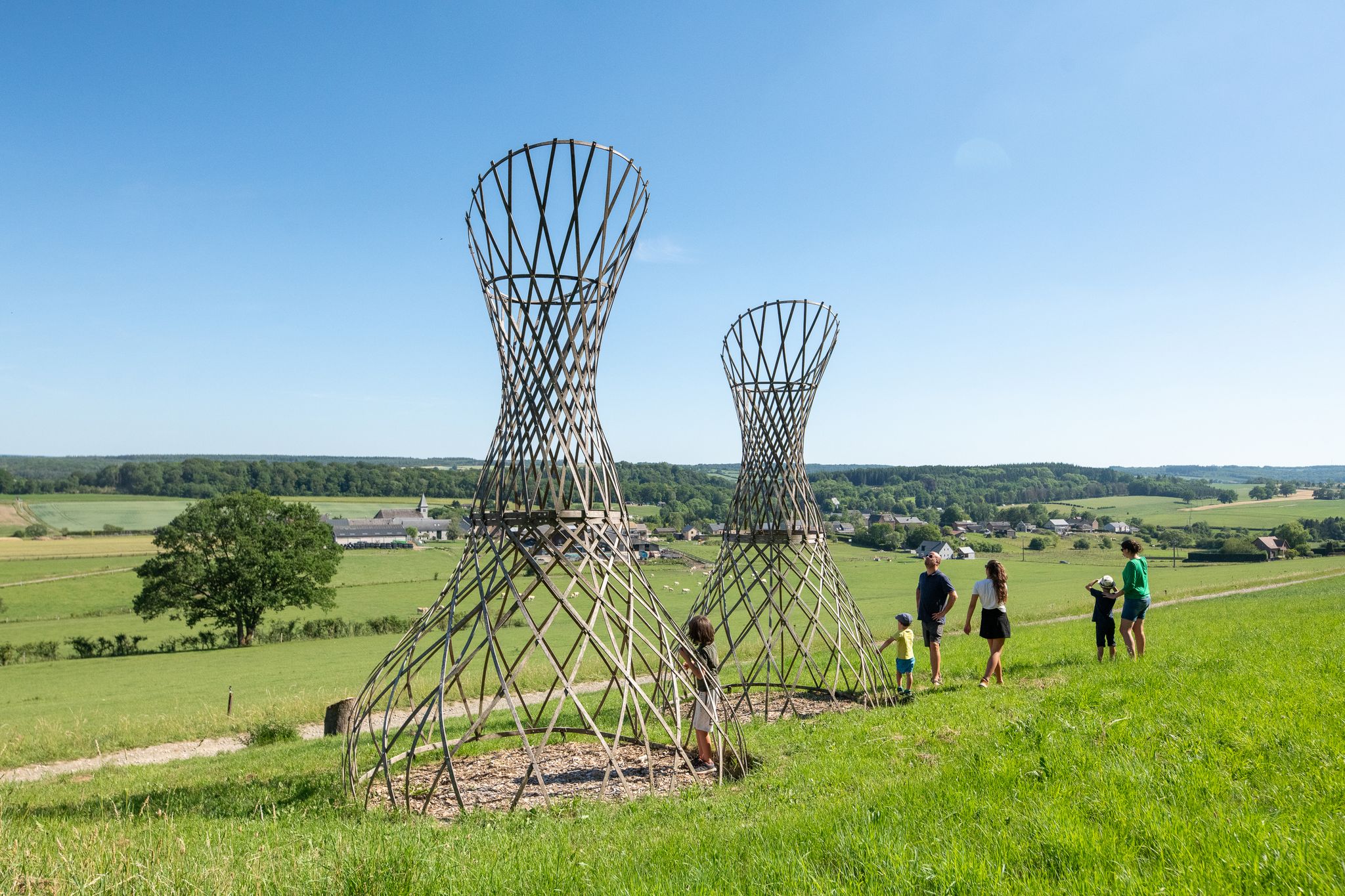
Nice large natural art objects
0
0

It all began in 1240, when the monks of the Belgian monastery of Notre-Dame de Leffe began brewing beer. For a long time, they produced their own abbey beer. However, during the French Revolution, the monastery was closed. It wasn't until 1929 that the monastery was revived, and the monks resumed their brewing activities. A good twenty years later, the brothers Nys and Albert Lootvoet began producing beer based on the Leffe Abbey recipe. Their company is now owned by the brewing giant Anheuser-Bush InBev. Source: bierpedia.org/bier/leffe-blonde
4
0
In 1152, Henry the Blind, Count of Namur, donated the church of Leffe to the Premonstratensians of Floreffe. The monastery resulting from this donation became an abbey in 1200. It was rebuilt in the 17th and 18th centuries and plundered by the revolutionaries in 1794. In 1816, the current buildings were sold and converted into workshops. They were repurchased in 1903 by French Premonstratensians who were then in exile and, starting in 1931, restored by their Flemish confreres from Tongerlo, who rebuilt the abbey. The abbey today has a double courtyard. The 17th-century abbey quarter, rebuilt in 1747, borders the guest quarter, dating from 1604. The former library, which was separate from the abbey, is now a primary school. Source: visitwallonia.de/de/content/abtei-notre-dame-de-lesse
4
0
It all began in 1240, when the monks of the Belgian monastery of Notre-Dame de Leffe began brewing beer. For a long time, they produced their own abbey beer. However, during the French Revolution, the monastery was closed. It wasn't until 1929 that the monastery was revived, and the monks resumed their brewing activities. A good twenty years later, the brothers Nys and Albert Lootvoet began producing beer based on the Leffe Abbey recipe. Their company is now owned by the brewing giant Anheuser-Bush InBev. Source: bierpedia.org/bier/leffe-blonde
4
0

Dinant is a beautiful little town with a rich history and is well worth a stop.
0
0

Today, the castle is part of the Radhadesh estate, which also includes a more recent residential center and several even more recent agricultural buildings. Openbaar Kunstbezit Vlaanderen (Flanders Public Art Agency) calls it a spiritual community, where the new residents have thoroughly restored the castle and transformed it into a true spiritual oasis where you can explore the colorful culture of Indian traditions. Specifically, the International Society for Krishna Consciousness (formerly the Hare Krishna movement) has a base and residential community there. There's also a vegan restaurant, a shop, a museum of sacred art (MOSA), and you can take a paid tour. The temple is accessible without payment. There's also a 2.8-kilometer "spiritual" walking trail. More at https://www.okv.be/museum/radhadesh-kasteel-van-petite-somme I'm not mentioning the domain's website because of a virus alert on my computer.
7
0
Built in 1888 and now in its neo-Gothic style, the castle served as a field hospital during the First World War, where the Jourda family cared for wounded and also sheltered local residents whose homes had been destroyed. During the Second World War, it housed American soldiers during the Rundstedt Offensive. From 1946 onwards, it became a holiday center, a school for people with intellectual disabilities, a youth hostel, a campsite, and a hotel-restaurant, all under the initiative of mayors Jean Andrieu of Herstal and Denis Deghaye of Oupeye. After the initiative's bankruptcy, a Brussels real estate agent, Serge Frankovich, bought the property in 1975, leaving it vacant for five years and plundering it. The Hare Krishna movement then purchased it and turned it into the Radhadesh estate. Sources: - https://www.castles.nl/petite-somme-castle - https://www.burchten-kastelen.be/provincies/luxemburg/002%20Kasteel%20van%20Petite%20Somme/Kasteel%20van%20Petite%20Somme.html - https://nl.wikipedia.org/wiki/Petite-Somme
7
0
Since 1980, the castle of Petite-Somme has housed a temple of the Hare Krishna movement, which today operates as the International Society for Krishna Consciousness. The dilapidated castle, of course, has a longer history. The current castle is also not the original and dates from 1888. The first mention of a castle on this site dates back to the eleventh century, when a certain Gozélonde Montaigu owned it. He was also the first Count of Montaigu. The County of Montaigu was quite influential for a time. It included the County of Duras in the Sint-Truiden region, the County of Clermont-sous-Huy, the Lordship of Jodoigne, and the village of Marcourt. The Counts of Montaigu were also vice-patrons of the Abbey of Sint-Truiden. Ecclesiastically, it belonged to the diocese of Liège. The castle was reportedly donated to the Abbey of Saint Hubert by the wife of Gozélon de Montaigu as penance for his husband's alleged plundering of the abbey's property. In the fourteenth century, a certain Jean de Bohême was said to have owned it, adding a tower to the castle, which became part of Luxembourg's defensive line. In 1461, the castle became the property of the de Hamal family, a Dutch-Belgian noble family that also appears in the histories of several Limburg villages and lordships (including 's Herenelderen, Grevenbroek, and the land of Vogelsanck). The de Hamal family held the lordship and castle of Petite Somme until 1774. Several noble families then succeeded one another. First came Albert Joseph de Favereau, born in 1750. De Favereau demolished the house that had served as the Hamal family's residence and built a brick manor house on its foundations. The new castle remained in the family's possession until 1877. Other sources claim that the demolition was carried out by the Count de Vaux, Aimable-Alexis de Jourda. What is certain is that the de Favereau family building was also demolished by a certain Louise Marie Eulalie, a relative of Baron Victor Albert de Favereau. And whatever the exact details are: it is certain that the current neo-Gothic castle stood there in 1888. Sources: - https://www.castles.nl/petite-somme-castle - https://www.burchten-kastelen.be/provincies/luxemburg/002%20Kasteel%20van%20Petite%20Somme/Kasteel%20van%20Petite%20Somme.html - https://nl.wikipedia.org/wiki/Petite-Somme
7
0
Frequently Asked Questions
How many no traffic touring cycling routes are available around Ciney?
There are over 75 dedicated no traffic touring cycling routes around Ciney, offering a wide range of options for all skill levels. You'll find everything from easy, short loops to more challenging, longer tours through the picturesque Condroz-Famenne region.
What is the best time of year for quiet touring cycling around Ciney?
The spring and autumn months generally offer the most pleasant conditions for quiet touring cycling around Ciney. The weather is mild, and the landscapes are particularly beautiful with blooming flowers or vibrant fall foliage. Summer can also be excellent, but routes might see slightly more activity, especially on weekends. Winter cycling is possible, but some paths might be less maintained or have icy patches.
What do other touring cyclists enjoy most about the no traffic routes in Ciney?
The no traffic touring routes around Ciney are highly rated by the komoot community, with an average score of 4.5 stars from over 140 ratings. Reviewers often praise the serene, car-free environment, the diverse and romantic landscapes of the Condroz, and the charming villages encountered along the way. Many appreciate the well-maintained paths and the opportunity to explore nature and history in peace.
Are there any easy, traffic-free routes suitable for beginners or families?
Yes, Ciney offers several easy, traffic-free routes perfect for beginners or families. These routes typically feature gentle gradients and well-surfaced paths. An excellent example is the Bocq Trout Pond – View of Château d’Emptinne loop from Ciney, which is just under 15 km and offers a relaxed ride through scenic countryside.
Are there any circular no traffic touring routes around Ciney?
Many of the no traffic touring routes around Ciney are designed as circular loops, allowing you to start and end at the same point without retracing your steps. For instance, the Les Avins Former Train Station – Bandstand on Ciney Square loop from Ciney offers a moderate 44 km circular experience, showcasing diverse landscapes and local charm.
What kind of terrain can I expect on these traffic-free routes?
The terrain on Ciney's traffic-free routes is quite varied, reflecting the region's diverse landscape. You'll encounter rolling hills characteristic of the Condroz-Famenne, gentle stretches along former railway lines (RAVeL), and some routes that delve into the more rugged Bocq Valley, which can include steeper climbs and descents. Most paths are well-maintained, suitable for touring bikes.
Are there options for longer, more challenging traffic-free touring rides?
Absolutely. For experienced touring cyclists seeking a challenge, there are several longer and more difficult traffic-free routes. These often involve more significant elevation changes and cover greater distances. The Château de Radhadesh – Leffe Valley Road loop from Haversin, for example, is a challenging 107 km route with over 1100 meters of elevation gain, offering an extensive exploration of the region's beauty.
What natural features or scenic viewpoints can I discover on these routes?
Ciney's no traffic routes are rich in natural beauty. You can expect to cycle through lush forests, along the picturesque Bocq Valley, and past rolling agricultural fields. Keep an eye out for stunning viewpoints, especially in areas like the Condroz-Famenne, known for its romantic landscapes. Some routes might even offer glimpses of natural monuments like the 'Aiguilles de Chaleux' limestone formations further afield.
Are there historical sites or cultural attractions along the no traffic routes?
Yes, many routes weave through areas rich in history and culture. You might pass by charming villages, historic churches, and even impressive castles. Notable attractions include the majestic Vêves Castle or the dramatic View of Walzin Castle perched on cliffs. The region also features the unique 'Sentiers d'Art' (Art trails), where you can discover art installations integrated into the natural landscape, such as the Sentiers d'Art – The Cubic Artbri.
Are there cafes or places to stop for refreshments along the traffic-free routes?
Many of the touring routes pass through or near small towns and villages where you can find local cafes, bakeries, or pubs to refuel. While specific cafes aren't listed for every route, the region is known for its hospitality. Planning your stops in advance, especially on longer routes, is advisable to ensure you have refreshment options available.
Can I access these routes using public transport with my bike?
Public transport options in Wallonia, including trains and some buses, generally allow bikes, though specific rules and peak hour restrictions may apply. Ciney is a railway station, making it accessible by train. It's always recommended to check the latest policies of the Belgian national railway (SNCB/NMBS) or local bus operators regarding bike transport before your journey.
Where can I park my car to access these quiet cycling routes?
Ciney, as a regional hub, offers various parking options, including public car parks in the town center, such as near Place Monseu. Many routes also start from or pass through smaller villages where street parking might be available. Look for designated parking areas near trailheads or town centers when planning your starting point.
Most popular attractions around Ciney

Get inspired with the komoot mobile app


Explore more
Browse the best Cycling routes in other regions.
