Top 20 Natural Monuments around Cantiano
Best natural monuments around Cantiano include a diverse range of geological formations and scenic landscapes. This village, situated on the border of Italy's Marche and Umbria regions, offers a rich natural environment. Visitors can explore 5 natural monuments, providing opportunities for outdoor activities and appreciating the local ecology. The area is characterized by its mountains, gorges, and forests.
Best natural monuments around Cantiano
- The most popular natural monument is Summit of Monte Cucco, a summit that offers panoramic views…
Last updated: June 28, 2026
Monte Catria Summit
Highlight • Summit
Translated by Google •
Tip by

Summit of Monte Cucco
Highlight • Summit
Translated by Google •
Tip by

Sign up now to discover places like this
Get recommendations on the best single tracks, peaks, & plenty of other exciting outdoor places.
Sign up for free
Fondarca Arch
Highlight • Natural Monument
The entrance to path no. 20 is found at the entrance to …
Translated by Google •
Tip by

Mondelacasa Castle (the Muracci)
Highlight • Castle
Translated by Google •
Tip by

Windy Pastures on Monte Nerone
Highlight • Viewpoint
Translated by Google •
Tip by

Sign up for free to discover even more natural monuments around Cantiano.
Sign up for free
Already have an account?
Start today with a free account
Your next adventure awaits.
Login or Signup

Other adventures around Cantiano

Tips from the Community

What can I say, simply fantastic.
0
0

The ruins of the Mondelacasa Castle (or Monte della Casa), called the Muracci, are located on the northern slopes of Mount Nerone, on the left bank of Val d'Abisso, at 707 m above sea level, about 1 km south of the historic center of Piobbico. (from COMUNE PIOBBICO 1999): Close to Mount Nerone stands a massive buttress whose base widens between the Biscubio torrent and the Petrello stream (Fosso di S. Maria) and carries the ruins of an ancient artifact on the summit. It was a castle, a primitive dwelling that the Brancaleoni, who arrived around the year 1000 in the Biscubio District, built and lived in until the mid-1300s. This is how our Costanzo Felici (1) describes it in a document from 1582:... climbing up to Monte Nerone a mile away on a rough and terrible hill and rock, there are vestiges of a superb, large and beautiful palace or fortress now in ruins, of which those (Brancaleoni) of Piobico were the owners. Built by Gentile Brancaleoni in the first half of the 13th century, it took the name of Mons Casa or Mondelacasa, today Muracci because of the ruins visible on the summit. Towards the middle of the 14th century, both because of the harshness of the place, difficult to reach when ... winter almost buried the tower under the snow, locked it under the grip of the ice, tormented it with the blizzard, confining it for months in isolation, and because of the need for other and more comfortable comforts, the two brothers Pazzo and Federico Brancaleoni decided to settle in the house that they had begun to build "in castro Plobici", on the hill to the right of the confluence of the Biscubio with the Candigliano, where there were already small houses piled up, that is, equipped with a watchtower with a Gothic arch portal to the north and a castle to the south-east. It is the place where the Brancaleoni Castle-Palazzo will develop and take shape over time. NOTE: (1) Costanzo Felici was born in the second decade of the 16th century in Casteldurante (now Urbania). However, he preferred to define himself as a native of Piobbico, where his ancestors had moved around 1330. He practiced medicine in Piobbico, Sant'Angelo in Vado, Pesaro, Rimini and Urbania. At the same time, he cultivated naturalistic and historical studies with notable results. He died in Pesaro on February 5, 1585. taken from: https://www.lavalledelmetauro.it/contenuti/beni-storici-artistici/scheda/11123.html
0
0

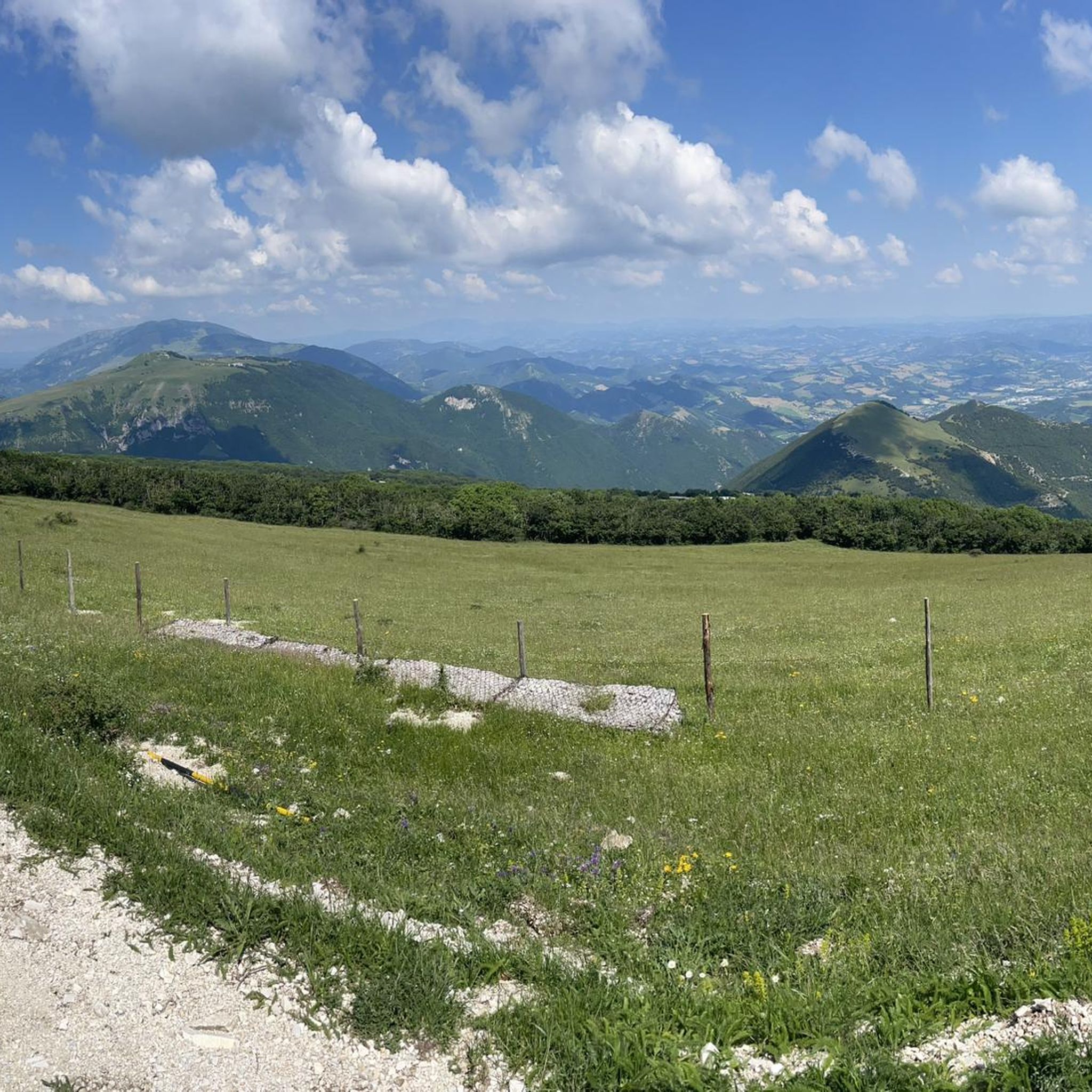
Monte Cucco is not only its peak... The natural park of Monte Cucco includes all the surrounding territory from its base, high plains and beautiful peak. This territory offers an infinite number of paths to travel on foot, by bike or even on horseback. This mountain is also very popular with those who love flying with paragliding or hang gliding. But it does not end here... Canyoning in the Rio Freddo gorge, camping, speleology etc... Also worth visiting inside its belly, the Monte Cucco cave. An oasis for fauna and flora and for people who love nature. The peak is one of the highest in the area. Have fun!
0
0

The view when you reach the summit is not surprising, because the summit cross - which seems almost gigantic and can therefore be seen from afar - crowns Monte CATRIA and is unmistakable. But despite its enormous mass, the cross erected here does not seem overwhelming at all; in fact, due to the steel framework construction (the most famous example of which is the Eiffel Tower in Paris), it appears almost delicate.
2
0

Very panoramic peak and relatively easy to reach. I recommend climbing from the south, you gradually gain altitude, increasing the view of the Umbrian landscape.
0
0
With a climb that is not excessively long and tiring you can admire a panorama that ranges from the Marche to Lazio
0
0
suggestive place (even if I always caught some great wind there) ═══════════════════ 168th excursion and 2nd time at Catria | double ring Monte Acuto and Monte Catria [Marche] ═══════════════════ 👇 here is the video in 4K 👇 https://youtu.be/Sf9gZQmEf08
1
0
Frequently Asked Questions
What are some of the most popular natural monuments to visit around Cantiano?
Visitors frequently enjoy the Summit of Monte Cucco, known for its panoramic views stretching from Marche to Lazio and its unique caves. Another favorite is the Monte Catria Summit, offering rewarding vistas from 1702m after a challenging ascent. The Fondarca Arch, a natural rock arch formed from a collapsed cave, also draws many visitors with its impressive geological features.
Are there natural monuments around Cantiano that are good for families?
While specific family-friendly categories aren't listed for all, the Gola del Burano (Burano Gorge) is an excellent choice. It features clear, fresh waters and natural pools perfect for swimming and relaxation, especially during warmer months. The ancient Roman Ponte Grosso within the gorge also adds a historical element that can be engaging for all ages.
What kind of geological features can I expect to see in the natural monuments near Cantiano?
The region is rich in geological interest. The Gola del Burano showcases Jurassic and Cretaceous marine sediments like 'Corniola' and 'Rosso Ammonitico,' which have yielded important fossils. The Fondarca Arch is a striking example of a natural rock arch, a remnant of a large cave whose ceiling collapsed, revealing numerous cracks and rock shelters.
Are there any historical sites integrated with the natural monuments?
Yes, the Gola del Burano features the well-preserved ancient Roman Ponte Grosso, adding a historical dimension to its natural beauty. Additionally, the Fosso dell'Eremo holds historical importance with visible remnants of an old hermitage, 'Eremo di S. Maria in Morimondo,' which gives the gorge its name. The Mondelacasa Castle (the Muracci), though a ruin, is a historical site in a panoramic natural setting on Monte Nerone.
What outdoor activities can I do near these natural monuments?
The area offers a variety of outdoor activities. You can enjoy hiking along the old Via Flaminia in the Gola del Burano, or try rock climbing at Fosso dell'Eremo, which has numerous routes. For more extensive hiking, explore the trails around Monte Catria or the Tecchie Forest. Cycling enthusiasts can find many routes, including the 'Monte Catria Loop' or the 'Monte Petrano Summit – Roman Bridge of Cagli loop from Cantiano'. For more details on routes, check out the hiking guide or road cycling guide for Cantiano.
Are there hiking trails near the natural monuments around Cantiano?
Absolutely. You can find trails leading to the Monte Catria Summit, which can be challenging but rewarding. The Tecchie Forest also offers opportunities for immersion in nature with its trails. For specific hiking routes, such as the 'Monte Catria summit cross – Monte Catria Summit loop from Bocca della Valle' or 'Rifugio Ca' Tecchie – Bosco di Tecchie Nature Park loop', refer to the hiking guide around Cantiano.
What is the best season to visit the natural monuments in Cantiano?
The Gola del Burano is particularly appealing during warmer months for swimming in its natural pools. Generally, spring and autumn offer pleasant temperatures for hiking and exploring, with lush greenery or vibrant fall colors. Some areas, like the Windy Pastures on Monte Nerone, are noted for their 'green grass and perennial wind' in spring and autumn, offering fantastic panoramas.
Are there any natural swimming spots near Cantiano's natural monuments?
Yes, the Gola del Burano is renowned for its clear, fresh waters and natural pools, which are ideal for swimming and relaxation, especially during the summer. It's a perfect spot to cool off after a hike.
What are some lesser-known natural gems around Cantiano?
Beyond the more prominent peaks, the Fosso dell'Eremo offers a captivating gorge experience, known for its impressive rock walls and as a significant rock climbing area, blending natural beauty with a sense of wild seclusion. The Tecchie Forest, a natural park, provides a serene wooded environment for quiet exploration away from more challenging trails.
What do visitors enjoy most about the natural monuments in Cantiano?
Visitors consistently praise the breathtaking panoramic views from summits like Monte Catria and Monte Cucco. The unique geological formations, such as the Fondarca Arch, also leave a lasting impression. Many appreciate the opportunity for deep connection with nature, whether through challenging hikes or relaxing by natural pools in places like the Gola del Burano.
Are there opportunities for cycling near the natural monuments?
Yes, the region around Cantiano is well-suited for cycling. You can find various road cycling and gravel biking routes. For instance, the 'Monte Catria Loop' is a popular road cycling route, and for gravel biking, there's the 'Monte Petrano Summit – Roman Bridge of Cagli loop from Cantiano'. You can explore more options in the road cycling guide or the gravel biking guide for Cantiano.
What should I bring for a visit to the natural monuments around Cantiano?
For hiking and exploring, sturdy footwear is essential, especially for challenging paths like those leading to the Monte Catria Summit. Water, snacks, and appropriate clothing for varying weather conditions are always recommended. If you plan to swim in the Gola del Burano, bring swimwear and a towel. For rock climbing at Fosso dell'Eremo, ensure you have the necessary safety equipment.
Most popular routes around Cantiano
Most popular attractions around Cantiano

Get inspired with the komoot mobile app


Explore more
Extend your search for the best caves by checking out these guides of the top ones around Cantiano:
