Top 7 Natural Monuments around Semèstene/Semestene
Natural monuments around Semèstene/Semestene showcase a landscape shaped by volcanic activity and ancient history. The village is nestled in a fertile valley, with features like Monte Benazzosu, a volcanic crater, defining the local terrain. This area in Sardinia integrates historical sites, such as Nuragic springs and rock-cut tombs, with significant natural formations. Visitors can explore diverse natural features that complement the region's rich cultural heritage.
Best natural monuments around Semèstene/Semestene
- The most popular natural monument is Tamuli Archaeological Site,…
Last updated: June 28, 2026
Sacred Spring of Su Lumarzu
Highlight • Historical Site
The paved rectangular atrium …
Translated by Google •
Tip by

Tamuli Archaeological Site
Highlight • Historical Site
Translated by Google •
Tip by

Sign up now to discover places like this
Get recommendations on the best single tracks, peaks, & plenty of other exciting outdoor places.
Sign up for free
Domus de Janas of Sant'Andrea Priu
Highlight • Historical Site
The once 20 Domus de Janas (rock tombs) of Sant' Andria Priu (Italian: Ipogeo S. Andrea Priu) are located in a 10-meter-high trachyte wall on the southern edge …
Translated by Google •
Tip by

Su Mudeju Mineral Springs
Highlight • Natural Monument
Translated by Google •
Tip by

Mount Traessu
Highlight • Summit
Translated by Google •
Tip by

Sign up for free to discover even more natural monuments around Semèstene/Semestene.
Sign up for free
Already have an account?
Start today with a free account
Your next adventure awaits.
Login or Signup
Popular around Semèstene/Semestene

Tips from the Community

from Wikipedia: The once 20 Domus de Janas (rock tombs) of Sant' Andria Priu (Italian: Ipogeo S. Andrea Priu) are located in a 10-meter-high trachyte wall on the southern edge of the Campeda plateau near Bonorva in the metropolitan city of Sassari on Sardinia. The 15 preserved structures date from the Ozieri culture (around 3000 BC).
0
0

These are mineral water sources naturally endowed with a light carbonation. You can reach it by temporarily deviating from the 292. The lay-by offers three taps, two directly in front of the road which offer moderately fizzy water, and one 50 meters further down with slightly more fizzy water and with more dissolved salts.
1
0

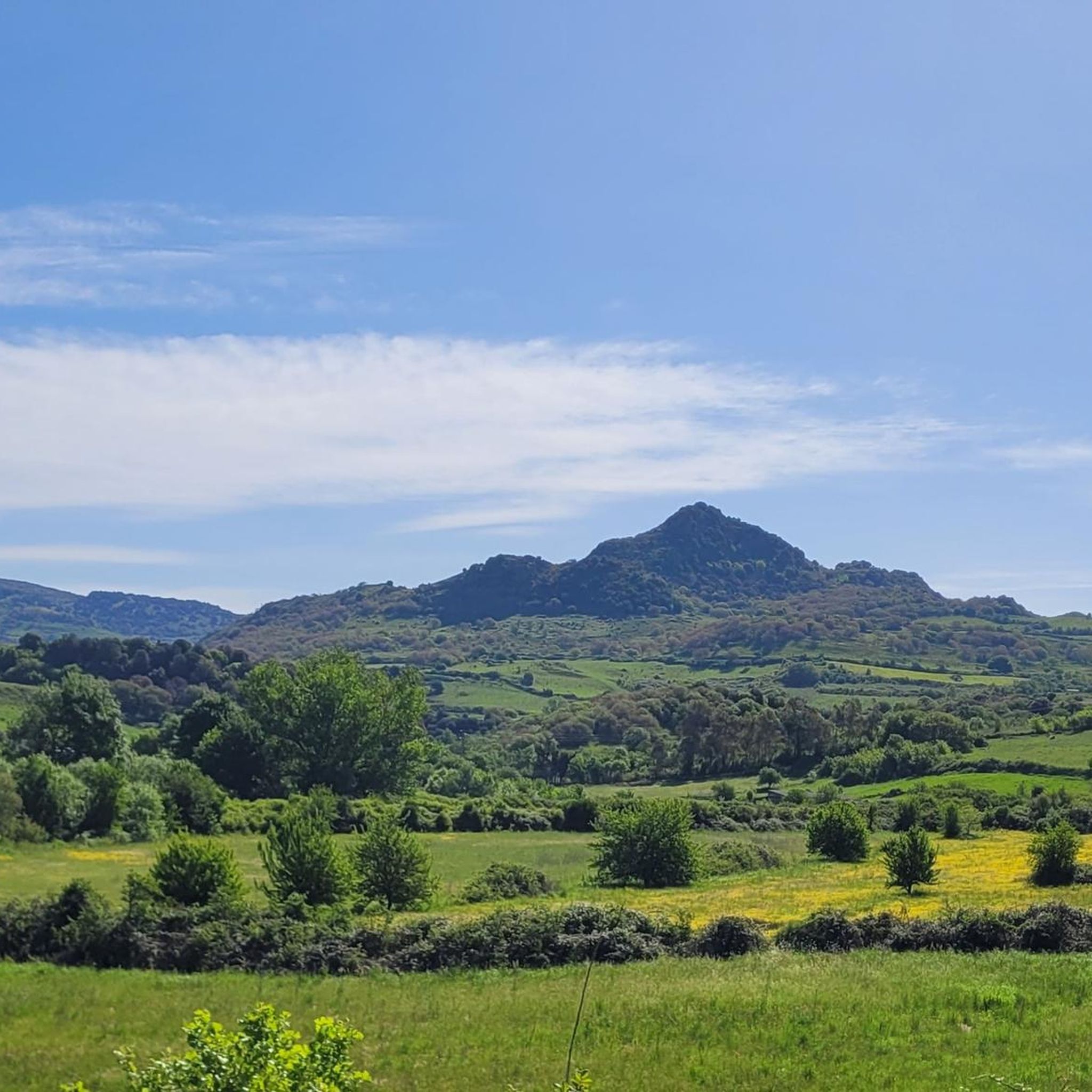
It is a basaltic massif located in the territory of the municipalities of Cossoine, Giave and Mara, in north-western Sardinia. Rich in gorges, cliffs and caves, the relief reaches a height of 717 meters and dominates a vast stretch of territory in the province of Sassari.
0
1

The monument, a small cult spring from the Nuragic period, consists of an atrium and a small cell where the vein of the spring is collected. The paved rectangular atrium (5.15 x 1.80 m) has seating along the walls (height 0.30 m; width 0.40 m) and a small alcove. The masonry (height 2 m; width 3 m) consists of regular rows of carefully squared basalt blocks. From the atrium one enters the small cell through an entrance with a trapezoidal light (0.65 m wide; 0.64 m high) obtained in a monolithic slab. The small room (diameter 0.97 m; height 1.60 m), built of roughly worked but carefully joined blocks of basalt, has a "tholos" roof closed by a large horizontal slab. In Christian times, a Latin cross was engraved on the underside of the end plate. The water flows through a channel carved into the sill of the entrance to the spring to a drainage channel built under the floor of the atrium itself. The settlement of the place lasted until late antiquity, as evidenced by coins from the fourth century. AD Found in the time of Taramelli while clearing the porch. Source: http://www.sardegnacultura.it/j/v/253?v=2&c=2488&t=1&s=21393
0
0

The nuragic complex of Tamùli is an important archaeological site dating back to the Middle Bronze Age. It is located at a height of 720 m, on the slope of Mount Sant'Antonio, where the Marghine chain joins the Montiferru and is part of the municipality of Macomer, in the province of Nuoro, which is about 5 km away. Source: https://it.wikipedia.org/wiki/Comlesso_archeologico_di_Tamuli
2
1

Tamuli Archaeological Area
4
1
Frequently Asked Questions
What unique natural features define the landscape around Semestene?
The landscape around Semestene is significantly shaped by its volcanic origins. You'll find features like Monte Benazzosu, described as an evocative volcanic crater, and a fertile valley carved by the Sa Orta and Sa Cariasa torrents. Another notable natural landmark is Pedra Mendalza, recognized as an 'Area of natural interest' for its ecological or geological importance.
Are there any historical sites with natural elements to explore near Semestene?
Yes, the region beautifully blends history with nature. The Sacred Spring of Su Lumarzu is a prime example, featuring a natural spring at its core within a well-preserved Nuragic archaeological complex. You can also visit the Tamuli Archaeological Site, known for its ancient Nuragic complex and unique betyls, or the Domus de Janas of Sant'Andrea Priu, ancient rock tombs carved into a trachyte wall.
Where can I find natural mineral water springs in the area?
You can visit the Su Mudeju Mineral Springs. These natural sources offer naturally carbonated water from multiple taps, providing a refreshing and unique natural experience.
Are there opportunities for hiking or walking near Semestene's natural monuments?
While specific hiking trails directly linked to the natural monuments are not detailed, the fertile valley and slopes of Monte Benazzosu offer potential for gentle walks. For more structured outdoor activities, you can explore various cycling and mountain biking routes in the broader area. Check out the MTB Trails around Semestene/Semestene or Cycling around Semestene/Semestene guides for nearby options.
What kind of views can I expect from viewpoints in the Semestene area?
From elevated points like Mount Traessu, you can expect panoramic views. This basaltic massif reaches 717 meters and dominates a vast stretch of territory in the province of Sassari, offering impressive vistas of gorges, cliffs, and the surrounding landscape.
Is the Semestene area suitable for family visits?
Yes, the area offers attractions that can be enjoyed by families. For instance, the Su Mudeju Mineral Springs are categorized as family-friendly, providing an accessible and interesting natural stop. Exploring the historical sites like the Sacred Spring of Su Lumarzu can also be an educational experience for older children.
What is the best time of year to visit the natural monuments around Semestene?
Given Sardinia's climate, spring (April-June) and autumn (September-October) are generally ideal. During these seasons, the weather is pleasant for exploring outdoor sites, with comfortable temperatures and lush landscapes after winter rains or before the peak summer heat. Summer can be very hot, making extensive outdoor exploration less comfortable.
Are there any cycling routes available near Semestene's natural monuments?
Yes, there are several cycling opportunities in the wider Semestene region. You can find various routes for different cycling types. For detailed options, refer to the Road Cycling Routes around Semestene/Semestene or Cycling around Semestene/Semestene guides.
What should I wear when visiting the natural monuments in Semestene?
Comfortable walking shoes are highly recommended, especially if you plan to explore any of the archaeological sites or natural features that might involve uneven terrain. Layered clothing is also advisable, as temperatures can vary, particularly during spring and autumn. Don't forget sun protection, such as a hat and sunscreen, especially during sunnier months.
How long should I plan for a visit to the natural monuments in Semestene?
To fully appreciate the blend of natural and historical sites, dedicating at least a full day is recommended. This allows time to visit a few key highlights like the Sacred Spring of Su Lumarzu, the Domus de Janas, and the Su Mudeju Mineral Springs, with time for travel between them and enjoying the scenic drives.
Can I bring my dog to the natural monuments around Semestene?
While specific regulations for each site vary, generally, many outdoor natural areas in Sardinia are dog-friendly, provided dogs are kept on a leash and owners clean up after them. For archaeological sites, it's best to check individual site rules or look for signage upon arrival. The Su Mudeju Mineral Springs, being an open natural area, is likely suitable for well-behaved dogs.
What makes the Sacred Spring of Su Lumarzu a significant natural monument?
The Sacred Spring of Su Lumarzu is significant because it's a small cult spring from the Nuragic period, where a natural water source is integrated into an ancient archaeological structure. It features an atrium and a small cell where the spring water is collected, all within a timeless landscape, showcasing a unique blend of natural and historical importance.
Most popular routes around Semèstene/Semestene
Most popular attractions around Semèstene/Semestene

Get inspired with the komoot mobile app


Explore more
Extend your search for the best caves by checking out these guides of the top ones around Semèstene/Semestene:
