Top 6 Castles around powiat żagański
Castles around powiat żagański offer a glimpse into the region's rich past in western Poland. This area is characterized by its historical significance and diverse architectural heritage. Visitors can explore a variety of historic estates, from grand palaces to ancient ruins. The landscape provides a fitting backdrop for these structures, inviting exploration of the region's history.
Best castles around powiat żagański
- The most popular castles is Iłowa Palace and Park, a castle that was built in the late Renaissance…
Last updated: October 19, 2026
Iłowa Palace and Park
Highlight • Castle
Translated by Google •
Tip by

Żagań Palace
Highlight • Castle
Translated by Google •
Tip by
Sign up now to discover places like this
Get recommendations on the best single tracks, peaks, & plenty of other exciting outdoor places.
Wiechlice Palace
Highlight • Castle
Translated by Google •
Tip by
Knight's Tower in Witków
Highlight • Historical Site
Translated by Google •
Tip by

Wichów Castle
Highlight (Segment) • Castle
Translated by Google •
Tip by

Ruins of Janowiec Castle
Highlight • Castle
Translated by Google •
Tip by

Start today with a free account
Your next adventure awaits.

Tips from the Community

The knights' tower in Witkowo is a unique building of this type in the Lubuskie region. According to available information, it was built in the second half of the 14th century. The vaults and walls on the ground floor remain from that time. On the first floor, there are remains of frescoes, of course related to religious themes. And generally, these two floors hide the most interesting things, and the appearance of the upper floors is the result of "so-called renovation works" after the war and does not really resemble medieval buildings. In front of the tower there is a single-storey building, slightly younger than it, because it dates back to the 15th century. This building is an outbuilding connected to the tower by an underground passage, although this passage dates back to the second half of the 20th century. Currently, the tower is inhabited by private individuals. A very nice couple will be happy to show you around the entire building, telling you its history in a very interesting way (for a small fee) "whatever you want". Rooms in the tower can be rented for a few days by prior arrangement.
2
0

The castle was built in 1462 using the walls of an earlier, knightly residential tower. In later centuries it was rebuilt and took on a more representative character. After World War II it became the seat of the State Agricultural Farm. In 1960 it burned down completely and was abandoned. It is currently in private hands, but there is no sign of any renovation work. It is just a decaying ruin.
2
0
The castle complex includes a defensive and residential tower, the remains of defensive walls with four towers and an entrance gate, and a moat. The facility is located in marshy areas, on an artificially built island reinforced with an oak grid. Probably there was a stronghold in this place before. The tower was built in the 14th century. Currently, the tower is in private hands and serves as an apartment and rooms for rent. Tours are possible. The friendly hosts will be happy to invite you inside and tell you about the history of this place.
1
0

It is worth visiting at any time of the year, but I recommend it most in summer or autumn.
0
0

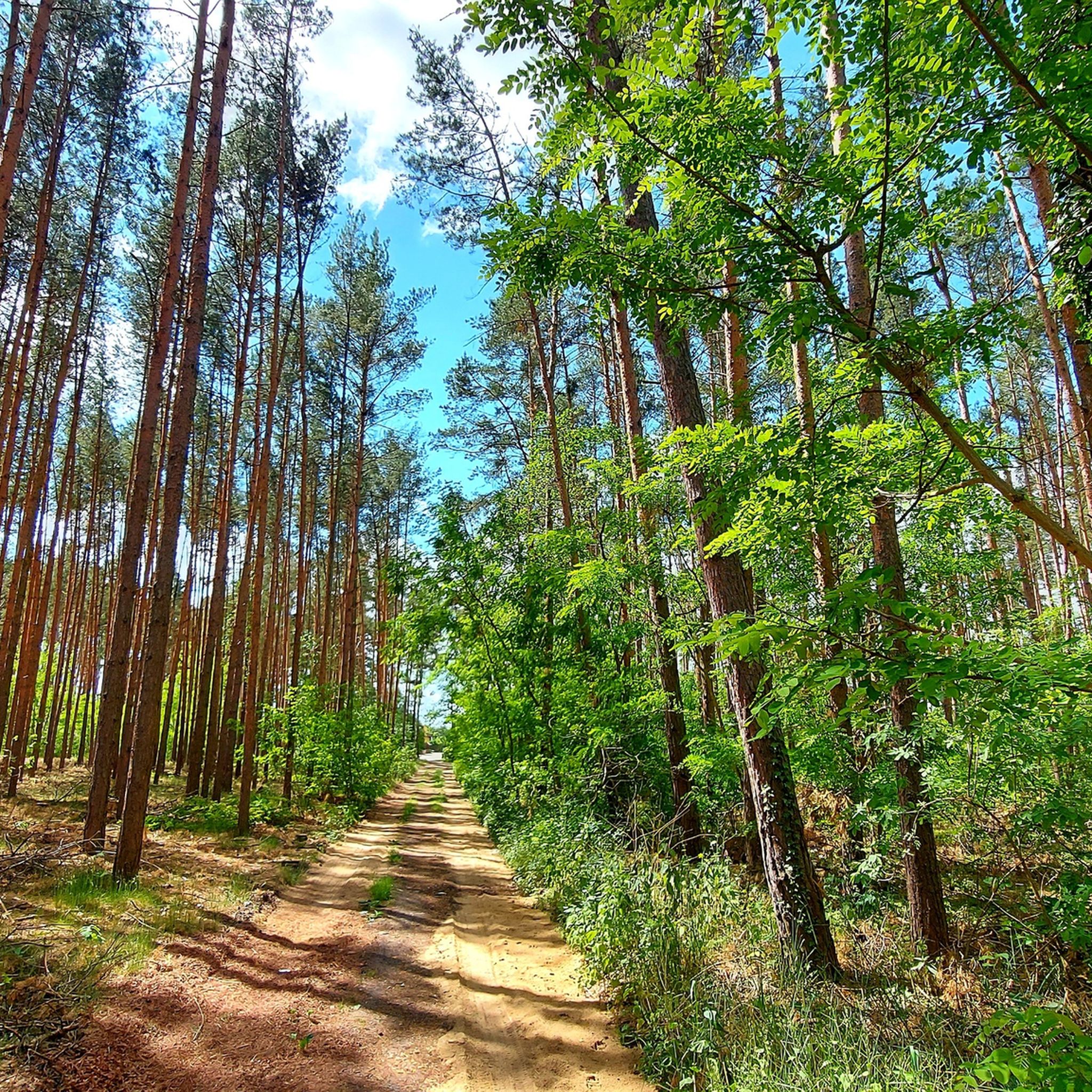
Bad Light: A beautiful route in terms of scenery but unfortunately the very poor condition of the road makes it very difficult to ride on a gravel bike. You should avoid this section if you are on a racing bike!
0
0

A castellan castle in Sagan is documented for 1202. It consisted of a wood-earth system. Apparently, a second castle complex soon existed, which was built by the Sagan Duke Konrad III in 1284. handed over to the Augustinian Canon Monastery, which had been relocated from Naumburg am Bober to Sagan that year. A third castle, to which today's castle goes back, located on the banks of the Bober, was sold in 1472 by Duke Hans II of Sagan to the House of Wettin. After a fire, this system was rebuilt for Duke Georg von Sachsen as an irregular four-wing system. After 1549 the castle was owned by the Habsburgs, who enfeoffed the von Promnitz with the rule. In 1627 the duchy was sold to Albrecht von Wallenstein by Emperor Ferdinand II. After his order, a four-wing new building was built under the direction of Vicenzo Boccacci using two existing castle wings, which is considered to be the first building of the early Baroque in Silesia. After Wallenstein's murder, the buildings were stopped. From 1646 Wenzel Eusebius von Lobkowicz was enfeoffed with the rule, who commissioned Antonio della Porta to complete the building with slight changes to the original plan. Wenzel Eusebius' grandson Philipp had the interior work done. From 1786, Duke Peter Biron von Kurland was in possession of the rulership, and had the interior of the palace redesigned in a classicist style. with stucco ceilings based on designs by Christian Valentin Schultze. Duke Peter also had an important art collection built. His daughter Louise Pauline had a chapel built in the east wing in 1839 according to plans by Leonhard Dorst von Schatzberg. Via the youngest daughter of Duke Peters, Dorothea von Sagan, the castle came to the Talleyrand-Périgord, who owned the castle even after the communist takeover of the region. However, when the Red Army moved in and in the late 1940s, the castle was completely looted. After repairs from 1965 to 1983, the castle serves as the city's cultural center. Source: Wikipedia
0
0
In 1626 Christian von Schellendorff had a palace built in the late Renaissance style on an island in the Tschirne (Czerna) with three storeys, a raised risalit and a tower tower. The main entrance with three arched portals was remarkably designed. From 1682 the barons of Promnitz were the owners, who redesigned the palace in Baroque style in 1712 and had a west wing added in 1720. After several changes of ownership, the castle was among other things. owned by von Kospoth, von der Recke and von Holleben. From 1902 Friedrich Maximilian von Hochberg was the owner, who in 1905 had the castle redesigned according to a design by Robert Weber. The central tower was given an onion helmet, the facade was redesigned in neo-baroque style, a reinforced concrete vestibule was placed in front of the portal, and the west wing was given an annex to the ballroom. Inspired by a trip to Asia, Friedrich Maximilian von Hochberg had the garden redesigned with several partial gardens. A Japanese garden with small watercourses and bridges between islets was laid out on an island in the Tschirne. From the castle to the west, the Chinese garden extends as a further partial garden, bounded by two backdrop-like clinker walls on a curved floor plan with round and oval window openings, which are intended to be reminiscent of Chinese moon gates. A path leads to the border of the garden, where a staircase and pagoda architecture crosses a street as a pedestrian bridge. Another area was the rose garden enclosed by an ornamental wall. From 1919 the von Alvensleben were the owners. Today the palace park has been extensively renovated. Source: Wikipedia Castle and castle park are accessible.
0
0
In 1538, Christoph von Kittlitz is named as the owner of the village. Possibly there was a manor house in the village in 1619. From 1718 to 1757 the von Stosch, then the von Studnitz and von Niebelschütz owners of the estate. Presumably by Georg Sigmund Neumann, today's late baroque palace was built from 1790 to 1795. Source: wikipedia. Today there is a hotel with a restaurant in the castle.
1
0
Frequently Asked Questions
What kind of historical architecture can I expect to see at the castles in Powiat Żagański?
The castles in Powiat Żagański showcase a rich architectural history. You'll find magnificent Baroque design at Żagań Palace, with its richly decorated facades. Iłowa Palace and Park began as a late Renaissance structure and later received Baroque redesigns. Chotków Manor is a fortified manor from the mid-16th century, also rebuilt in Baroque style. The Knight's Tower in Witków dates back to the 14th century, offering a glimpse into medieval defensive architecture.
Are there any family-friendly castles to visit in the Powiat Żagański region?
Yes, several castles in the region are suitable for family visits. Iłowa Palace and Park is noted as family-friendly, offering unique garden designs including Japanese and Chinese elements that can be engaging for all ages. Żagań Palace, with its extensive landscape park, also provides ample space for families to explore.
What are some unique features of the castles in Powiat Żagański?
The castles here boast several unique characteristics. Żagań Palace features distinctive mascarons inspired by Leonardo da Vinci's sketches and is surrounded by one of Silesia's most magnificent landscape parks. Iłowa Palace and Park is remarkable for its garden, redesigned with Japanese and Chinese elements, including moon gates. The Knight's Tower in Witków is a unique defensive and residential tower from the 14th century, built on an artificial island.
Can I explore the grounds and parks around the castles?
Yes, many castles in the region offer beautiful grounds and parks for exploration. Żagań Palace is set within an extensive and magnificent landscape park. The park at Iłowa Palace and Park has been extensively renovated and features unique Japanese and Chinese garden designs, perfect for a stroll.
Are there opportunities for outdoor activities like hiking or cycling near the castles?
Yes, the Powiat Żagański region offers various outdoor activities. You can find numerous hiking routes, including easy loops like the 'Ulica Warszawska – St. Dorothea Hospital Complex loop from Żagań' (6.2 km) or the 'Serene Stream – Bridge Over the Czerna loop from Żagań' (5.3 km). For cycling enthusiasts, there are gravel biking routes such as the 'Chrobry Oak – Intersection of Fire Roads loop from Przemków' (67.4 km). You can explore more options on the hiking guide or the gravel biking guide for the region.
Which castles offer a glimpse into the region's defensive history?
For insights into defensive architecture, Chotków Manor is an excellent example. Built in the mid-16th century, it was originally surrounded by embankments, a defensive wall with four bastions, and a moat. The Knight's Tower in Witków, a 14th-century defensive and residential tower, also provides a unique look at historical fortifications, including remains of defensive walls and a moat.
What is the best time of year to visit the castles in Powiat Żagański?
While castles can be visited year-round, spring and autumn offer pleasant weather for exploring the extensive parks and grounds. Autumn, in particular, can provide beautiful scenery with changing foliage. Summer is also popular, though it can be warmer. Winter visits might offer a different, quieter perspective, especially if you enjoy the serene atmosphere of historical sites in colder months.
Are there any castles that are less crowded or off the beaten path?
While Żagań Palace and Iłowa Palace and Park are popular, smaller sites like Chotków Manor or the Knight's Tower in Witków might offer a more intimate experience. The Ruins of Janowiec Castle, though largely abandoned, could also be considered off the beaten path for those interested in exploring historical remnants.
Can I find accommodation or places to rent rooms within a castle?
Yes, for a unique experience, the Knight's Tower in Witków is currently inhabited by private individuals who offer rooms for rent by prior arrangement. This allows visitors to stay directly within a historic 14th-century tower.
What happened to some of the castles in the region after historical events?
Many castles in the region have a complex history of ownership and transformation. For example, the Ruins of Janowiec Castle, after serving as the seat of a State Agricultural Farm, burned down completely in 1960 and was subsequently abandoned. Chotków Manor, after various owners and rebuilds, was partly renovated in the 1980s but its bastions are now in poor condition, requiring protection.
Are there any castles that have undergone significant renovation?
Yes, the park at Iłowa Palace and Park has been extensively renovated, restoring its unique Japanese and Chinese garden designs. Żagań Palace, while maintaining its Baroque splendor, functions as a cultural center, indicating ongoing preservation and use.
What are the historical origins of the castles in Powiat Żagański?
The castles in Powiat Żagański have deep historical roots. Żagań Palace was built on the site of a former Piast castle dating back to the 13th century. The Knight's Tower in Witków was constructed in the second half of the 14th century. Many estates, like Chotków Manor, have medieval origins and were later rebuilt or fortified in subsequent centuries.
Are there any castles that are currently in private hands?
Yes, some historical sites in the region are privately owned. The Knight's Tower in Witków is currently inhabited by private individuals who also offer tours and rooms for rent. Chotków Manor is also in private hands, as are the Ruins of Janowiec Castle, though no renovation work is currently visible there.
Most popular routes around powiat żagański
Most popular attractions around powiat żagański

Get inspired with the komoot mobile app


Didn’t find what you were looking for?
Explore powiat żagański’s best castles region by region:
Explore more
Looking for the best castles somewhere else? Discover other guides around powiat żagański:
