Top 4 Castles around Ronsenac
Best castles around Ronsenac offer a glimpse into the rich history and architecture of the Charente department. The vicinity of Ronsenac features a diverse landscape, providing a setting for historical sites. Visitors can explore various architectural styles, from grand manor houses to medieval fortresses. These historical structures are situated within the natural environment of the area.
Best castles around Ronsenac
- The most popular castles is Château de la Mercerie, a castle known for its dazzling white stone facade extending…
Last updated: June 24, 2026
Château de la Mercerie
Highlight • Castle
Translated by Google •
Tip by

Château de Torsac
Highlight • Castle
Translated by Google •
Tip by
Sign up now to discover places like this
Get recommendations on the best single tracks, peaks, & plenty of other exciting outdoor places.
Sign up for free
Château de Villebois-Lavalette
Highlight • Castle
Translated by Google •
Tip by
The Breuil Tower
Highlight • Castle
Translated by Google •
Tip by
Montmoreau Castle
Highlight • Castle
Montmoreau is a new French commune located in the Charente department, in the Nouvelle-Aquitaine region. It was created on …
Translated by Google •
Tip by

Start today with a free account
Your next adventure awaits.
Login or Signup

Tips from the Community

The Tower is difficult to visualize; you must stay in the castle, which offers guest rooms, to access it.
0
0
Montmoreau Castle is in the new commune of Montmoreau in Charente Montmoreau is a new French commune located in the Charente department, in the Nouvelle-Aquitaine region. It was created on January 1, 2017 from the merger of Montmoreau-Saint-Cybard, Saint-Amant, Saint-Eutrope, Saint-Laurent-de-Belzagot and Aignes and Puypéroux. Montmoreau Castle stands at the top of a natural hill overlooking the Tude Valley. In the centuries of instability and disorder that followed the collapse of Roman Gaul, the invasion of the Arabs from Spain around 700 and the Viking raids in 844 added to the anxiety of the populations of our region. Then the disintegration of the Carolingian empire led to a dispersion of the centers of power from which feudalism would be born. This is why the 10th and 11th centuries were a time when a large number of fortified entrenchments or camps were established, often built on "castral mounds", which are at the origin of many of today's "castles". The hill of Montmoreau offered in a way a perfect natural mound for the construction of what was probably at first a simple fortified camp and became a feudal castle in the 11th century. It occupied the platform and was provided with a double fortified enclosure. The two round towers of the current building belonged to the feudal castle. Likewise the porch chapel, Notre-Dame chapel, which was located in the first enclosure. But excavations would surely reveal traces of other remains. The current castle was built on this same site in the middle of the 15th century, perhaps by Guy de Mareuil, lord of Montmoreau, Villebois and Mareuil. With the exception of the two feudal towers, the entire building is partly Gothic and partly Renaissance. It is a perfect witness to this pivotal period between a world that was ending and a world that was beginning. Over the centuries, it seems that the various lords and then owners of the castle never had enough money to add buildings from different periods to the building, as can be seen in so many other castles. Preserved almost intact since its construction, the castle of Montmoreau therefore offers an architectural heritage of exceptional purity. The renovations carried out by the current owner aim, by reinforcing the solidity of the buildings, to restore the original aspects under the few modifications that have been made. Towards the east, overlooking the Tude valley, the castle displays a façade that looks great with its high main building flanked by the two round feudal towers and its sloping roofs of flat tiles from which the chimneys emerge. On the side of the north tower, about halfway up, we can make out an old door that opened onto the castle's patrol path. The Gothic gables of the central body bristle with stone plant crosiers. Their bases are seated on two sculptures of "intimidating lions", one opening its mouth to the north, the other to the south, and they are crowned by a finial. To the north and south, a pavilion leans against the gable. The southern one has just regained its original three-sided roof. Towards the west, the façade that faces the park also mixes eras. The mullioned Renaissance windows retain civil Gothic motifs. The hexagonal tower of the staircase projects from the façade. It has a very beautiful door in flamboyant Gothic style, with a tympanum sculpted with prismatic ribs and intertwined foliage practically erased by the erosion of time. But if you look closely, you can make out a bird in profile among the foliage on the right side. Perhaps the signature of the stonemason artist. In the corner of this tower and the façade, stands a watchtower with a pointed bell tower made of chestnut essentes (a type of shingle) whose base in a "cul-de-lampe" is completely in the Renaissance style. Source: https://montmoreau.fr/index-module-orki-page-view-id-116.html#:~:text=L'%C3%A9difice%20a%20%C3%A9t%C3%A9%20class%C3%A9,%C3%A9difice%20par%20la%20nef%20porche. https://fr.wikipedia.org/wiki/Ch%C3%A2teau_de_Montmoreau https://monumentum.fr/monument-histoire/pa00104431/montmoreau-chateau
0
0

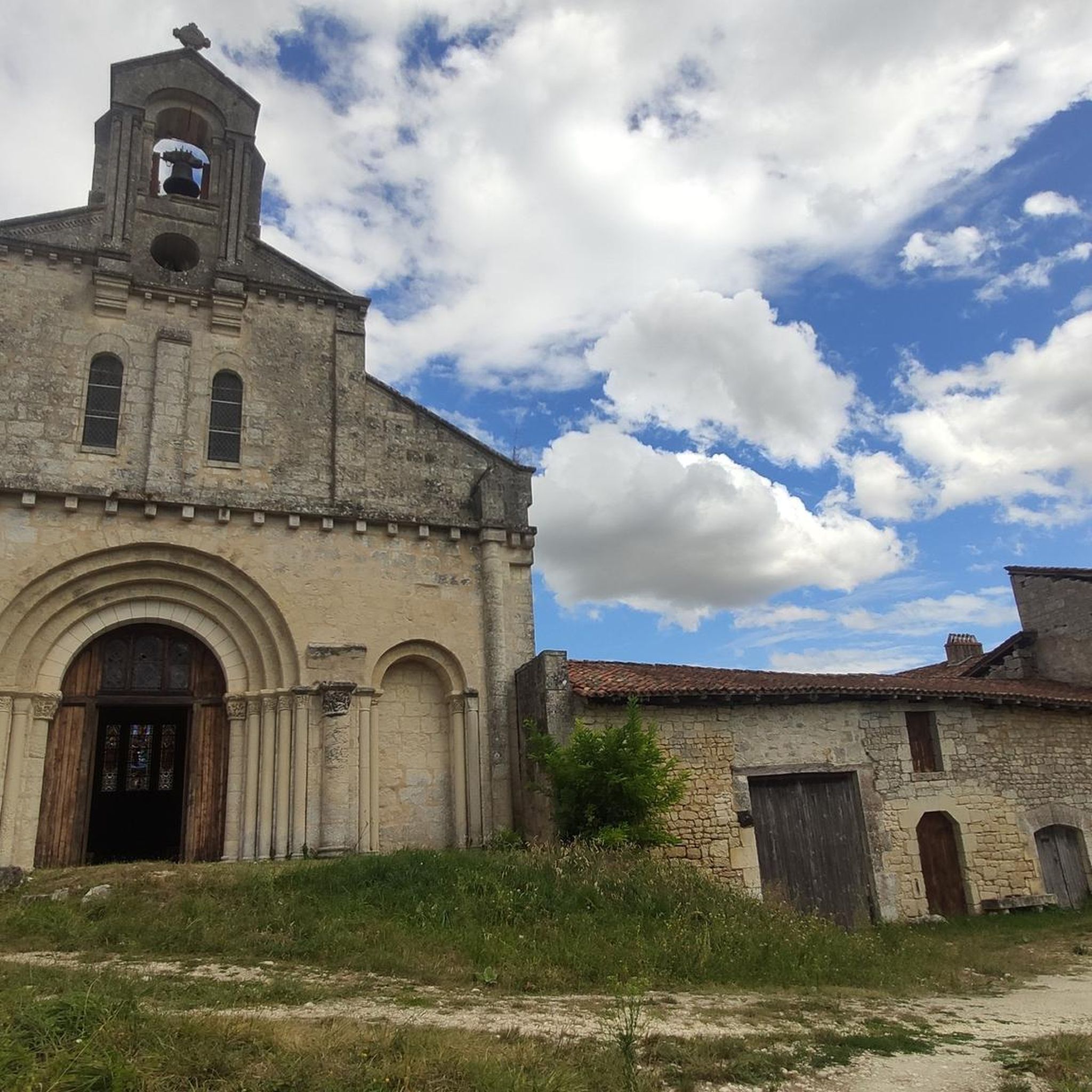
Magnificent little Charentais village, with a small church and its garden
0
0

The extraordinary history of this grandiose residence began in 1924, in the heart of a small 19th century manor (to the left of the current façade): the troubadour castel of La Mercerie was then acquired by Alphonse and Raymond Réthoré. From then on, the two brothers, dreaming of the great Versailles, devoted all their resources to enlarging and embellishing the building. The work undertaken is commensurate with the ambition that drives it. Outside, colonnades and balusters in white stone soon extend the first building. the cut stone increases the gigantism and the rigor of a facade with a perfect rhythm. Inside, nothing is too beautiful for La Mercerie, Raymond brings back from his travels furniture and paintings, chandeliers and precious woods, marbles from Italy, azulejos from Portugal etc. He returns from Italy with a painter sculptor who will carry out on the spot the most monumental decorations with the assistance of the inhabitants of the country. The treasures are piling up, but 30 years of work will not be enough to complete the colossal project. The collections are dispersed during auctions in June 1987. When the two brothers died, the castle fell into oblivion, until the mobilization of the inhabitants of the town, who decided to found an association to safeguard this unique and prestigious heritage. The Béruges room, the central living room, the Vernet living room, the vestibule, the mahogany gallery and the large Azulejos gallery, each more impressive than the last, now fully conquers the visitor eager for cultural discoveries. A short tour of the belvedere of the castle allows you to admire it from the height. In the park of the castle, the rose garden and the arboretum can be visited by little train. The little train is random due to the health context and will be reserved for people with reduced mobility and children, and mainly on Sundays.
0
0

Pretty castle in height after a climb from Angoulême
1
0
The tower was built in the 15th century. The keep is a strong square tower that may date from the end of the 14th or the beginning of the 15th century. The defensive walls are made of cut stone. The machicolations are intact. Only the walkway is damaged to the east. Inside, the rooms and the original staircase no longer exist. The small chapel has remains of frescoes from the beginning of the 15th century or perhaps from the 14th (knight; Saint Michael; Saint Christopher; king; horsewoman...). The remains of the tower buildings were remodeled in the 19th century.
2
0
Villebois-Lavalette castle is a real citadel overlooking the village of Villebois-Lavalette. Surrounded by a fortress with seven towers, it stands between Charente and Périgord. A medieval atmosphere floats at its approach. This medieval castle more than a thousand years old, with exceptional architecture, overlooks a charming village labeled "Small City of Character" and "capital of Cornuelle". In 1980, this old citadel was crumbling under ivy, brambles and time, a dynamic was set in motion for its restoration for 18 years. In 2000, Mr. Norbert FRADIN, promoter and patron from Bordeaux passionate about heritage and its preservation, became the owner. He is working to restore it to give it back its superb appearance, its impressive enclosure bristling with seven towers finally reveals its secrets. Something to delight all curious young and old, as well as history lovers.
1
0
Its dazzling white stone facade extends over 220 meters in length, in the middle of a 50 Ha green setting. Some rare and remarkable trees adorn the walk through the park.
2
0
Frequently Asked Questions
What unique architectural features can I find among the castles near Ronsenac?
The castles near Ronsenac showcase diverse architectural styles. For instance, Château de la Mercerie is known for its dazzling 220-meter white stone facade, often called the 'Little Versailles of Charente'. Château de Torsac retains 13th-century elements like truncated rectangular towers and vaulted rooms, with 19th-century battlements. Château de Villebois-Lavalette is a medieval citadel with seven towers, reflecting over a thousand years of history. Montmoreau Castle features a double fortified enclosure and two round towers from its 11th-century feudal origins, alongside 15th-century Gothic and Renaissance elements.
Are there family-friendly castles to visit near Ronsenac?
Yes, Château de Villebois-Lavalette is highlighted as family-friendly. Its impressive fortress with seven towers and medieval atmosphere can delight both curious young and old visitors, offering a captivating historical experience.
Can I find scenic viewpoints at castles around Ronsenac?
Absolutely. Château de Villebois-Lavalette is a medieval castle and viewpoint, offering commanding views over the village. Montmoreau Castle, perched atop a natural hill overlooking the Tude Valley, also provides scenic vistas. A short tour of the belvedere at Château de la Mercerie allows you to admire it from a height.
What outdoor activities can I do near these castles?
The area around Ronsenac offers various outdoor activities. You can find numerous running trails, such as the 'Running loop from Ronsenac' or the 'Villebois-Lavalette Castle loop'. For cycling enthusiasts, there are routes like the 'Château de Villebois-Lavalette depuis Villebois loop' and the 'Montmoreau Castle loop'. Mountain biking trails are also available, including the 'Mountainbike loop from Villebois-Lavalette'. You can explore more options on the Running Trails around Ronsenac, Cycling around Ronsenac, and MTB Trails around Ronsenac guide pages.
What is the best time of year to visit the castles around Ronsenac?
While specific seasonal recommendations for castles are not provided, the region's green parks and natural settings suggest that spring and summer offer pleasant conditions for exploring the grounds. Autumn could provide beautiful foliage, and winter visits might offer a different, quieter perspective, especially for fortified castles.
Is there parking available at the Château de la Mercerie?
The provided information does not explicitly detail parking facilities for visitors at Château de la Mercerie. It is advisable to check their official website or contact them directly for current parking information before your visit.
What kind of natural surroundings can I expect at these castle sites?
Many castles near Ronsenac are set within beautiful natural environments. Château de la Mercerie is situated within a 50-hectare green park featuring rare and remarkable trees. Montmoreau Castle is perched on a natural hill overlooking the Tude Valley, offering a picturesque setting. These natural surroundings enhance the walking experience and provide a serene backdrop to the historical structures.
Are there any lesser-known or 'hidden gem' castles worth exploring near Ronsenac?
While the main highlights are well-known, The Breuil Tower offers a unique historical experience. This 15th-century keep features intact machicolations and remains of 15th-century frescoes in its small chapel. It's noted that you typically need to stay in the castle, which offers guest rooms, to access it, making it a more exclusive discovery.
What do visitors particularly enjoy about the castles near Ronsenac?
Visitors appreciate the rich history and diverse architecture of the castles. The grandeur of places like Château de la Mercerie with its impressive facade, and the medieval atmosphere of Château de Villebois-Lavalette, are often highlighted. The komoot community has shared 7 photos and given 19 upvotes, indicating a strong appreciation for these historical sites and their scenic settings.
Can I visit castles near Ronsenac during winter?
Information regarding specific winter opening hours for each castle is not provided. While the exterior of fortified castles can be impressive in winter, it's recommended to check the individual castle websites for their winter operating schedules, as some may have reduced hours or closures during the off-season.
Are the castle grounds generally accessible for visitors with mobility concerns?
General accessibility information for all castle grounds is not specified. However, the arboretum and rose garden at Château de la Mercerie can be visited by a little train, which is reserved for people with reduced mobility and children, especially on Sundays. For other castles, it's best to inquire directly about their specific accessibility features.
Are there dog-friendly walking trails around the castles?
The guide does not explicitly state which specific walking trails around the castles are dog-friendly. It's generally advisable to check local regulations or contact the individual castle sites regarding their pet policies for both the grounds and any nearby trails.
Most popular attractions around Ronsenac

Get inspired with the komoot mobile app


Explore more
Looking for the best castles somewhere else? Discover other guides around Ronsenac:
