Top 6 Caves around Ginosa
Best caves around Ginosa are found within the Gravina di Ginosa, a dramatic ravine in Puglia, Italy. This area is known for its ancient rock-cut settlements and cave dwellings, offering insight into centuries of human habitation. The region's unique geology has allowed for the creation of sophisticated cave homes and rock churches. Ginosa provides a tangible connection to historical periods and architectural ingenuity.
Best caves around Ginosa
- The most popular caves is Grotta Croce in Laterza, a cave that…
Last updated: August 23, 2026
Grotta Croce in Laterza
Highlight • Cave
Translated by Google •
Tip by

Gravina di Ginosa Cave Dwellings
Highlight • Cave
Translated by Google •
Tip by

Sign up now to discover places like this
Get recommendations on the best single tracks, peaks, & plenty of other exciting outdoor places.
Sign up for free
Rock Church of Santa Sofia
Highlight • Religious Site
Saint Sofia is identified in hagiographical tradition with the figure of Sofia of Milan, the mother of Saints …
Tip by

Sanctuary of Madonna della Loe and Rock Settlement
Highlight • Religious Site
Translated by Google •
Tip by

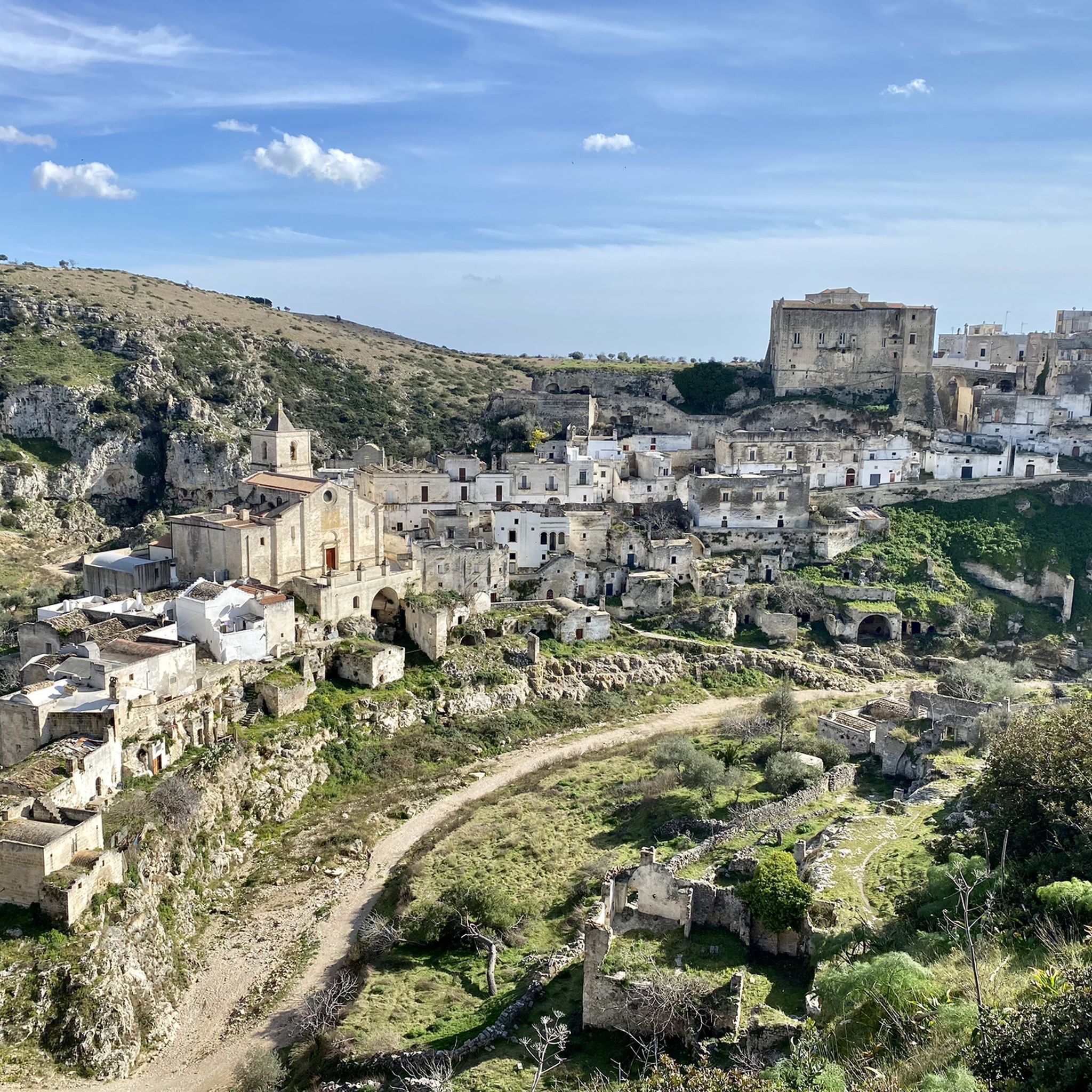
View of the Rock Village Rione di Rivolta
Highlight • Historical Site
Tip by
Sign up for free to discover even more caves around Ginosa.
Sign up for free
Already have an account?
Start today with a free account
Your next adventure awaits.
Login or Signup
Tips from the Community

The rock church of Saint Sofia comes with two beautiful Byzantine frescoes. Saint Sofia is identified in hagiographical tradition with the figure of Sofia of Milan, the mother of Saints Faith, Hope and Charity, whose veneration is attested for the sixth century. However, there are conflicting hagiographical traditions; one tradition makes Sofia herself a martyr under the Diocletian Persecution (303/4). This conflicts with the much more widespread hagiographical tradition (BHL 2966, also extant in Greek, Armenian and Georgian versions) placing Sofia, the mother of Faith, Hope, and Charity, in the time of Hadrian (second century) and reporting her dying not as a martyr but mourning for her martyred daughters.
0
0
Along the sides of the ravine as it snakes its way around the town are the ruins of rock-cut settlements so distinctive of Ginosa. These are the settlements of people who cut their houses and churches into the rock. There are two parts of the rock village: Rione Casale and Rione di Rivolta. Travel Guides by Experienced Archaeologists & Historians Destinations • Europe • Italy Travel Guide • Puglia • Ginosa Historic Landmarks Facebook-f Twitter Pinterest 5 Historical Landmarks that Tell the Stories of Ginosa Discover the stories of a town in southern Italy where the inhabitants were living in rock-cut caves for centuries; from the time of the Romans to the not so distant past. Ginosa – a town off the beaten track, even for Puglia. Thomas Dowson Last Checked and/or Updated 15 December 2021 No Comments Italy Travel Tips & Ideas Like many towns in Puglia, Ginosa owes its fascination to its geographical location as much as its history. Both the physical and historical aspects of the town are immediately visible. In fact the two are intertwined, and have been for centuries. Many, many thousands of years ago a u-shaped bend in a river, as it meanders its way towards the Gulf of Taranto (about 20km away), created a spur of land that has obviously been very attractive to successive inhabitants of Ginosa. Over the centuries people have built on this spur and in the horseshoe-shaped ravine giving Ginosa its distinctive character today. These five historical landmarks are a great way to discover that character. Peucetian Funerary Structure Perhaps not as prominent as some of the other landmarks, but significant nonetheless. On the edge of the square in front of the town hall are the oldest remains of human habitation on view in Ginosa. Just below street level and underneath a row of holm oak trees is a series of Peucetian tombs, left exposed and visible through glass covers. Little is known about the Peucetians. They are one of three Iapygian populations that occupied what is Puglia today; the other two being the Daunians and Messapians. Some archaeologists have suggested that the Iapygians are descendants of the Illyrians, who crossed the Adriatic Sea and settled in southern Italy during the 9th century BC. Whatever their origins, artefacts excavated by archaeologists show they were in close contact with the nearby Greek colonies, such as Metaponto and Taranto. It was the Roman defeat of these Greek colonies in southern Italy in the Phyrric War (280 to 275 BC) that lead to the incorporation of the region into the Roman Republic. During the construction of the square in front of the Ginosa’s town hall, builders came across a Peucetian funerary complex. The necropolis was excavated by archaeologists and left open, but covered with protect glass structures to enable people to see the different types of tombs. One limestone sarcophagus stands above ground on the square; a few others can be seen in their original place within the tombs. Troglodyte Village Along the sides of the ravine as it snakes its way around the town are the ruins of rock-cut settlements so distinctive of Ginosa. These are the settlements of people who cut their houses and churches into the rock. The best place to visit these dwellings is on the eastern side of the town, in the Rione di Rivolta. Towards the end of the 5th century AD when the Roman Empire came under attack from the Goths and other Germanic tribes attacking Rome, the open plains were no longer safe. And it was then that people sought refuge in the relatively safer ravines. The soft, limestone bedrock made it easy to cut into the sides of the ravines to create places to live that were easier to protect against the Goths to begin with, but also the Saracens later. Over the turbulent centuries of the Middle Ages that followed the fall of the Western Roman Empire fully developed communities emerged in these ravines. These early Medieval troglodytes ‘built’ surprisingly complex villages simply by cutting into the rock at different levels. Besides creating domestic spaces – Casa Grotto (cave house), they also cut churches into the sides of the ravines. They also cut channels and cisterns into the rock to supply water.
0
0

Grotta Croce, located in Gravina di Laterza, is one of the many karst caves in this suggestive canyon in Puglia. Famous for its natural beauty and historical interest, the cave offers spectacular limestone formations. Explored by speleology enthusiasts and hikers, it is part of the Terra delle Gravine Natural Park, an area rich in biodiversity and characterized by deep ravines and hidden caves. Grotta Croce also has archaeological value, with finds that testify to human presence in ancient times.
1
0

Grotta Croce is a natural cavity located in the ravine of Laterza, a deep canyon dug by the river Lato. The cave has a shape resembling a Greek cross and a vault 9 meters high, and is inhabited by many birds, such as kestrels and swifts. It is part of the Lipu Oasis, a protected area for nature conservation
2
0

Take a long walk through this valley with the many cave dwellings. You can easily walk back to the starting point through the village.
0
0
Cave settlement with more very many cave dwellings. Highly recommended, take your time and enjoy this journey into the past without the usual tourist hype.
0
0

The rock settlement of the Loe. La Loe is a torrential shaft that flows into the Gravina at the level of the Pianelle district. Around the canal there are 4 churches and various hypogea, stables and sheepfolds. The group of churches could constitute a monastic settlement of the lauriotic type, organized around a central church, the sanctuary of the Madonna della Murgia or a small rupestrian farmhouse in which, in several phases, several churches follow one another. The structures identified so far in the gully are the crypt of the Canarino, of the Scaletta, of S. Andrea, the sanctuary of the Madonna della Murgia or della Loe; a Neolithic settlement, a considerable number of cisterns, three early medieval necropolises (casket, hypogeum, arcosolium), a defensive wall, a demic settlement, remains of dry construction of the inverted cone type, small tuff and the suggestive road system access.
0
0

The Gravina di Ginosa develops around two villages, the Casale and the Rivolta, the latter consisting of over sixty cave houses arranged on five superimposed levels and connected to each other by stairs and paths. On the highest shelf of the Revolt there is the Church of the Santi Medici in which an Ecce Homo is painted while in the center of the two villages there is the Mother Church built on an ancient necropolis and with inside original representations dating back to 1600: suggestive the authentic painting with the very rare representation of pregnant Mary and another of Mary in childbirth.
1
0
Frequently Asked Questions
What makes the cave dwellings around Ginosa historically significant?
The caves around Ginosa offer a tangible connection to prehistoric times, with evidence of human presence for over 800,000 years in the wider Apulian cave system. These rock-cut settlements, like those in Rivolta and Casale, were inhabited until as recently as the 20th century, showcasing centuries of human adaptation and ingenuity.
What can I expect to see at the Rivolta rock village?
The Rivolta settlement is considered one of Italy's most important rock villages. It features 66 cave houses arranged on five levels, interconnected by steps. These homes were ingeniously designed with features like chimneys, cisterns for water collection, ovens, and cellars, often with southern exposure for warmth. You can get a good view of this area from the View of the Rock Village Rione di Rivolta.
Are there any rock churches with frescoes in the Ginosa area?
Yes, the Casale area, opposite Rivolta, is known for several frescoed cave churches and crypts. The Rock Church of Santa Sofia remains accessible and showcases remnants of Byzantine frescoes and altars, providing a glimpse into the region's artistic past.
What kind of natural features can be found in the caves around Ginosa?
The caves are primarily located within the dramatic Gravina di Ginosa, a deep ravine. You can find natural cavities like Grotta Croce in Laterza, which has a unique Greek cross shape and a 9-meter high vault. This cave is also inhabited by various birds, such as kestrels and swifts, and is part of a protected nature conservation area.
What outdoor activities can I do near the caves of Ginosa?
The Ginosa area, being part of the Terra delle Gravine Natural Park, offers various outdoor activities. You can explore mountain biking trails, with options like the 'Gravina Stream of Matera loop from Ginosa' or 'Castelletto di Ginosa – Laterza loop from Ginosa'. For running, consider routes like the 'Sentiero Italia: Gravina di Laterza Loop'. You can find more details on these activities in the MTB Trails around Ginosa and Running Trails around Ginosa guides.
Are the caves around Ginosa suitable for families with children?
Exploring the ancient cave dwellings and rock-cut settlements can be a unique and educational experience for families. The largely untouched nature of these sites provides a sense of discovery. While some areas might require careful navigation, the historical and architectural aspects are engaging for all ages. Specific family-friendly trails or access points should be checked locally.
What is the best time of year to visit the caves in Ginosa?
The caves and rock settlements are generally accessible year-round. However, spring (April-May) and autumn (September-October) offer pleasant temperatures for exploring the outdoor sites and ravines. Summers can be hot, and while the caves themselves offer some respite, outdoor walking might be less comfortable. Winter can be cooler and potentially wetter.
Where can I see a rock complex developed on multiple levels?
You can admire the rock complex including the View of the Rock Church of San Nicola all’Ofra. This religious building is developed on several levels and is literally embedded in the rock, offering a unique architectural sight within the ravine.
Are there any monastic settlements or ancient churches to explore?
Yes, the Sanctuary of Madonna della Loe and Rock Settlement includes a group of churches and various hypogea, stables, and sheepfolds. This area could have constituted a monastic settlement of the lauriotic type, organized around a central church, the sanctuary of the Madonna della Murgia, or a small rupestrian farmhouse.
What should I know about accessing the cave areas in Ginosa?
The caves and rock settlements are largely within the Gravina di Ginosa. While efforts are underway to develop tourism infrastructure, many areas retain an authentic feel. Access to specific sites like the rock churches or cave dwellings might involve walking on uneven terrain. Parking is generally available in Ginosa town, and from there, you can access the ravine areas.
What kind of architectural ingenuity is evident in the Ginosa caves?
The cave houses demonstrate remarkable adaptation to the environment. They feature sophisticated designs, including systems for collecting rainwater through cisterns, chimneys for ventilation, ovens, shelves, and cellars. Their southern exposure was also strategically utilized to keep the homes warm during winter, showcasing a high level of ingenuity.
Most popular attractions around Ginosa

Get inspired with the komoot mobile app


Explore more
Extend your search for the best caves by checking out these guides of the top ones around Ginosa:
