The best gravel rides around Vert-En-Drouais
15
riders
5
rides
Gravel biking around Vert-En-Drouais features a landscape characterized by extensive forested areas, river valleys, and tranquil waterscapes. The region includes the Forêt de Dreux, offering numerous unpaved paths suitable for gravel cycling. Routes often follow the Vallée de l'Eure and pass by structures like the Aqueduc de l'Avre. The terrain also includes rolling hills and country lanes, providing a mix of surfaces for varied gravel bike trails.
Best gravel bike trails around Vert-En-Drouais
- The most popular gravel bike trail is…
Last updated: June 30, 2026
5
riders
42.7km
03:19
280m
280m
Hard gravel ride. Good fitness required. You may need to push your bike for some segments of this route.
5
riders
37.0km
02:42
310m
310m
Moderate gravel ride. Good fitness required. Mostly paved surfaces. Suitable for all skill levels.

Sign up for free
2
riders
28.9km
01:48
210m
210m
Moderate gravel ride. Good fitness required. Mostly paved surfaces. Suitable for all skill levels.
1
riders
38.6km
02:19
160m
160m
Moderate gravel ride. Good fitness required. Mostly paved surfaces. Suitable for all skill levels.
1
riders
Moderate gravel ride. Good fitness required. Mostly paved surfaces. Suitable for all skill levels.
Our route recommendations are based on thousands of hikes, rides, and runs completed by other people on komoot.
Start today with a free account
Your next adventure awaits.
Login or Signup



Tips from the Community

Abondant is located in the Eure Valley, in the immediate vicinity of the Dreux national forest and the important Château de Sourches, which was extensively transformed in the 19th century, and whose grounds were designed by the Duchênes. It appears that the extensive work carried out on the church in the 16th and 18th centuries was due to the generosity of this family. The current Saint-Pierre church succeeds a 12th-century building that was under the control of the canons of Saint-Étienne de Dreux and later the monks of Notre-Dame du Bec. Thanks to parish registers, the dates of its construction are precisely known: in 1508, the roof frame was raised; in 1516, construction continued thanks to donations from Pierre de Guerry, then lord of Abondant; in 1548, the erection of a 60-meter bell tower, which was topped with a cross in 1549. The dedication ceremony by the Bishop of Meaux did not take place until 1604. In the same year, a brotherhood of Charity was created under the patronage of Saint Sebastian and Saint Barbara, which remained
0
0
The Church of Saint-Pierre stands in the middle of the village, surrounded by the former cemetery area, which has been transformed into a grassy mound. On the north side, it is dominated by a large three-story stone bell tower. The western façade is preceded by a very rustic enclosed porch. The church consists of a single nave extended by a choir and a five-sided apse. The chapel, which occupies the base of the bell tower to the north, and the south chapel form a false transept. The church is built of flint rubble; the quoins, bands, cornices, and buttresses are made of sandstone. The interior of the building is covered with beautiful wainscoting, with battens, entirely redone based on the original layout above the nave. The radiating wainscoting of the apse is highlighted with a black geometric decoration painted on either side of the battens. The sculpted beams of the roof structure were preserved and placed on the new beams. The 18th-century waxed wooden high altar is decorated with a Crucifixion embroidered on fabric, possibly replacing a painting. The statues of Saint Peter and Saint Paul were placed in the niches to the left and right of the central altarpiece. The church has enclosed wooden pews that have been restored. When the pews were removed, gravestones were unearthed in the floor; they were photographed and drawn. A stone statue with a separated body and head was discovered in the thickness of a wall: it is Saint Peter wearing the papal tiara. During World War II, the bombing of a train stopped at the station destroyed the stained-glass windows, which were of varying value; however, one of them, dating from the 16th century, was listed. In 1948, the Bernard Campin workshop in Chartres was hired to renovate all the windows, in the style of the 1930s. Drainage work, masonry, timber framing, and roofing were carried out throughout the building, the most significant of which was the restoration of the paneled vault. The Sauvegarde de l'Art Français (French National Art Protection Agency) awarded €10,000 in grants in 2005.
0
0

Travel the Eure Valley from Montreuil to Fermaincourt for a scenic ride along quiet country roads. The route passes through charming villages, lush green meadows and peaceful stretches of the Eure River. You'll enjoy gentle slopes that make the ride enjoyable and relaxing, with plenty of places to stop and admire the picturesque countryside.
1
0
Saint-Pierre Church. The village is spread out over the Douze valley. The church, of large dimensions, is composed of two chronologically distinct parts: a Romanesque nave and, on the other hand, a false transept and a 16th century choir. Although the nave is not vaulted, it is supported by three almost flat buttresses which divide it into three "bays". The oldest parts of the construction seem to be the western part of the nave and a portion of the herringbone wall. The hypothesis of the Drouais and Thimerais Archaeology Society would be that the choir and the south chapel date from the 15th century and the north chapel from the 16th century. According to the Archaeological Society of Eure-et-Loir, all the transformations date from the 16th century: we would be inclined to agree with this latter opinion, given the size of the south chapel and the coherence of the whole of the eastern part of the church, particularly highlighted by the presence of a vigorous dripstone cordon that underlines the base of the building, structuring the elevation all around the chevet and the two chapels. The two chapels forming a transept are lit by two large windows: those of the south chapel are in a pointed arch, divided by a tracery into two lancets and a polylobed arch, perhaps traced during a later restoration. Three sculpted buttresses support this elevation, two were placed at the corners, the third between the two windows that light the chapel to the south. The applique of the west wall of the south chapel is very neat. The upper part of the south gable wall has been rebuilt, but the base in the lower part is also carefully dressed. The chevet built in fine stone is also supported by elegant buttresses. However, it is the chapel built symmetrically to the north that appears to be the most refined by the quality of its limestone with live joints, by the design of the buttresses and the tracery of the large windows. On the north side, the "door of the dead" communicating with the cemetery, was pierced on the west wall of the chapel. It is surmounted by a pediment, the jambs are decorated with pilasters, not protruding. It is certainly a seigneurial chapel. We enter the church by the west door under an 18th century porch covered with a beautiful frame. The door is also old. At the entrance to the church, we find ourselves under the stool of the frame spire. There may be remains of ancient decorations under the whitewash of the nave. A beam of glory separates the nave from the choir: it is a complete polychrome wooden ensemble, Christ on the cross surrounded by the Virgin Mary and Saint John and below, the Virgin of Pity. The work bench has been preserved. Inside the north chapel, we can see at the corners bundles of ribbed vaults which seem to be waiting for a vault which may have collapsed, or, more likely, which was never erected. In the south wall is embedded a pile whose capital, with an angel's head, bears the barely legible date of 1514. The high altar, from the 18th century, in carved wood, has been preserved in place; the painting of the altarpiece represents the denial of Saint Peter. The fragments of stained glass from the 16th century were removed during the work. The church preserves a wooden Education of the Virgin, split, a Saint Peter, a Saint George, a Saint Sebastian, a naïve Saint Eligius. The Sauvegarde de l’Art français granted aid of €5,000 in 2005 for drainage, masonry and framework repairs and tile roofing.
0
0

Beautiful picnic areas along the water
0
0

mounted when entering Eure-et-Loir
0
0

Small Norman town located in the confines of Eure! Special geographical location located at the intersection of 3 departments and 3 regions. The church located there is the Saint-Pierre church.
0
0
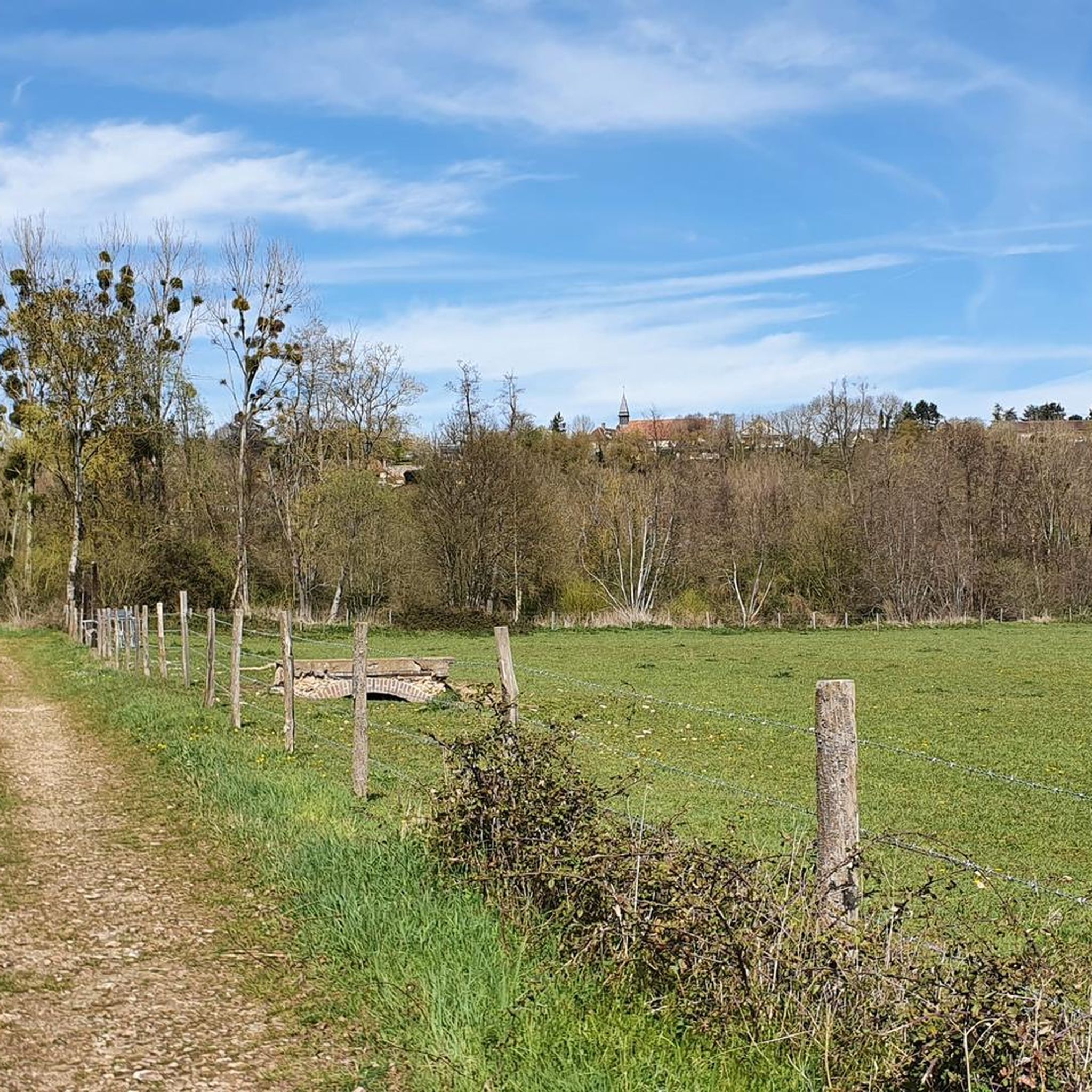
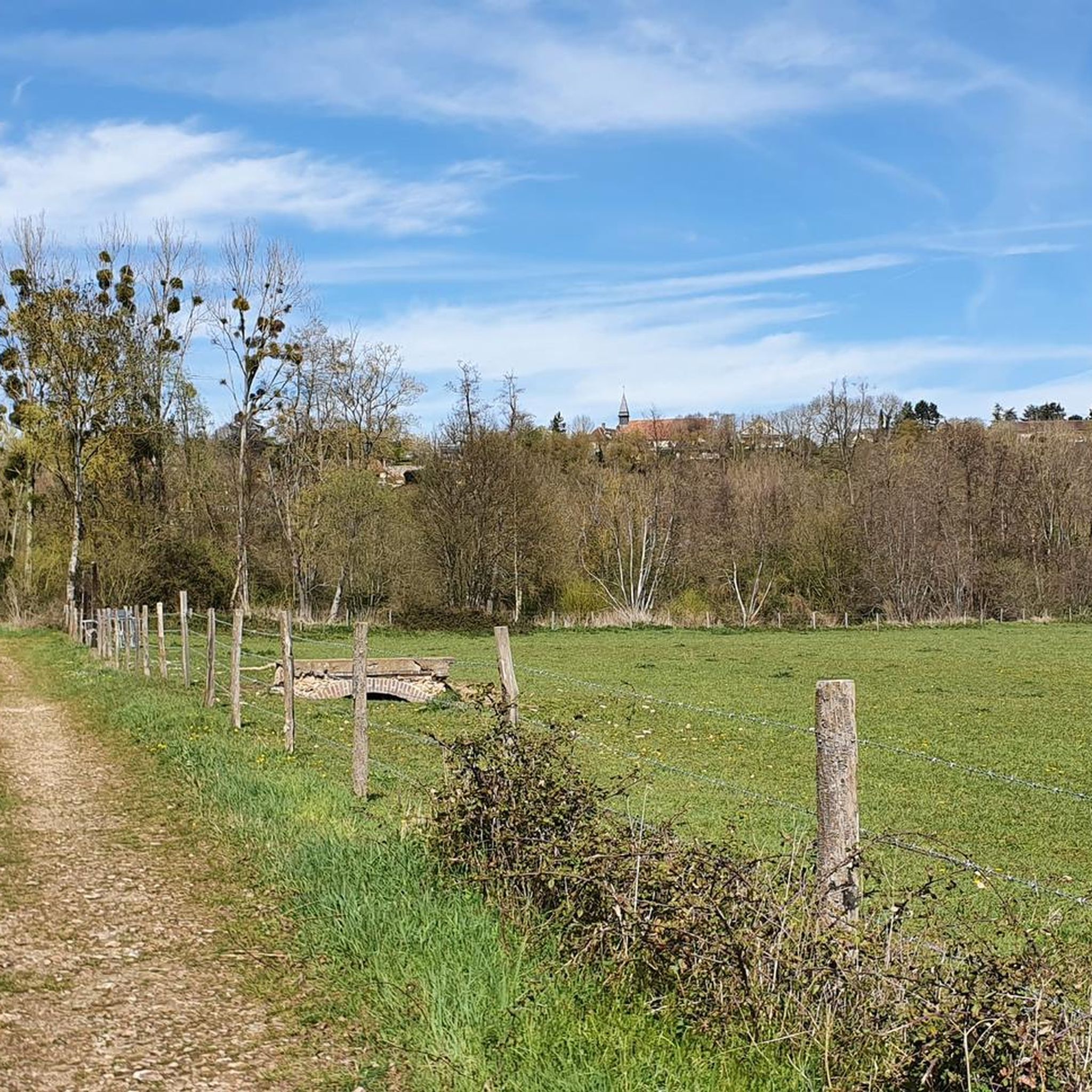
This magnificent viewpoint will allow you to fully appreciate the village of Anet and in particular the bell tower of its church. Don't forget to take your camera and stop for a moment along your route to immortalize the scene.
2
0
Frequently Asked Questions
How many gravel bike trails are available around Vert-En-Drouais?
There are 7 gravel bike trails around Vert-En-Drouais listed on komoot. These routes cater to various skill levels, from easy to difficult, offering diverse experiences across the region's forests, river valleys, and rolling hills.
What is the best time of year for gravel biking in Vert-En-Drouais?
The Eure-et-Loir department, including Vert-En-Drouais, is generally pleasant for cycling from spring through autumn. The forested areas, such as the Forêt de Dreux, offer welcome shade during warmer periods, making summer rides enjoyable. Spring and autumn provide cooler temperatures and beautiful seasonal foliage.
Are there any easy gravel bike routes suitable for beginners or families?
Yes, there is 1 easy gravel bike route available. Additionally, several moderate routes, like the Lovely trail along the Avre – Cocherelle Dolmen loop from Marcilly-sur-Eure, offer manageable distances and elevation, making them suitable for those new to gravel biking or families looking for a pleasant ride. This route is 16.7 miles (26.9 km) long and takes about 2 hours.
What kind of landscapes can I expect to see on these gravel trails?
Gravel biking around Vert-En-Drouais offers a mix of landscapes. You'll find extensive forested areas like the Forêt de Dreux, scenic river valleys along the Eure and Avre, and tranquil waterscapes such as the Étang d'Écluzelles. The region also features rolling hills and country lanes, providing varied terrain and picturesque views.
Are there any historical sites or attractions along the gravel routes?
Yes, several routes pass by historical points of interest. For example, the Bas Buissons Hill – Cocherelle Dolmen loop from Chapelle royale de Dreux takes you past historical sites. You can also explore nearby castles like Sorel Castle or Escorpain Castle, which are close to some of the trails.
Are there any longer or more challenging gravel bike routes?
For a more challenging ride, consider the Walk in the Dreux Forest – Sorel Castle loop from La Pinède. This difficult 26.7-mile (42.9 km) trail explores the extensive Forêt de Dreux, offering natural, unpaved terrain and a good workout. It typically takes nearly 4 hours to complete.
What do other gravel bikers enjoy most about Vert-En-Drouais?
The gravel routes in Vert-En-Drouais are highly rated by the komoot community, with an average score of 4.2 stars from 7 reviews. Riders often praise the varied terrain, the peaceful forested sections, and the scenic river paths that make for an engaging and enjoyable experience.
Are the gravel bike trails in Vert-En-Drouais typically loop routes or point-to-point?
Most of the gravel bike trails listed for Vert-En-Drouais are designed as loop routes, allowing you to start and finish at the same location. Examples include the Moulin de la Bellassière – Fontaine les Ribouts loop from Vernouillet and the Saint Peter's Church – Saint-Pierre Church of Abondant loop from Cherisy.
Is there public transport access to the gravel bike trailheads in Vert-En-Drouais?
While Vert-En-Drouais itself is a smaller commune, the nearby town of Dreux serves as a regional hub with public transport connections. From Dreux, you may be able to access various starting points for the gravel trails, though direct public transport to all trailheads might be limited. Planning your route in advance and checking local bus schedules is recommended.
Where can I find parking for gravel biking in Vert-En-Drouais?
Many of the gravel routes start from locations with available parking, especially near villages or designated recreational areas. For instance, routes originating from La Pinède or Chapelle royale de Dreux likely have parking facilities nearby. Always check the specific tour details on komoot for recommended starting points and parking information.
Are there any places to eat or drink along the gravel bike routes?
While the trails themselves often traverse natural and rural areas, you'll find cafes and pubs in the villages and towns along or near the routes. The nearby town of Dreux offers a wider selection of amenities. It's a good idea to plan your stops in advance, especially on longer rides, or carry sufficient provisions.
Can I bring my dog on the gravel bike trails?
Many natural areas and trails in France are dog-friendly, especially if your dog is well-behaved and kept on a leash. However, specific regulations can vary, particularly in protected natural areas like the Étang d'Écluzelles or within certain parts of the Forêt de Dreux. Always check local signage and respect wildlife. Ensure your dog is comfortable with the distance and terrain.
Most popular routes around Vert-En-Drouais
Most popular attractions around Vert-En-Drouais

Get inspired with the komoot mobile app


Explore more
Browse the best Gravel rides in other regions.
