Top 14 Castles around Ebermannsdorf
Best castles around Ebermannsdorf offer a journey through centuries of history in the Upper Palatinate region of Bavaria. The area features both well-preserved Baroque architecture and medieval ruins, providing insights into the region's past. These historical sites are set within a landscape that invites exploration. Visitors can discover structures dating back to the 12th century, showcasing distinct architectural styles and historical significance.
Best castles around Ebermannsdorf
- The most popular castles is Ebermannsdorf Castle and Castle Church, a castle that…
Last updated: October 4, 2026
Rossstein Castle Ruins
Highlight • Castle
Roßstein is located near Schmidmühlen and Hohenburg in the middle of the lonely Taubenbacher Forest.
Chunrad Oerelheimer named himself after the castle for the first time in 1331, …
Translated by Google •
Tip by

Schwarzenfeld Castle
Highlight • Castle
Translated by Google •
Tip by

Sign up now to discover places like this
Get recommendations on the best single tracks, peaks, & plenty of other exciting outdoor places.
Moos Water Castle
Highlight • Castle
Translated by Google •
Tip by

Ebermannsdorf Castle and Castle Church
Highlight • Castle
Translated by Google •
Tip by

Theuern Cultural Palace
Highlight • Castle
Translated by Google •
Tip by
Sign up for free to discover even more castles around Ebermannsdorf.
Already have an account?
Start today with a free account
Your next adventure awaits.

Other adventures around Ebermannsdorf

Tips from the Community

Moos Castle Moos was the seat of the noble family of Moos. Otto von Moß is mentioned as a witness in documents in 1121, Hermann von Moße in 1126, Otto von Mose in 1166, and Friedrich Mosaer in 1190. The service in which this family served and their coat of arms are unknown. Presumably, there was no stone manor at that time, but rather a motte-and-bailey castle built on a hill. The Moos family appears until the end of the 12th century, after which their trail disappears. In the first half of the 14th century, Moos was already a Hofmark (a type of manor). The Nortweiner family, who were wealthy landowners in the area, are mentioned as its owners. In the mid-15th century, Moos came into the possession of Jörg Kastner; the subsequent ownership history is unclear. The estate moved to the center of Bavarian history when Elector Maximilian had the city of Amberg surrendered to him at Moos Castle on October 8, 1621, after the Battle of White Mountain. Thus, the estate reverted from the Electorate of the Palatinate to Bavaria. Due to heavy debt, the estate passed to the government in Amberg, and various owners followed. In 1904, all the property belonging to the castle was demolished. A year later, Leonhard Bernreuther acquired the castle and renovated it in exemplary fashion. It then passed to the Uwe Herrmann family. The newly renovated castle is a three-story solid building with a hipped roof, dormer windows, and simple stucco detailing. The building dates back to the Late Gothic period; it may have previously been a fortified house. In 1738, it was rebuilt with the exception of the four main walls. Until the reconstruction, it was a defensive structure with one-meter-thick walls on the ground floor and narrow slits instead of windows. Two windows remain on the east side. There, on the first floor, is an exposed Late Gothic window with a straight lintel and dressed stonework, as well as a latrine bay window. A ring wall with numerous keyhole-shaped loopholes hewn from dressed stone and four projecting corner towers from the first construction phase surrounds the castle. It is approximately three meters high and 80 cm thick. The tall spires were added during the last renovation (1982–1984). The former moat can still be seen as a strip of barren land on the south and east sides. Access to the complex is from the north; a bridge once stood here, the inner section of which could be raised. Source: Excerpts from www.wikipedia.de
2
0
Filial Church of St. John the Baptist The church as we see it today is the result of the new building based on a castle chapel from around 1250, some of whose substance has been preserved or reused. Today's St. John's Church was built on behalf of the Electoral Court Chamberlain, Johann Joseph von Dyer, by Ignaz Anton Gunezrhainer and his stepfather Johann Mayr, both master masons in Munich. 300 years ago, from May 1721, Munich craftsmen were on site here. The castle was also built by the Gunezrhainer workshop, which is why all the buildings form a self-contained ensemble. The interior shows a rare conical narrowing from the nave to the end of the choir, which is due to the previous building. In the Apis, the high altar is impressive: the large painting by Johann Adam Müller depicts the baptism of Jesus by John. It is elaborately framed with a wide architectural and picture frame and additionally surrounded by a floor-to-ceiling blue curtain with gold fringes in stucco work. Two powerful putti hold up this curtain and thus open up the view of the Theatrum Sacrum. Cuddled up to the tabernacle, four seraphim stand and praise the divine glory, present in the Eucharist, while the life-size sculptures of Abraham and Moses represent God's eternal covenant with his people. The church was extensively renovated in 1911. The recently completed renovation (between 2016 and 2020) restored the 1911 colors to the altar tables and pulpit. For the room shell, i.e. the wall design with stucco, pilasters and wood paneling, the color scheme from the period of construction from the restoration-supervised findings was decisive. The restoration of the stone steps and the floor also followed the period of construction findings. The figural decorations were cleaned. The necessary new pieces were designed by the Munich architect Franz Steinberger Source: www.pfarrei-theuern-eb-pi.de
5
0
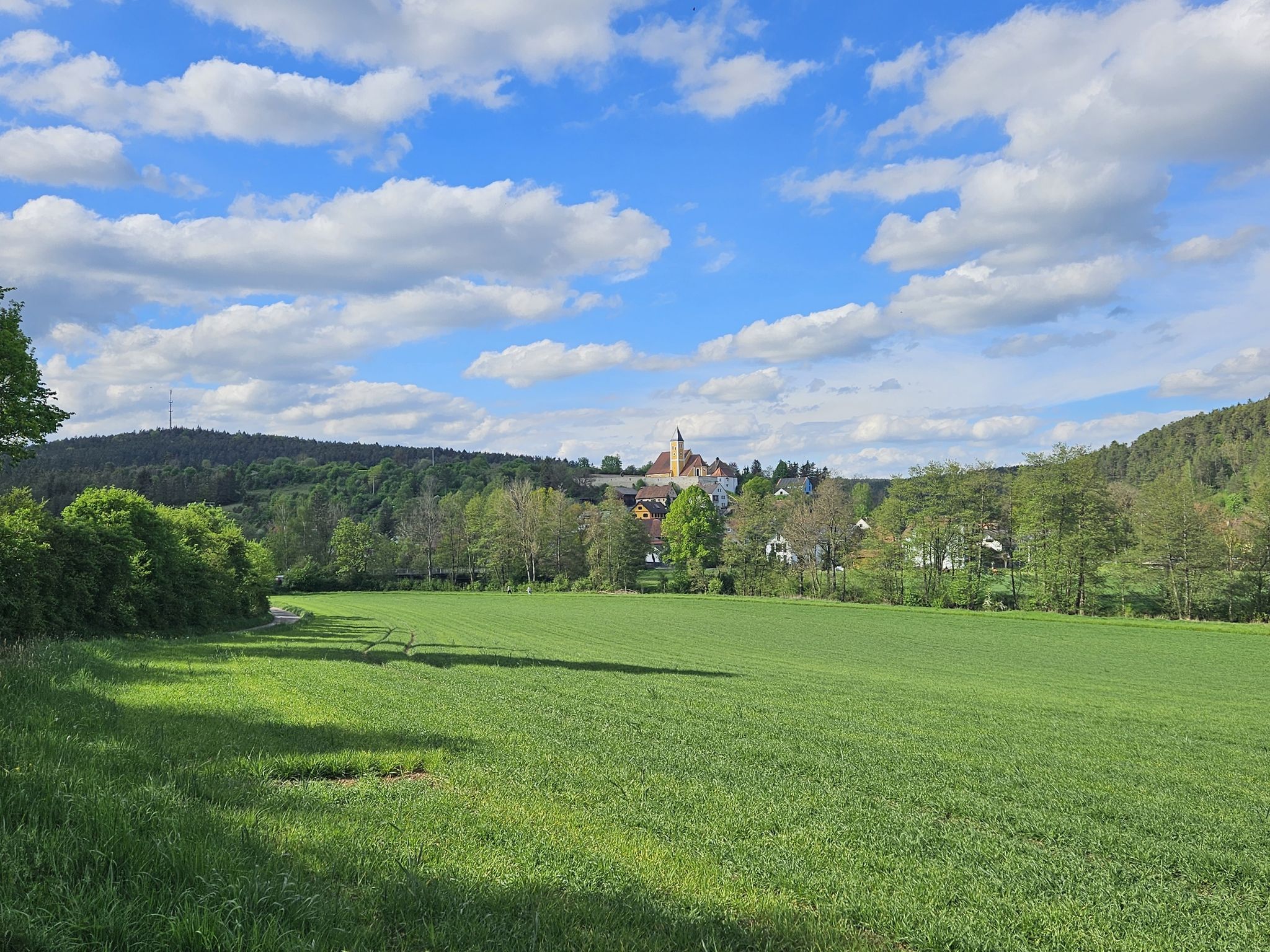
Ebermannsdorf Castle The local noble family of Ebersdorf has been documented here since the early 12th century. They lived in the Eberburg. In 1480, Jakob Kemnather zu Ebermannsdorf is mentioned with the "lower seat" as a fief of his sister Agnes, widow of Jakob Kemnather zu Ebermannsdorf. A new seat had therefore already been built next to the old castle at that time. The current castle is, as the year "1723" shows, a baroque building from the early 18th century. It was built under the manor owner Johann Josef von Dyrr using the old walls according to plans by Ignaz Anton Gunetzrhainer. It is an elongated two-storey solid building with a hipped roof, a central projection with a mansard roof. A transverse building with a mansard roof and a stair tower with a hipped roof is aligned towards the castle church. The castle building has a plaster structure. The complex is closed off by a castle wall, also with plasterwork, basket-arch gates and a niche figure. The castle was renovated in 1977/78. Since 1963, the castle has been owned by a branch of the Barons von Eyb family. The complex also includes the former castle church, now the branch church of St. John the Baptist, which was also built in 1721-23 according to plans by Ignaz Anton Gunetzrhainer. It is a hall building with a mansard hip roof and a recessed tower covered by a tower cap. It also has a segmental gable portal and a plasterwork structure. The church was renovated inside and out in 2018-2020. A special feature is the historic organ from the 19th century, which is attributed to Friedrich Specht. Source: Excerpts from www.wikipedia.de
5
0

Today, Schwarzenfeld Castle is a conference and recreation hotel with a beautiful park on the banks of the Naab.
3
0

In 1972, the Amberg-Sulzbach district founded the supra-regional Mining and Industry Museum in Theuern. Its primary mission is to research, document, and present the mining and industrial history of the entire eastern Bavarian region. The Mining and Industry Museum is housed in the Hammerherrenschloss (Hammer Lord's Castle), built in 1781. In addition, regionally typical industrial monuments were relocated to Theuern: an ironworks, a glass grinding and polishing works (which has also housed the Eastern Bavarian Electricity Museum since 1996), and a winding tower with an engine house.
10
0
The current castle is a baroque building from the early 18th century. It was built using the old walls according to plans by Ignaz Anton Gunetzrhainer. It is an elongated two-storey solid building with a hipped roof, a central projection with a mansard roof. A transverse building with a mansard roof and a stair tower is aligned towards the castle church. The complex is enclosed by a castle wall. The castle was renovated in 1977/78. The complex also includes the former castle church, now the branch church of St. John the Baptist, which was also built from 1721 to 1723 according to plans by Ignaz Anton Gunetzrhainer. It is a hall building with a mansard hipped roof and a recessed tower covered by a tower cap. The church was renovated from 2018 to 2020. A special feature is the historic organ from the 19th century.
8
0
Schwarzenfeld Castle The Schwarzenfeld seat was built and inhabited by Conrad Pullenhofer in 1372, before it became the property of the Plankenfelser noble family in 1389. They expanded the rather inconspicuous building and added four towers in the 15th century. In the 1580s, the Teuffel von Pirkensee family bought Schwarzenfeld. During the Thirty Years' War, the castle and the town were devastated. The castle's four towers were probably destroyed and have not been rebuilt since. From 1654, the imperial colonel Peter Pischer and his family were lords of Schwarzenfeld. In 1686, the baronial von Schneidau family took over Schwarzenfeld as a manor. In 1707, a fire destroyed the castle and the surrounding buildings, so that it had to be completely rebuilt elsewhere. A new building, called the "Plankenfelser Schlössl", was built on the foundations of the old castle. It was adapted to the period with stepped gables. In 1717, Schwarzenfeld was owned by the von Wildenau family, and in 1794 the property was purchased by the Counts of Holnstein. At the beginning of the 19th century, the main building was given its current shape by removing the stepped gables in favor of a hipped roof. Two small towers with onion tops were also added. In 1890 and 1892, Maximilian von Holnstein had the castle extended by Julius Hofmann to include the annex and the two towers in the style of the then popular historicist architectural style. At times, up to 160 workers were involved in the reconstruction, which gave the castle its final appearance. Surrounding buildings were also demolished to provide a view of the castle. Shortly after its completion, Count von Holnstein used the castle as a retirement home. He went blind in 1893 and died in the castle on February 1, 1895. After the Holnstein family moved out in 1907, the castle remained unused for a long time, except for short-term leases. The market acquired the castle in 1934, and after several changes of ownership, the main building of the castle burned down on the night of June 25, 1982 and lay abandoned for many years. In 1995, it was sold to private individuals Christine and Hans Dobler from Nabburg. They had the castle completely gutted, renovated and converted into a conference hotel, which opened in 1996 and is called "Hotel Schloß Schwarzenfeld". Source: Excerpts from www.wikipedia.de
3
0
Theuern Hammer Mill A family named von Theuern can be traced back to the end of the 11th century, which coincides with the first documented mention of Theuern. Hartnit von "Tiuren" appears as a witness in a document written between 1092 and 1114. A hammer mill likely did not exist in Theuern until the end of the 15th century. In 1518, the Portner family acquired the hammer mill and the associated estate. As early as 1682, Johann Georg Portner built a hunting lodge on the site of the present-day castle. During the Counter-Reformation, the Portners were expelled from their hammer mill. After the Portners, the hammer mill was operated by Andreas von Ruland's widow (1705) and, from 1709, by the Lochner family of Hüttenbach. According to the church records, the foundation stone for the late Baroque castle, which still stands today, was laid on August 25, 1780; the builder was Joseph Christian von Lochner. The Elector's master builder, Wolfgang Diller from Amberg, was commissioned to design the Hammerherrenschloss (Theuern Manor). Several outbuildings were constructed as early as the 1770s, resulting in a four-winged complex around an enclosed courtyard. The east facade of the three-story main building is adorned with a central projection topped by a triangular pediment. The Lochner-Bibra coat of arms is displayed in the pediment. The imposing main portal with pilasters and a broken pediment—judging by its style—originates from the hunting lodge built in 1682. Inside, the original room decorations, including the staircase with its richly carved banister, and a salon on the first floor with carved Rococo doors have been preserved. The manor is a plastered building with a hipped roof; an angled extension with a gable roof likely dates from the 19th century. On September 17, 1816, Karl Christian von Mann, also known as Tiechler, purchased the Theuern estate from Countess Sophie von Hirschberg. In 1832, the local ironworks had a blast furnace. The son of von Mann sold the estate to Florian Dorfner on August 28, 1855. At that time, it comprised 1,707 Tagwerk (approximately 1,707 hectares), of which 1,561 Tagwerk were forests. In 1935, the Dorfner family sold the forest estate, including the castle, to the Berlin timber wholesaler Breba. Today, the property belongs to the Wittmann family. Theuern Castle houses the Mining and Industry Museum of Eastern Bavaria. In addition, the castle is used for numerous cultural events and entertainment. Source: Excerpts from www.wikipedia.de
4
0
Frequently Asked Questions
What types of historical sites can I explore around Ebermannsdorf?
The Ebermannsdorf area offers a diverse range of historical sites, from well-preserved Baroque castles like Ebermannsdorf Castle and Castle Church to ancient medieval ruins such as the Burgruine Ebermannsdorf (Eberburg Ruin) and Rossstein Castle Ruins. You can also find fortified gates like Ziegeltor, Amberg, showcasing different eras of the region's past.
Are there any well-preserved castles to visit in the region?
Yes, Ebermannsdorf Castle and Castle Church is a notable example. This Baroque castle, built in the early 18th century, features an elongated two-story building with a hipped roof and an integrated castle church, St. John the Baptist. While it is private property, its exterior and surrounding grounds offer a glimpse into its historical grandeur.
Where can I see medieval castle ruins near Ebermannsdorf?
The Burgruine Ebermannsdorf (Eberburg Ruin) is located a few hundred meters above Schloss Ebermannsdorf. This ruin dates back to the early 12th century, with its octagonal keep showcasing Salian-period masonry from around 1100. Another significant ruin is Rossstein Castle Ruins, which offers a tangible connection to the region's history despite its small size.
What is the historical significance of the castles in Ebermannsdorf?
The castles in Ebermannsdorf hold deep historical roots. The Burgruine Ebermannsdorf (Eberburg Ruin) was the ancestral seat of the Ebersdorfer family, dating back to the 11th century. Ebermannsdorf Castle, built in 1723, replaced the older structure and reflects the Baroque era. These sites collectively illustrate centuries of regional nobility and defensive architecture.
Are there any castles that are now hotels or have been repurposed?
Yes, Schwarzenfeld Castle, originally mentioned in 1015, was destroyed by fire in 1982 but was later converted into a conference hotel. This offers a unique way to experience a historical site with modern amenities.
What are the best times to visit the castles around Ebermannsdorf?
Visiting during spring or autumn is ideal. The weather is generally pleasant for exploring the outdoor ruins and castle grounds, and the natural scenery is particularly beautiful. Summer can also be good, but may be warmer, while winter offers a different, often quieter, experience, especially for hiking to ruins.
Are there hiking trails that lead to or around the castles?
Yes, many of the castles and ruins are accessible via hiking trails. For example, a field path leads up to the Burgruine Ebermannsdorf (Eberburg Ruin), offering impressive views. You can find various running and hiking routes around the area, including the 'Ebermannsdorf Castle Ruins loop from Schafhof'. Explore more options in the Running Trails around Ebermannsdorf guide.
Are there any family-friendly castle experiences in the area?
While specific family tours are not detailed, exploring the exteriors of castles like Ebermannsdorf Castle and the ruins like Burgruine Ebermannsdorf can be an engaging historical adventure for families. The Ziegeltor, Amberg, a Gothic gate system, is also listed as family-friendly.
Can I find viewpoints near the castle ruins?
Yes, the Burgruine Ebermannsdorf (Eberburg Ruin) offers impressive views of the surrounding landscape and Schloss Ebermannsdorf below. Rossstein Castle Ruins is also noted for its viewpoint, especially when combined with a hike through the Taubenbach valley.
What outdoor activities can I do near the castles?
Beyond exploring the castles, the region offers various outdoor activities. You can find numerous road cycling routes, such as the 'Wolfsbach Chapel loop from Ebermannsdorf' in the Road Cycling Routes around Ebermannsdorf guide. For gravel biking, consider routes like 'Trail along the Vils – Vils River in Ensdorf loop' from the Gravel biking around Ebermannsdorf guide. There are also many running and hiking trails, including those that pass by the castle ruins.
Is there parking available at the castles?
While specific parking details for each castle are not always provided, generally, for sites like Schloss Ebermannsdorf, parking is available nearby, often in the village. For ruins like Burgruine Ebermannsdorf, you might need to park at the base of the hill and walk up a field path.
How long does it typically take to visit the castles?
The time required varies. For a quick visit to view the exterior of Ebermannsdorf Castle and Castle Church, an hour might suffice. Exploring the Burgruine Ebermannsdorf (Eberburg Ruin) and enjoying the views could take 1-2 hours, especially if combined with a short hike. Larger sites or those requiring more extensive walks, like Rossstein Castle Ruins, might take half a day.
Most popular routes around Ebermannsdorf
Most popular attractions around Ebermannsdorf

Get inspired with the komoot mobile app


Explore more
Looking for the best castles somewhere else? Discover other guides around Ebermannsdorf:
