Attractions and Places To See around Oświęcim - Top 20
Best attractions and places to see around Oświęcim include historical landmarks, cultural sites, and natural areas. The city, known for its significant WWII history, also features a past dating back to the 12th century. Oświęcim is situated near the Soła and Vistula rivers, offering recreational spaces and scenic routes. The surrounding region includes protected natural areas, providing diverse landscapes for exploration.
Best attractions and places to see around Oświęcim
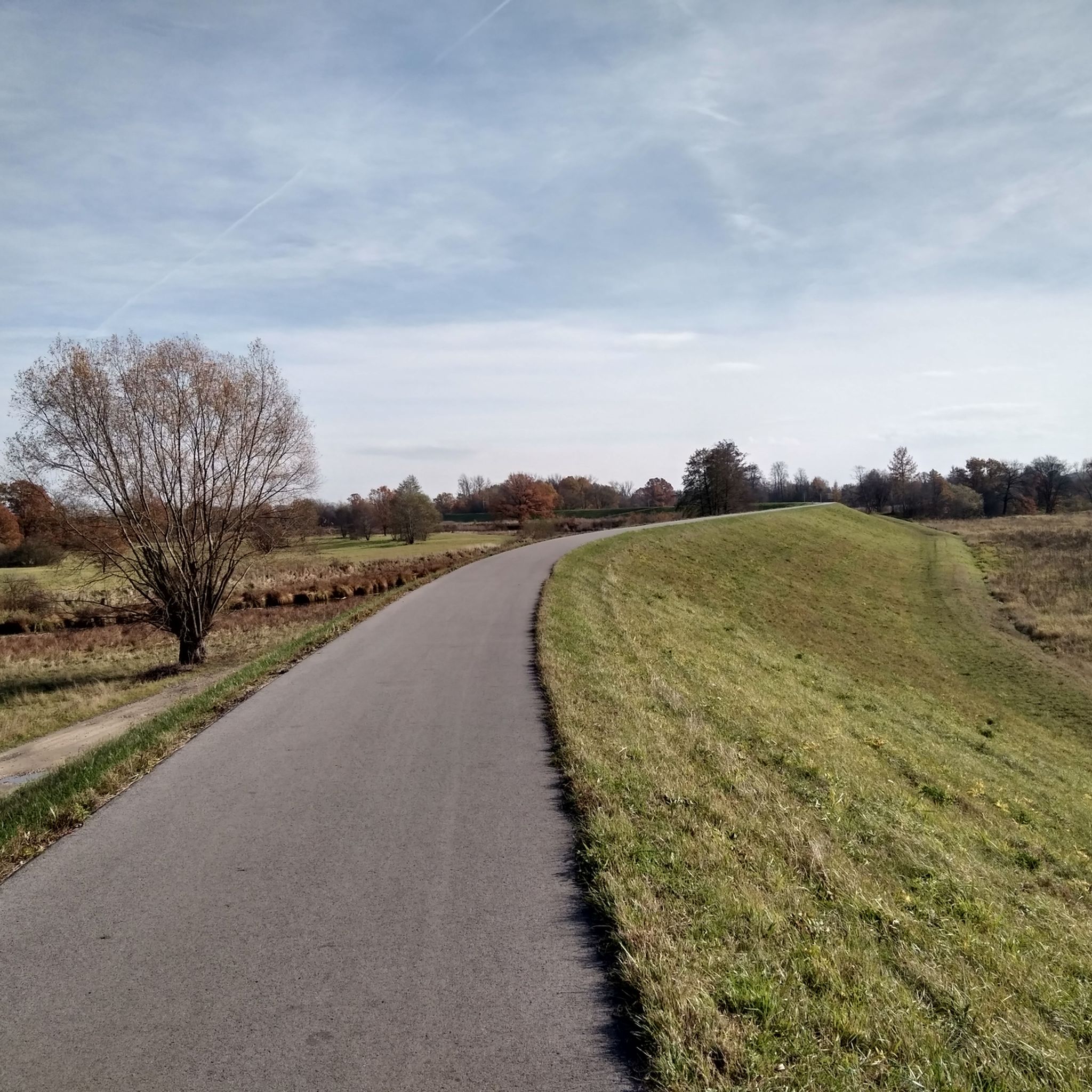
- The most popular attractions is Vistula Cycling Route WTR Oświęcim–Miętków, a cycle way that offers a high-quality asphalt section along the Vistula embankments. This route provides scenic views of the river and surrounding nature, making it suitable for cycling and observing local wildlife.
- Another must-see spot is Oświęcim Castle, a historical site built in the Middle Ages on a hill overlooking the Soła River. The castle features an early Gothic bergfried tower from the late 13th century and includes tunnels, one of which served as an air-raid shelter during WWII.
- Visitors also love Wooden church in Jawiszowice, a baroque religious building located in the Oświęcim district. This church, built in 1692, is part of the wooden architecture route of the Lesser Poland Voivodeship and contains three altars and rococo pulpit.
- Oświęcim is known for its historical sites, religious buildings, and natural river areas. Visitors can explore a variety of attractions, from ancient castles and churches to modern cycling routes and market squares.
- The attractions around Oświęcim are appreciated by the komoot community, with 138 photos and 273 upvotes.
Last updated: October 18, 2026
Vistula Cycling Route WTR Oświęcim–Miętków
Highlight (Segment) • Cycleway
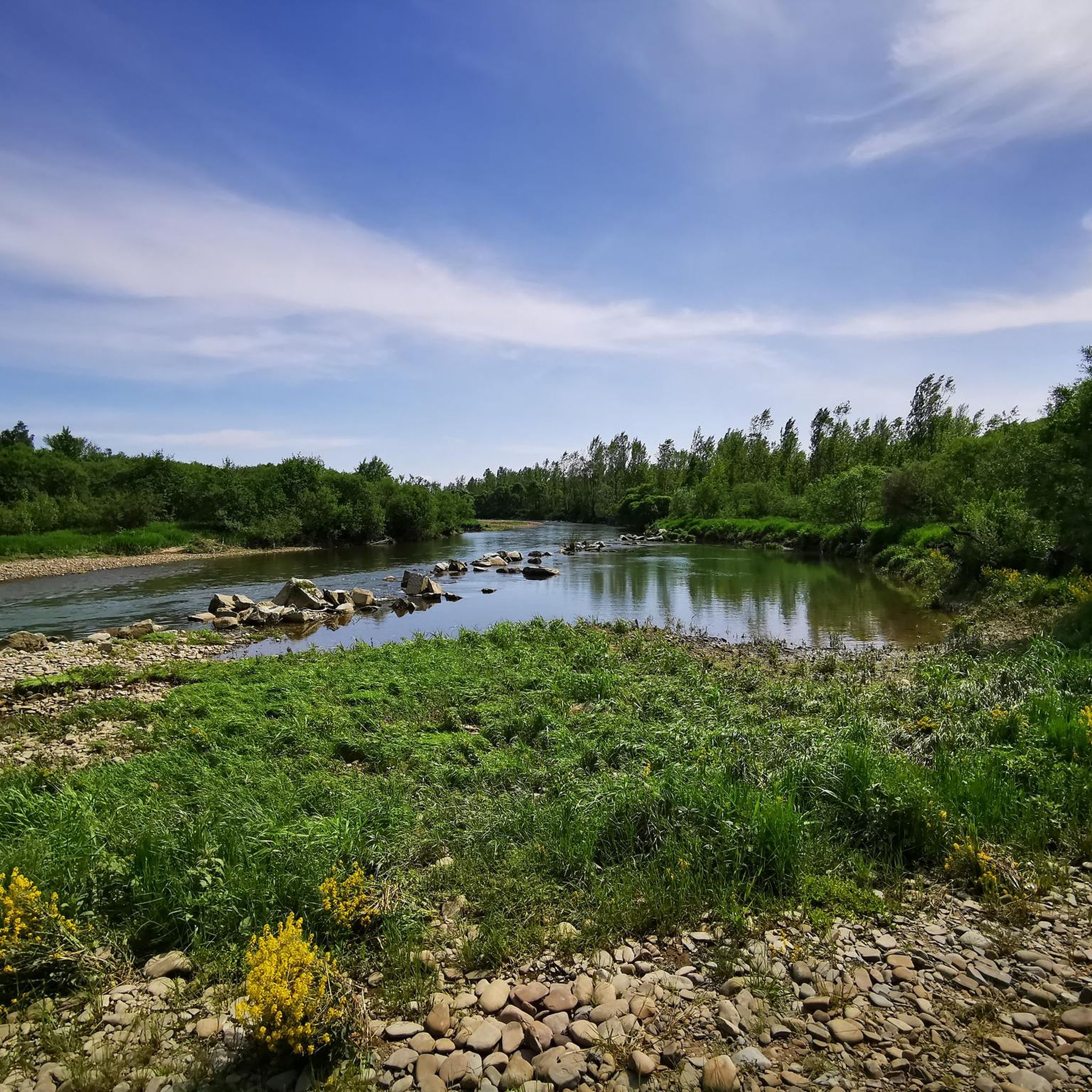
There is a view of the Vistula River from the route.
We liked the stage from Oświęcim the most - the first-class surface on the Vistula embankment is a recipe for the success of this route. On both sides of the embankment, my eyes were filled with vigorous green, and my nose was dizzy with the scent of blooming trees and flowers. The area around the route is a kingdom of nature due to the limited human interference in the floodplain.
In the meadows we searched for pheasants absorbed in courtship, hares flashed in the fields, and we accidentally scared a herd of deer out of the bushes. Sometimes the route rubbed against the forest wall, other times it approached small towns, but we still saw the thin thread of the Vistula and the spring nature exploding in its surroundings.
polskapogodzinach.pl/wislana-trasa-rowerowa-oswiecim-krakow
Translated by Google •
Tip by

Oświęcim Castle
Highlight • Castle
The castle consists of an early gothic bergfried tower built at the end of the 13th century and a two-storey, basement building erected on a rectangular plan (old castle wing from the beginning of the 16th century) and a link from 1929–1931 built on the site of older buildings. A significant part of the fortifications was taken by the river - which changed its course for centuries.
On the castle hill there are remains of defensive walls and bastions. The royal castle was located in the second half of the 16th century in the Silesian poviat of the Kraków voivodeship. There are two tunnels under the castle: the older one (built before 1914) and the other one drilled by the Germans (1940–1944). This tunnel served as an air-raid shelter.
The first mentions of the Oświęcim castellany come from the period when it was incorporated into the Duchy of Opole (1177–1179). The reconstruction and fortification of the castle are attributed to the son of Mieszko Plątonogi, Prince Kazimierz. This is evidenced by archaeological discoveries near the tower confirming the existence of a brick structure on the castle hill in the first half of the 13th century.
pl.wikipedia.org/wiki/Zamek_w_O%C5%9Bwi%C4%99cimiu
malopolska.szlaki.pttk.pl/1568-pttk-malopolska-zamek-w-oswiecimiu
Translated by Google •
Tip by
Sign up now to discover places like this
Get recommendations on the best single tracks, peaks, & plenty of other exciting outdoor places.
Oświęcim Market Square
Highlight • Settlement
Tip by

Wooden church in Jawiszowice
Highlight • Religious Site
St. Martin in Jawiszowice was built in 1692 on the site of the burned down church from 1511, which, according to the popular tradition, was probably accidentally set on fire by the son of the organist at that time.
There are three altars inside (the main one and two side ones). The main altar is probably from around 1700, and the side altars from the 19th century. The presbytery of the church is covered with a shallow apparent barrel vault, and the nave is covered with a ceiling. On the profiled rood beam between the nave and the presbytery there is a baroque crucifix and statues of the Virgin Mary, St. John the Evangelist and St. Mary Magdalene. The pulpit is rococo. The stalls are late baroque, and the confessional with figural paintings on the back and on the door is early baroque. An interesting monument is a stone folk stoup, probably made in the 17th century. There are also several Baroque paintings in the church.
pl.wikipedia.org/wiki/Ko%C5%9Bci%C3%B3%C5%82_%C5%9Bw._Marcina_w_Jawiszowicach
Translated by Google •
Tip by
Wilamowice – settlers from the Netherlands (?) and their language
Highlight • Settlement
From the analysis of the language and clothes of the later inhabitants, it can be concluded that its settlers came from Friesland and Flanders. The town was founded away from large rivers, which may be related to the fear of floods. In 1238, the North Sea flooded large areas of Flanders, prompting its inhabitants to emigrate. The inhabitants of Stara Wieś later assimilated, but the Wilamowiceans remained in cultural isolation until World War II. They kept their archaic imaginary language, customs, costumes, and a sense of separateness.
pl.wikipedia.org/wiki/Wilamowice
gmina.wilamowice.pl
Translated by Google •
Tip by
St. Bartholomew’s Church in Poręba Wielka
Highlight • Religious Site
Translated by Google •
Tip by

Church of the Assumption of the Blessed Virgin Mary
Highlight • Religious Site
Mentioned in the years 1325-1327. As brick also for Jan Długosz. The date when the church was built is not known exactly. It was rebuilt many times, and before 1530, little is known about its architectural structure. Rebuilt in the third quarter of the 17th century. Restoration after a fire in 1863. Square tower finally built in 1863-77, earlier the lower part from the end of the 16th century. Oriented, brick, rectangular two-span chancel, sacristy to the south. From the north, the chapel of the crucified Christ. The presbytery is connected with the body by a rainbow with a semicircular arch. A three-nave, hall, two-span body with a choir. The nave is open to the aisles on each side with two rectangular pillar arcades with pilaster decorations. Chancel vaults and barrel naves with lunettes on the arch. Music choir on three arcades across the width of the body, the choir sill is arched in the center. The choir sill and the vaults are decorated with geometric figures made of stucco moldings. In the presbytery windows and side aisles, there are colorful stained-glass windows. From the north, the small chapel of St. Maximilian Maria Kolbe. From the west, on the axis, a high clock tower with a porch. Decorated with a quadruple motif in the upper storey. Outside the church, on the corners of the presbytery there are buttresses, also a buttressed tower. A bell on the roof of the body. On the eastern wall of the presbytery, there is a crucifix from the second half of the c. XVII.
pl.wikipedia.org/wiki/Ko%C5%9Bci%C3%B3%C5%82_Wniebowzi%C4%99cia_Naj%C5%9Bwi%C4%99tszej_Marii_Panny_w_O%C5%9Bwi%C4%99cimiu
Translated by Google •
Tip by
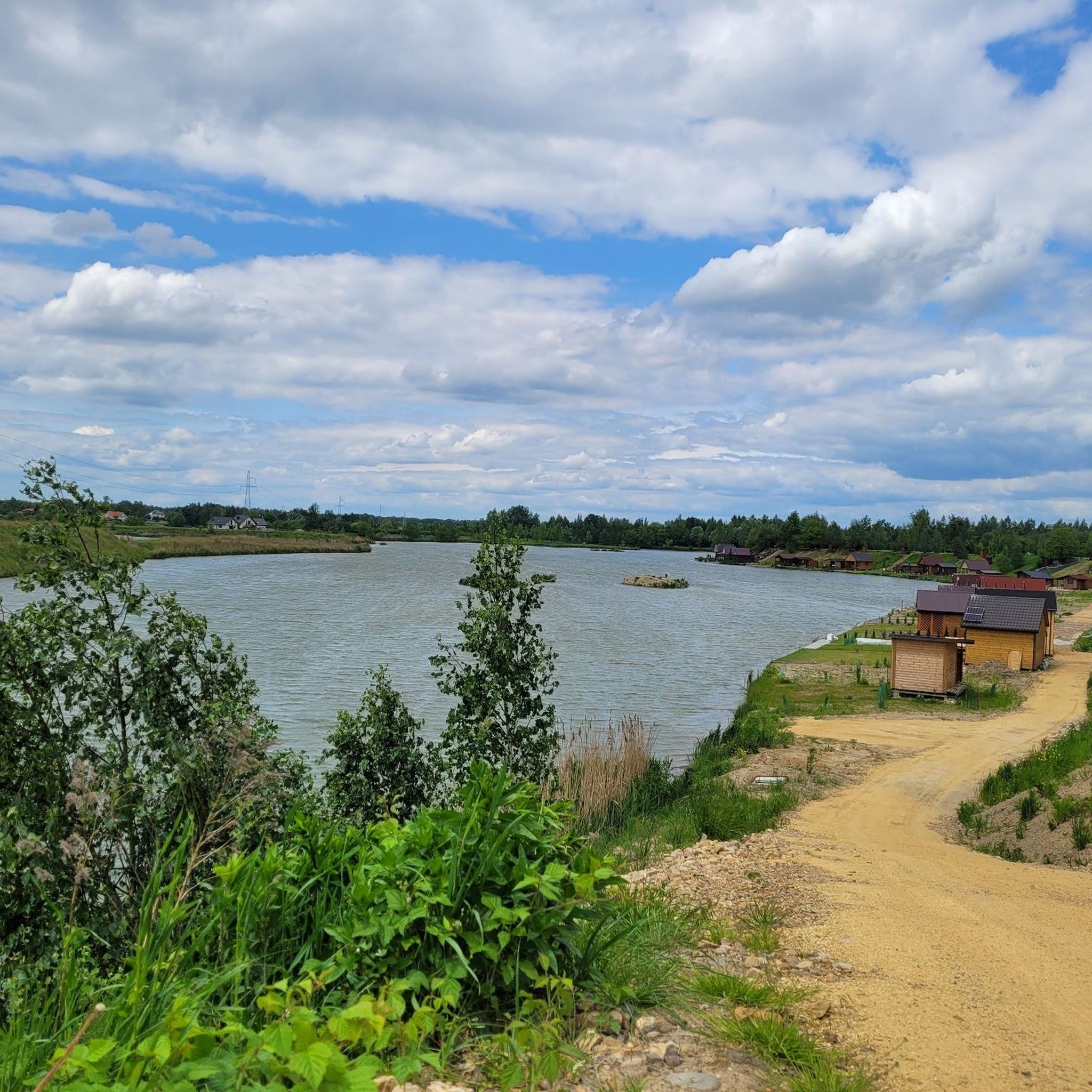
Adofińskie Ponds
Highlight • Lake
Natural, dirt-and-gravel path running along embankments and dikes. In places, it can be muddy or overgrown with grass after rainfall. Gravel / MTB / trekking tires will work best.
Number and names of reservoirs: Officially, it is a complex of 9 ponds (Krzemieńczyk Duży, Adam Duży, Średni, Górny, Zimowy, Letni, Malinowski, and the Kościelecki I and II, divided by a dike). In the terrain, considering small hydrological cutoffs, up to 10 can be counted.
Nature and protection:
Natura 2000 protected area (Dolina Dolnej Soły) and a natural-landscape complex. Breeding ground for rare birds, including the white-winged tern. Beautiful views of the water surfaces and reed beds can be seen from the dikes.
Route connection:
The complex borders the Soła river embankments to the west and smoothly transitions into the Grojeckie Ponds area to the south. It offers an excellent, car-free connection between the southern districts of Oświęcim and Zaborze and Grojec.
Showing Translation
Tip by
Manor in Czaniec
Highlight • Historical Site
Translated by Google •
Tip by

Church of Our Lady Help of Christians in Oświęcim
Highlight • Religious Site
In 1594, the Dominicans transformed the existing chapter house into a chapel on the occasion of the canonization of St. Jack. It was oriented similarly to the church. In the years 1608-1610 the church was rebuilt in the Renaissance style.
After the monastery was closed down by Emperor Joseph II, it was turned into a warehouse in the first quarter of the 19th century, completely ruined. After some time, the building fell into Jewish hands and fell into ruin. In 1895, during the Corpus Christi procession, Our Lady appeared on the ruins of the church, which was an impulse for the recovery and reconstruction of the church by the Catholic community of the city of Oświęcim. On the centenary of the event, the church was recognized as the Sanctuary of Our Lady, Help of Christians.
The church was restored by the Salesians, but lost its original character - now it is neo-Gothic. The chancel was turned into a nave due to the entrance from Jagiełły Street (previously on the side of the church). Thanks to this, it is no longer oriented like the chapel (chapter house) of St. Jacek, with whom it was originally a monastery complex.
pl.wikipedia.org/wiki/Ko%C5%9Bci%C3%B3%C5%82_Matki_Bo%C5%BCej_Wspomo%C5%BCenia_Wiernych_w_O%C5%9Bwi%C4%99cimiu
sanktuarium-oswiecim.pl
Translated by Google •
Tip by
Sign up for free to discover even more attractions around Oświęcim.
Already have an account?
Start today with a free account
Your next adventure awaits.

Tips from the Community

The Castle in Oświęcim is a medieval defensive stronghold located on a hill on the right bank of the Soła River. Currently, the site is home to the Museum of the Castle in Oświęcim, which presents the rich history of the city, the former Duchy of Oświęcim, and valuable historical and archaeological collections. It was here that a great diplomatic turning point occurred: in 1454, the last Piast duke of this region, Jan IV, bowed to the might of Poland and ceded the castle and his entire duchy as a fief to King Casimir Jagiellon. Three years later (in 1457), he completely sold these lands to him. The castle ceased to be a Silesian borderland and became Polish royal property for centuries. It is worth taking a look at the mighty, 13th-century Gothic tower, which remembers those events and that agreement! The history of the castle in Oświęcim dates back to the 11th century, when there was an early medieval agricultural settlement on the hill above the Soła. After it burned down, a fortified castellany stronghold was erected here. The first official documentary mention of it dates from 1179. It was then that King Casimir the Just transferred these lands to the Duke of Opole, Mieszko Plątonogi. Early Gothic tower – dates from the end of the 13th century, it is a defensive building type (bergfried) and is one of the oldest preserved brick structures in Lesser Poland. Royal history – the castle hosted prominent historical figures, including the future Queen of Poland, Bona Sforza. Underground tunnels – there are two corridors under the castle, including an air-raid shelter built by the Germans during World War II. Address: ul. Zamkowa 1, 32-600 Oświęcim Opening hours: Tuesday to Sunday from 10:00 AM to 6:00 PM (the museum is closed on Mondays).
1
0
Entering Wilamowice, you step into one of the most fascinating cultural enclaves in Europe! The town's name (in the local language: Wymysoü) comes directly from the name Wilhelm (William) – a legendary Flemish or Frisian nobleman. In the 13th century, Wilhelm brought a group of settlers from Western Europe (present-day Belgium, the Netherlands, and even Scotland) who were fleeing great floods to this region. For centuries, the community, living in isolation, created its own unique Wilamowice language (wymysiöeryś), which has survived to this day and is the smallest living language in Poland. What is worth seeing here? Museum of Wilamowice Culture – a modern place where you can learn about the history of Wilhelm's migrants. Unique costumes and traditions – if you are lucky, you will see local women in colorful, traditional costumes with Frisian motifs. The Market Square in Wilamowice – the intimate center of the town, perfect for a short break on your cycling route.
0
0
Wilamowice and Stara Wieś The first settlers from the West did not found one village, but two twin settlements located right next to each other. This is confirmed by the oldest church documents (lists of tithes) from 1326: Stara Wieś – recorded in the documents as Antiquo Willamowicz (Old Wilamowice). Wilamowice – recorded as Novovillamowicz (New Wilamowice). Interestingly, the fates of the inhabitants of both villages took completely different paths: The inhabitants of Stara Wieś were very quickly assimilated with the surrounding Polish population. They adopted their language and customs, thereby erasing their Western roots. In turn, the inhabitants of (New) Wilamowice abandoned farming in favor of crafts and trade, lived in isolation, and thanks to this, preserved their unique language (wymysiöeryś), costumes, and cultural distinctiveness for centuries. Hypothesis about settlers from Scotland.. Mention of Scots appear regularly in the Wilamowice tradition alongside Flemings and Frisians. Local tradition in the Municipality of Wilamowice still officially upholds the version that the founding core consisted of fugitives from Western Europe, among whom, alongside the dominant Flemings and Frisians, there was also a group of Scots. Influence on language: Some researchers and the Wilamowians themselves have pointed out that in the Wilamowice language, one can find isolated sounds or archaic words that phonetically show a surprising similarity not only to Dutch, but also to Celtic languages or Old Scots (Scots) and Anglo-Saxon. Traces in surnames: Part of the family names and nicknames in Wilamowice has, over the years, been attempted to be etymologically linked to origins from the British Isles.
0
0
Wilamowice is a town near Bielsko-Biała, called "Polish Flanders". It is famous for its unique community: Wilamowian language: A distinct Germanic language that survived despite persecution after 1945. It is currently undergoing intense revitalization, and young scientists are conducting research on it. Traditions: Residents still cultivate colorful local customs today, cherishing the memory of 13th-century settlers from Western Europe. Wilamowian costume: The group also uses its own very characteristic and richly decorated traditional folk costume.
0
0

Very picturesque cycle path along the Vistula river embankment
0
0

Surface: Natural, dirt-and-gravel path running along embankments and dikes. In places, it can be muddy or overgrown with grass after rainfall. Gravel / MTB / trekking tires will work best. Number and names of reservoirs: Officially, it is a complex of 9 ponds (Krzemieńczyk Duży, Adam Duży, Średni, Górny, Zimowy, Letni, Malinowski, and the Kościelecki I and II, divided by a dike). In the terrain, considering small hydrological cutoffs, up to 10 can be counted. Nature and protection: Natura 2000 protected area (Dolina Dolnej Soły) and a natural-landscape complex. Breeding ground for rare birds, including the white-winged tern. Beautiful views of the water surfaces and reed beds can be seen from the dikes. Route connection: The complex borders the Soła river embankments to the west and smoothly transitions into the Grojeckie Ponds area to the south. It offers an excellent, car-free connection between the southern districts of Oświęcim and Zaborze and Grojec.
2
0
Stawy Adofińskie An exceptionally picturesque, flat gravel section leading through the dikes of a historic complex of 9-10 carp ponds in the Soła Valley. A refuge for wild birds, ideal for a peaceful ride on a trekking or gravel bike, or for a hike away from car traffic.
1
0

A superb cycle path which is, among other things, the EuroVelo 4 which crosses Poland. I realize that I can take it all the way to Krakow, my final destination, but the wind is blowing hard today and the path is elevated, so I am not at all sheltered from the wind. I decide to leave it further on to follow my initial itinerary.
0
0
Frequently Asked Questions
Beyond Auschwitz-Birkenau, what historical sites can I visit in Oświęcim?
Oświęcim offers several other historical sites. You can explore Oświęcim Castle, a medieval structure with a 13th-century tower and tunnels that served as an air-raid shelter. The city's Market Square also preserves remnants of its 16th-century town hall. Additionally, the Jewish Museum and Synagogue provides insight into the city's pre-WWII Jewish community, and the Remembrance Museum of Land of Oświęcim Residents offers a different perspective on the camp's history.
Are there any significant religious buildings to see in the Oświęcim area?
Yes, the region has several notable religious buildings. The Wooden church in Jawiszowice, built in 1692, is a baroque structure part of the wooden architecture route of the Lesser Poland Voivodeship. In Oświęcim itself, you can visit the historic Church of the Assumption of the Blessed Virgin Mary and the Church of Our Lady Help of Christians, which is part of a former Dominican monastery complex.
What cycling opportunities are available around Oświęcim?
For cyclists, the Vistula Cycling Route WTR Oświęcim–Miętków offers a high-quality asphalt section along the Vistula embankments, providing scenic views and opportunities for wildlife observation. This route is highly rated by the komoot community for its excellent surface. For more cycling options, you can explore various routes in the area, including those found in the Cycling around Oświęcim guide.
Are there places for leisurely walks or enjoying nature in Oświęcim?
Absolutely. The Boulevards on the Soła river provide a pleasant recreational space with landscaping, perfect for walks, rollerblading, and cycling. The wider region also includes the picturesque Carp Valley and Natura 2000 areas, known for fish ponds, meadows, and bird sanctuaries, offering tranquil natural settings.
Where can I find hiking trails near Oświęcim?
The area around Oświęcim offers several hiking opportunities. You can find routes like the 'Czupel Peak (933 m) – View of Czupel Summit Cairns loop from gmina Czernichów' or the 'U Panienki Pass (739 m) – Cross on Chrobacza Łąka loop from Gaiki'. For a comprehensive list of trails, refer to the Waterfall hikes around Oświęcim guide.
Are there any natural reserves or unique natural features worth exploring near Oświęcim?
Yes, the region boasts the Bukowica Nature Reserve, featuring Carpathian beech forests, Triassic limestone formations, and old quarries, ideal for walking and observing plant and bird species. The Carp Valley and Natura 2000 areas are also significant, known for their fish ponds and as sanctuaries for wild birds.
Are there family-friendly attractions in Oświęcim?
Many attractions in Oświęcim are suitable for families. The Vistula Cycling Route WTR Oświęcim–Miętków is great for family bike rides, and the Boulevards on the Soła river offer space for walks and play. Historical sites like Oświęcim Castle and the Oświęcim Market Square are also generally family-friendly for exploration.
Are any attractions in Oświęcim wheelchair accessible?
Yes, some attractions in Oświęcim are noted for their accessibility. The Vistula Cycling Route WTR Oświęcim–Miętków is wheelchair accessible, offering a smooth surface along the river. The Oświęcim Market Square is also generally accessible, allowing visitors to enjoy the city's heart.
What cultural experiences does Oświęcim offer besides its historical memorials?
Beyond its memorials, Oświęcim has a vibrant cultural side. You can explore the unique Mural Trail, which features monumental murals conveying messages of peace. The city also has an Avenue of Memory Trees, a living monument for peace with trees from places like Hiroshima and Guernica. The Centre for Roma History and Culture, established in 2024, is dedicated to preserving Roma culture and history.
What is the best time of year to visit Oświęcim for outdoor activities?
The spring and summer months (roughly April to September) are generally ideal for outdoor activities in Oświęcim. During this time, the weather is pleasant for cycling along the Vistula, walking on the Soła River Boulevards, and exploring natural reserves. The blooming trees and flowers along routes like the Vistula Cycling Route add to the scenic beauty.
Are there any unique local communities or traditions to discover near Oświęcim?
Yes, the nearby town of Wilamowice is known for its unique history. Its inhabitants are believed to be descendants of settlers from Friesland and Flanders, who maintained their archaic language, customs, and costumes in cultural isolation until World War II. This offers a fascinating glimpse into a distinct local heritage.
Most popular routes around Oświęcim
Most popular attractions around Oświęcim

Get inspired with the komoot mobile app


Didn’t find what you were looking for?
Are you keen on exploring more awesome places nearby? Browse our guides:
Explore more
Still not found the Highlight you’re looking for? See guides of the top attractions in other regions:
