Top 4 Caves around Bastheim
Caves around Bastheim are found within the Rhön Mountains, a region known for its diverse natural landscapes and geological formations. The area features unique natural monuments and protected zones, offering opportunities for exploration. Its geology includes basalt formations and historical mining sites, contributing to its distinct character. Hiking trails near Bastheim Rhön provide access to these natural attractions.
Best caves around Bastheim
- The most popular caves is Teufelskeller (Devil’s Cellar), a natural monument and cave located in the biosphere…
Last updated: June 29, 2026
Teufelskeller (Devil’s Cellar)
Highlight • Cave
Translated by Google •
Tip by

Women's Cave (Klefallsloch)
Highlight • Cave
Translated by Google •
Tip by

Sign up now to discover places like this
Get recommendations on the best single tracks, peaks, & plenty of other exciting outdoor places.
Sign up for free
Moritz Visitor Mine (Lignite Tunnel)
Highlight • Historical Site
Translated by Google •
Tip by

Marian Grotto
Highlight • Religious Site
Translated by Google •
Tip by
Marian Grotto at the Gangolf Chapel
Highlight • Religious Site
Translated by Google •
Tip by

Sign up for free to discover even more caves around Bastheim.
Sign up for free
Already have an account?
Start today with a free account
Your next adventure awaits.
Login or Signup

Tips from the Community

When you arrive at this place, you're immediately impressed because you didn't expect it to be like this. It's definitely worth seeing.
2
0

Mary's Grotto, with altar niche and standing stone figure of Mary, 20th century, in front of the Gangolf Chapel
0
0

Transcript of the information board. The Women's Cave When the old Hildenburg Castle was devastated and set on fire, the Lord of Hildenburg and all his servants and men perished in a cruel manner. The young lady and her maids, however, fled with great treasures into a walled underground passage. The end of the passage is the women's cave in the ice ditch, which was also called Klefalls or Klefallsloch. However, the lady from Hillenberg and her ladies did not reach this exit. They all died in the underground passage. To this day they guard their treasures. Every seven years they are allowed to emerge from their underground kingdom and show themselves to people. They sit on a pile of wood or on a heap of brushwood and sing such beautiful tunes that the hearts of those who hear them tremble. Many people have already tried to get through the Klefallsloch into the underground passage and to the great treasures. But no one has managed it so far. After just a few steps you come to an iron door or plate. It is also said to be very dangerous to look for the treasure down there. The women's cave, one of the rare natural caves in the basalt. It is also protected by law as a natural monument. Its name is partly explained by the fact that women used this cave to hide from the cruelty of the Mercenaries were hiding there. Others said that the Women's Cave was the end of the underground passage that leads from Hildenburg. The legend, which has often been laughed at by "enlightened" contemporaries and dismissed with a pitying shrug, was confirmed when Hermann Happel from Mühlbach discovered a new entrance in 1965 next to the previously known eight-meter-deep cave that ended in a six-cubic-meter-large room. The cave, also called "Klefallsloch", was examined and measured by speleologists from Düsseldorf in 1972. They discovered a cave system 50 cm long and 20 m deep. The cave consists of narrow crevices, collapsed passages and two small rooms. In the lower part there is a canyon about 5 m long and 1.5 m deep. No traces of human hands were discovered. The entrance to the Women's Cave is walled up. It is strongly advised to exercise caution in the area, as deep crevices in the rocks are dangerous and there is a risk of collapse in some places. Bavarian Rhön Nature Park Association
1
0

One of the few known caves in the Rhön
1
0

Mariengrotte is a shady resting place in summer
4
0
The Mariengrotte is located at the beginning of the Way of the Cross through the forest. Many benches invite you to linger.
0
0

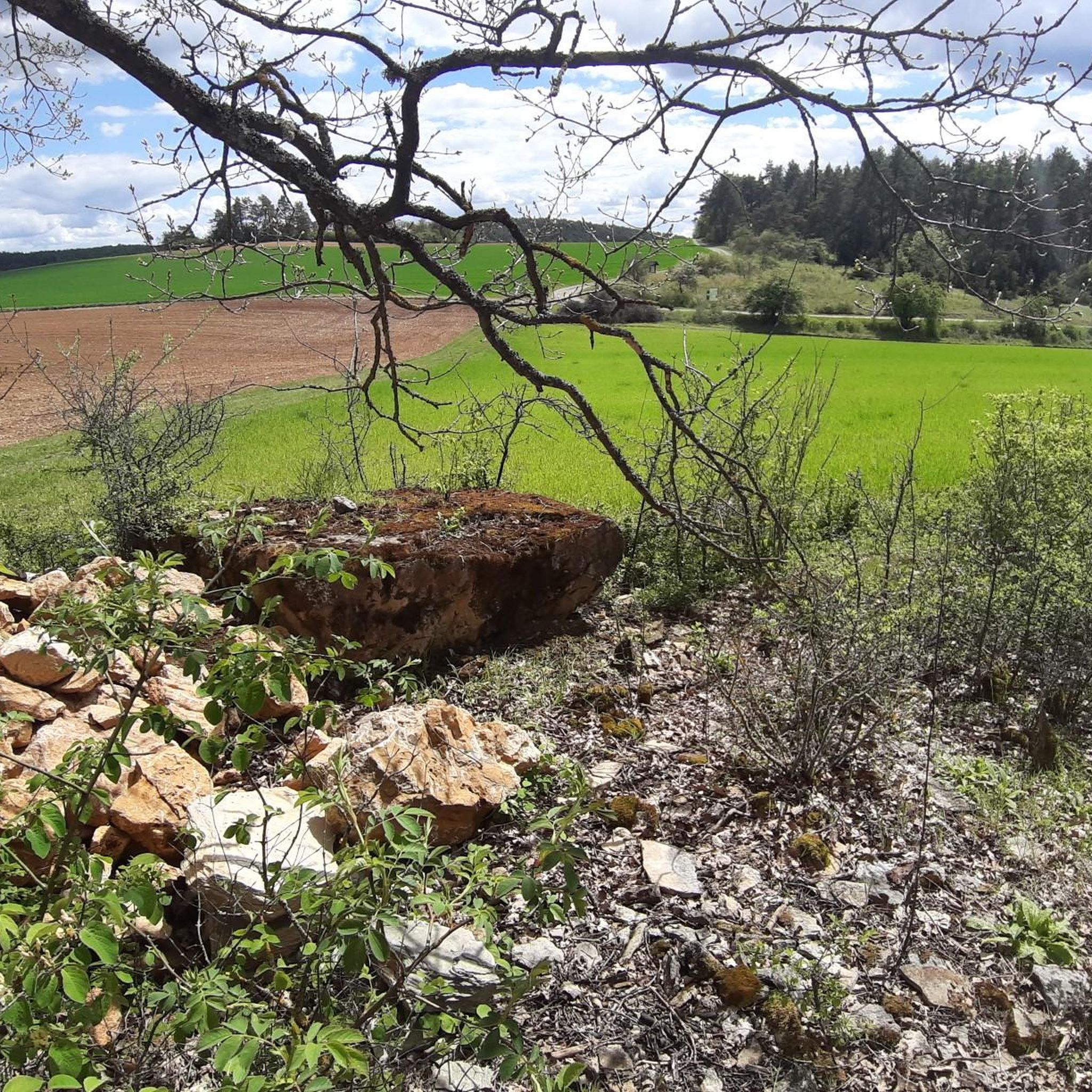
The women's cave or the entrance, which is closed by a grille, is quite inconspicuous. But caves are rare in basalt rock and in this respect it is something special. It was probably created by shifting earth and was scientifically examined and measured in detail in 1972.
4
0

A mighty rock. Legend of the Devil's Cellar: When the Rhön was still pagan, the devil still felt like the master of the area. But then Saint Kilian came to the country, preached Christianity, and many were baptized. This made the devil terribly angry. When work began on building a church in the valley, the devil became so angry that he dragged all the stones that had been brought to build the church up to the Gangolfsberg and joined them together to form a grotto so tightly that no one could separate them. When people noticed this, they drew a cross on every building stone. The devil had to leave it alone. But the stones that he had brought up previously formed the Devil's Church. The devil lived hidden in this Devil's Church, which was actually just a dark cave, and continued to cause mischief on earth. Unsuspecting farmers, berry pickers, and hard-working forest workers had to make his acquaintance. He offered the good people money to win them over to his schemes and to lead them astray. One day, however, someone confided in a priest because he had a bad conscience. That same day, some brave men set out with the priest to drive the devil out of his hiding place with prayers and holy water. And so it happened. The cave smelled of sulphur and when the priest sprayed the holy water, the devil came out of the cave cursing loudly and has not been seen since. That is why the place is still called the Devil's Cellar today and sometimes it is said that it still smells of sulphur today.
2
0
Frequently Asked Questions
What kind of "caves" can I expect to find around Bastheim?
The Bastheim region, situated in the Rhön Mountains, features a variety of natural rock formations, historical mining tunnels, and grottoes rather than large, traditional show caves. These include natural monuments like the Teufelskeller (Devil’s Cellar), historical sites such as the Moritz Visitor Mine, and smaller natural caves like the Women's Cave (Klefallsloch), offering diverse experiences from geological exploration to historical insights.
What are the geological features of the Bastheim region's caves?
The geology around Bastheim is characterized by its location in the Rhön Mountains, known for diverse natural landscapes and geological formations. Many of the 'caves' or rock formations, such as the Teufelskeller, are associated with basalt formations. The region also has historical mining sites, like the Moritz Visitor Mine, which provides insight into lignite deposits.
Can you tell me more about the <a href="https://www.komoot.com/highlight/6782955" target="_blank" rel="noopener">Teufelskeller (Devil’s Cellar)</a>?
The Teufelskeller (Devil’s Cellar) is an absolute natural highlight located within the core zone of the Rhön biosphere reserve and the Gangolfsberg nature reserve. It's a unique natural monument with a local legend about the devil. Due to its protected status, mountain biking is only permitted on marked paths, and climbing is forbidden to protect nature.
What is the historical significance of the <a href="https://www.komoot.com/highlight/124611" target="_blank" rel="noopener">Women's Cave (Klefallsloch)</a>?
The Women's Cave (Klefallsloch) is a natural cave under conservation, noted for its historical significance. It served as a hiding place for women during wartime, offering a glimpse into the past struggles of the region.
Is the <a href="https://www.komoot.com/highlight/80239" target="_blank" rel="noopener">Moritz Visitor Mine</a> suitable for families?
Yes, the Moritz Visitor Mine (Lignite Tunnel) is considered family-friendly. Visitors can explore the lignite tunnel and learn about the region's geology and history. An accompanying nature trail around the Bauersberg provides additional information, making it an educational experience for all ages.
Are there any religious grottoes or cave-like structures in the area?
Yes, the Bastheim region features religious grottoes. Examples include the Marian Grotto on the outskirts of Hollstadt, known as a beautifully designed and shady resting place, and the Marian Grotto at the Gangolf Chapel, which offers a nice view over Fladungen.
What outdoor activities can I do near these caves?
The area around Bastheim offers various outdoor activities. You can find numerous hiking trails, including easy hikes like the 'Nonnenpfad' or 'Gustav Fuchs Monument' loops. For cycling enthusiasts, there are gravel biking routes such as the 'Saale Cycle Path' or 'Cycle Path in the Elstal Valley'. Running trails are also available, like the 'Bastheim Village Fountain' loop. You can explore more options in the Easy hikes around Bastheim, Gravel biking around Bastheim, and Running Trails around Bastheim guides.
Are there specific hiking trails that lead to the caves?
Yes, many of the natural monuments and sites are accessible via hiking trails. For instance, the Teufelskeller is located within the Gangolfsberg nature reserve, which has designated paths. The Moritz Visitor Mine also features an accompanying nature trail. You can find suitable routes in guides like Easy hikes around Bastheim.
What is the difficulty level for exploring the caves around Bastheim?
The difficulty level varies depending on the specific site. Many of the natural monuments and grottoes are accessible via intermediate hiking trails. For example, the Teufelskeller is rated as intermediate to challenging, while the Moritz Visitor Mine is intermediate and family-friendly. The Women's Cave is described as challenging, partly due to its inconspicuous access.
Is it possible to visit these caves during winter?
While the region's natural attractions are generally accessible year-round, winter conditions can affect trail accessibility and safety, especially for sites like the Teufelskeller which are in nature reserves. It's advisable to check local weather conditions and trail reports before planning a winter visit. Historical sites like the Moritz Visitor Mine might have specific opening hours that vary seasonally.
Are there any guided tours available for the caves in Bastheim?
For the Moritz Visitor Mine (Lignite Tunnel), visitors can explore the tunnel and learn about the region's history, suggesting a visitor-friendly setup that might include guided elements or informative displays. For natural formations like the Teufelskeller or Women's Cave, formal guided tours are less common, as they are more about self-exploration within nature reserves.
Where can I find parking when visiting the caves?
Parking availability will depend on the specific location. For sites within nature reserves or near hiking trails, designated parking areas are usually available at trailheads or nearby villages. For example, when visiting the Teufelskeller in the Gangolfsberg area, look for parking options near the nature reserve access points. For the Moritz Visitor Mine, there is likely dedicated visitor parking.
Are dogs allowed in the caves and on nearby trails?
Generally, dogs are welcome on most hiking trails in the Rhön region, provided they are kept on a leash and owners clean up after them. However, specific rules may apply to protected areas like the core zone of the Rhön biosphere reserve where the Teufelskeller is located. For indoor attractions like the Moritz Visitor Mine, it's best to check their specific pet policy beforehand.
Most popular routes around Bastheim
Most popular attractions around Bastheim

Get inspired with the komoot mobile app


Explore more
Extend your search for the best caves by checking out these guides of the top ones around Bastheim:
