Attractions and Places To See around Vila Nova Da Baronia - Top 20
Best attractions and places to see around Vila Nova Da Baronia include a variety of historical sites and natural features. This Portuguese town, located in the municipality of Alvito, is rich in history, featuring religious architecture, ancient remnants, and notable landmarks. The surrounding Baixo Alentejo region is characterized by its rural scenery, with landscapes of cork oaks, olive trees, and wheat fields. The area provides a blend of cultural heritage and natural beauty for exploration.
Best attractions and places to…
Last updated: July 2, 2026
Odivelas Reservoir
Highlight • Monument
Translated by Google •
Tip by

Alvito Castle and Pousada
Highlight • Castle
Tip by
Sign up now to discover places like this
Get recommendations on the best single tracks, peaks, & plenty of other exciting outdoor places.
Sign up for free
Alvito Bandstand
Highlight • Monument
The lower part currently houses public and accessible toilets.👍🇵🇹
Translated by Google •
Tip by

Ribeira de Odivelas
Highlight • River
Translated by Google •
Tip by

Henriques Palace
Highlight • Historical Site
Translated by Google •
Tip by
Sign up for free to discover even more attractions around Vila Nova Da Baronia.
Sign up for free
Already have an account?
Start today with a free account
Your next adventure awaits.
Login or Signup
Popular around Vila Nova Da Baronia
Tips from the Community

The Castle of Alvito (Castelo de Alvito) is a historic fortified residence located in the Alentejo region of Portugal, which since 1993 has hosted the Pousada Castelo Alvito, a luxury hotel belonging to the prestigious Pousadas de Portugal network.
2
0

Alvito Castle is a military monument and an inn, located in the village of Alvito, in the Alentejo region, in Portugal. It is considered an example of a fortified palace, which combined the functions of a fortress and a wealthy house. It also stands out for its combination of styles, with several Gothic and Manueline elements, and Islamic inspiration. (Source: Wikipedia) Alvito Castle is currently an inn.
13
0

Place where the Peace Treaty of Alcáçovas was signed in 1479, between the kingdom of Portugal and the kingdom of Castile.
7
0
Situated at a high point in the midst of the Alentejo plains, and offering extensive views over the distant horizons, the graceful town of Alvito has grown around its palatial castle, where the Pousada de Alvito is now housed. The white houses give Alvito the distinct and unmistakable appearance of an Alentejo town, many of them having doors framed by Manueline-style arches, revealing their seventeenth-century origin. The settlement of this town dates back to the early days of the Portuguese monarchy. The town was granted its first charter by the king D. Dinis in 1327, later confirmed by D. Manuel in 1516. The Alvito Castle, whose construction began in 1494, is undoubtedly one of the most curious buildings of its kind in Portugal. Visiting it helps to evoke memories of the town´s historical past. The long Moorish presence in this region left its distinctive marks in the Mudejar architecture clearly visible in various monuments (which laymen can easily recognise through the small cupolas and white-painted conical pinnacles). The parish church of Nossa Senhora da Assunção, dating back to the early sixteenth century, has certain exterior decorative features that clearly identify it as an example of Mudejar architecture. A modest Renaissance doorway leads to the interior, its walls covered in azulejo panels whose beautiful patterns are a harmonious blend of blue and yellow. In the upper choir, there is a large seventeenth-century altarpiece of carved and gilded wood. The same Mudejar influence is also to be noted in the small fortified chapel of São Sebastião, crowned by an array of chamfered merlons. Inside, painted on the vaulted Gothic ceiling are frescos depicting musical angels. Attention is also drawn to the town hall with its picturesque clock tower, a typical feature of Alentejo architecture. Two almost adjoining churches, the Igreja da Misericórdia and the Igreja da Senhora das Candeias (the latter housing a museum of Sacred Art), are equally interesting buildings of some architectural merit, as is the small chapel of Santa Luzia on the outskirts of the town, which was originally a Muslim oratory.
9
0
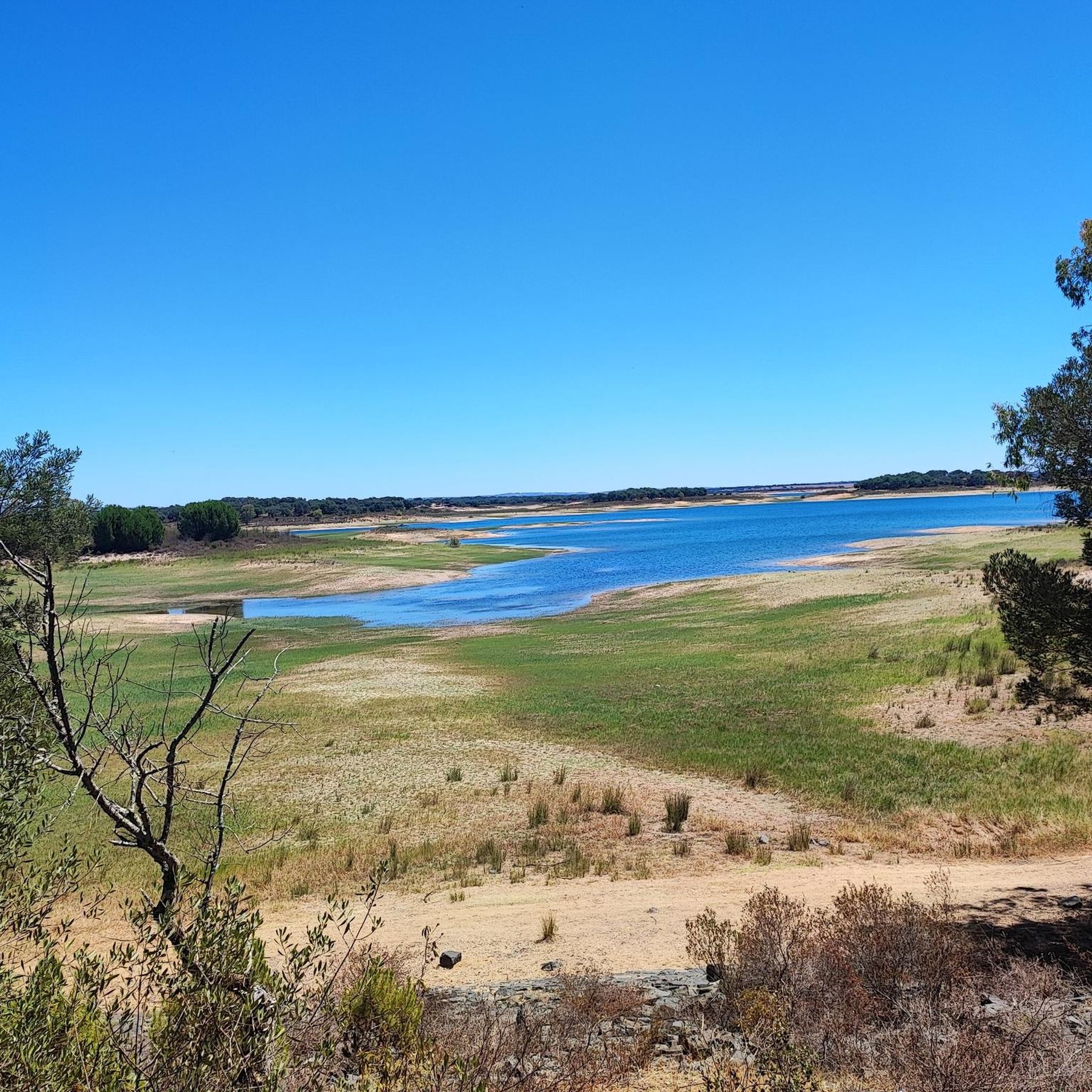
Built on the bed of the Odivelas river and located near the village of the same name, the Odivelas dam is one of the largest dams in the Baixo Alentejo. Approximately 5 km long, 3 km wide, and with a flooded area of approximately 970 ha, the Odivelas reservoir is an important gathering point for a variety of aquatic birds. Here you can fish for bass, practice water sports or simply relax and enjoy a light meal in the picnic area in the leisure area.
7
1
The Odivelas Dam was the first Zagope project work, it is located in Baixo Alentejo, in the municipality of Ferreira do Alentejo, in Portugal. It was built on the riverbed of Odivelas River and came into operation in 1972. The water stored in the dam is mainly used for irrigation. The dam is 48 meters high and has a capacity of 96 million m³.
6
1

In Praça da República, in the center of Alvito, you will find this bandstand, which was once the stage for philharmonic band concerts. The lower part currently houses public and accessible toilets.👍🇵🇹
18
0
Very interesting bandstand, located in the center of Praça da República.
3
0
Frequently Asked Questions
What historical and religious sites can I visit in Vila Nova da Baronia?
Vila Nova da Baronia is rich in historical and religious architecture. You can explore the 13th-14th century Igreja Matriz de Vila Nova da Baronia, the Capela de Santa Ágata with its valuable frescoes, and the Igreja da Misericórdia. Other notable sites include the Pelourinho de Vila Nova da Baronia, a national monument, and the ancient Ponte do Azinhal (Roman Bridge) just outside town.
Are there any castles or palaces to visit near Vila Nova da Baronia?
Yes, you can visit the impressive Alvito Castle and Pousada, a renovated 15th-century castle combining Islamic, Gothic, and Manueline architectural styles. It now functions as a guesthouse with gardens and a swimming pool. Another significant historical site is the Henriques Palace, known as the place where the Treaty of Alcaçovas was signed in 1479.
What unique attractions are available for visitors?
A truly unique attraction is the Shell Garden. This medieval garden features two chapels with interiors lined with shells, and its adjacent garden showcases colorful designs made from shells and shards of old porcelain.
What natural features or outdoor areas are there to explore?
The Odivelas Reservoir is a significant man-made lake on the Odivelas river, offering opportunities for fishing, water sports, and relaxation. It's also an important gathering point for aquatic birds. The surrounding Baixo Alentejo region is characterized by picturesque rural scenery, with landscapes of cork oaks, olive trees, and wheat fields.
Are there family-friendly activities or attractions?
Many attractions around Vila Nova da Baronia are suitable for families. The Odivelas Reservoir is great for outdoor recreation, and the Shell Garden offers a whimsical experience. Historical sites like Alvito Castle and Pousada and Henriques Palace also welcome families.
What kind of hiking trails are available near Vila Nova da Baronia?
You can find a variety of hiking trails in the area. For example, there's an easy 6.4 km loop from Alcáçovas connecting the Shell Garden and Henriques Palace. Moderate trails include the 13.3 km 'Odivelas, Alentejo – Almond Orchard loop' from Markadia, and the 13.9 km 'Olive Grove – Odivelas Reservoir loop' from Odivelas. For more options, explore the Hiking around Vila Nova Da Baronia guide.
Can I go road cycling near Vila Nova da Baronia?
Yes, the region offers several road cycling routes. You can find challenging rides like the 117.3 km 'Serra de Vila Nova – Castle of Beja loop' from Beja, or the 115.3 km 'Portas de Aljustrel – al-Mu’tamid Memorial loop' from Alvito. For a comprehensive list of routes, check the Road Cycling Routes around Vila Nova Da Baronia guide.
What is the best time to visit Vila Nova da Baronia for outdoor activities?
The Baixo Alentejo region, where Vila Nova da Baronia is located, experiences hot summers. Spring and autumn generally offer more pleasant temperatures for outdoor activities like hiking and cycling, allowing you to comfortably explore the historical sites and natural landscapes.
Are there any accessible attractions in the area?
The Alvito Bandstand in Praça da República, Alvito, features public and accessible toilets in its lower part, making it a convenient stop. While specific accessibility details for all historical buildings vary, many town centers and main squares are generally navigable.
What kind of terrain can I expect on trails around Vila Nova da Baronia?
The region is part of the Alentejo plain, characterized by generally flat to gently rolling terrain. Trails often pass through agricultural landscapes with cork oaks, olive groves, and wheat fields. While some routes might have moderate elevation changes, extreme mountainous terrain is not typical.
What do visitors enjoy most about the attractions in this region?
Visitors appreciate the rich historical and cultural heritage, particularly the well-preserved religious buildings and castles. The unique artistic decoration of sites like the Shell Garden and the historical significance of places like Henriques Palace are frequently highlighted. The tranquil natural setting of the Odivelas Reservoir also receives positive feedback for relaxation and birdwatching.
Most popular routes around Vila Nova Da Baronia
Most popular attractions around Vila Nova Da Baronia

Get inspired with the komoot mobile app


Explore more
Still not found the Highlight you’re looking for? See guides of the top attractions in other regions:
