The best cycling routes around Vermoim
4.4
(354)
2,926
riders
134
rides
Touring cycling around Vermoim, located in Vila Nova de Famalicão, Portugal, offers access to diverse landscapes suitable for cycling. The region features rural areas, agricultural fields, and forest paths, with green valleys and riverine environments characteristic of the Minho River region. Terrain includes flat sections along old railway lines and gentle inclines through agricultural areas. The area benefits from proximity to the Ave River and the Atlantic coast, providing varied cycling experiences.
Best touring cycling routes around Vermoim
- The most…
Last updated: October 16, 2026
4.8
(15)
93
riders
16.1km
01:01
130m
130m
Easy bike ride. Great for any fitness level. Mostly paved surfaces. Suitable for all skill levels.
28
riders
54.4km
04:31
910m
910m
Hard bike ride. Very good fitness required. Mostly paved surfaces. Suitable for all skill levels.

18
riders
28.5km
02:16
410m
410m
Moderate bike ride. Good fitness required. Mostly paved surfaces. Suitable for all skill levels.
14
riders
62.8km
03:56
560m
560m
Hard bike ride. Very good fitness required. Mostly paved surfaces. Suitable for all skill levels.
4.0
(1)
12
riders
24.3km
02:01
250m
250m
Moderate bike ride. Good fitness required. Mostly paved surfaces. Suitable for all skill levels.
Get access to more routes and recommendations from other explorers.
Already have an account?
Our route recommendations are based on thousands of hikes, rides, and runs completed by other people on komoot.
Start today with a free account
Your next adventure awaits.

Tips from the Community

Definitely the best part of the route. Beautiful scenery and a well-maintained path.
0
0

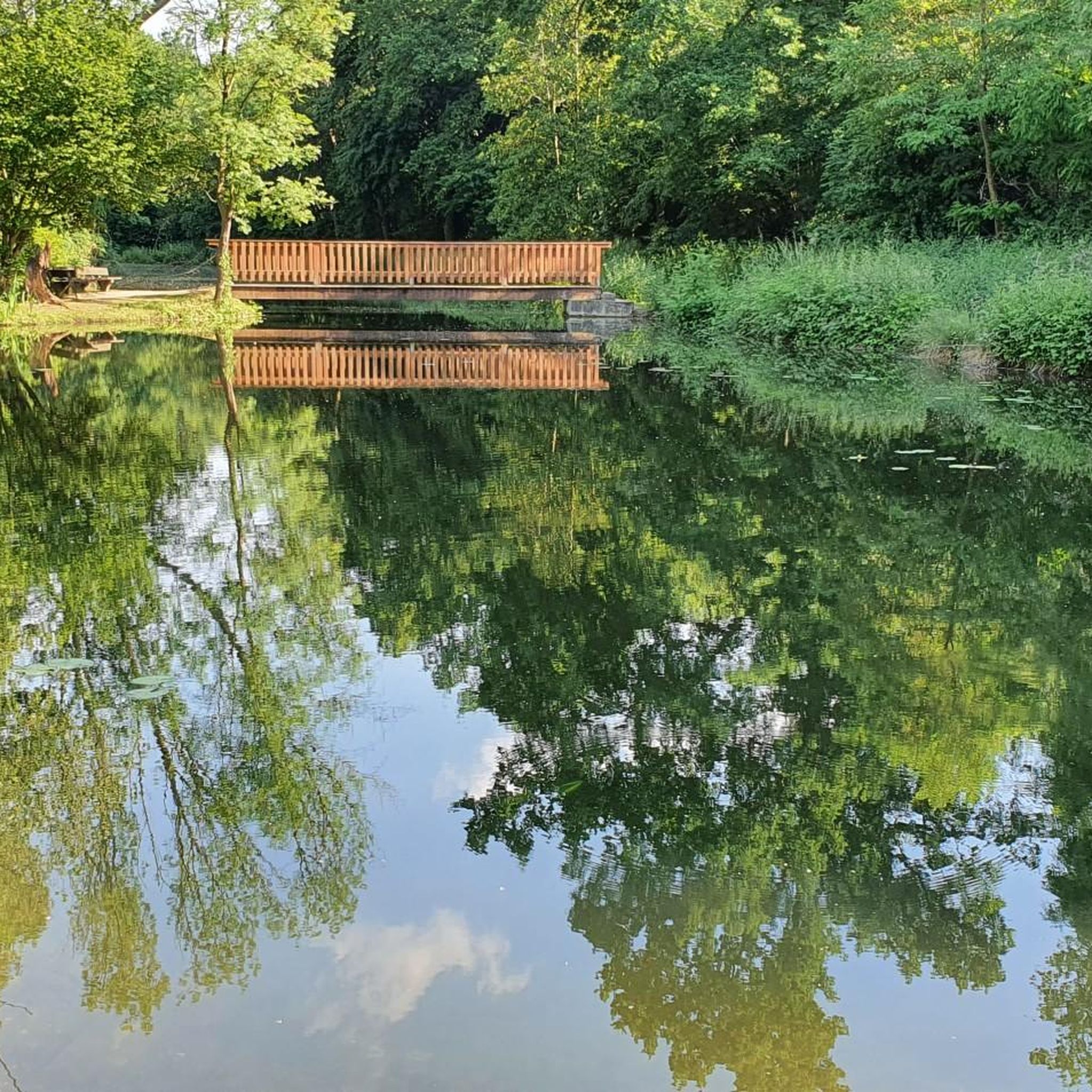
The Dom Zameiro Bridge crosses the Ave River in a bucolic setting of vineyards and fields, connecting the parishes of Bagunte and Macieira da Maia. Although reminiscent of Roman architecture, its origins date back to the 12th or 13th centuries. Part of the old Via Veteriz, the medieval road that connected Porto to Barcelos and Esposende, it continues to welcome pilgrims today, with a small resting place. Windmills and a rural house complete the serene picture of a place where time seems to slow down.
1
0


Very good course. It has technique and speed and a top track.
0
0

trail in the middle of the forest but very pleasant
0
0

Unique place with excellent landscape and tranquility
1
0
The work entitled “Monument to the Farmer” was designed by Teresa Salgueiro and was inaugurated in 1982. Later, in 2000, it received an architectural setting designed by the architect João Portugal. The sculpture is located in Praça Domingos Nogueira da Costa, also known as “Rotunda do Lavrador”. The “Monument to the Farmer” is a tribute from the municipality to one of the most important professions in the entire city. Having been a rural city, agriculture was one of the main economic activities in Maia. This sculpture serves as a reminder of the city’s rural past, and highlights the image of the city’s farmers. According to Cátia Raquel da Hora e Silva, who wrote the dissertation “Sculpture in the public space of the municipality of Maia. Heritage appreciation and dissemination”, the architectural setting designed by João Portugal led to the “appearance of several elements associated with agricultural activity itself, including the wine press, the vine, trees and a cage for the turtledoves”. “The farmer appears to be calm and focused on his work of sowing. With his right leg in front of his left leg, the farmer appears to be moving while he sows. His body is thin and tall, and his right arm seems disproportionate to his body; the opposite arm is holding a basket of potatoes at his waist,” describes Cátia Raquel da Hora e Silva.
0
0
Based on the classic concept of the Arc de Triomphe in three volumes, it nevertheless reflects the simplicity and rectitude of the people of Maia when it uses smooth planes and rectilinear shapes. The side volumes, contrary to what is normal, have openings in a different direction from the central volume, which evokes a pluralism of visions and perspectives that has always been the prerogative of the Maiatos, as well as a unified vision of development, regardless of the cardinal point of the Maia territory. The raw materials also evoke two of its basic characteristics: bronze, which recalls religiosity, but also strength, tenacity and resistance, the paradigm of which is that of church bells; gold recalls the nobility of the Maiatos, but also the dominant colour of the corn cobs, a source of food and the wealth of this fertile land. The three volumes correspond to three fundamental pillars of the Maiata idiosyncrasy: religiosity, work and rural popular culture. The insertion of volumes with rectilinear shapes in a circular space such as the roundabout evokes the foreseen and planned rupture that Maia has experienced since the 1970s, which led to the municipality, from a very modest plan, becoming one of the five most important municipalities in the country, ceasing to be a rural municipality to become truly urban, without however losing the positive aspects of rurality: work, honesty, spirit of sacrifice, volunteerism, love for the land. These characteristics were the reason for the triumph of the people of Maia. A triumph that is embodied and embodied in some immortal winners, such as Lidador, Viscount Barreiros and Doctor José Vieira de Carvalho, as will be in the future all those who are capable, today, of learning from these examples and of building the future based on the foundations of the work and example of these builders of Maia. It celebrates the selfless effort of our People in the construction of our Land, and expresses the triumph of their work, which is clearly evident in the development that the municipality is experiencing.
1
0
Frequently Asked Questions
How many touring cycling routes are available around Vermoim?
There are over 160 touring cycling routes around Vermoim, offering a wide variety of options for different skill levels and preferences. This includes 25 easy routes, 71 moderate routes, and 65 difficult routes.
What kind of terrain can I expect on touring cycling routes in Vermoim?
The terrain around Vermoim is quite diverse. You'll find a mix of rural areas, agricultural fields, and forest paths. Many routes feature green valleys and riverine environments, characteristic of the Minho River region. Notably, the Famalicão–Póvoa de Varzim cycle path, built on an old railway line, is largely flat with both macadam and asphalt surfaces, making it very accessible.
Are there any family-friendly touring cycling routes in the area?
Yes, Vermoim offers several family-friendly options. The Famalicão–Póvoa de Varzim cycle path is particularly suitable for families due to its flat profile and well-maintained surfaces. It's about 28-30 kilometers long and provides a pleasant ride through diverse surroundings, including vineyards and pine trees, connecting the rural interior to the Atlantic coast.
What are some notable natural features or viewpoints I can encounter on a touring bike ride?
You can experience green valleys and crystal-clear rivers, especially along the Ave River. The Famalicão–Póvoa de Varzim cycle path offers views of vineyards and pine trees, eventually leading to the Atlantic coast. For a route with varied terrain and river views, consider the Alvarelhos Hillfort – Rio Onda Trail loop from Fórum Maia, which takes you along the Rio Onda.
Are there any historical or cultural landmarks accessible by touring bike?
Absolutely. The region is rich in history. You could plan a route to visit the Monastery of São Bento (Santo Tirso), a National Monument founded in 978, located on the left bank of the Ave River. Additionally, some routes pass through charming localities like Amorim, Terroso, and Rates, allowing you to experience local life. For specific historical sites, you might encounter highlights such as the Fort of Saint Francis Xavier (Cheese Castle) or the Praça da Sé ⛪ Porto Cathedral if your route extends towards Porto.
What is the best time of year for touring cycling in Vermoim?
Northern Portugal, where Vermoim is located, generally offers pleasant cycling conditions for much of the year. Spring and autumn typically provide mild temperatures and beautiful scenery, ideal for touring. Summer can be warm, especially inland, but coastal routes benefit from sea breezes. Winter is generally mild but can bring more rain.
Can I combine touring cycling with public transport in Vermoim?
Yes, the area has good intermodal connections. The Famalicão–Póvoa de Varzim cycle path, for example, links directly to the Vila Nova de Famalicão train station and the Porto Metro station in Póvoa de Varzim. This makes it convenient to access the start or end points of routes, or to extend your journey using public transport.
What do other touring cyclists enjoy most about the routes around Vermoim?
The touring cycling routes around Vermoim are highly rated by the komoot community, with an average score of 4.5 stars from over 349 reviews. Cyclists often praise the diverse landscapes, from rural paths to coastal views, and the variety of routes suitable for different abilities. The well-maintained paths, like the Famalicão–Póvoa de Varzim cycle path, are frequently highlighted for their accessibility and scenic beauty.
Are there any challenging routes for experienced touring cyclists?
Yes, for more experienced touring cyclists, there are several challenging routes. An example is the Lidador Statue loop from Fórum Maia, which is a difficult 53.1 km path with significant elevation changes. Another demanding option is the Water mills on the Rio Ave – Quincentennial Carrack loop from Parque Maia, covering 63.1 km with notable ascents.
Are there any circular touring cycling routes available?
Many touring cycling routes around Vermoim are designed as loops, offering convenient circular journeys. For instance, the Ecovia do Leça – Mosteiro de Leça do Balio loop from Fórum Maia is an easy 16.1 km circular route. For a moderate option, consider the Matosinhos Beach – Anemone by Janet Echelman loop from Fórum Maia, which offers coastal views on a 38.0 km loop.
What kind of natural attractions can I expect to see along the routes?
The region is characterized by green valleys and crystal-clear rivers, particularly near the Minho and Ave rivers. You'll also find agricultural fields and forest paths. The coastal routes, like those connecting to Póvoa de Varzim, offer views of the Atlantic. While not directly in Vermoim, the broader region is part of the Vinho Verde wine region, meaning you might cycle through scenic vineyards.
Are there any specific points of interest or landmarks I should look out for?
Beyond the natural beauty, you can find several points of interest. The Dom Luís I Bridge and the São Bento Station are notable architectural highlights if your route takes you towards Porto. Along the coast, you might pass the Wooden Walkway Along the Portuguese Coastal Way or the Ribeira Promenade along the Douro River.
Most popular routes around Vermoim
Most popular attractions around Vermoim

Get inspired with the komoot mobile app


Explore more
Browse the best Cycling routes in other regions.
