The best cycling routes around Oura
5.0
(2)
33
riders
7
rides
Touring cycling routes around Oura are situated in a region characterized by rolling hills, river valleys, and historical landmarks. The terrain features varied elevations, with routes often traversing through rural landscapes and past traditional villages. This area offers a mix of moderate and challenging paths, suitable for cyclists seeking diverse gradients and scenic views.
Best touring cycling routes around Oura
- The most popular touring cycling route is Camillo Station – Roman Bridge of Chaves loop from Vidago, a 27.4…
Last updated: August 25, 2026
9
riders
52.6km
03:24
690m
690m
Hard bike ride. Very good fitness required. Mostly paved surfaces. Suitable for all skill levels.
7
riders
23.9km
01:39
450m
450m
Moderate bike ride. Good fitness required. Mostly paved surfaces. Suitable for all skill levels.

Sign up for free
4
riders
63.8km
04:26
1,030m
1,030m
Hard bike ride. Very good fitness required. Mostly paved surfaces. Suitable for all skill levels.
5.0
(2)
6
riders
Hard bike ride. Very good fitness required. Mostly paved surfaces. Suitable for all skill levels.
5
riders
19.2km
01:12
210m
210m
Moderate bike ride. Good fitness required. Mostly paved surfaces. Suitable for all skill levels.
Get access to more routes and recommendations from other explorers.
Sign up for free
Already have an account?
Our route recommendations are based on thousands of hikes, rides, and runs completed by other people on komoot.
Start today with a free account
Your next adventure awaits.
Login or Signup
Popular around Oura

Tips from the Community

Town on the iconic EN2 road and the Ecopista do Corgo
0
0

The Roman Baths Museum, recently opened, is a must-see. It is located in Largo do Arrabalde, very close to the current baths. It is the largest Roman bath complex in the Iberian Peninsula. What makes this museum special is that, after an earthquake in the 4th century, the structures collapsed and remained "frozen" in time until they were rediscovered a few years ago. You can see the huge original stone pools where Roman legionaries bathed 2,000 years ago. The Roman Baths Museum What to see: It is the largest Roman bath complex in the Iberian Peninsula. What makes this museum special is that, following an earthquake in the 4th century, the structures collapsed and remained "frozen" in time until they were rediscovered a few years ago. You can see the huge original stone pools where Roman legionaries bathed 2,000 years ago.
0
0
Fort of São Francisco (The Main One) This is the fort that dominates the city skyline and where the statue of General Silveira is located. What it is today: It has been magnificently restored and operates as a 4-Star Hotel, but the historical area is open to visitors. Why visit: History: It was here that General Silveira besieged and defeated Napoleon's troops in 1809. Interior: You can enter (entry to the courtyard is free) and see the Church of São Francisco. Originally a convent, the church houses the tomb of the first Duke of Braganza. Views: The ramparts offer an incredible panoramic view over the city and the Tâmega River.
0
0
Visiting the Castle of Chaves is worth it because it is, quite literally, the high point of the city—both in altitude and in history. Although "only" the imposing Keep (Torre de Menagem) and parts of the walls remain from the original grand defensive system, a visit is a must for these 4 reasons: 1. The Best View in the City Climbing to the top of the Keep (about 28 meters high) offers an unmatched reward. The Panorama: From there, you have a 360º view over the old rooftops, the Tâmega River winding below, the Roman Bridge, and the Brunheiro and Larouco mountains in the distance. It is the best place to understand the city's geography. 2. The Military Museum (A Journey Across 4 Floors) The tower is not empty. The interior has been transformed into a very interesting Military Museum (and the ticket is almost symbolic, usually costing around €1). As you climb the stairs, you pass through four themed floors showing the evolution of weaponry, from the Middle Ages to World War I. It is fascinating to see armor, swords, and uniforms in an authentic stone setting, which helps you imagine the lives of the soldiers who defended the border there. 3. The Castle Garden The tower is surrounded by a beautifully kept garden, which functions as an open-air museum. It is a peaceful space, full of flowers, where you can see Roman and medieval archaeological pieces displayed on the lawns. It is the ideal spot for a break in the shade after walking through the city. 4. A History of Resistance This castle is a symbol of Portugal's independence. Given its proximity to Spain (only 10 km away), Chaves was always the "Key to the Kingdom." Visiting the castle means standing on ground where countless battles were fought to keep the border safe against Castilian and French invasions. The climb is done via stairs (there is no elevator), but the view from the top makes up for every step. Try to go near the end of the day, when the setting sun hits the stones of the tower and the city below, creating a spectacular golden color.
3
0
The Bridge of Trajan (often simply called the Roman Bridge) is, without a doubt, the most important monument in Chaves. It is worth visiting because it is not just an "old stone bridge"; it is a masterpiece of engineering that defines the city's identity. Here are the 4 main reasons why: 1. Walking on 2,000 Years of History This is one of the best-preserved Roman bridges in the entire Iberian Peninsula. It was built between the late 1st and early 2nd century AD, during the reign of Emperor Trajan. The Feeling: Crossing it on foot (cars are forbidden) means you are literally walking on the same stones as Roman legions, medieval merchants, and Napoleonic troops. It is an instant trip back in time. 2. Engineering that Defies Time It is worth looking closely at the structure to understand why it is still standing. The Tâmega River is known for its violent floods, yet the bridge has withstood them for two millennia. The Secret: If you go down to the riverbank, notice the cutwaters (the triangular structures at the base of the pillars). They were designed to "cut" the force of the water and prevent the bridge from collapsing. It is a live lesson in ancient architecture. 3. The Stones that "Speak" (Milestones) In the middle of the bridge, you will find two cylindrical stone columns (milestones) with Latin inscriptions. One of them is particularly important: the "Padrão dos Povos" (Standard of the Peoples). The inscription lists the 10 local tribes of the region (the "Aquiflavienses") who contributed to the construction of the bridge. It is a historical document carved in stone that has survived to this day. 4. The Photogenic Scenery The bridge connects the historic center to the Madalena neighborhood and is set within a beautiful public garden (Jardim do Tabolado). It is the perfect spot to watch the sunset, seeing the reflection of the arches in the water with the Castle of Chaves dominating the landscape high above. Visitor Tip: After crossing the bridge coming from the historic center, turn left and walk along the landscaped riverbanks. There are stepping stones (pedras poldras) nearby in the water that allow you to see the grandeur of Trajan's Bridge from an impressive low angle.
2
0

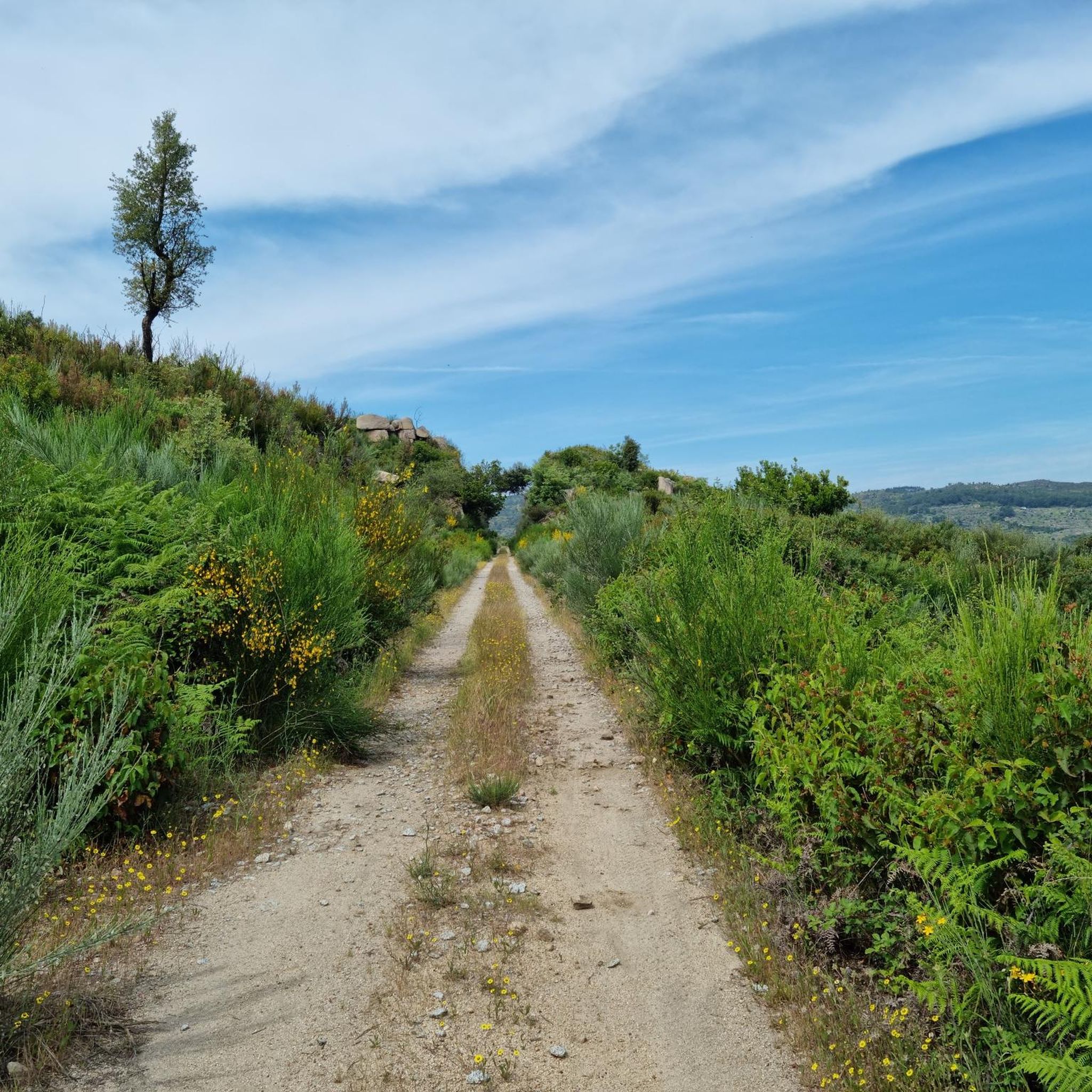
Well-developed even red and yellow colored bicycle and walking paths
3
0

Chaves Castle was built in the 9th century by Alfonso III of León to reinforce the city's defenses during the Christian Reconquest. Over the centuries, it has undergone several renovations. It can be visited for just one euro.
6
0

The Pedras Salgadas Railway Station is a closed junction of the Corgo Line, which served the town and the spa of Pedras Salgadas, in the Vila Real District, Portugal. A decree of 13 September 1905 approved the project for the section between Ribeiro de Varges and Pedras Salgadas Station.[ The section between Vila Real and Pedras Salgadas of the Corgo Line was opened on 15 July 1907, while the next section, to Vidago, opened on 20 March 1910.
0
0
Frequently Asked Questions
How many touring cycling routes are available in Oura?
There are 9 touring cycling routes documented in Oura, offering a variety of experiences for cyclists. These routes are highly rated by the komoot community, with an average score of 4.75 stars.
What is the general terrain and difficulty level for touring cycling in Oura?
Touring cycling routes in Oura are characterized by rolling hills and river valleys, featuring varied elevations. The terrain offers a mix of moderate and challenging paths, suitable for cyclists seeking diverse gradients and scenic views. For example, the Camillo Station – Pedras Salgadas N2 30 loop from Capeludos is a difficult route with significant elevation changes.
What landmarks or viewpoints can I expect to see on Oura's touring cycling routes?
The routes in Oura often traverse through rural landscapes and past traditional villages, incorporating historical landmarks. A notable example is the Camillo Station – Roman Bridge of Chaves loop from Vidago, which includes the historic Roman Bridge of Chaves. Another route, the Camillo Station – Castle of Chaves loop from Redondelo, passes by the Castle of Chaves, offering historical insights and scenic views.
When is the best time of year for touring cycling in Oura?
Given Oura's location in Portugal, the region generally benefits from a pleasant climate. While specific seasonal data for this Oura is not available, the broader Portuguese region is known for around 300 days of sunshine annually. Spring and autumn typically offer the most comfortable temperatures for cycling, avoiding the peak heat of summer and potential chill of winter.
Are there family-friendly touring cycling routes in Oura?
While the guide highlights routes with moderate to difficult ratings, the Camillo Station loop from Oura is a moderate 14.9-mile (23.9 km) trail that takes about 1 hour 39 minutes, which might be suitable for families with some cycling experience. It's always recommended to check the route details for elevation and terrain to ensure it matches your family's ability.
Are there circular touring cycling routes available in Oura?
Yes, many of the touring cycling routes in Oura are designed as loops. Examples include the Camillo Station – Roman Bridge of Chaves loop from Vidago, the Camillo Station – Pedras Salgadas N2 30 loop from Capeludos, and the Camillo Station loop from Oura, all of which offer circular paths.
What do other touring cyclists enjoy the most about touring cycling in Oura?
The area is highly rated by the komoot community, with an average score of 4.75 stars from over 10 reviews. Reviewers often praise the diverse gradients and scenic views found along the routes, as well as the opportunity to explore rolling hills, river valleys, and historical sites.
Are there any easy touring cycling routes in Oura for beginners?
The guide indicates that Oura's routes range from moderate to difficult. While there are no routes explicitly classified as 'easy', the Camillo Station loop from Oura is a moderate 14.9-mile (23.9 km) route with a duration of about 1 hour 39 minutes, which could be a good starting point for beginners looking for a less strenuous option compared to the more challenging paths.
What are some of the longer touring cycling routes in Oura?
For those seeking longer rides, the Camillo Station – Castle of Chaves loop from Redondelo covers 38.9 miles (62.7 km) and the Fort of São Francisco – Camillo Station loop from São João da Corveira is 37.6 miles (60.6 km). These routes are classified as difficult due to their length and elevation changes.
Are there options for parking or public transport access to Oura's cycling routes?
While specific parking facilities or public transport links for individual trailheads are not detailed in the guide, many routes start from towns or villages like Vidago, Capeludos, Oura, Redondelo, and São João da Corveira. These locations typically offer some form of parking. For detailed public transport information, it's advisable to check local transport services for the specific starting point of your chosen route.
Can I find cafes or accommodation along the touring cycling routes in Oura?
The touring cycling routes in Oura often pass through traditional villages and rural landscapes. It is likely that you will find opportunities for refreshments in these villages. For accommodation, larger towns like Chaves, which is near some of the mentioned routes, would offer more options. It's recommended to plan your stops in advance, especially on longer routes, to ensure availability.
Most popular routes around Oura

Get inspired with the komoot mobile app


Explore more
Browse the best Cycling routes in other regions.
