Top 19 Castles around Falkenstein
Castles around Falkenstein offer a journey through historical landscapes, primarily featuring castle ruins and historical sites in the Upper Palatinate region of Bavaria. The area is characterized by its elevated positions, providing viewpoints over surrounding valleys and natural scenery. Visitors can explore remnants of medieval fortifications, often integrated into hiking trails through forests and hills. This region provides insights into past architectural styles and strategic locations.
Best castles around Falkenstein
- The most popular castles is Lobenstein Castle Ruins, a…
Last updated: May 11, 2026
Brennberg Castle
Highlight • Castle
You should climb the steps to the watch tower, from there you have a magnificent view of Brennberg and the surrounding area
Translated by Google •
Tip by

Lobenstein Castle Ruins
Highlight • Castle
Translated by Google •
Tip by

Sign up now to discover places like this
Get recommendations on the best single tracks, peaks, & plenty of other exciting outdoor places.
Sign up for free
Heilsberg Castle Ruins
Highlight • Castle
Translated by Google •
Tip by
Sengersberg Castle Ruins
Highlight • Castle
Translated by Google •
Tip by

Wörth an der Donau Castle
Highlight • Castle
Translated by Google •
Tip by

Sign up for free to discover even more castles around Falkenstein.
Sign up for free
Already have an account?
Start today with a free account
Your next adventure awaits.
Login or Signup
Popular around Falkenstein
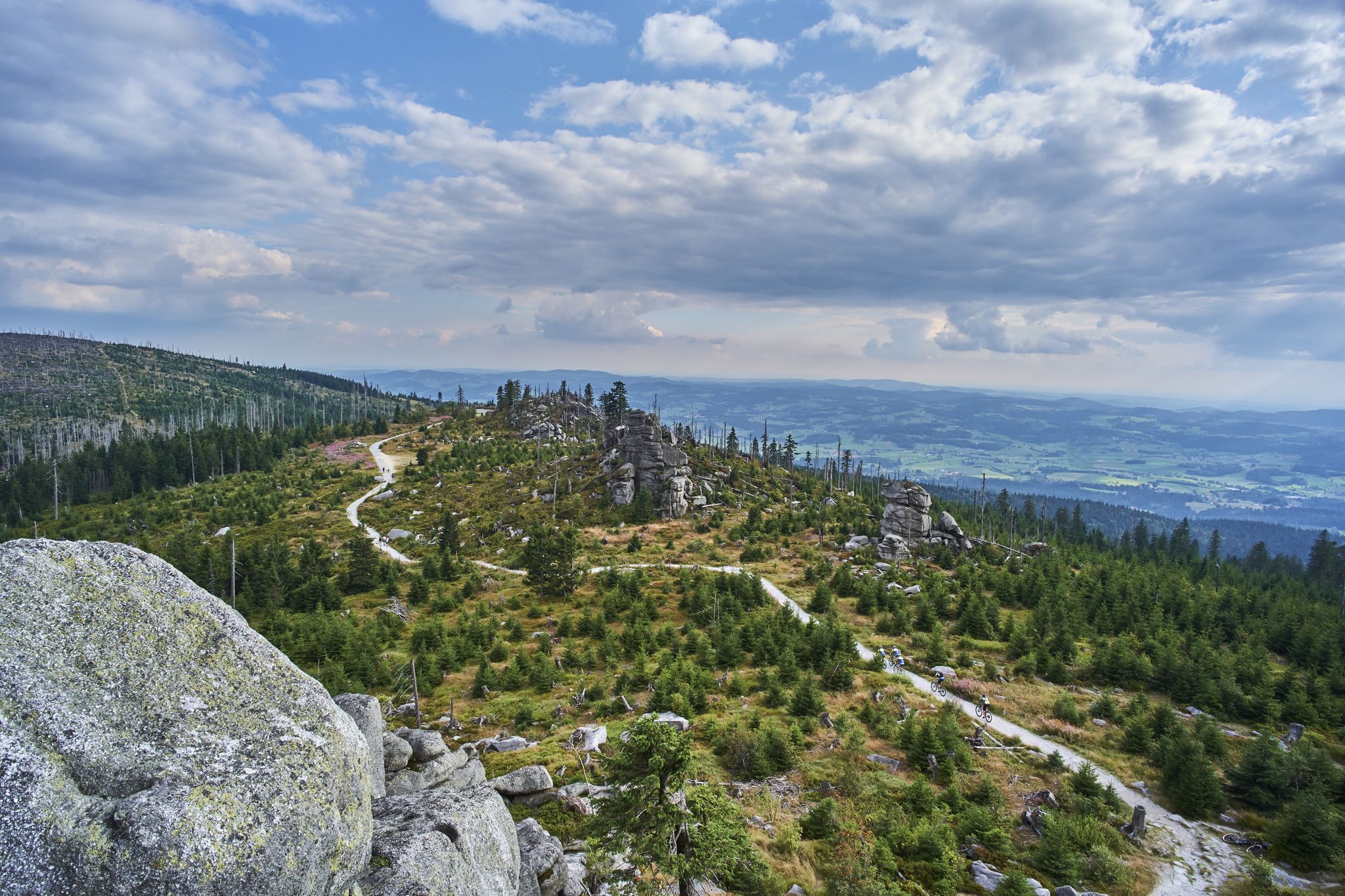
Trans Bayerwald – A mountain bike adventure through Bavaria's finest nature
The Goldsteig – 38 stages between Upper Palatinate and Passau
Goldsteig — The best routes for long distance hiking in Eastern Bavaria
Hiking around Falkenstein
Cycling around Falkenstein
MTB Trails around Falkenstein
Running Trails around Falkenstein
Road Cycling Routes around Falkenstein
Gravel biking around Falkenstein
Mountain Hikes around Falkenstein
Other adventures around Falkenstein


Tips from the Community

Great place, in some places you can still see castle walls.
0
0


Few remains of the ruins, but very beautiful and photogenic.
0
0

Super beautiful, but also very strenuous uphill
0
0

Beautiful place with a summit cross, the climb is not entirely without danger, there is a fall protection secured with a chain. The ruins are very overgrown and can hardly be really seen anymore.
0
1

Lobenstein Castle Ruins Around 1150, Othmar and Rizman von Lobeneck appear in local documents as ministerials of the Margrave of Cham. It is uncertain whether the nobility was referring to the later Lobenstein Castle. We are on safe ground in 1340, when Eberhard von Hof buys an existing "purkstal near Zelle" from Eiban von Peilstein and receives permission from Emperor Ludwig the Bavarian to build there in return for the right to open it. From 1342, Eberhard calls himself Hofer von Lobenstein. He manages a Hofmark in Zell for Bavaria and appoints judges there. After the castle is destroyed by the Hussites at the beginning of the 15th century, the Hofers run into financial difficulties and become robber barons. In 1443, Duke Albrecht III of Bavaria occupied the castle because Degenhard Hofer had killed some of his subjects. Hans Hofer's part of the castle was taken away from him by Count Palatine Otto II in 1468 for similar crimes. From 1489, Dietrich Hofer was a member of the Löwler Knights' League, which opposed the Bavarian Duke. He conquered the castle and only returned it to Dietrich's son Wolf in 1507. In 1530, Lobenstein became part of the Palatinate, but after the damage it was probably never properly inhabited again. The Hofers remained the owners because nobody wanted to buy the ruins. The last Hofer to live in Lobenstein was Hans Georg, who had to leave his domain in 1629 because of his Protestant faith. The Bavarian-occupied Lobenstein Castle was probably finally destroyed by the Swedes in 1633. It has remained a ruin ever since. All that is left of Lobenstein Castle today is the residential tower, which seems to literally grow out of the stone of the granite rock tower. The slightly raised entrance was protected by a round wall tower on the southeast corner. Instead of simple beamed ceilings, barrel vaults were built on Lobenstein with plaster that is still clearly visible today. The residential tower has 3 floors and is 18 m high with a wall thickness of 2.5 m. The walls are built from rough rubble stone and the corners are made of ashlars. In the lower regions between these rocks, remains of walls can still be found that stand out clearly from the rest and could have come from the previous castle. In the basement there are a few narrow light slits, while the larger windows on the upper floors have comfortable seating niches. On the northwest corner of the second floor, the consoles of a toilet bay can still be seen. Source: Excerpts from www.burgenseite.de
3
0
Heilsberg Castle Ruins In the last third of the 12th century, Ulrich and Wernhardus from Heilsberg appeared in documents for the first time. Since Ulrich's successor Ekbert, they were also vassals of Eggmühl and fiefs of the Bavarian duke. They were thus in the middle of the power struggle between the Wittelsbach dukes and the Regensburg bishops. In a contract, Duke Ludwig of Kelheim had to give up a castle that was already under construction near Heilsberg, which the Heilsbergers were obviously supposed to receive as a fief. Over the course of the 13th century, Ekbert and his son Ulrich repeatedly tried to use their bailiwick rights to alienate property from the bishop. The bishop accused them of forcing their subjects to perform unjust feudal labor in order to illegally expand their castle. In addition, the Heilsbergers had bloody feuds with the Paulsdorfers and with Konrad von Hohenfels. In the first third of the 14th century, the male line of Heilsberg died out, followed by a series of owners, including the powerful Upper Palatinate knightly family of Notthafft. It was not until around 1500 that the Wittelsbachs were finally able to take over the Heilsberg domain, and in 1505 it was assigned to the Palatinate-Neuburg line. The castle was probably already abandoned in the 16th century, and on Apian's map of 1568 it is already marked as a ruin. A local support group has recently been working to save the ruins. The most striking remains of the castle are the keep, which dates from around 1200 and has a side length of 7.5 meters with 2.5 m thick walls. This is evidenced by its masonry, which consists of smooth blocks and humped blocks with 5 to 10 centimetre wide edges; the ring wall fragment with the archway is so deep in the ground that it is almost impossible to date it. Among the later extensions to the castle that are known to have been made, there is also a new gate in 1498. In 1474, a new bridge and a new gate were built. In 1498, the castle was repaired after a fire, and work on the bower, the new parlor and the stables is known to have been carried out. Recently, the keep has been secured and renovated at great expense, and the buried interior of the tower has also been uncovered. The extremely deep, almost circumferential moat separates the castle grounds from the Heilsberg plateau on two sides. Source: Extracts from www.burgenseite.de / www./burgen/detail/burgruine-heilsberg/178
3
0

Somehow a mystical-looking place
0
0
Frequently Asked Questions
What are the most popular castles to visit around Falkenstein?
The komoot community highly recommends several castles in the region. Lobenstein Castle Ruins is a freely accessible former noble castle offering a beautiful vantage point from its lookout tower. Brennberg Castle is another popular ruin, also freely accessible, where climbing its watchtower provides magnificent views of Brennberg and the surrounding area. Visitors also appreciate Heilsberg Castle Ruins for its preserved keep and wall fragments, creating an enchanted atmosphere.
Are there family-friendly castles or activities around Falkenstein?
Yes, several castles around Falkenstein are suitable for families. Both Brennberg Castle and Lobenstein Castle Ruins are categorized as family-friendly. They are freely accessible and offer engaging historical exploration and scenic viewpoints that can be enjoyed by all ages. Exploring these ruins and climbing their towers provides an adventurous outing for families.
What kind of historical insights can I gain from visiting these castles?
The castles around Falkenstein offer a deep dive into medieval history. For instance, Brennberg Castle dates back to the early 11th century, showcasing its past as a Ganerbeburg (a castle owned by multiple families). Heilsberg Castle Ruins, with its 12th-century origins and 2.5-meter-thick walls, reveals the power struggles between Wittelsbach dukes and Regensburg bishops. Even the ruins of Sengersberg Castle Ruins, first mentioned in 1269, tell a story of episcopal and ducal ownership, offering a glimpse into the region's strategic importance.
Are there hiking trails near the castles around Falkenstein?
Absolutely! The castles are often integrated into hiking trails through forests and hills. For mountain hikes, you can explore routes like the 'Höllbachtal Trail – Höllbach Wooden Bridge loop' or the 'Lauberberg – Blick Marienstein loop from Falkenstein'. You can find more details and routes on the Mountain Hikes around Falkenstein guide page.
What outdoor activities are available in the Falkenstein region besides visiting castles?
Beyond castle exploration, the Falkenstein region offers a variety of outdoor activities. You can enjoy extensive road cycling routes, such as the 'Falkenstein Castle – View of Wörth Castle loop'. For mountain biking enthusiasts, there are numerous MTB trails, including the 'Tannerl Pilgrimage Chapel – Brennberg Castle loop from Falkenstein'. The area is also excellent for mountain hikes, with trails leading to scenic viewpoints and natural monuments.
What are the accessibility considerations for visiting the castle ruins?
Most of the castle ruins, such as Lobenstein Castle Ruins and Brennberg Castle, are freely accessible. However, accessing the watchtowers or certain parts of the ruins may involve climbing steps or navigating uneven terrain. For Sengersberg Castle Ruins, the ascent to the summit cross requires good surefootedness and grip, with stable chains provided for assistance. Wheelchair accessibility is generally limited due to the nature of historical ruins and hiking trails.
Can I visit Wörth an der Donau Castle?
Yes, Wörth an der Donau Castle, a proud structure dating back to the 16th century, can be visited. However, access is typically part of a guided tour. You can find more information about visiting hours and tour bookings on the official website of the town of Wörth an der Donau.
What kind of views can I expect from the castle ruins?
The castles around Falkenstein are often situated on elevated positions, providing excellent viewpoints. From Lobenstein Castle Ruins, you get a beautiful vantage point over the surrounding landscape. Climbing the watchtower at Brennberg Castle offers magnificent views of Brennberg and the wider area. Even from Sengersberg Castle Ruins, despite some overgrown sections, you can enjoy clear views to the north.
What do visitors enjoy most about the castles around Falkenstein?
Visitors particularly enjoy the historical atmosphere and the scenic beauty. Many appreciate the opportunity to ponder the history of the old walls and imagine life in medieval times. The panoramic views from the lookout towers are a major draw, as is the integration of these historical sites into beautiful hiking routes through forests and hills. The freely accessible nature of many ruins also makes them a popular choice for spontaneous exploration.
Are there any other notable 'Falkenstein' castles in Germany that are different from those in this guide?
Yes, it's important to note that several castles across Germany bear the name Falkenstein. While this guide focuses on castles *around* Falkenstein in the Upper Palatinate, other prominent ones include Burg Falkenstein in the Harz Mountains, known for its well-preserved medieval layout and falconry, and Burg Falkenstein near Pfronten in Bavaria, which is Germany's highest castle ruin and was King Ludwig II's last dream project. These offer different historical contexts and experiences.
What is the best time to visit the castles and go hiking in the Falkenstein region?
The region's castles and hiking trails are generally enjoyable from spring through autumn. These seasons offer pleasant weather for exploring the ruins and enjoying the natural scenery. While specific winter conditions can vary, some trails might be accessible, but it's always advisable to check local conditions for snow and ice, especially for routes involving steep ascents or uneven terrain like at Sengersberg Castle Ruins.
Most popular routes around Falkenstein
Most popular attractions around Falkenstein

Get inspired with the komoot mobile app


Explore more
Looking for the best castles somewhere else? Discover other guides around Falkenstein:
