The best cycling routes around Dam Starina
5.0
(7)
74
riders
3
rides
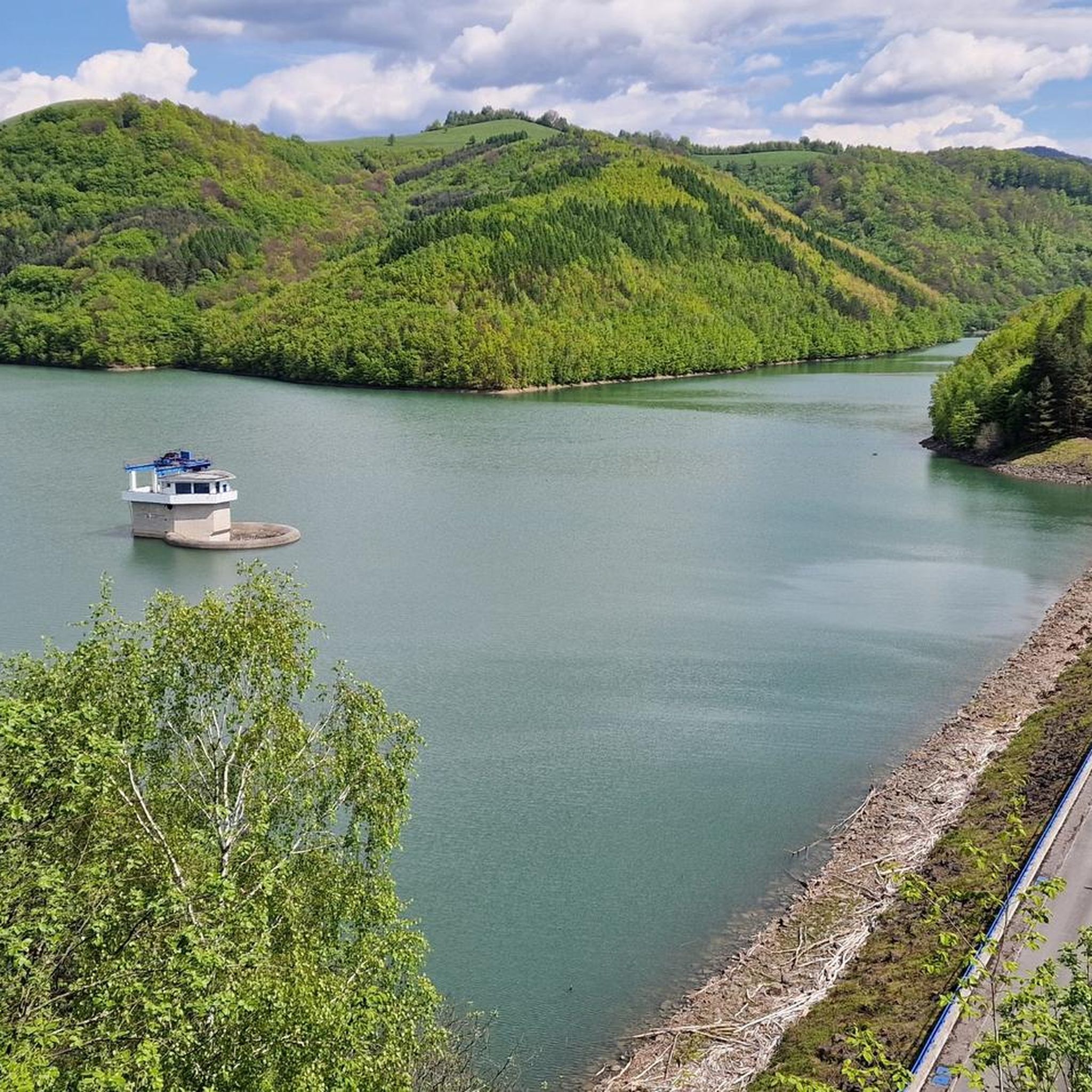
Touring cycling routes around Dam Starina are set within the Poloniny National Park, a UNESCO World Heritage Site known for its untouched wilderness and primeval beech forests. The region features the Starina reservoir, a significant water source, surrounded by diverse landscapes including lush groves and lively streams. Cyclists encounter varied terrain with notable elevation changes, characteristic of the Carpathian mountain range.
Best touring cycling routes around Dam Starina
- The most popular touring cycling route is Starina Reservoir – Porta Rusica…
Last updated: August 20, 2026
5.0
(4)
33
riders
55.4km
04:05
1,000m
1,010m
Hard bike ride. Very good fitness required. Mostly paved surfaces. Suitable for all skill levels.
5.0
(1)
7
riders
88.1km
06:21
1,270m
1,270m
Hard bike ride. Very good fitness required. Mostly paved surfaces. Suitable for all skill levels.

Sign up for free
6
riders
30.1km
02:04
480m
480m
Hard bike ride. Very good fitness required. Mostly paved surfaces. Suitable for all skill levels.
5.0
(1)
5
riders
65.5km
04:30
820m
820m
Hard bike ride. Very good fitness required. Mostly paved surfaces. Suitable for all skill levels.
5.0
(1)
4
riders
42.5km
03:29
1,090m
1,090m
Hard bike ride. Very good fitness required. Mostly paved surfaces. Suitable for all skill levels.
Our route recommendations are based on thousands of hikes, rides, and runs completed by other people on komoot.
Start today with a free account
Your next adventure awaits.
Login or Signup
Popular around Dam Starina
Tips from the Community


The Greek Catholic wooden church in the village of Kalná Roztoka was built in 1750. It is dedicated to the feast of the Nativity of the venerable and famous prophet of the Lord, the forerunner and baptist John. The wooden temple in Klaná Roztok was built in log style. The temple consists of a sanctuary, nave and vestibule. The vestibule has a tower with a dome and a three-armed cross. The shrine has a three-armed cross on its roof. The temple tower and the temple roof are covered with wooden shingles. This temple is unique in that its wooden walls are plastered inside and out and painted with lime in an attempt to protect the temple from adverse weather.
0
0
Wooden church of St. Michael the Archangel was built at the turn of the 17th and 18th centuries in the village of Topoľa. The temple of a log structure on a stone foundation is built on a slope and is surrounded by a cemetery. The three-room wooden church once stood at the lower end of the village, but in 1780 it was moved above the village of Topoľa, from where there is a beautiful view of the surroundings. The wooden temple has a massive roof in the shape of a truncated pyramid and has only one tower with a three-armed cross. The church bells are currently located in the brick church. The iconostasis from the middle of the 18th century is extremely valuable. It has a four-row architecture and a variety of colors. Part of the area is an empty wooden belfry, which was built in the 20th century. In the vicinity of the church there is a military cemetery that was established in 1917. 240 soldiers of the 44th Infantry Division of General Ziegler's 2nd Austro-Hungarian Army are buried in the cemetery.
0
0

Border crossing between Poland and Slovakia
0
0

Approximately 200-300 m of asphalt exit to the Slovak side. Then a road paved with flat stones begins
0
0

The cycle path ends before Snina. Here you can cross the river
0
0
Ruské (until 1927 Slovak Ruská; Hungarian Zemplénoroszi - until 1907 Oroszruszka)[1] is a former village in Okres Snina (Prešovský kraj) and today a cadastral municipality of Stakčín in eastern Slovakia. It is located in the Bukovské vrchy Mountains below the main Carpathian ridge in the source area of the Cirocha River and near the state border with Poland. The former town center lies at an altitude of 486 m above sea level, the distance to Snina is about 26 kilometers. The Pľaša National Nature Reserve extends to the east of the town,[2] the cadastral municipality as such lies entirely in the Poloniny National Park. The end of the town came with the construction of the Starina reservoir on the Cirocha further downstream in the 1980s. Although it was far from the flooded area, an extensive drinking water protection area meant that all villages in the upper Cirocha valley, including Ruské, had to be evacuated. In 1986, the displaced village was incorporated into Stakčín. Today, only the municipal cemetery, the military cemetery from the First World War, a chapel on the site of the demolished church from 1789 and three houses stand on the site of the former village. A stone road from 1861, the so-called Porta Rusica, leads to the Ruské sedlo saddle on the border with Poland.[5]
0
0
Porta Rusica stone road On the cadastral area of the former village of Ruské, in the area of the Starina reservoir, there is the Porta Rusica stone road, which has been declared a cultural monument. This road was built between 1861 and 1865 and originally led from Michalowiece through the Russian border crossing Sattel to the Polish town of Baligród, from where it probably continued to Lviv. The Porta Rusica stone road thus connected Hungary with Lesser Poland. It is the only road that has survived from this period in the territory of Slovakia. The Porta Rusica stone road is still preserved today on a section with a length of 4 km, with 16 bends and a height of 247 m. On the Polish side, it is only a short section, about 200 m long. Porta Rusica is also part of the tourist border crossing with Poland - Osadné - Balnica.
0
0
Frequently Asked Questions
What is the general difficulty level of touring cycling routes around Dam Starina?
The touring cycling routes around Dam Starina are generally considered challenging. For example, routes like the Starina Reservoir – Porta Rusica Stone Road loop from Jalová and the Starina Reservoir – Porta Rusica Stone Road loop from Stakčín feature significant elevation changes, characteristic of the Carpathian mountain range. The region's terrain offers rewarding views but requires a good level of fitness.
What kind of natural features can I expect to see while cycling near Dam Starina?
Cycling around Dam Starina immerses you in the stunning natural beauty of the Poloniny National Park, a UNESCO World Heritage Site. You'll encounter primeval beech forests, lush green groves, and lively streams. The area is also known for its abundant wildlife, including wild bison, and its designation as a Dark Sky Park offers exceptional stargazing opportunities.
Are there any specific cultural or historical landmarks along the cycling routes?
Yes, the region is rich in cultural and historical landmarks. The Starina Reservoir – Porta Rusica Stone Road loop from Stakčín includes a section of the historic Porta Rusica stone road, a cultural monument built between 1861 and 1865. You can also discover picturesque Ruthenian villages, wooden churches, and an Astronomical Observatory along various paths.
What is the best time of year for touring cycling in the Dam Starina area?
The best time for touring cycling around Dam Starina is generally from spring through autumn. During these seasons, the weather is more favorable, and the natural landscapes are at their most vibrant. The Poloniny National Park's unique forests and lush groves are particularly beautiful in spring and autumn.
Are there any circular touring cycling routes available?
Yes, several circular routes are available. Examples include the Starina Reservoir – Porta Rusica Stone Road loop from Jalová and the Poloniny Dark Sky Park – River Crossing loop from Snina. These loops allow you to start and finish at the same point, offering convenient exploration of the region.
What do other touring cyclists enjoy most about cycling in Dam Starina?
The area is highly rated by the komoot community, with an average score of 5.0 stars from more than 6 reviews. Reviewers often praise the untouched wilderness, the expansive Starina reservoir views, and the unique Primeval Beech Forests of the Carpathians. The challenging terrain and diverse landscapes are also frequently highlighted.
Can I explore the Poloniny Dark Sky Park by bike?
Absolutely. The Poloniny Dark Sky Park is a significant feature of the region, and you can cycle through it. The Poloniny Dark Sky Park – River Crossing loop from Snina is a dedicated route that takes you through this unique area, offering opportunities for exceptional stargazing if you plan your ride accordingly.
Are there options for easier cycling if I'm not looking for a difficult route?
While many routes in the immediate Dam Starina area are classified as difficult due to significant elevation, the broader Poloniny National Park offers over 250 kilometers of cycling paths catering to various levels. For those seeking an easier ride through the challenging terrain, e-bike rentals are available in the region, allowing comfortable exploration of the wilderness.
What is the Porta Rusica Stone Road and can I cycle on it?
The Porta Rusica Stone Road is a significant historical and cultural monument, a preserved 4-kilometer section built between 1861 and 1865, featuring 16 bends. It also serves as a tourist border crossing with Poland. You can cycle on this historic road, as it is part of routes like the Starina Reservoir – Porta Rusica Stone Road loop from Stakčín.
Is it possible to see wild bison while cycling in Poloniny National Park?
Poloniny National Park is the only place in Slovakia where wild bison live completely in the wild. While there's no guarantee, cycling through the park, especially on routes that traverse its deeper sections, offers a chance to spot these majestic animals. Specialized bison watching tours are also available in the region.
Are there any international cycling routes that pass through Dam Starina?
Yes, the International Green Bicycle Route passes through the heart of Poloniny National Park, allowing cyclists to explore the Slovak, Polish, and Ukrainian wilderness. This route incorporates historical elements like the Porta Rusica stone road, offering a unique cross-border cycling experience.
What is the total number of touring cycling routes available in the Dam Starina area on komoot?
Komoot currently features several touring cycling routes around Dam Starina, including challenging options like the River Crossing – Stariná Reservoir loop from Snina and the Morské Oko loop from Snina. These routes offer diverse experiences within the Poloniny National Park.
Most popular routes around Dam Starina

Get inspired with the komoot mobile app


Explore more
Browse the best Cycling routes in other regions.
