Attractions and Places To See around Ebbesborne Wake - Top 20
Best attractions and places to see around Ebbesborne Wake include a mix of historical landmarks and natural features within Wiltshire's scenic Chalke Valley. The area is characterized by its picturesque countryside, with the River Ebble flowing through the valley. It offers opportunities for exploring ancient sites, significant historical buildings, and diverse natural landscapes. Ebbesborne Wake serves as a base for walking and cycling enthusiasts.
Best attractions and places to see around Ebbesborne Wake
- The most popular attractions is Win Green Summit, a summit and historical site that is the highest point in the Cranborne Chase. It offers panoramic views over Blackmore Vale and the Salisbury Plain, with a Bronze Age bowl barrow at its peak.
- Another must-see spot is Zig Zag Hill Climb, a challenging trail and viewpoint. This climb near Wingreen Hill provides rewarding views from the top of Cranborne Chase.
- Visitors also love Wimborne St Giles Village and Church, a historical religious building and settlement. The church has a rich history, with origins dating back to the 13th century, and features significant architectural elements and memorials.
- Ebbesborne Wake is known for its historical sites, natural viewpoints, and diverse trails. The area provides a variety of attractions to see and explore, from ancient earthworks to scenic natural monuments.
- The attractions around Ebbesborne Wake are appreciated by the komoot community, with 60 upvotes and 35 photos shared by visitors.
Last updated: August 29, 2026
Win Green Summit
Highlight • Historical Site
Tip by

Zig Zag Hill Climb
Highlight (Segment) • Viewpoint
Tip by

Sign up now to discover places like this
Get recommendations on the best single tracks, peaks, & plenty of other exciting outdoor places.
Sign up for free
Bokerley Dyke
Highlight • Trail
Tip by

Wimborne St Giles Village and Church
Highlight • Religious Site
The church's origins date back to at least the 13th century, with the first recorded rector in 1207. The current building is a fascinating mix of architectural styles due to its turbulent history.
18th-Century Georgian: The church was almost entirely rebuilt in 1732 by the Dorset architects John and William Bastard, who were also responsible for much of the reconstruction of the town of Blandford Forum after a fire. The exterior of the church, with its greensand and flint walls, still largely reflects this Early Georgian design.
Tip by

Fontmell Down
Highlight (Segment) • Viewpoint
Tip by
Sign up for free to discover even more attractions around Ebbesborne Wake.
Sign up for free
Already have an account?
Start today with a free account
Your next adventure awaits.
Login or Signup


Tips from the Community

Fontmell Down is a Site of Special Scientific Interest (SSSI) and a nature reserve located in Dorset, England, within the Cranborne Chase Area of Outstanding Natural Beauty. It is known for its beautiful chalk downland, rich biodiversity, and panoramic views. The down is a steep, sinuous flank of a chalk plateau, offering extensive views across the Blackmore Vale, a landscape featured in the novels of Thomas Hardy. The chalk was formed about 100 million years ago from microscopic plants, and the down's steep-sided dry valleys were created by periglacial meltwater erosion during the last Ice Age. Earthworks visible on the down are much more recent, including those from a golf course that was present in the 1930s. In 1645, the downs were the site of an assembly of 3,000 Dorset "Clubmen," who were local residents protesting against the armies of both sides in the English Civil War.
0
0
St. Giles Church is known for its numerous monuments, particularly those dedicated to the Earls of Shaftesbury. Sir Anthony Ashley's Tomb: A historic highlight is the spectacular gilded tomb of Sir Anthony Ashley, dating to 1628. The tomb features intricate classical columns and symbolism. A curious detail is a sphere at his feet, which has been the subject of various theories, including that it represents a globe, a jewel, or even a cabbage. Ashley-Cooper Family Memorials: The church houses several other memorials to the Ashley-Cooper family, including tombs for the 1st, 3rd, 4th, 7th, and 9th Earls. The 1st Earl's memorial includes a bust by Rysbrack, and the 3rd Earl's is a grand wall monument by Scheemakers. Crusader Effigy: There is a much-restored 14th-century effigy of a crusading knight, believed to be Sir John de Plecy. Comper's Work: The interior is almost entirely a result of Sir Ninian Comper's restoration. This includes the highly decorated screen separating the nave and chancel, new stained glass windows, and the gilded tester over the altar.
1
0
19th-Century Gothic Revival: In the 19th century, the church was remodeled twice. The most significant work was in 1887, a Gothic Revival-style memorial to the 8th Earl of Shaftesbury. The 1908 Fire and Comper's Restoration: A catastrophic fire in 1908 destroyed most of the church's interior, leaving only the walls standing. The 9th Earl of Shaftesbury commissioned the renowned Gothic Revival architect Sir Ninian Comper to restore and rebuild the church. Comper's work, completed between 1908 and 1910, is considered one of his masterpieces. He kept the 18th-century external walls but completely redesigned the interior, adding a new north aisle and a lady chapel. His intricate work, including stained glass, a wooden screen, and numerous sculptures, makes the church a "treasure-house of Comper work," as described by Sir John Betjeman.
1
0
St. Giles Church is the parish church for the village of Wimborne St Giles in Dorset. It has a rich and complex history, marked by several rebuilds, a major fire, and the patronage of the Ashley-Cooper family, the Earls of Shaftesbury. The church's origins date back to at least the 13th century, with the first recorded rector in 1207. The current building is a fascinating mix of architectural styles due to its turbulent history. 18th-Century Georgian: The church was almost entirely rebuilt in 1732 by the Dorset architects John and William Bastard, who were also responsible for much of the reconstruction of the town of Blandford Forum after a fire. The exterior of the church, with its greensand and flint walls, still largely reflects this Early Georgian design.
1
0
Bokerley Dyke is a substantial linear earthwork, approximately 5.75 kilometers (3.6 miles) long, located on Cranborne Chase. It runs along part of the border between Dorset and Hampshire, specifically between Woodyates and Martin. It is part of a larger Scheduled Monument that also includes Grim's Ditch and other earthworks. The dyke has a multi-period history. It is believed to have originated in the Bronze Age or Early Iron Age as an important political and cultural boundary. In the 1st century, it was cut through by a Roman road, Ackling Dyke, which ran between Old Sarum and Badbury Rings. In the 4th century, the dyke was remodeled and brought back into use. During this period, the Roman road was blocked. A coin of Valens found during excavations dates this activity to shortly after 364 AD, with some sources suggesting it was built between 367-368 AD. This remodeling may have been a defensive measure against attacks on Britain by Picts, Scots, and Saxons. The Roman road was eventually reopened, but the dyke may have continued to be used as a boundary after the Roman administration ended. Today, it still forms part of the border between the counties of Dorset and Hampshire.
0
0

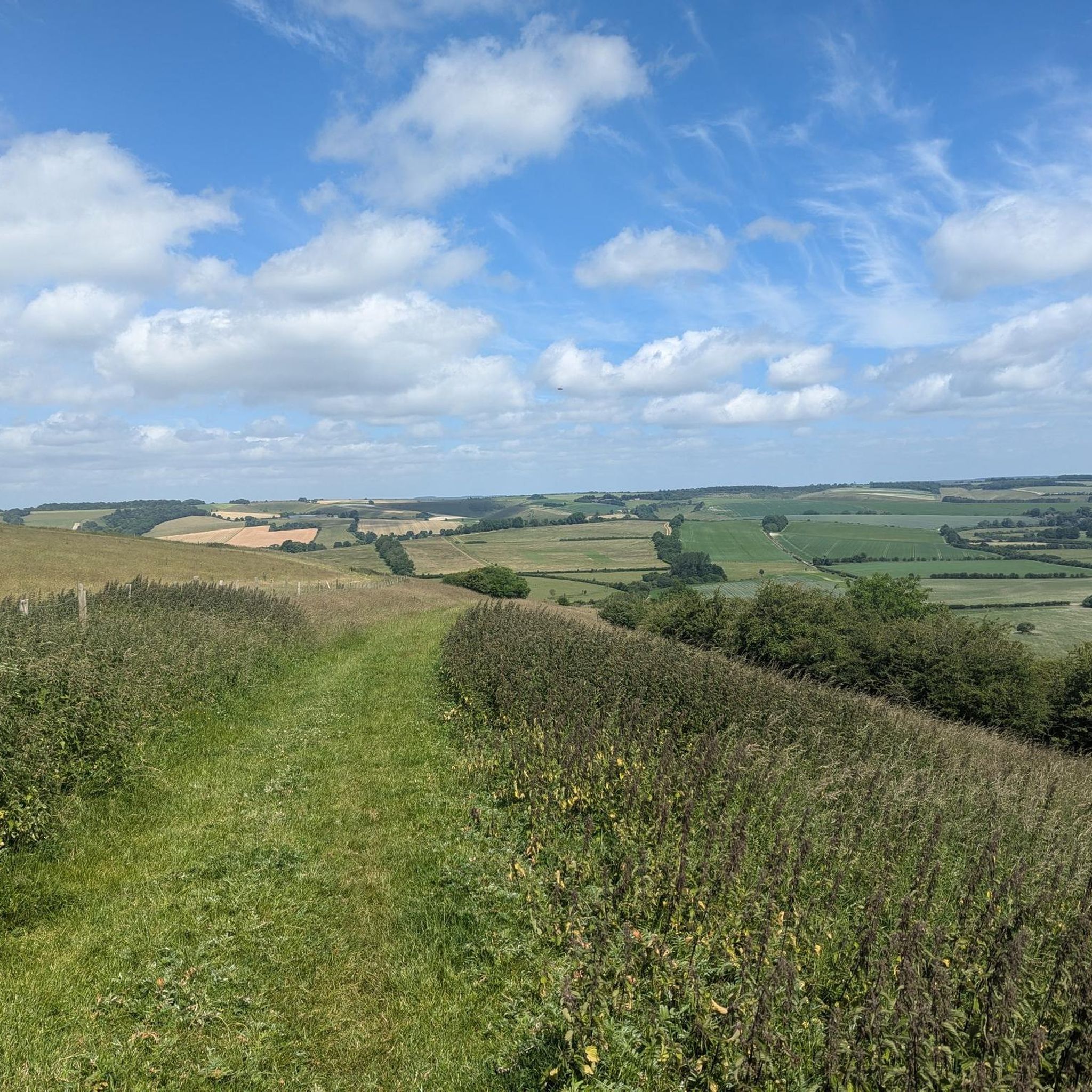
One of the most beautiful places in the south of England 🏴 and amazing views of Wiltshire and Dorset 🤩
0
0

Win Green at 277 m is the highest point on Cranbourne Chase. The tree topped summit also has a Bronze Age hill barrow, topography stone and trig point. Lots of great running loops from here as well as easy parking close by.
0
0

Frequently Asked Questions
What historical sites can I explore around Ebbesborne Wake?
The area is rich in history. You can visit Wimborne St Giles Village and Church, a historical religious building with origins dating back to the 13th century and significant architectural elements. Another notable historical site is Bokerley Dyke, a substantial linear earthwork with a multi-period history, believed to have originated in the Bronze Age. The village itself is home to the 12th-century St. John the Baptist Church, a fine example of Norman architecture, and ancient barrows dating from Neolithic times.
Where can I find the best panoramic views in the region?
For breathtaking panoramic views, head to Win Green Summit, the highest point in the Cranborne Chase. From here, you can see over Blackmore Vale and the Salisbury Plain, and on clear days, even to the Isle of Wight. Another excellent viewpoint is Zig Zag Hill Climb, which offers rewarding vistas from the top of Cranborne Chase after a challenging ascent.
Are there opportunities for walking and hiking near Ebbesborne Wake?
Yes, Ebbesborne Wake is an excellent base for walking and cycling, with numerous field paths and quiet lanes. You can find a variety of routes, including easy hikes around Ebbesborne Wake. Popular local walks include routes up to Prescombe Down and Sutton Down, or the Ebbesbourne Wake and Bowerchalke walk, which can be extended to visit the grave of author William Golding.
What natural features and wildlife can I observe?
The scenic Chalke Valley, through which the River Ebble flows, offers beautiful countryside. Nearby, you'll find several Dorset Wildlife Trust sites. Fontmell Down is known for its stunning displays of chalk downland flowers and butterflies, offering impressive views. Prescombe Down, a National Nature Reserve, is a Site of Special Scientific Interest and Special Area of Conservation, boasting species-rich chalk grassland, abundant wildflowers (including various orchids), and rare butterflies like the adonis blue.
Are there any family-friendly attractions or activities?
Many of the natural and historical sites can be enjoyed by families. Win Green Summit is listed as family-friendly, offering open spaces and views. The village's traditional pub, The Horseshoe Inn, has a charming garden that can be pleasant for families. Exploring the ancient barrows and the historical St. John the Baptist Church can also be an engaging educational experience for children.
Where can I go cycling around Ebbesborne Wake?
The area is popular with cyclists, offering quiet lanes and scenic routes. You can explore various road cycling routes around Ebbesborne Wake, including moderate options like the 'View from Charlton Down – Chalk Downland Descent loop'. For mountain biking enthusiasts, there are also MTB trails around Ebbesborne Wake, such as the 'Win Green and Cranborne Droves Way Loop'.
What is the best time of year to visit Ebbesborne Wake for outdoor activities?
The Chalke Valley and surrounding downs are beautiful year-round. Spring and summer are ideal for experiencing the chalk downland flowers and butterflies at sites like Fontmell Down and Prescombe Down. The River Ebble's upper reaches are a winterbourne, flowing primarily in the colder months, which can offer a different natural spectacle. Clear days in any season will provide the best panoramic views from summits like Win Green.
Are there any pubs or places to eat in Ebbesborne Wake?
Yes, Ebbesborne Wake is home to The Horseshoe Inn, a traditional pub renowned for its homemade food, local real ales, and a charming garden. It often serves as a convenient starting point or end point for local walks.
What are some lesser-known historical gems in the area?
Beyond the prominent sites, the parish of Ebbesborne Wake holds archaeological significance with ancient barrows, including bowl-barrows with human remains, dating from Neolithic times into the early Bronze Age. A hoard of Late Bronze Age bangles and a bronze torque has also been discovered, pointing to a rich prehistoric past. Historic religious sites like Buntings, a former independent meeting house, and a stone chapel also exist.
Can I find dog-friendly trails around Ebbesborne Wake?
Many of the numerous field paths and quiet lanes around Ebbesborne Wake are suitable for dog walking. For example, the 6-mile walk through the Rushmore Estate from Win Green Summit is noted as nice for dogs, though they may need to be kept on a lead in parts due to animals. Always be mindful of livestock and local regulations when walking with dogs in rural areas.
What is the significance of the churches in the Ebbesborne Wake area?
The area features several historically significant churches. St. John the Baptist Church in Ebbesborne Wake is a 12th-century Grade I listed building showcasing Norman architecture. Further afield, Wimborne St Giles Village and Church has a rich and complex history, with origins dating back to the 13th century, multiple rebuilds, and a significant restoration by Sir Ninian Comper, making it a 'treasure-house' of his work.
Most popular attractions around Ebbesborne Wake

Get inspired with the komoot mobile app


Explore more
Still not found the Highlight you’re looking for? See guides of the top attractions in other regions:
