The best walks and hikes around Lake Świętokrzyskie
4.8
(28)
551
hikers
68
hikes
Hiking around Lake Świętokrzyskie offers a collection of trails primarily characterized by gentle terrain and proximity to water bodies. The landscape features paths around lakes, through urban areas, and alongside local points of interest. Routes typically involve minimal elevation changes, making them accessible for various activity levels.
Best hiking trails around Lake Świętokrzyskie
- The most popular hiking route is Taster Rabbit Statue – Gniezno market loop from Gniezno, a 2.6 miles (4.2 km) trail that takes 1 hour 6…
Last updated: July 11, 2026
5.0
(1)
65
hikers
4.24km
01:06
30m
30m
Easy hike. Great for any fitness level. Easily-accessible paths. Suitable for all skill levels.
4.9
(14)
99
hikers
4.60km
01:12
30m
30m
Easy hike. Great for any fitness level. Easily-accessible paths. Suitable for all skill levels.

Sign up for free
7
hikers
2.50km
00:39
10m
10m
Easy hike. Great for any fitness level. Easily-accessible paths. Suitable for all skill levels.
3.0
(1)
3
hikers
7.28km
01:54
60m
60m
Easy hike. Great for any fitness level. Easily-accessible paths. Suitable for all skill levels.
8
hikers
1.95km
00:30
10m
10m
Easy hike. Great for any fitness level. Easily-accessible paths. Suitable for all skill levels.
Get access to more routes and recommendations from other explorers.
Sign up for free
Already have an account?
Our route recommendations are based on thousands of hikes, rides, and runs completed by other people on komoot.
Start today with a free account
Your next adventure awaits.
Login or Signup



Tips from the Community

Gniezno Cathedral is considered one of the most important religious buildings in Poland. Since the 15th century, the church has served as both the seat of the Archbishop of Gniezno and the Primate of Poland. The Gniezno Double Doors, made of bronze, are of great significance on a European scale.
2
0

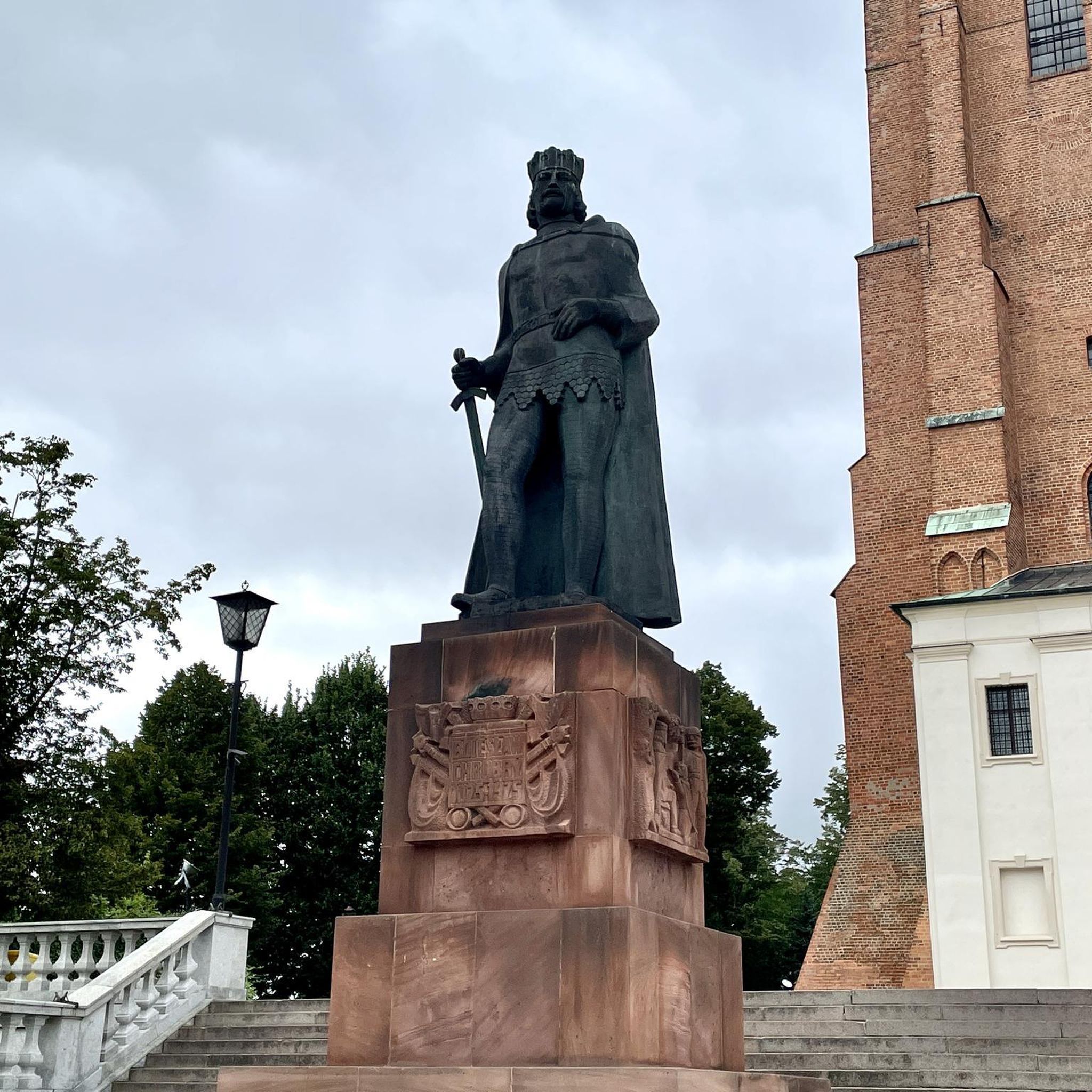
The original bronze monument was designed by sculptor Marcin Rożek and unveiled by President Ignacy Mościcki on May 30, 1929, but was destroyed by German forces during the 1939 September Campaign. The current monument, standing 4.75 meters tall on a nearly 4-meter pedestal, was recreated by sculptor Jerzy Sobociński based on the original design and unveiled on May 9, 1985.
1
0
A Roman Catholic church originally built as a Protestant garrison church in the first half of the 19th century, designed by Karl Friedrich Schinkel and consecrated in 1842. The brick building features arcade-style architecture with a square plan, a four-story tower, and empires surrounding the interior. After World War II in 1945, the church was transferred to the Catholic Church and rededicated to the Virgin Mary Queen of Poland.
2
0
The contemporary urban layout of Gniezno cast in bronze with descriptions in Braille
2
0
The sculpture was unveiled on 2018 as the final piece of Gniezno's Royal Route project, depicting Poland's first king who was crowned in 1025. The statue stands in front of the Old Town Hall on Chrobrego Street, representing the ruler who led the famous Congress of Gniezno in 1000 AD when Emperor Otto III visited the city. This is the third sculpture commemorating Bolesław the Brave in Gniezno, completing a collection of five royal statues honoring kings crowned here.
2
0
The Market Square is located in the Old Town on Panieński Hill, one of Gniezno. After a devastating fire in 1819 that destroyed most of Gniezno, the square was rebuilt according to new urban planning that created a spatial axis between the cathedral and the evangelical church, with only two original medieval buildings surviving. Today the cobblestone square features a fountain inaugurated in 2014, and during winter months it hosts a 10-12 meter Christmas tree and an ice rink that has operated since 2008.
2
0
A Gothic archcathedral located on Lech Hill, serving as the burial place of Saint Adalbert and the site of five royal coronations since 1000 AD. Known as the "Mother of Polish Churches," it has been the seat of Polish primates and was designated as a minor basilica in 1931. The cathedral houses the famous Gniezno Doors, bronze doors from around 1175 that depict scenes from Saint Adalbert's life.
2
0
The bell originally produced the musical note E-flat and bears the maker's inscription on its cap between ornamental bands.
2
1
Frequently Asked Questions
How many hiking trails are available around Lake Świętokrzyskie?
There are over 40 hiking trails around Lake Świętokrzyskie, offering a variety of options for different preferences and skill levels. Most of these routes are considered easy, making them accessible for many hikers.
What is the general difficulty level of hikes around Lake Świętokrzyskie?
The majority of hikes around Lake Świętokrzyskie are classified as easy. Out of over 40 available routes, 29 are easy and 12 are moderate, with no difficult trails. This makes the area ideal for casual walks and family outings.
Are there any circular hiking routes around Lake Świętokrzyskie?
Yes, many of the trails around Lake Świętokrzyskie are circular, offering convenient loop options. For example, you can explore the Jezioro Winiary loop from Gniezno, which provides scenic views of the lake, or the Taster Rabbit Statue – Gniezno market loop from Gniezno for a mix of urban and park areas.
What kind of scenery can I expect on hikes around Lake Świętokrzyskie?
Hikes around Lake Świętokrzyskie primarily feature paths around local lakes, through urban areas, and alongside local points of interest. The landscape is generally gentle with minimal elevation changes, offering pleasant views of water bodies and city parks.
What do other hikers say about the trails in this area?
The trails around Lake Świętokrzyskie are highly rated by the komoot community, with an average score of 4.8 stars from more than 20 reviews. Hikers often praise the accessibility of the routes and the pleasant, gentle terrain.
Are there any short, easy routes suitable for beginners or quick walks?
Absolutely. Many routes are short and easy. For a quick walk, consider the Jelonek loop from Gniezno, which is just over 2 km long. Another accessible option is the Gniezno market – Taster Rabbit Statue loop from Gniezno, a 3.4 km trail.
What are the typical durations for hikes around Lake Świętokrzyskie?
Most hikes around Lake Świętokrzyskie are relatively short, typically ranging from 1 to 2 hours. For instance, the popular Taster Rabbit Statue – Gniezno market loop from Gniezno takes about 1 hour and 6 minutes to complete.
Is the Świętokrzyskie region known for any unique geological features?
While the immediate area around Lake Świętokrzyskie (near Gniezno) focuses on lake and urban walks, the broader Świętokrzyskie Voivodeship, particularly the Świętokrzyski National Park, is renowned for its ancient mountains and unique geological formations. These include the distinctive 'Gołoborza' (stone runs) composed of Cambrian quartzite sandstone, which are significant geological attractions.
Are there any historical or cultural attractions near the hiking trails?
The hiking trails around Lake Świętokrzyskie often pass through or near urban areas like Gniezno, which has its own historical significance. In the broader Świętokrzyskie region, you can find cultural and historical sites such as the Benedictine Holy Cross Abbey on Łysa Góra, and castles or museums in towns like Kielce and Chęciny.
Can I combine hiking with other outdoor activities in the Świętokrzyskie region?
Yes, the Świętokrzyskie region offers opportunities to combine hiking with other activities. While the trails around Lake Świętokrzyskie are primarily for walking, other bodies of water in the broader region, such as Brodzki Reservoir and Sielpia Wielka, offer recreational activities like fishing, water sports, and cycling along paved paths, complementing a hiking trip.
What kind of forests can be found in the Świętokrzyskie region?
The Świętokrzyski National Park, a significant part of the broader Świętokrzyskie region, is heavily forested. You'll find primarily pine and beech trees, along with fir trees. The area is also known for valuable fir wilderness and areas of Polish larch, with some ancient trees protected as natural monuments.
Most popular routes around Lake Świętokrzyskie

Get inspired with the komoot mobile app


Explore more
Browse the best Hikes in other regions.
