The best cycling routes around La Campana
4.1
(15)
116
riders
27
rides
Touring cycling routes around La Campana traverse a landscape characterized by mountainous terrain, rolling hills, and deep ravines. The region features diverse ecosystems, including unique Chilean Palm forests and sclerophyllous forests. Elevations vary, with prominent peaks and lower hills, offering varied gradients for cycling. The terrain includes both paved and gravel sections, providing a range of experiences for touring cyclists.
Best touring cycling routes around La Campana
- The most popular touring cycling route is Marchena – Arrival in Marchena loop…
Last updated: June 26, 2026
3.8
(4)
21
riders
32.9km
02:58
160m
160m
Moderate bike ride. Good fitness required. Mostly paved surfaces. Suitable for all skill levels.
4.8
(5)
16
riders
47.3km
02:49
320m
320m
Moderate bike ride. Good fitness required. Mostly paved surfaces. Suitable for all skill levels.

Sign up for free
9
riders
104km
09:51
870m
880m
Hard bike ride. Very good fitness required. Mostly paved surfaces. Suitable for all skill levels.
4.0
(1)
9
riders
24.7km
02:14
130m
120m
Moderate bike ride. Good fitness required. Mostly paved surfaces. Suitable for all skill levels.
4.0
(2)
8
riders
64.4km
05:12
280m
280m
Hard bike ride. Very good fitness required. Mostly paved surfaces. Suitable for all skill levels.
Get access to more routes and recommendations from other explorers.
Sign up for free
Already have an account?
Our route recommendations are based on thousands of hikes, rides, and runs completed by other people on komoot.
Start today with a free account
Your next adventure awaits.
Login or Signup

Tips from the Community

This is a great and really beautiful church. Unfortunately, I couldn't take any more photos because there was an event there.
0
0
The figure is astonishing on the church. It is something special for me that under the blessing hands is an inhabited stork nest.
0
0

The old parish church of Santa María belonged to the Gothic-Mudejar type of church. It seems that it was built by D. Pedro Fernández Gragera, a knight in the service of San Fernando in the reconquest of Écija. According to sources, it was completed in 1262. The structure was designed with three naves and a polygonal head, later two side naves were added, so its plan was irregular, with a tower, a patio with orange trees and a cemetery. The building was extensively renovated in the 16th and 17th centuries, with the church being demolished and rebuilt in 1758.
4
0

The tower's origins date back to the 15th century, when it was built on an ancient Arab tower. Due to lightning damage in 1892, it was partially demolished, and the first part of the old Mudejar tower remains today as a bell tower.
3
0

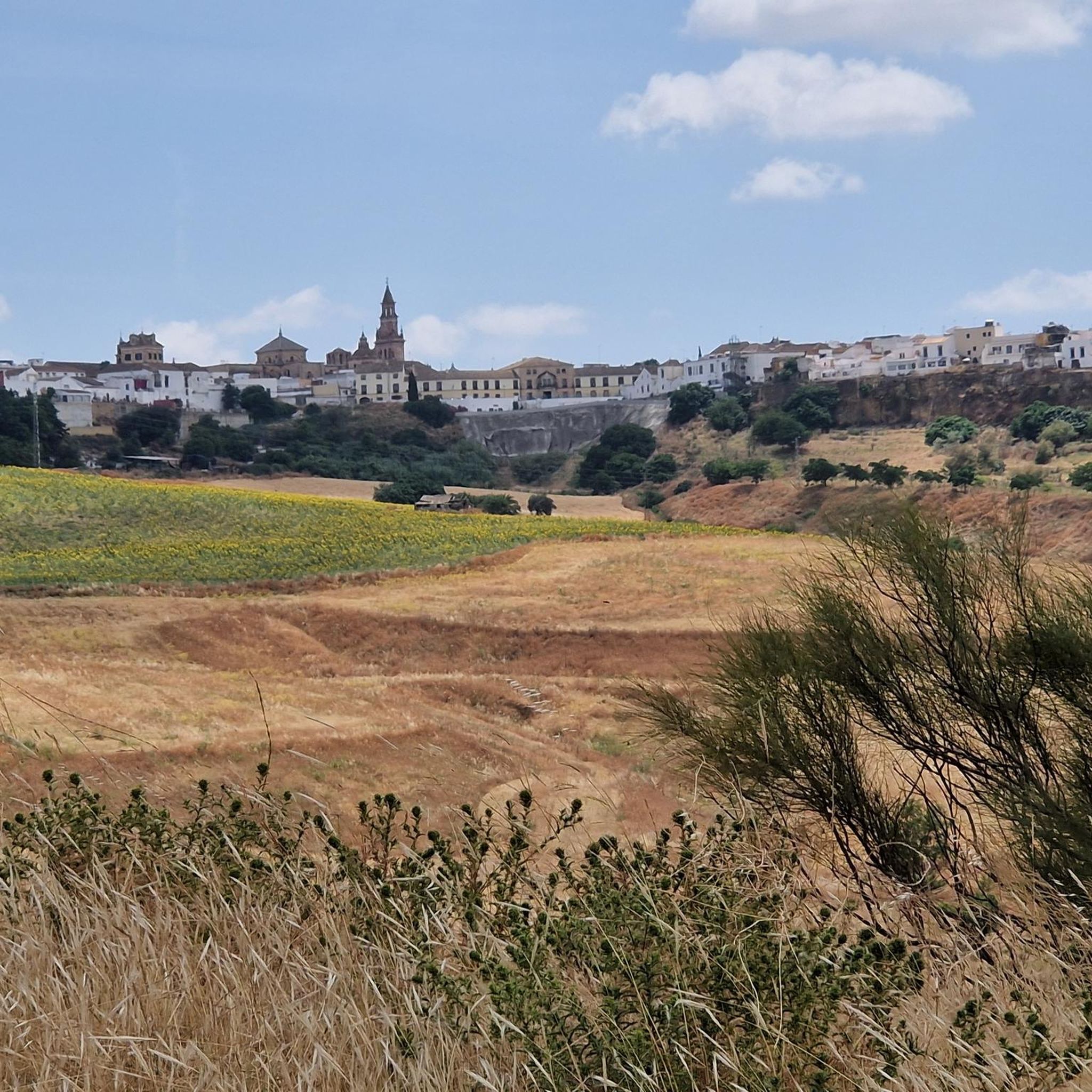
At the end of the Vía Verde de la Campiña, you reach the town of Marchena, where you can see from afar the two towers of the town that rise above the town itself.
1
0
Écija is a municipality of Seville but nevertheless, this municipality is closer to the province of Córdoba than to the provincial capital, Seville. The city popularly known as Ciudad del Sol, the City of Towers and the Pan of Andalusia (because of its high temperatures, especially during the summer seasons). It is considered one of the most important Historical Sites in Andalusia.
3
0

Marchena was declared a Historic-Artistic Site in 1966, among the monuments that stand out are: the church of San Juan Bautista (one of the most interesting in the province of Seville, Gothic-Mudejar style with Renaissance elements) and the Puerta de Sevilla also called the Arco de la Rosa (one of the access doors that the walled perimeter of Marchena had).
2
1
Beautiful church from the 18th century, built on an old Mudejar temple from the 16th / 17th centuries, damaged by the Lisbon earthquake. It is worth the visit especially for its beautiful and very decorative interior.
2
0
Frequently Asked Questions
How many touring cycling routes are available in La Campana?
There are over 25 touring cycling routes around La Campana, offering a diverse range of experiences. These routes are highly rated by the komoot community, with an average score of 3.95 stars.
What kind of terrain can I expect on touring cycling routes in La Campana?
The routes in La Campana feature varied terrain, including both paved and gravel sections. You'll encounter rolling hills, deep ravines, and mountainous areas, providing a range of gradients and challenges. The region is known for its unique Mediterranean ecosystem, with sclerophyllous and lauriphyllous forests.
Are there challenging touring cycling routes in La Campana?
Yes, La Campana offers several challenging routes. Approximately half of the available touring cycling routes are classified as difficult, featuring significant elevation changes and longer distances. An example is the 66.5-mile (107.0 km) Roman Baths of La Luisiana – Scenic Gravel Path loop from La madre, which includes substantial elevation gain.
Are there any family-friendly touring cycling routes in La Campana?
While many routes in La Campana involve moderate to difficult terrain, some sections within the park's sectors, like Ocoa or Cajón Grande, might offer flatter or less strenuous paths suitable for families. It's recommended to check individual route details for specific difficulty levels and elevation profiles to ensure they match your family's capabilities.
What are some notable natural features or viewpoints along the cycling routes?
La Campana National Park is rich in natural beauty. You can expect panoramic views that, on clear days, extend from the Andes Mountains to the Pacific Ocean, especially from higher elevations. The park is also home to one of the last remaining Chilean Palm forests, particularly notable in the Ocoa sector, where you can see over 60,000 specimens of these unique trees. Additionally, the beautiful 35-meter high waterfall called 'La Cortadera' in the Ocoa area is a significant natural attraction.
Are there any circular touring cycling routes in La Campana?
Yes, many touring cycling routes in La Campana are designed as loops, allowing you to start and finish at the same point. For instance, the Marchena – Arrival in Marchena loop from Fuentes de Andalucía is a popular moderate 26.3-mile (42.3 km) option, and the Scenic Gravel Path – Fuentes de Andalucía loop from La Luisiana offers a 16.0-mile (25.7 km) ride through varied terrain.
What historical sites or landmarks can be explored near the cycling routes?
Beyond the natural beauty, the region around La Campana has historical significance, notably its association with Charles Darwin. While cycling, you might encounter various points of interest. For example, the Roman Baths of La Luisiana – Scenic Gravel Path loop from La madre suggests historical elements. Other nearby attractions include the Canal de los Presos del Bajo Guadalquivir and the charming settlement of Fuentes de Andalucía.
What is the best time of year for touring cycling in La Campana?
La Campana National Park experiences a Mediterranean climate. While specific cycling conditions vary, spring is often vibrant with wildflowers, and the weather is generally pleasant for outdoor activities. It's always advisable to check local weather forecasts before your trip, especially considering the mountainous terrain.
Are there any specific regulations or permits required for cycling in La Campana National Park?
As La Campana is a National Park, there may be specific regulations regarding access, trail usage, and permits. While general cycling is mentioned, it's always best to verify the latest park rules and any required permits directly with the park authorities before planning your ride, especially for certain trails or sectors.
What are some other interesting places to see around La Campana while cycling?
Beyond the main park, the surrounding area offers several points of interest. You could explore the natural beauty of The Santa Lucía valley, visit the Peñaflor Reservoir - Guadalquivir River, or admire the Puente de Hierro de Lora del Río. These attractions can add variety to your touring cycling experience.
Is it possible to find accommodation or camping facilities near the cycling routes?
Yes, for those looking to extend their stay, La Campana National Park has designated picnic and camping areas, particularly in the Cajón Grande and Palmas de Ocoa sectors. This allows cyclists to immerse themselves fully in the natural environment and enjoy multi-day touring adventures.
Most popular attractions around La Campana

Get inspired with the komoot mobile app


Explore more
Browse the best Cycling routes in other regions.
