The best walks and hikes around Creissels
4.5
(174)
1,122
hikers
30
hikes
Hiking around Creissels offers varied landscapes within the Grands Causses Regional Natural Park. The region features the Corniches du Larzac, providing panoramic views, and the distinctive Cascade de Creissels with its tuff rock formations. Trails range from gentle paths along plateaus to more demanding routes with significant ascents. The area is characterized by natural monuments and diverse terrain, including views of the Millau Viaduct.
Best hiking trails around Creissels
- The most popular hiking route is Larzac Cornices Trail, a…
Last updated: October 10, 2026
4.9
(12)
91
hikers
13.1km
04:03
470m
480m
Hike the Corniches du Larzac loop from Creissels for panoramic views of the Millau Viaduct and diverse Larzac plateau landscapes.
4.4
(14)
73
hikers
9.85km
02:45
170m
170m
Hike the challenging 6.1-mile Cirque du Boundoulaou and Larzac Loop from Creissels for panoramic views of the Tarn valley and Millau Viaduct

4.6
(25)
167
hikers
Easy hike. Great for any fitness level. Easily-accessible paths. Suitable for all skill levels.
4.8
(4)
32
hikers
3.19km
00:58
110m
110m
Easy hike. Great for any fitness level. Easily-accessible paths. Suitable for all skill levels.
4.2
(15)
102
hikers
6.96km
02:00
170m
170m
Moderate hike. Good fitness required. Easily-accessible paths. Suitable for all skill levels.
Get access to more routes and recommendations from other explorers.
Already have an account?
Our route recommendations are based on thousands of hikes, rides, and runs completed by other people on komoot.
Start today with a free account
Your next adventure awaits.

Tips from the Community

The Baoumas fountain springs from a real cavity carved into the limestone wall, at the foot of the rock that bears the castle of Creissels. The name of the place, which comes from the Occitan « bauma » (cave, rock shelter), thus very accurately describes what is observed: the water gushes out in a lively jet from the darkness of the small cave, before falling back into a basin with green reflections, surrounded by a stone wall. This configuration is not an architectural coincidence: it testifies, like the Pesquié basin a little further in the village, to the karstic functioning of the Creissels subsoil, where water infiltrated into the Larzac limestones re-emerges through multiple springs and cavities, to the point of having earned the village the nickname of « Venice of the Larzac ».
3
0
In the heart of Creissels, the Pesquié basin forms a surprisingly vast body of water (1,000 m²) compared to the modest stream that feeds it. Its name, which comes from Occitan and means "fish pond", recalls the ancient purpose of the place, linked to fish farming. The town hall now occupies the premises of a former fish farm. The basin is fed by the Creissels waterfall, a typical resurgence of the karst functioning of the Larzac: the water infiltrated into the limestones of the plateau reappears after an underground journey. In September 2023, the municipality dredged the basin and created a spawning ground for brown trout (Salmo trutta). The restoration has borne fruit, as trout have since recolonized the body of water, alongside amphibians and other aquatic organisms that find refuge in the surrounding wetland.
2
0
Built between 1818 and 1821, the Lerouge bridge became one of the main structures for crossing the Tarn in Millau. It replaced the Pont Vieux, several arches of which had been destroyed by a flood in 1758, leaving the town without a permanent bridge for over sixty years. During this long period, crossing the Tarn was mainly done by ferry. The project was launched on the initiative of the prefect of Aveyron, d’Estourmel. The plans were drawn up by Pierre-Jacques Le Rouge, an engineer for the district. The first stone was laid on June 20, 1818, and the bridge was opened to traffic in January 1821. Its name therefore comes from its designer, not from the color of its stones. A curious detail: its construction was largely financed by private individuals, and a toll was collected until 1875. This tax even caused tensions with the inhabitants of Creissels, some of whom continued to cross the Tarn on foot or by boat to avoid paying it.
3
0
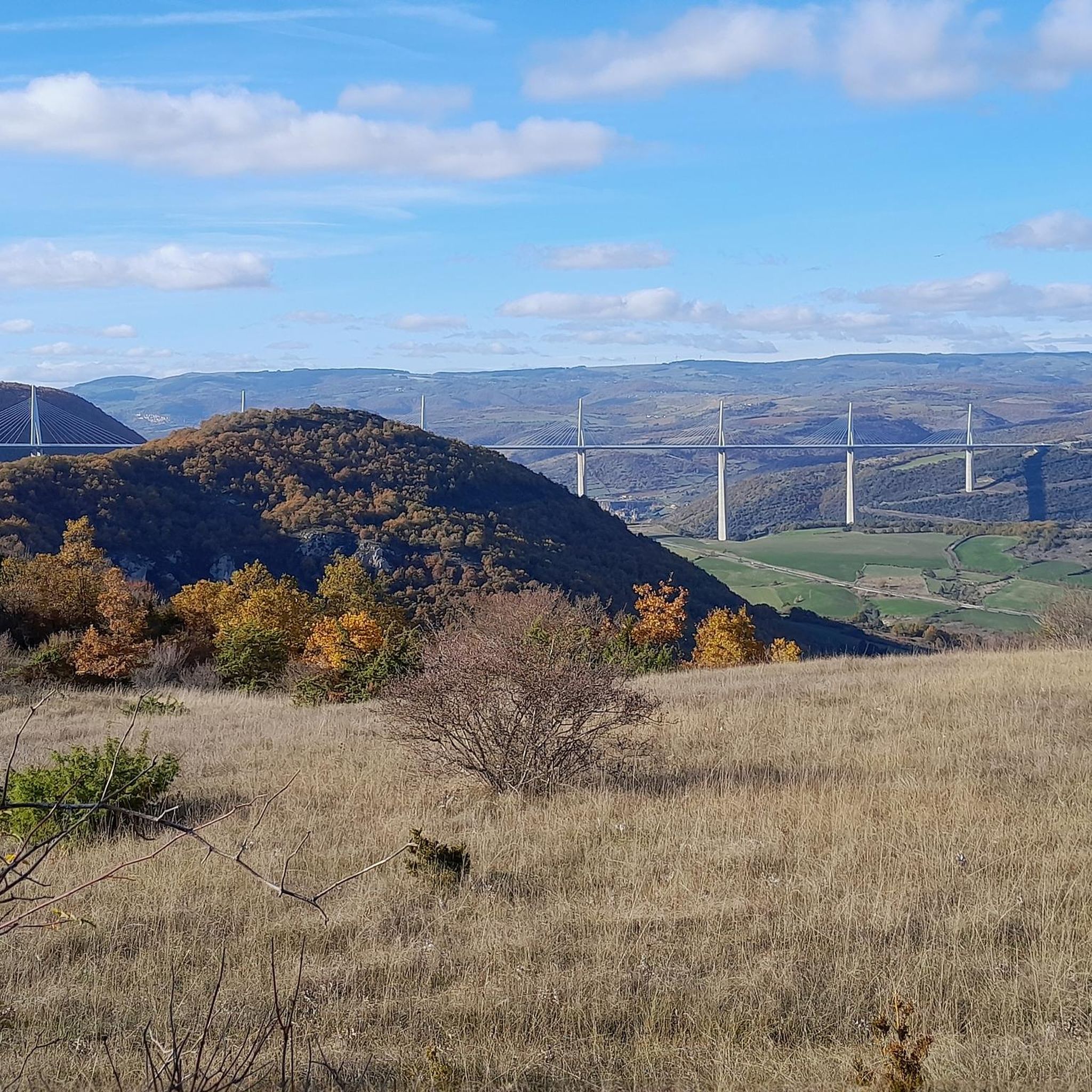
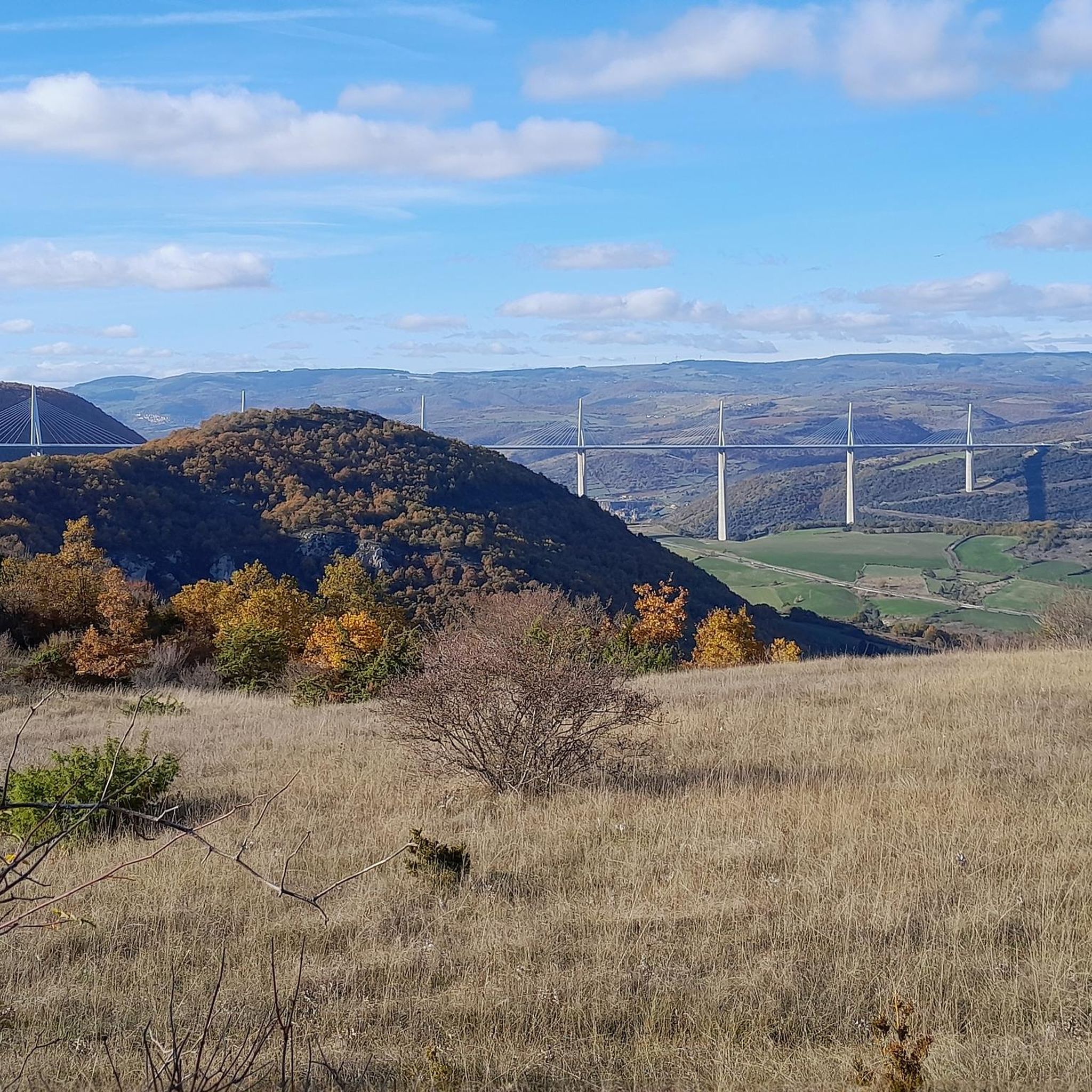
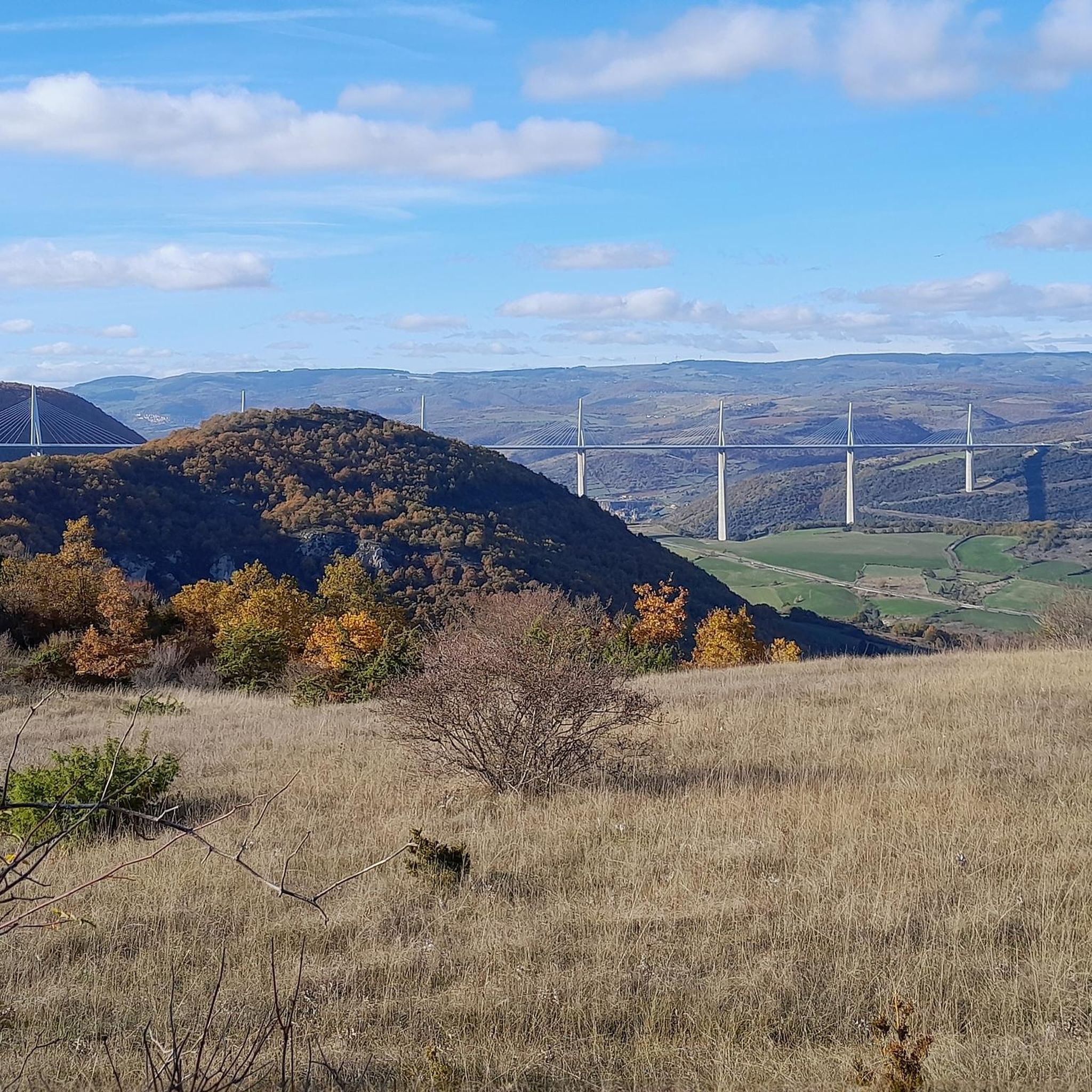
From the Larzac plateau, the Brunas site offers a vast panorama of the Millau valley. Stretched between the two banks of the Tarn, the viaduct with its seven concrete piers appears in its entirety. Behind it unfolds the entire Causse Rouge, a large limestone plateau whose undulations dominate the valley. Then, the Puech d’Andan is distinguished by its wooded silhouette, cut in two by a clear central notch. Further to the right stands the Pouncho d'Agast, a pyramidal promontory marking the beginning of the Causse Noir at an altitude of 841 m. Brunas is also a real site for paragliding. The take-off area is located directly on the plateau; the site is mainly used with a north wind and allows paragliders to take off and land near the same area, with an altitude difference of about 370 m to the valley. The spectacle of the sails evolving in front of the viaduct adds a special dimension to this panorama.
3
0
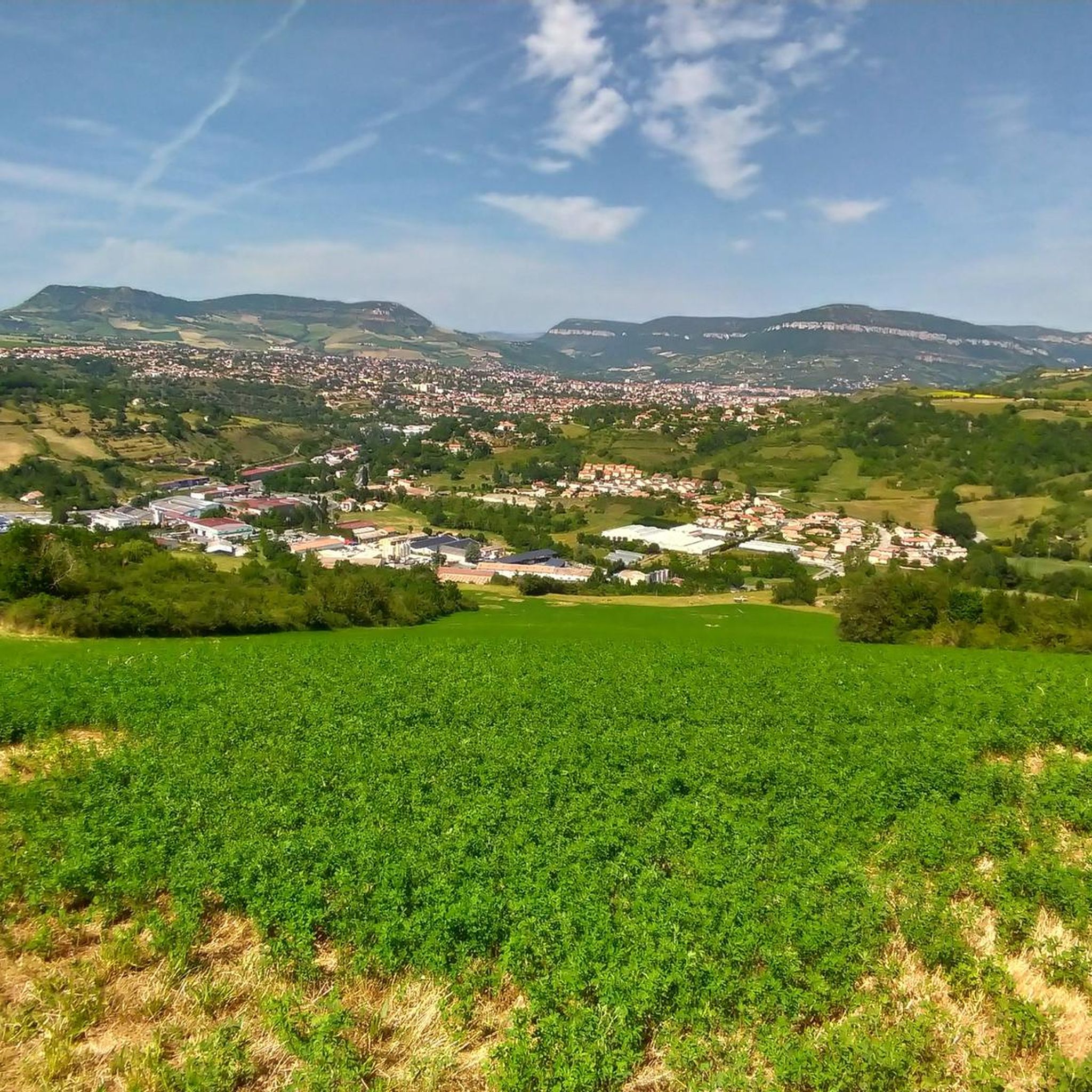
Three stone crosses, erected in a line on this small rise above Creissels, give the place its name, but in reality there are five in total: a fourth is hidden below, a fifth watches further on at a crossroads, on the side of the old Tournal mill. This marking, inherited from centuries-old rural piety, perhaps outlined an ancient processional path now fallen into oblivion. The panorama unfolds in 360°: to the west, the Tarn valley and the Millau viaduct with its fine suspended line and its seven pylons. To the south, the landscape closes in on the Boundoulaou cirque, from which one can distinguish, on the right, the limestone outcrop of Puech de Fayssel which closes the natural amphitheater carved into the edge of the causse. To the north, the town of Millau unfolds almost entirely below, dominated in its center by the massive silhouette of Puech d'Andan, whose summit plateau is divided into two distinct parts. Further to the right stands the Pouncho d'Agast, a pyramid-shaped promontory that marks the beginning of the Causse Noir at an altitude of 841 m.
3
0
Perched at an altitude of about 730 meters, the Cap de Coste viewpoint overlooks the eastern end of the Boundoulaou cirque. It reveals a vast panorama of the Millau basin and its surrounding massifs. To the left, the easily recognizable Millau Viaduct spans the Tarn valley to connect the Larzac to the Causse Rouge. Further to the right stretches the latter: a large limestone plateau whose undulations dominate the valley. Then, the Puech d’Andan stands out with its wooded silhouette, cut in two by a clear central notch. Finally, further away, the Pouncho d’Agast, an emblematic relief of the Causse Noir, is easily recognized by its profile like a true limestone pyramid.
3
0
Installed on rue de la Fontaine, this washhouse testifies to the importance of water in the daily life of the former village of Creissels. Fed by springs that descend from the causse and cross the town, it was once used by the inhabitants for washing clothes. It is part of a hydraulic system that is particularly present in Creissels, where waterfalls, canals, mills, and springs have long contributed to the village's activity. The washhouse thus recalls a time when water was both a domestic resource and an essential element of the local economy.
3
0
In the heart of old Creissels, this medieval dwelling is known as the “Prieuré”. The two-story building most likely dates from the first half of the 13th century. Each level has a large hall lit by two twin bays, whose capitals rest on polygonal columns. The travertine construction bears witness to the medieval civil architecture of the village. The ground floor, called the Pierre Granier hall, is named after a painter, sculptor, and architect born in Creissels around 1679. It is now used as a cultural space and regularly hosts temporary exhibitions and various events. A copy of one of his works, The Holy Family, is also presented there. To understand the historical importance of Creissels, one must place the village within its former political context: it was the capital of a viscounty, which entered the house of Rodez in 1270 before passing to the Armagnacs in 1304. This viscounty lasted until 1497. The castle, perched on the rocky spur overlooking the village, still recalls this seigneurial function and Creissels' strategic position in the Tarn valley.
3
0
Frequently Asked Questions
How many hiking trails are available around Creissels?
Creissels offers a diverse network of over 30 hiking trails. These include 14 easy routes, 13 moderate options, and 4 more challenging excursions, catering to various fitness levels.
Are there any trails that feature the Cascade de Creissels?
Yes, the picturesque Cascade de Creissels is a highlight of several trails. You can explore routes like The Creissels waterfalls – Bizarre Felsformationen loop from Creissels, which leads through areas with unique rock formations and the waterfall itself. The cascade is known for its distinctive tuff rock formations and transforms into a magical spectacle with frozen concretions in winter.
What are the best trails for panoramic views of the Millau Viaduct?
For expansive panoramic views of the Millau Viaduct and the Larzac plateau, consider hiking the Larzac Cornices Trail. The Corniches du Larzac offer numerous viewpoints where you can admire this impressive architectural marvel, especially when low-lying clouds create the illusion of the bridge floating above the valley. Another excellent viewpoint is the Pas Destrech Cross on the Causse du Larzac.
Are there any family-friendly hiking options in Creissels?
Yes, Creissels has several easy trails suitable for families. Routes around the Cascade de Creissels, such as The Creissels waterfalls – Tournal Mill loop from Creissels, are generally shorter and offer engaging natural features like the waterfall and an old watermill, making them enjoyable for all ages.
Can I find circular hiking routes around Creissels?
Many of the trails in Creissels are designed as loops, offering convenient circular routes. For example, the Cirque du Boundoulaou and Larzac Loop from Creissels provides a comprehensive exploration of the Larzac plateau. There are also several loop options around the waterfalls, such as Bizarre Felsformationen – The Creissels waterfalls loop from Creissels.
What is the best time of year to go hiking in Creissels?
Creissels is an exceptional destination for outdoor activities throughout the year. While spring and autumn offer pleasant temperatures and vibrant scenery, winter provides a unique experience, especially around the Cascade de Creissels, where the waterfall can form captivating frozen concretions. Always check local weather conditions before heading out.
Are there any dog-friendly hiking trails in Creissels?
Many trails in the Grands Causses Regional Natural Park are suitable for dogs, provided they are kept under control, especially in areas with livestock or protected wildlife. It's always recommended to keep your dog on a leash and carry water for them, particularly on longer routes or during warmer months.
What interesting landmarks or attractions can I see near the hiking trails?
Beyond the natural beauty, you can discover several notable attractions. The colossal Millau Viaduct is visible from many trails. You can also visit the historic Pont Lerouge over the Tarn, or explore nearby caves such as Baume du Boffi and Grotte des Résistants.
What do other hikers enjoy most about hiking in Creissels?
The area is highly rated by the komoot community, with an average score of 4.4 stars from over 150 reviews. Hikers frequently praise the diverse landscapes, the stunning panoramic views of the Millau Viaduct, and the unique natural features like the Cascade de Creissels and its 'bizarre rock formations'.
Are there challenging hikes available for experienced hikers?
Yes, for experienced hikers seeking a challenge, Creissels offers several more demanding routes. The Cirque du Boundoulaou and Larzac Loop from Creissels is classified as difficult and explores the varied terrain of the Larzac plateau. Some paths around the waterfall also feature steep climbs and rocky sections.
Is public transport available to reach hiking trailheads in Creissels?
While Creissels is well-suited for exploration by car, public transport options directly to specific trailheads might be limited. It's advisable to check local bus schedules or consider driving to the main starting points, especially for trails further into the Grands Causses Regional Natural Park.
Where can I find parking for hiking trails in Creissels?
Parking is generally available near popular trailheads and attractions in Creissels. For routes around the Cascade de Creissels or those offering views of the Millau Viaduct, designated parking areas are usually provided. It's recommended to check specific route descriptions for detailed parking information.
Most popular routes around Creissels
Most popular attractions around Creissels

Get inspired with the komoot mobile app


Explore more
Browse the best Hikes in other regions.
