The best road cycling routes around Noyal-Sur-Vilaine
4.3
(14)
729
riders
98
rides
Road cycling around Noyal-Sur-Vilaine offers diverse landscapes, from the flat, scenic paths along the Vilaine River valley to quiet minor roads through fields and pastures. The region, located east of Rennes, benefits from a network of dedicated cycle paths and greenways, providing varied terrain for road cyclists. The Ille-et-Vilaine department features extensive cycling infrastructure, including routes that follow towpaths and old railway lines. This area provides access to both natural features and historical towns like Châteaugiron and Rennes.
Best road…
Last updated: August 25, 2026
4.7
(3)
61
riders
34.4km
01:27
190m
190m
Easy road ride. Great for any fitness level. Mostly well-paved surfaces and easy to ride.
38
riders
88.7km
03:46
590m
590m
Moderate road ride. Good fitness required. Mostly well-paved surfaces and easy to ride.

Sign up for free
29
riders
56.8km
02:30
520m
520m
Moderate road ride. Good fitness required. Mostly well-paved surfaces and easy to ride.
3.3
(3)
37
riders
48.2km
02:06
400m
400m
Moderate road ride. Good fitness required. Mostly well-paved surfaces and easy to ride.
3.0
(1)
26
riders
32.7km
01:26
270m
270m
Easy road ride. Great for any fitness level. Mostly well-paved surfaces and easy to ride.
Get access to more routes and recommendations from other explorers.
Sign up for free
Already have an account?
Our route recommendations are based on thousands of hikes, rides, and runs completed by other people on komoot.
Start today with a free account
Your next adventure awaits.
Login or Signup


Tips from the Community

The Sainte-Marie-Madeleine church was built in the 19th century in a neo-Gothic style by Aristide Tourneux, an architect from Castelgiron. With a touch of humor, the town's priest in 1912 wanted to give "cats to the girons": Arthur Regnault, a sculptor, therefore sculpted cats at the four corners of the bell tower. Having collapsed in 1998 following a severe storm, the bell tower was rebuilt identically in 2000.
0
0
Old church mentioned as early as 1160 and rebuilt in the 16th and 17th centuries (old tower dated 1582). The current church was entirely built to the plans of Arthur Regnault in 1904 (date and attribution by source). He uses the model of the so-called Plantagenet vaulted ceiling for the covering of the nave and aisles, but for the bell tower, he draws inspiration from Cornish bell walls. Two windows from the late 15th and 16th centuries of the old church were reused on the south side of the nave. This church, rebuilt in the Breton flamboyant style, is representative of the architect's style during this period.
0
0
The construction of the old church, razed in 1880, was attributed to the lord of Gué. The current church was built between 1880 and 1885 by the contractor Jean-Marie Huchet, based on plans by architect Aristide Folie. The furniture program was designed by Arthur Regnault between 1880 and 1900. The oldest stained glass windows are signed Claudius Lavergne et Fils. This church has a Latin cross plan and a porch bell tower at the facade. The interior is divided into three naves covered by false vaults on ribbed vaults. Neo-Gothic style. Spire not built.
0
0
The bell tower is visible from afar and has long dominated the town and its surroundings. The Saint-Pierre church has retained its impact on the local landscape for over a century. It was indeed in 1888 that the Fabrique Council decided to entrust Arthur Régnault, the diocese's architect, with the project for a new construction. His plan was accepted and work began in October 1889, before the blessing of the first stone on March 13, 1890. As an anecdote, the stones are extracted from the quarry of La Bouëxière. Quickly, the inhabitants discovered its citadel-like appearance, Arthur Régnault having wanted to honor the city of Châteaubourg which had not had a castle for a long time! The structural work was completed on March 28, 1893, but due to lack of funds, the bells would wait until 1894. The work on the woodwork and the construction of the high altar took place in 1911, the church being due to host the important Eucharistic congress of 1913. Maintenance work continued over the years, the church having become the property of the municipality since 1905. During the bombings of the summer of 1944, the church was spared. The inhabitants would not forget it: on May 9, 1945, the day after the armistice, the men carried Notre Dame de Boulogne in procession and paraded barefoot through the streets. The centenary was celebrated in 1992 with the decision to install the current organ. The church of Châteaubourg has thus traversed local history from the 15th century – the date of construction of the previous, much smaller church – to that designed by Arthur Régnault.
0
0
The sacristy and tower of the current church were built in 1628 and 1632. A chapel was dedicated to Saint Nicholas in 1643. As for the nave, it dates from 1856. It contains a carved wooden altarpiece, bearing the coat of arms of Brignon, one of the church's financiers.
0
0
It originally consisted of a simple nave built in the 15th and 16th centuries, and whose straight chancel was rebuilt in 1700. The church, thus restored, was solemnly blessed by the rector on August 2, 1761. In 1806, a chapel dedicated to Saint Margaret was added to the south, and in 1818, to the north, the tower was partly redone, with at its base the chapel of the Virgin Mary. The lord Du Val, at Saint-Didier, has in the church of Saint-Jean-Baptiste a tomb where Jean de La Porte, lord Du Val, was buried in 1618, and in 1761 Suzanne Marion, daughter of lord Du Val and widow of Charles Du Boispéan. M. de Guersans, vicar general, erected the confraternity of the Holy Spirit at Saint-Jean-sur-Vilaine on June 25, 1746. Several foundations exist in this church: that of Le Poirier, that of La Bâte, that of La Porte. Jeanne Guyot, lady of La Hamonais, founded an annuity of 36 livres for the maintenance of candles during the octave of the Blessed Sacrament.
0
0


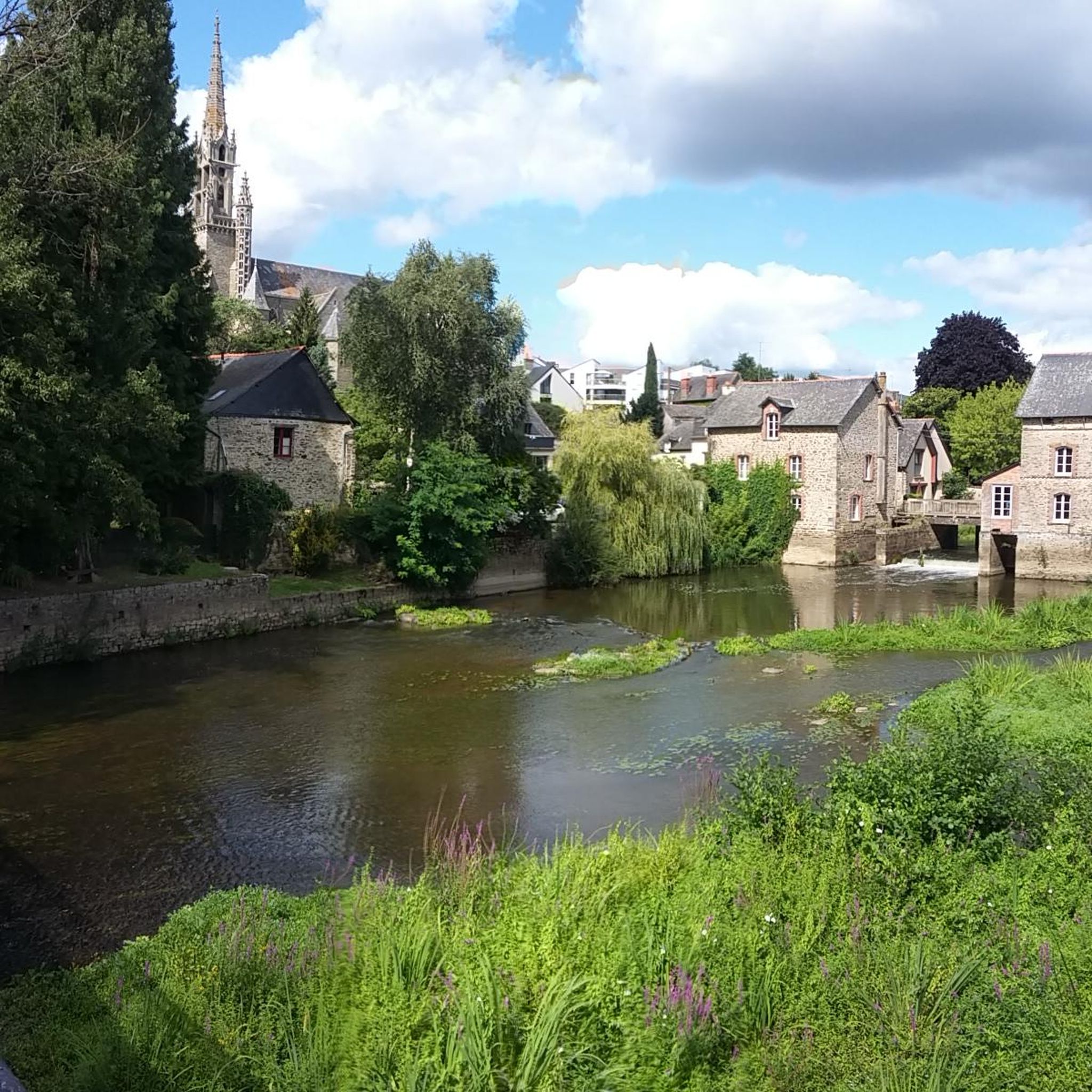
Nice and agreeable path along the Villaine river with ample shade. Best for strolls. If on a bike, please be courteous to walkers and watch out for the kids. There are many running around.
0
0
Frequently Asked Questions
How many road cycling routes are available around Noyal-Sur-Vilaine?
There are nearly 100 road cycling routes around Noyal-Sur-Vilaine, offering diverse landscapes and experiences for cyclists. These routes are highly rated by the komoot community, with an average score of 4.5 stars.
What are the general difficulty levels for road cycling routes in the area?
The routes around Noyal-Sur-Vilaine cater to all abilities. You'll find a good mix of easy (around 26 routes), moderate (about 70 routes), and a few challenging options (2 routes), ensuring there's something for every skill level.
Are there any scenic routes along the Vilaine River?
Yes, the Vilaine River valley is a primary natural asset for road cycling. Many routes follow the meandering Vilaine, offering tranquil, rural settings. The "Vallée de la Vilaine amont: Vélo Promenade n°11" is a specific circuit that connects Noyal-Sur-Vilaine with nearby towns through fields and pastures. You can also find routes along the towpaths, showcasing diverse scenery and charming villages.
What historical landmarks or points of interest can I see along road cycling routes?
Road cyclists can easily access several historical and cultural attractions. For example, the route Chevré Mill and Pond – Acigné Bridge loop from Noyal - Acigné features the historic Chevré Mill. Other routes may pass by the Tizé Estate, or offer views of the 15th-century Château du Bois Orcan. The nearby town of Châteaugiron, with its castle and timber-framed houses, is also accessible.
Are there any family-friendly road cycling routes in Noyal-Sur-Vilaine?
Yes, the region offers several easy routes suitable for families. The extensive network of dedicated cycle paths and greenways, often following old railway lines or towpaths, provides flat and safe options. An example of an easy route is Étangs de Cesson-Sévigné – Dézerseul Trail loop from Noyal - Acigné, which is 21.4 miles (34.4 km) long and passes by local ponds and through rural landscapes.
What is the best time of year for road cycling in Noyal-Sur-Vilaine?
The best time for road cycling in Noyal-Sur-Vilaine, and Brittany in general, is typically from spring through early autumn. During these months, the weather is generally mild and pleasant, making for comfortable rides. Summer offers longer daylight hours, while spring and autumn provide beautiful scenery with fewer crowds.
Are there circular road cycling routes available?
Yes, many of the road cycling routes around Noyal-Sur-Vilaine are designed as loops, allowing you to start and finish in the same location. Examples include Acigné Bridge – Tizé Manor loop from Noyal - Acigné and Acigné Bridge – Chevré Mill and Pond loop from Noyal - Acigné, which offer convenient circular journeys through the local countryside.
What do other road cyclists enjoy most about cycling in Noyal-Sur-Vilaine?
The area is highly rated by the komoot community, with an average score of 4.5 stars from over 10 reviews. Cyclists often praise the diverse landscapes, from the tranquil Vilaine River valley to quiet minor roads, and the well-developed cycling infrastructure that makes exploring the region enjoyable.
Can I find routes that lead to nearby towns like Châteaugiron or Rennes?
Yes, the strategic location of Noyal-Sur-Vilaine allows for rides to charming nearby towns. Châteaugiron, a 'Petite Cité de Caractère' known for its castle, is just 7 km away. Rennes, the capital of Brittany with its picturesque medieval center, is also easily accessible, about 12 km to the west. You can find routes like Châteaugiron Castle – Châteaugiron Castle loop from Domloup that explore the vicinity of these historic locations.
Where can I find more information about the broader cycling network in Ille-et-Vilaine?
The Ille-et-Vilaine department boasts nearly 3,300 km of developed cycle routes, including greenways and towpaths. For more detailed information on the main cycling routes across the department, you can visit the official tourism website: Ille-et-Vilaine Tourism.
Are there any specific routes that offer views of natural sites like the Rimon or Yaigne Valleys?
While specific komoot routes might not explicitly name these valleys, the region research indicates that the natural sites of the Rimon Valley and the Yaigne Valley are integrated into local cycling routes. These areas contribute to the picturesque scenery you'll encounter on many rides around Noyal-Sur-Vilaine, offering additional natural beauty beyond the Vilaine River.
Most popular routes around Noyal-Sur-Vilaine
Most popular attractions around Noyal-Sur-Vilaine

Get inspired with the komoot mobile app


Explore more
Browse the best Road cycling routes in other regions.
