Attractions and Places To See around Cérons - Top 13
Best attractions and places to see around Cérons are nestled in the Garonne valley, at the heart of the Graves wine country, and near the renowned Sauternes vineyards. This region in Nouvelle-Aquitaine, France, is characterized by its historical landmarks, viticultural heritage, and natural beauty, influenced by the Ciron River. Visitors can explore a blend of ancient castles, significant religious sites, and unique geological formations. The area offers diverse experiences for those interested in history, wine, and outdoor exploration.
Best attractions…
Last updated: October 9, 2026
Budos Castle
Highlight • Castle
Translated by Google •
Tip by

Château de la Benauge.
Highlight • Castle
Translated by Google •
Tip by

Sign up now to discover places like this
Get recommendations on the best single tracks, peaks, & plenty of other exciting outdoor places.
Sainte-Croix-du-Mont
Highlight • Historical Site
Translated by Google •
Tip by
Verdelais
Highlight • Other
Translated by Google •
Tip by
Les Domaines de la Mette
Highlight (Segment) • Other
Translated by Google •
Tip by

Sign up for free to discover even more attractions around Cérons.
Already have an account?
Start today with a free account
Your next adventure awaits.

Other adventures around Cérons

Tips from the Community

Budos Castle is the work of Raymond Guilhem de Budos, nephew of Pope Clement V. Largely supported by his uncle, he rebuilt the old family castle in 1306, adopting the architectural features of the neighboring Château de Villandraut, as evidenced by the following document from King Edward I, written from Wynten on March 9, 1306, to the Seneschal of Gascony[4]: "The Knight of Budos, nephew of Clement V, Sovereign Pontiff, has begged us to allow him to crenellate his house in Budos, to surround it with walls, towers, moats, and finally to fortify it. Out of respect for the Sovereign Pontiff, and because a fortress of this nature will protect not only our possessions in this part of Guienne, but also the subjects of the Pope's nephew, we grant the aforementioned Raymond permission to fortify his castle and we grant it to him, his heirs, and successors in perpetuity, and we undertake not to disturb him in any way in this possession." In 1422-23, the King of England took possession of the castle and placed Pons, Lord of Castillon, in charge. Around 1433, Henry VI granted the lands and the castle to the Duke of Gloucester. In 1446-47, Budos was given to Gaston IV of Foix-Béarn, Count of Foix, following the death of the Earl of Gloucester. After the conquest of Guyenne, the Budos family, which had supported the cause of France, regained possession of its lordships in Guyenne. Purchased from the Budos family by Raymond de La Roque in 1571, Budos Castle suffered a severe assault in 1652 during the Fronde Wars. Lasserre ransacked, pillaged, and burned its archives. The Budos lordship remained in the La Roque family until the Revolution, which nearly destroyed it. It was sold as national property and used as a quarry to build dikes on the Ciron. In 1841, the Gironde Historical Monuments Commission was informed of this by Léo Drouyn. In 1860, it became the property of Léon de Brivazac, son of Delphine Catherine de La Roque de Budos (born at the castle in 1789). Five descendants (including Savary de Beauregard) entrusted it to the Adichats association, which brings together young people to enhance and preserve what can be preserved. The castle was registered as a historic monument in 1988
0
0

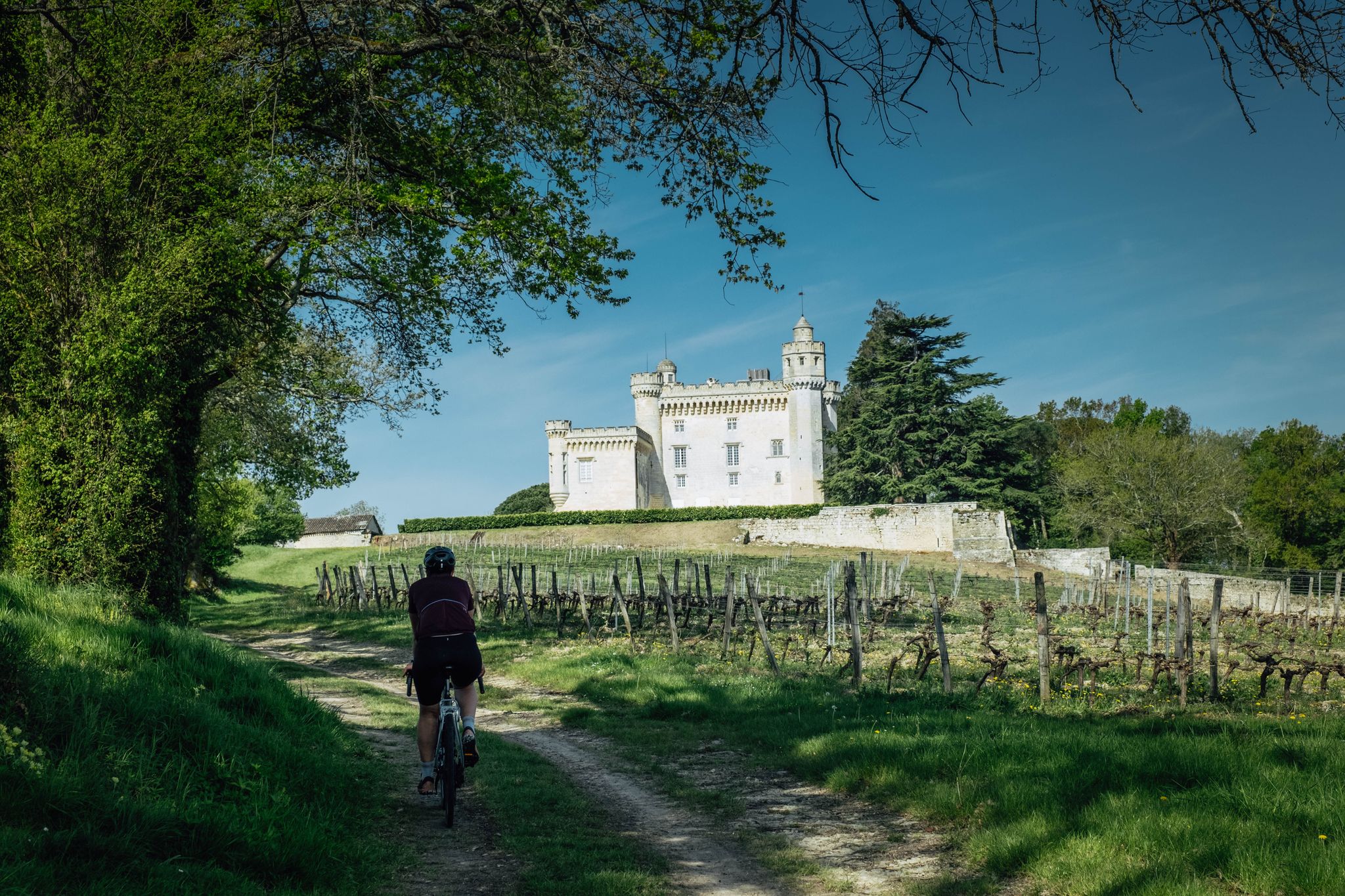
A pretty (private) chateau surrounded by its hillsides of vines.
2
0

Beautiful ruins of the castle of Budos, accessible by road but also by paths along the river. Much nicer!
1
0

Incredible ruins of the 14th century Budos castle, in the middle of the vineyards. Under restoration by Adichats association for about thirty years.
2
1
On the way to Santiago de Compostela, Verdelais has a large basilica, an impressive Calvary (in the cemetery where Toulouse-Lautrec is buried), as well as a mill still in operation: the mill of Cussol. The central alley of the village, lined with plane trees is ideal for taking a break in the shade!
2
0
Sainte-Croix-du-Mont is built on a rocky outcrop overlooking the Garonne valley and the Sauternes vineyards. At the foot of the imposing castle of Tastes, there is an interpretive trail and a belvedere from which you can see the Pyrenees on a clear day. The town also has a unique geological site in France: a cave made up of oyster fossils dating back 22 million years. Have !
2
0

Small road from Portets to the Langoiran bridge. Helps avoid the circulation of the D
1
0

Private place generally open during Heritage Days, it can be admired anyway from all around. You will have to climb to look at it from a distance, and climb to admire it up close! But the reward for the eyes on these landscapes of Entre-Deux-Mers will be well worth these efforts.
2
0
Frequently Asked Questions
What historical landmarks can I explore around Cérons?
The region is rich in history. You can visit the impressive 12th-century Church Saint-Martin in Cérons, or explore the 17th-century Château de Cérons, known for its wine. Further afield, discover the 14th-century ruins of Budos Castle, which is currently undergoing restoration. Other historical structures like the ruins of St Cricq Castle and Lépiney Castle offer glimpses into the past.
Are there any unique natural features to see near Cérons?
Yes, Sainte-Croix-du-Mont offers a unique geological site: a cave formed by 22-million-year-old oyster fossils. The area is also defined by the Garonne Valley and the Ciron River, which influences the microclimate crucial for the region's sweet wines.
What outdoor activities are available around Cérons?
Cérons is a great base for outdoor activities. You can find various cycling routes, from easy to difficult, including options for touring bikes, road bikes, and mountain bikes. Explore guides like Cycling around Cérons, Road Cycling Routes around Cérons, and MTB Trails around Cérons for detailed routes.
Can I visit vineyards and taste wine in Cérons?
Absolutely. Cérons is renowned for its wine production, especially the sweet white Cérons AOC. Many châteaux, such as Château de Cérons, offer guided tours of their vineyards and cellars, often concluding with a wine tasting. For more information on visiting Château de Cérons, you can check their discovery tour details.
What is there to see in Verdelais?
Verdelais, located on the Way of St. James pilgrimage route, features a large basilica, an impressive Calvary (where Toulouse-Lautrec is buried), and the Cussol mill, which is still in operation. Its central alley, lined with plane trees, is perfect for a relaxing break.
Are there any castles that offer scenic views?
Yes, Château de la Benauge., though private, can be admired from a distance and offers rewarding views of the Entre-Deux-Mers landscapes. Additionally, Sainte-Croix-du-Mont, with its imposing Château de Tastes, provides a belvedere overlooking the Garonne valley and Sauternes vineyards, where the Pyrenees can be seen on a clear day.
What is the 'Fête du petit pois' in Cérons?
Cérons hosts a traditional 'pea festival' (Fête du petit pois) each May. This event celebrates the historical cultivation of peas in the vineyards and features animations, street circus performances, and a country meal, offering a vibrant local cultural experience.
How can I get to Cérons and its attractions using public transport?
Cérons has a train station that provides convenient rail connections to larger cities like Bordeaux, as well as to Agen and Langon. This makes Cérons accessible for visitors relying on public transport to reach the area and its nearby attractions.
What is <a href="https://www.komoot.com/highlight/1048625" target="_blank" rel="noopener">Les Domaines de la Mette</a>?
Les Domaines de la Mette is a scenic road connecting Portets to the Langoiran bridge. It's known for helping to avoid main traffic and features a castle overlooking the route, making it a pleasant drive or cycle.
Are there any UNESCO World Heritage sites nearby?
Yes, the impressive Château de Cadillac, a UNESCO World Heritage site, is located approximately 1.1 km from Cérons and is a significant attraction in the vicinity.
What is the significance of the Ciron River to the region?
The Ciron River, a tributary of the Garonne, plays a significant role in creating the unique microclimate of the region. Its misty mornings foster the noble rot (Botrytis Cinerea) on grapes, which is essential for producing the renowned sweet white wines of the area, including Cérons AOC and Sauternes.
What is the Abbey of La Sauve-Majeure?
The Abbey of La Sauve-Majeure, located about 15 km from Cérons, consists of impressive ruins that showcase remarkable examples of historical architecture. It's a site of significant cultural and historical interest in the wider region.
Most popular attractions around Cérons

Get inspired with the komoot mobile app


Explore more
Still not found the Highlight you’re looking for? See guides of the top attractions in other regions:
