The best road cycling routes around Derval
3.9
(14)
331
riders
70
rides
Road cycling routes around Derval traverse a landscape characterized by meadows, woodlands, and agricultural areas within the Loire-Atlantique department of France. The region offers a mix of relatively flat terrain with gentle undulations, suitable for varied road cycling experiences. Historical sites, such as the Saint-Clair Tower and the Château de la Haye, are present and can be incorporated into routes. The area provides a network of roads connecting smaller communes and natural features.
Best road cycling routes around Derval
- The…
Last updated: July 5, 2026
4.0
(1)
18
riders
181km
08:03
1,430m
1,430m
Hard road ride. Very good fitness required. Some segments of this route may be unpaved and difficult to ride.
11
riders
82.4km
03:42
720m
720m
Moderate road ride. Good fitness required. Some segments of this route may be unpaved and difficult to ride.

Sign up for free
4.0
(3)
7
riders
47.3km
02:01
280m
280m
Moderate road ride. Good fitness required. Mostly well-paved surfaces and easy to ride.
7
riders
64.0km
02:39
420m
420m
Moderate road ride. Good fitness required. Mostly well-paved surfaces and easy to ride.
4
riders
49.6km
02:07
340m
340m
Moderate road ride. Good fitness required. Mostly well-paved surfaces and easy to ride.
Get access to more routes and recommendations from other explorers.
Sign up for free
Already have an account?
Our route recommendations are based on thousands of hikes, rides, and runs completed by other people on komoot.
Start today with a free account
Your next adventure awaits.
Login or Signup
Tips from the Community

This superb bird's-eye view offers an exceptional panorama of **l’Erdre**, captured from one of the bridges that span it (like the Pont de la Jonelière or the Viaduc de la Beaujoire). **A royal river with a lake-like appearance:** The Erdre stretches majestically, wide and peaceful, bordered by dense green wooded banks where large properties and preserved natural areas can be glimpsed. **The call of the great outdoors:** In the distance, the white silhouettes of a few sailboats and light craft dot the blue water, testifying to the nautical activity for which this river is renowned. * **The urban and nature contrast:** In the foreground, the modern, metallic lines of the bridge's railing recall the proximity of the city, creating a perfect graphic transition with the wild softness of the landscape in the background under a sky adorned with beautiful cumulus clouds. A beautiful invitation to contemplation or a stroll along the banks!
0
0
Nicknamed the «pearl of the Erdre», the port of Sucé-sur-Erdre is an unmissable charming stopover where lively terraces and pleasure boats coexist in a green and peaceful setting. It is the ideal starting point for strolling along the quays or taking a trip on the water, to discover one of the most beautiful rivers in France.
0
0

Sorry for the Mouaisiens...
0
0
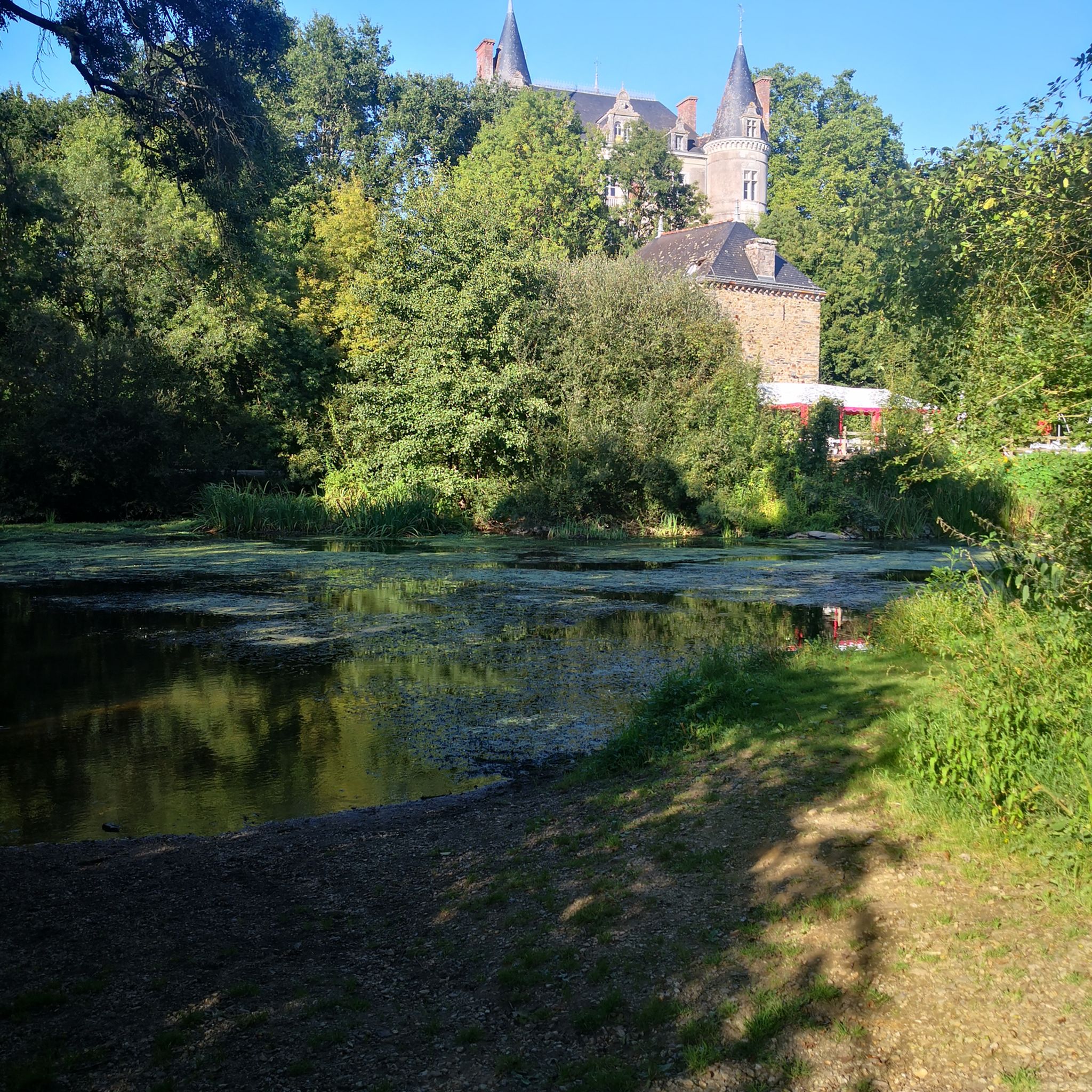
An ancient feudal fortress, the castle of Derval was considered in its time as one of the strongholds of the Marches of Brittany with its 9 towers. After experiencing prestigious sieges, including that of Du Guesclin, in 1598, it would fall under the axe of the Edict of Nantes which condemned it to demolition. The only remnant, the old keep, renamed Tour Saint-Clair and giving its name to the castle, still resists and bears witness today to the history of the castle known since the 11th century.
0
0
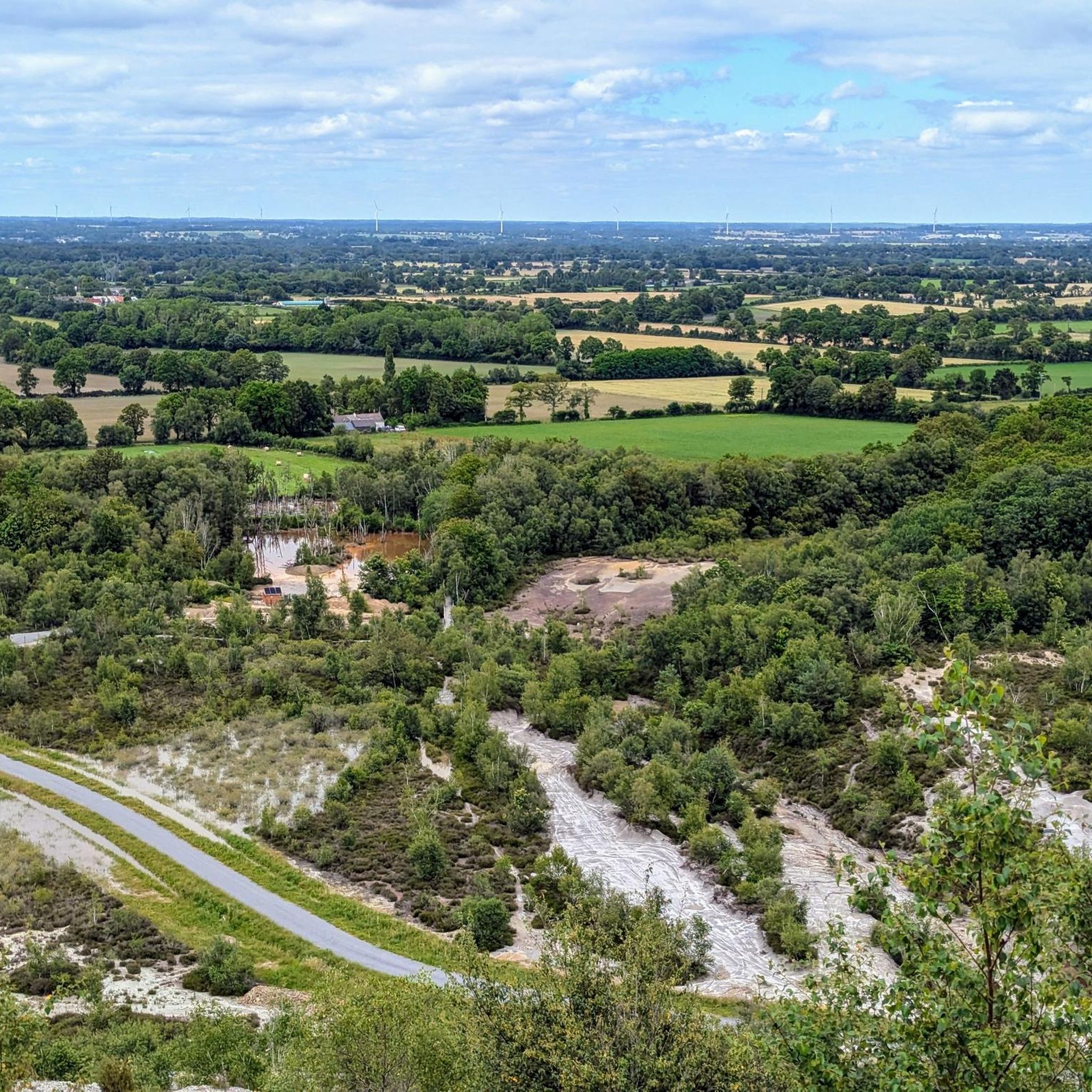
Small road with little traffic offering a clear view of the valley
0
0

Very beautiful descent and therefore magnificent climb
0
0

The church, which consists of a large nave and two six-bay aisles, a transept, and a three-bay choir without an ambulatory, is 65 meters long. The transept is 26.50 m long, and the naves are 17.5 m wide. The bell tower is 65 meters high without the cross. It has a set of five bells made in 1895 by the Bollée foundry in Le Mans: Saint-Nicolas (the bourdon), weighing 4027 kg, playing the A of octave 2 Anne, weighing 1552 kg, playing the D of octave 3 Marie, weighing 1067 kg, playing the M of octave 3 Joséphine-Jeanne, weighing 726 kg, playing the F sharp of octave 3 Henriette-Victorienne, weighing 450 kg, playing the A of octave 3
0
0
The original chapel, initially dedicated to Notre-Dame, was built by Geoffroy IV, Baron of Châteaubriant, on the site where the cattle market was held from May to October until 1763. A text attests to its existence in 1263. [Threatening to fall into ruin, it was demolished in 1518, leaving only the choir of the old chapel standing. The place of worship was immediately rebuilt in a more spacious form using Châteaubriant schist (Nozay stone), based on the plans of Jean Delorme, brother of Philibert Delorme, thanks to the demolition of a neighboring house and the financial support of Jean de Laval. However, the latter's poor financial situation meant that by 1530, only the nave of the building had been built. At the death of Françoise de Foix in 1537 and Jean de Laval in 1543, the Notre-Dame chapel still lacked a framework. It was not until 1551 that the final work was undertaken by Baron Anne de Montmorency. The dedication of the new place of worship took place ten years later, on November 5, 1561, in the presence of the coadjutor of the Bishop of Nantes, and the name of Notre-Dame was changed to Saint-Nicolas, for an unknown reason. On the same day, the body of Jean de Laval, then encased in a lead reliquary, was transported from the castle chapel to the new building. Jean de Laval had wished to see the chapel erected as a collegiate church, but this wish was not granted. However, the building, as vast as a church, shared the honors of worship with the Church of Saint-Jean de Béré, which was then the parish church of the town, until the Revolution. Indeed, the Saint-Nicolas chapel, although of undeniable architectural value, was not suitable for worship in a parish as large as that of Châteaubriant. Nevertheless, in the 15th and 16th centuries, masses, vespers, and many ceremonies were held in the chapel for reasons of convenience, as it was closer to the town of Châteaubriant, while baptisms were all celebrated at Saint-Jean de Béré. At the end of the 19th century, the church, which became the parish seat in 1801, was completely rebuilt. The architect Eugène Boismen drew up the plans, inspired by those of the Saint-Nicolas basilica in Nantes, one of the first neo-Gothic projects in France, which was beginning to inspire architects throughout the west of the country. The foundation stone was blessed on April 25, 1875, by Bishop Fournier of Nantes. The choir, sacristies, transept, and five bays were only completed at the time of the consecration, which was performed by his successor, Bishop Le Coq, on February 1, 1881. The foundations of the bell tower and the remaining bay began in June 1892, based on plans by architect François Bougoüin. The tower and spire were completed in August 1894.
0
0
Frequently Asked Questions
How many road cycling routes are available around Derval?
There are over 60 road cycling routes around Derval listed on komoot, catering to various skill levels. This includes 24 easy routes, 41 moderate routes, and 3 more challenging options for experienced cyclists.
What is the typical terrain for road cycling in the Derval area?
The terrain around Derval is generally characterized by a gentle topography, making it suitable for varied road cycling experiences. While the broader Loire-Atlantique region features some modest ascents, the landscape around Derval offers a mix of relatively flat sections with gentle undulations, ideal for recreational and intermediate riders.
Are there any family-friendly road cycling routes in Derval?
Yes, Derval offers several family-friendly road cycling routes due to its gentle terrain. For instance, the Roadbike loop from Derval is an easy 46.3 km path that takes about 2 hours to complete, perfect for a leisurely ride through the local countryside.
Can I find circular road cycling routes around Derval?
Many of the road cycling routes around Derval are designed as loops, allowing you to start and finish in the same location. An example is The Vilaine at Beslé – Rocs de Gascaigne loop from Derval, a moderate 78.7 km route offering scenic views of the Vilaine river.
What natural features or landmarks can I see while cycling near Derval?
While cycling near Derval, you can encounter various natural features and historical landmarks. Highlights include the Chapel of the Holy Sites, the scenic Vilaine Loop, and tranquil spots like La Roche Pond and Valley Pond. The region's landscape also features open fields, quiet country roads, and woodlands.
What do other road cyclists enjoy most about cycling in Derval?
The road cycling routes in Derval are highly rated by the komoot community, with an average score of 3.85 stars from over 13 reviews. Cyclists often praise the quiet country roads, the extensive rural landscapes, and the opportunity to explore both natural beauty and occasional historical landmarks.
Is there ongoing development for cycling infrastructure in Derval?
Yes, efforts are underway to enhance cycling connectivity directly around Derval. A project is in progress to establish a cycling route between Derval and the nearby commune of Pierric, utilizing low-traffic communal roads and an agricultural path to ensure a safer and more pleasant experience for cyclists.
Are there any longer, more challenging road cycling routes from Derval?
For those seeking a longer and more challenging ride, the Côte du Saz – Sucé sur Erdre bridge and port loop from Derval is a difficult 185.5 km trail. This extensive route explores rural landscapes and connects Derval to the Sucé sur Erdre area, taking approximately 8 hours to complete.
Can I access famous cycling routes like the Loire à Vélo from Derval?
While Derval is not directly on the famous Loire à Vélo route, its location within the Loire-Atlantique department means you can access sections of this long-distance trail. The Loire à Vélo follows the Loire River, offering scenic views of historic towns, vineyards, and châteaux, providing a different kind of cycling experience within reach.
What kind of natural parks are accessible near Derval for outdoor activities?
Derval's location in Pays de la Loire provides access to larger natural areas. The Brière Regional Nature Park, near Saint-Nazaire, is a vast wetland reserve known for birdwatching. Further afield, the Loire-Anjou-Touraine Regional Natural Park offers stunning landscapes with châteaux, vineyards, and forests, ideal for exploring beyond cycling.
Most popular attractions around Derval

Get inspired with the komoot mobile app


Explore more
Browse the best Road cycling routes in other regions.
