Attractions and Places To See around Solignac - Top 20
Attractions and places to see around Solignac include a blend of historical landmarks, cultural sites, and natural beauty in the Haute-Vienne department of Nouvelle-Aquitaine, France. The village is known for its significant abbey and picturesque surroundings, situated on the banks of the Briance river. Visitors can explore Romanesque architecture, medieval bridges, and various hiking trails.
Best attractions and places to see around Solignac
- The most popular attractions is Saint Stephen's Cathedral, a historical site. This impressive Gothic building, dedicated…
Last updated: October 5, 2026
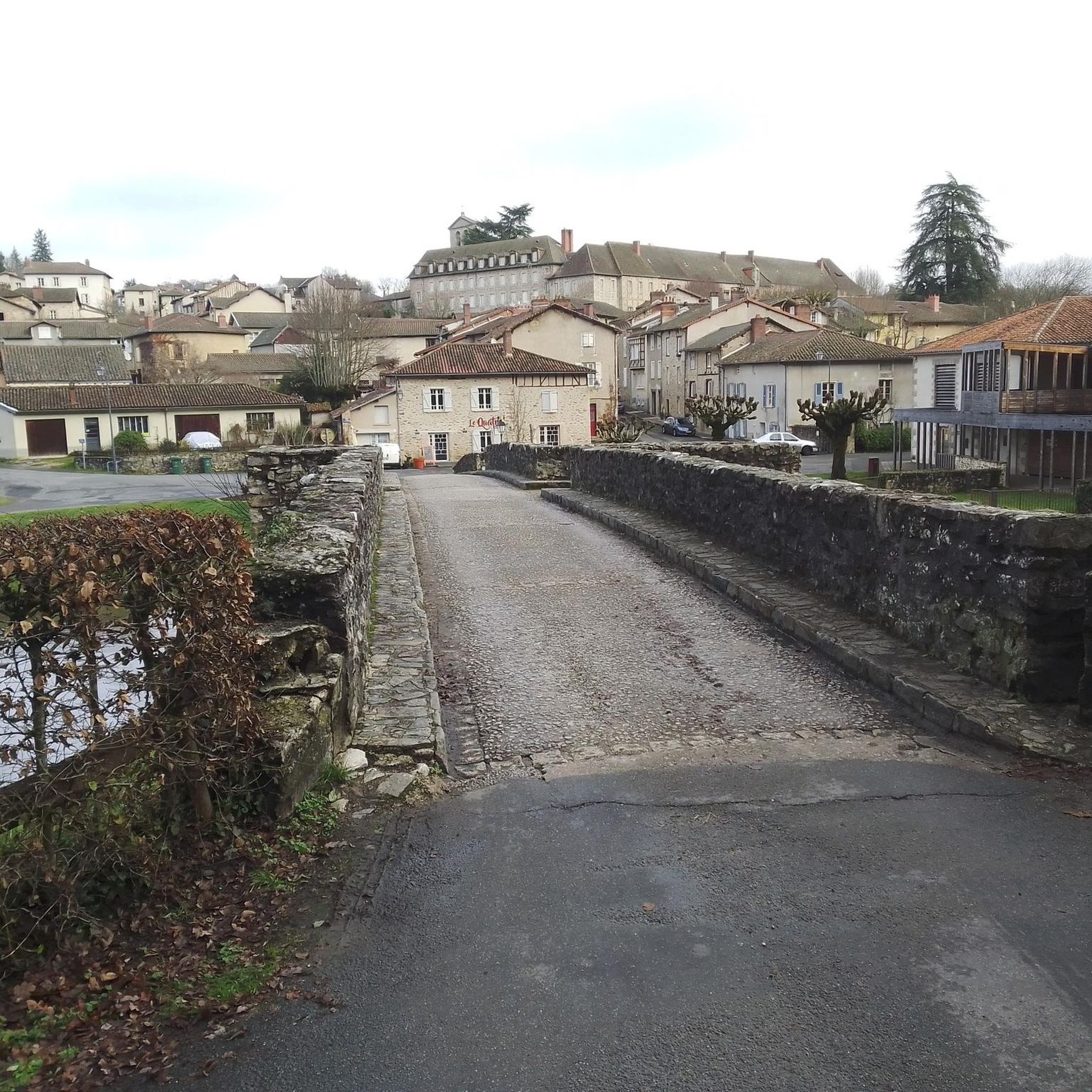
Saint-Étienne Medieval Bridge
Highlight • Bridge
Translated by Google •
Tip by

Saint Stephen's Cathedral
Highlight • Historical Site
Translated by Google •
Tip by

Sign up now to discover places like this
Get recommendations on the best single tracks, peaks, & plenty of other exciting outdoor places.
Château de Châlucet
Highlight • Castle
Translated by Google •
Tip by

Basilica of Saint-Michel-des-Lions
Highlight • Religious Site
Translated by Google •
Tip by

Boucherie district
Highlight • Other
Translated by Google •
Tip by

Sign up for free to discover even more attractions around Solignac.
Already have an account?
Start today with a free account
Your next adventure awaits.


Tips from the Community

A granite hall church in the late Gothic style (14th-15th centuries), topped by a typical Limousin bell tower, 70 meters high and adorned with a copper ball in 1824. Four corner turrets mark the start of the octagonal upper floors. The current church was rebuilt on the site of a chapel dedicated very early to the Archangel Saint Michael on a high point in the city, along which the old Roman road from Lyon to Saintes passed. It houses the relics of Saint Martial, the city's first bishop, and Saint Loup, his successor, saved from the revolutionaries of 1793. That year, the church was declared a "Temple of Reason." The head (skull) of Saint Martial, patron saint of the city, is shown to the people every seven years during a solemn display, and his bust framed by the letters S and M still constitutes the "furniture" of the coat of arms of Limoges.
1
0

Vienne, historic Limoges, the gourmet palace of the market halls and a return to nature before an appetizer
0
1

In the heart of Limoges, a timeless district nestles just a stone's throw from the market halls. On the menu: picturesque heritage, good restaurants, artisan shops, bohemian cafés... There's no doubt about it, it smells like a gourmet walk that flatters our taste buds and our curiosity. A bit of history: head to the Saint-Aurélien chapel A medieval marvel enhanced by its baroque decorum. The masterpieces begin even before you cross the entrance. There, on the district's central square, charming and on a human scale, the pretty building offers a bell tower covered in chestnut shingles. A cross sculpted in soft stone and a calvary recall the devotion of the historic people of the district, generations of butcher families. It is this body so necessary for supplying an entire city that settled here centuries ago. All the houses were inhabited by people in the trade. The interior of the chapel holds many beauties: an altarpiece housing the relic of the patron saint Aurélien, ex-votos plastered on the walls, remarkable sculptures including the famous group "The Child with the Kidney". To understand life in the past, a museum space, the Maison de la Boucherie at 36 rue, is open in the summer or by reservation at the Tourist Office the rest of the year. You enter rooms kept in their original condition with utensils and personal objects. From the shop to the attic via the slaughterhouse, you change era. Fascinating. Picturesque and modern: the lively Boucherie district. Coming out of there, you have to stroll through the alleys, find the shaded and discreet Place Barreyrette, admire the countless half-timbered houses, scrutinize the sculpted, upright stones. For a drink or a bite on rue de la Boucherie Each storefront is more beautiful than the other, don't miss the bookseller's which is one of the most photographed. In the line of sight going up, the fabulous Halles Centrales in the Baltard style with 368 porcelain panels. It is the promise of taste. It is also a belly of Limoges that is taking shape: the restaurants of the Boucherie are renowned, the bars well filled for the most lively discussions, and even a restaurant-grocery store where we live "local". - Restaurant Les Petits Ventres, for lovers of traditional French cuisine. - Restaurant Le Versant, for cheese lovers, but not only! - Restaurant CHAM FEL, for a taste journey around the Mediterranean. - Café Cantine Épicerie La Locale, for a meal, a drink or 100% local gourmet shopping. - Restaurant L’Amphitryon, to enjoy exceptional and inspired cuisine. - Restaurant Café Traiteur Idylle, to enjoy delicious hearty brunches. - Bar Le Duc Etienne, for a friendly after-work with friends and why not until the end of the night. For shopping at independent retailers On the shopping side, great shopping is to be expected at designers, decorators, and the famous Galerie du Canal which showcases a unique know-how of our destination: enamel. - Boutique Ferdinand, the nice shop where you can find gifts for all tastes. - Boutique Madam Edit’, addicted to stationery, this shop is made for you! - Concept Store Stronzo Shop, a real “Alibaba’s cave” to pimp your interior. / Boutique Bazar Marguerite, the girly decoration shop that will make you fall in love. - Concept Store La Manufacture Française, 100% ethical, 100% made in France to please you without feeling guilty. - Boutique Les Petits Palmiers, fan of the bohemian chic look? Head over to their place! - Galipettes and Roudelous, looking for the perfect gift for your little ones? It's this way. - Atelier Feu et Flamme, in the same vein as the Galerie du Canal, discover unique creations around the arts of fire An event to remember: La Frairie des Petits Ventres Finally, a date to remember, the third Friday of October when La Frairie des petits-ventres takes place, a major event around taste, and good in specialties like girot, chestnut black pudding, veal head and strawberry, sheep's tongue, sheep's balls but also potato pâté, galétous, clafoutis and flognarde…! To say that you are in the middle of a city in a "village" atmosphere is to admit that time does not pass like elsewhere here.
1
0
Saint Loup, Bishop of Limoges, gave a Saint-Michel chapel to the canons of Saint Martial around 630. Two fires in Limoges, in 1123 and 1147, destroyed the church. It was the monk Pierre de Verteuil who rebuilt it. The church was consecrated in 1213. This new church collapsed and the first stone of a new church was laid in 1364. Of this, two chapels and part of the walls remain. In 1552, enlargement work was carried out with a bay added to the west, remarkable for its large stained glass windows. Work was carried out over the following centuries, particularly on the bell tower (1604, 1754, 1810). It is a Gothic-style church, built between the 14th and 16th centuries. It has a typical Limousin bell tower (like the Saint-Étienne cathedral) topped with a curious metal ball. In 1810, when lightning struck the church bell tower, the religious building was damaged. The soldier in charge of the project to restore the monument's spire had the idea of topping it with a ball, "to facilitate triangulation operations and geodesic measurements". This sphere weighs 600 kg and is about two meters in diameter. The people of Limoges have become accustomed to this military appendage (a hotel even borrows its name from it: the Hôtel de la Boule d'Or) which is very exposed to the wind and once again puts the building in danger. Restoration work is underway and the debate rages between those who want a bell tower with or without a ball. The members of the Limousin Archaeological and Historical Society are also divided between boulophiles and boulophobes. The Prefect of the time decided by asking the opinion of the Ministry of Fine Arts. A new ball had to replace the old one; the First World War was declared. The new sphere was openwork and made of copper. It waited until the end of the war to find its place alongside the weather vane, which had not moved since 1824. The church was listed as a historical monument in 1903. The lions, from the Gallo-Roman period, were probably funerary monuments placed at the entrance to the public ancient necropolises. They always remained in the same place, once the cemetery became Christian, then when the cemetery was moved for reasons of sanitation.
0
0
In France there are 173 basilicas. Saint-Michel-des-Lions becomes the 174th", explains Father François Renard. At the head of the Saint-Martial parish, which includes, in addition to Saint-Michel, the churches of Saint-Joseph and Saint-Pierre-du-Queyroix, he learned the news on February 2, 2023. Noting that there was no basilica in Limousin, Monsignor Bozo, Bishop of Limoges, launched the procedure in 2020. The process was long and laborious. First, he made his request to all the bishops of France. 97% responded favorably to this request. Then he sought the agreement of the Congregation for Divine Worship and the Discipline of the Sacraments, placed under the authority of a cardinal prefect. With the help of Mathias Martin, a layman, member of the sacred art commission in Limoges, Father Renard, the bishop and all the parish's vital forces responded to a questionnaire in Latin. They drew up an inventory of the monument and created a complete list of the movable and liturgical heritage contained in this place. Sent to Rome in April 2021, this document took a long time to return to Limoges. In November, Monsignor Bozo, passing through the Vatican, relaunched the prelates. A tenacity that proved to be profitable. If the cathedral remains the mother church of a city, the basilica is, for tourists and pilgrims, a reference. To obtain this title, the building must be built on a tomb that is very strong in terms of symbolism and commemoration. Saint-Michel houses the tomb of Saint Martial, thirteenth apostle of Aquitaine and above all the first bishop of Limoges. Thus, Saint-Michel is linked to the universal church of Rome. As luck would have it, it became a basilica when the 2023 ostensions began on March 19. That day, during the flag-raising ceremony, François Renard read the decree during the mass. The blessing will then follow. Believers or not, the people of Limoges are attached to what must now be called the basilica. In the 6th century, there was a small chapel dedicated to Saint Michael and John the Baptist on this site. Founded in 535 by Rorice II, Bishop of Limoges, it was located in the middle of a cemetery, guarded by granite lions. They symbolize the protective deities because they are reputed to sleep with one eye and watch over sleeping souls. The work began in 1364 and was completed in 1455, the year of the consecration. In 1373, construction began on the bell tower, which was 70.91 metres high at the time. Saint-Michel-des-lions has a particularity. The pillars inside are not straight. Named "Temple of Reason" during the Revolution, the church has a rich heritage of buildings. The stained glass windows are superb. The triptych on the ostensions dates from 1875. It shows Clement V, Edward I of England, Philip the Bold, son of Saint Louis, and Alienor of Aquitaine bowing before the head of Saint Martial. The basilica should benefit from greater visibility. The town signs will be modified and inside, the information on hunting and the tomb will be denser. Its bas-reliefs show the most significant episodes in the life of the holy founder of Limoges. All of this will be highlighted. In short! Tourists and pilgrims will soon have the "basilica instinct". Jean-François Julien Le Populaire du Centre
0
0
1A large necropolis existed during the Late Empire around the current Place de la République in Limoges. Within this necropolis several mausoleums were to be located. Two are known today. One of them probably housed a cult to Saint Martial, the first bishop of Limoges, from the 5th century.
0
0
Built in an agglomeration that was to become the Cité, the bishop's town opposite the town of the Viscount's castle and the Saint-Martial abbey, its origin is probably early Christian. In 1884, Antoine Héron de Villefosse published an inscription that he saw engraved on a fragment "engaged in the base of the entrance tower of the cathedral, NE pillar", which according to him could be a re-use of a Roman milestone.
0
2
Built in an agglomeration that was to become the Cité, the bishop's town opposite the town of the Viscount's castle and the Saint-Martial abbey, its origin is probably early Christian. In 1884, Antoine Héron de Villefosse published an inscription that he saw engraved on a fragment "engaged in the base of the entrance tower of the cathedral, NE pillar", which according to him could be a re-use of a Roman milestone. In 2005, a hexagonal baptistery that the probable dating places in the first third of the 5th century was explored on the north face of the cathedral.
0
1
Frequently Asked Questions
What are some notable historical and cultural sites in Solignac?
Solignac is rich in history. The most prominent landmark is the Abbey Church of Saint-Pierre-Saint-Paul, founded around 631 AD, known for its Romanesque architecture and 12th-century structures. Another significant site is the Château de la Borie, a 17th-century castle that now hosts music and sound art events, featuring a unique 'garden of sounds'. You can also explore Le Pont Rompu, a historic bridge dating from the 13th to 15th centuries, which was once part of a Roman road.
Are there opportunities for hiking or exploring nature around Solignac?
Yes, Solignac is situated on the banks of the Briance River, offering picturesque strolls. The Sentier de la Briance is a dedicated hiking trail for exploring local flora and fauna. Several marked hiking trails are accessible in and around the village, providing ample opportunities to appreciate the natural beauty of the Limousin region.
What is the significance of the Abbey Church of Saint-Pierre-Saint-Paul in Solignac?
The Abbey Church of Saint-Pierre-Saint-Paul is Solignac's most important historical site. Founded by Saint Eligius around 631 AD, its current buildings largely date back to the 12th century. It is considered one of the oldest and most remarkable Romanesque churches in the Limousin region, characterized by its majestic exterior and a nave covered with cupolas. Inside, you can admire finely sculpted capitals and oak stalls. For more historical context, you can visit its Wikipedia page.
Can I visit Château de la Borie, and what does it offer?
Yes, the Château de la Borie is a 17th-century castle that has been fully restored. It now houses the La Borie foundation, dedicated to music and sound arts, regularly hosting concerts and artist residencies. The château is also known for its seven hectares of 'garden of sounds,' which blend landscape design with light, offering a unique sensory experience.
What kind of cycling routes can I find near Solignac?
There are numerous cycling opportunities around Solignac. For touring cyclists, routes like the 'Pont Rompu – Pont Rompu loop' (22.6 km) or a more challenging 'Bike loop from Solignac - Le-Vigen' (55.7 km) are available. Road cyclists can explore longer routes such as the 'Eyjeaux – Château de Châlucet loop' (76.2 km) or the 'Old bridge of Solignac – Pont Rompu loop' (83.6 km). You can find more details on these and other routes in the Cycling around Solignac and Road Cycling Routes around Solignac guides.
Are there mountain biking trails around Solignac?
Yes, mountain biking enthusiasts will find several trails near Solignac. Options include the 'Auzette Ford – Au fil de l'Auzette loop' (48.7 km, moderate difficulty) or the 'Cascade de Leychoisier – Lac de Plaisance loop' (69.5 km, difficult). These trails offer a great way to experience the region's natural landscapes. More information can be found in the MTB Trails around Solignac guide.
Are there family-friendly activities available in Solignac?
Beyond historical sites, families can enjoy the interactive Terra Aventura Course 'Eloi's Game', which offers a playful way to discover Solignac. Many of the historical sites, such as the Abbey Church and the medieval bridges, are also considered family-friendly for exploration. Additionally, the natural trails along the Briance River provide pleasant walks suitable for families.
What attractions are available in nearby Limoges?
Solignac is conveniently located near Limoges, which offers additional attractions. These include the impressive Gothic building of Saint Stephen's Cathedral, the Saint-Étienne Medieval Bridge over the Vienne river, and the Basilica of Saint-Michel-des-Lions. The historic Boucherie district in Limoges is also a must-visit for its picturesque heritage, artisan shops, and restaurants.
When is the best time to visit Solignac for outdoor activities?
The best time to visit Solignac for outdoor activities, such as hiking and cycling, is generally during the spring (April to June) and early autumn (September to October). During these months, the weather is typically mild and pleasant, making it ideal for exploring the trails and natural features without the intense heat of summer or the chill of winter.
What do visitors particularly enjoy about the attractions around Solignac?
Visitors frequently appreciate the blend of historical depth and natural beauty. The impressive Gothic architecture of Saint Stephen's Cathedral and the charm of the Saint-Étienne Medieval Bridge are often highlighted. Many also enjoy the opportunity to explore the remains of Château de Châlucet and the scenic walks along the Briance River, noting the peaceful atmosphere and rich history of the area.
Are there dog-friendly trails in Solignac?
Yes, the natural trails around Solignac, particularly those along the Briance River and the Sentier de la Briance, are generally dog-friendly. These paths offer a great opportunity for you and your dog to enjoy the local wildlife and plant life. Always ensure your dog is on a leash and that you clean up after them to preserve the natural environment for everyone.
Is there an interactive way to explore Solignac?
For a more engaging and playful discovery of the area, you can try the Terra Aventura Course 'Eloi's Game'. This interactive course provides a unique and fun way to explore Solignac's landmarks and hidden gems, often involving geocaching-style puzzles and challenges.
How can I get to Solignac's attractions, and is parking available?
Solignac is easily accessible by car, and parking is generally available within the village, especially near major attractions like the Abbey Church. For those relying on public transport, Solignac is located approximately 9 km from Limoges, which is a larger transport hub. Local bus services may connect Solignac to Limoges, but it's advisable to check current schedules for specific routes and timings.
Most popular routes around Solignac

Get inspired with the komoot mobile app


Explore more
Still not found the Highlight you’re looking for? See guides of the top attractions in other regions:
