The best road cycling routes around Écurat
4.4
(60)
2,109
riders
475
rides
Road cycling around Écurat, a rural commune in Charente-Maritime, France, offers access to a network of quiet country roads and varied terrain. The area features gentle hills, river valleys, and vineyards, with altitudes ranging from 14m to 69m. Its proximity to Saintes provides opportunities to combine rides with visits to historic sites. The region is known for its cycling-friendly landscape, including sections of the Flow Vélo route.
Best road cycling routes around Écurat
- The most popular road cycling route is…
Last updated: July 1, 2026
29
riders
Easy road ride. Great for any fitness level. Mostly well-paved surfaces and easy to ride.
19
riders
42.9km
01:48
230m
230m
Easy road ride. Great for any fitness level. Mostly well-paved surfaces and easy to ride.

Sign up for free
13
riders
Moderate road ride. Good fitness required. Mostly well-paved surfaces and easy to ride.
14
riders
43.5km
01:52
320m
320m
Moderate road ride. Good fitness required. Mostly well-paved surfaces and easy to ride.
1.0
(1)
12
riders
Moderate road ride. Good fitness required. Mostly well-paved surfaces and easy to ride.
Get access to more routes and recommendations from other explorers.
Sign up for free
Already have an account?
Our route recommendations are based on thousands of hikes, rides, and runs completed by other people on komoot.
Start today with a free account
Your next adventure awaits.
Login or Signup



Tips from the Community

It is an absolutely beautiful village.
0
0

Small town with a special charm along the Charente.
0
0

The Abbaye-aux-Dames is built around the church of Sainte-Marie, built in the twelfth century. Famous for its facade and its characteristic "pinecone" bell tower, it is one of the emblematic monuments of Saintonge's Romanesque art. After several wars and fires, the place was restored in the 1970s and 1980s and is now a hotel. When you walk through the long corridors you feel like you have been transported back to the time when the abbey was still alive.
4
0


A former Benedictine abbey created in 1047, Abbaye-aux-Dames was the first women's monastery in Saintonge. These powerful women were nuns, that is to say, nuns living cloistered and having taken a vow of piety, occupying their lives in contemplation. They carried the crosier, in other words the pastoral staff of a bishop, and minted coins. Richly endowed, the abbey carried its influence well beyond the borders of the county and over time it became one of the most powerful women's monasteries in all of South-West France. With up to a hundred nuns at its peak, it was entrusted with the mission of instructing young girls, often from the French nobility, and counted among its most illustrious residents the future Marquise de Montespan, favorite of Louis XIV. The Abbaye-aux-Dames is structured around the Sainte-Marie church, built in the 12th century, famous for its facade and its characteristic “pine cone” bell tower. The premises were restored during the 1970s and 1980s and now house a Cité de la musique in which the Saintes Festival dedicated to classical music takes place each year. You can also stay in a wing of the building, the cells having been converted into hotel rooms, and leave your bike in a secure room.
0
0
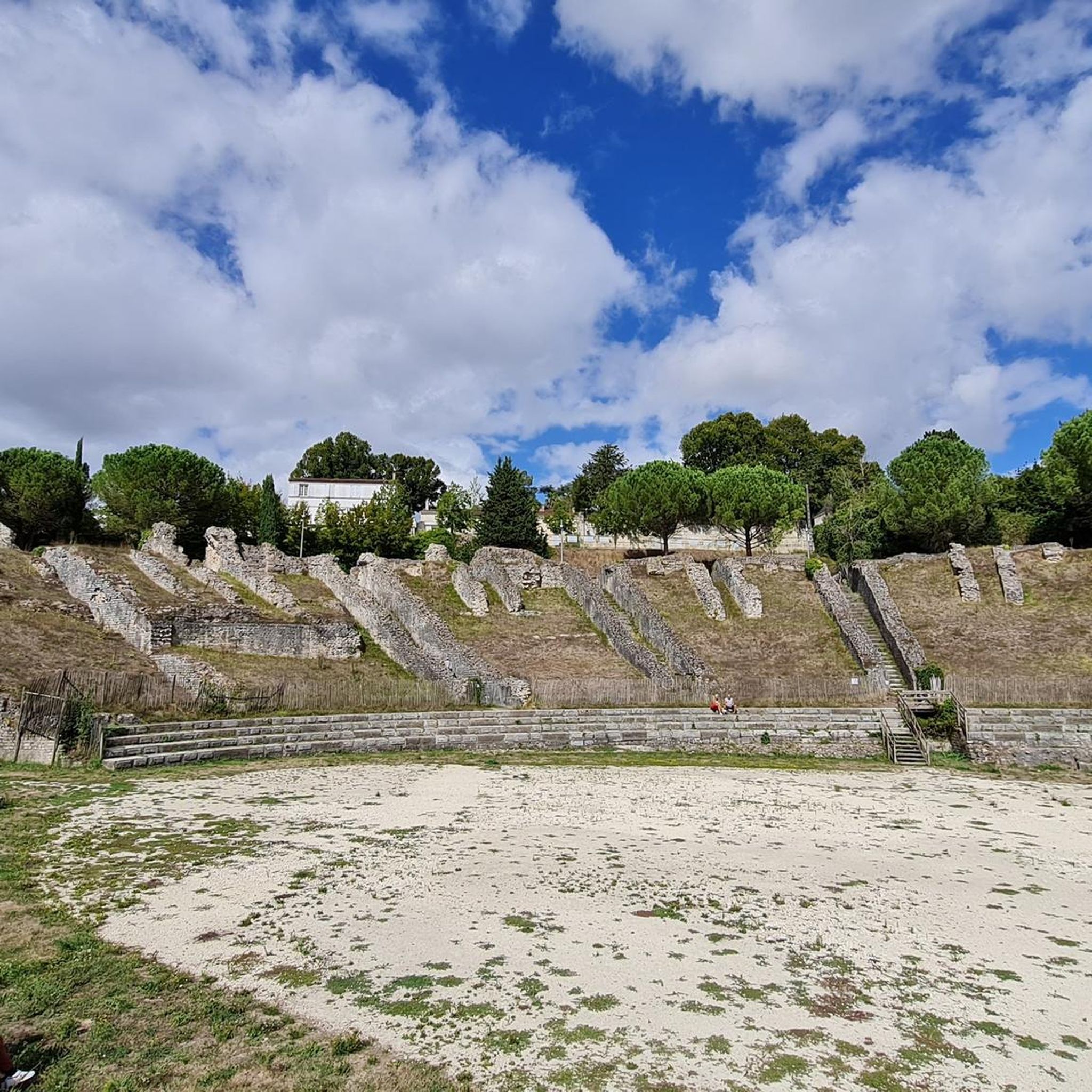
The Santons people occupied Saintonge during the Gallic era. The Romans conquered the region and settled on the banks of the Charente. The town of Saintes (then designated Mediolanum), located at the western end of the Via Agrippa which linked Lyon (capital of the Three Gauls) to the Atlantic coast, quickly became monumental. At the time of Augustus (27 BC – 14 AD), the city probably became the capital of the province of Greater Aquitaine (Aquitania). This then extended from the Loire to the Pyrenees. Mediolanum is endowed with important public monuments: the amphitheater, the arch of Germanicus, the thermal baths and the aqueduct are still partially visible today. At the time of its peak (end of the 1st century – beginning of the 2nd century), the city must have had several thousand inhabitants. The amphitheater of Mediolanum is one of the earliest in Gaul. It is estimated that its construction began during the reign of Tiberius (14 – 37 AD), and was completed during the reign of Claudius (41 – 54 AD). Like many amphitheaters of the Roman Empire, that of Saintes was located on the outskirts of the ancient city in a chosen and developed site: the “vallon des Arènes”. Thanks to a favorable topography, the builders were relieved of part of their work, the amphitheater resting on the slope of the valley. This elliptical monument, with imposing dimensions (126 meters long and 102 meters wide), made it possible to accommodate several thousand spectators around bloody and violent representations such as gladiator fights (munera) or animal hunts (venationes ). In the 3rd century, the city declined and was entrenched within an impressive rampart, built from the remains of public and funerary monuments from previous decades. The amphitheater is then no longer used. Since the Middle Ages, it has been used, among other things, as a stone quarry. It was classified as a Historic Monument in 1840. It was from this moment that it was gradually restored. Today, despite the disappearance of the superstructures, the remains provide a faithful image of what this monument could have been at the time of its splendor. The site welcomes visitors all year round. Certain objects found during various excavations in the amphitheater district are visible at the archaeological museum.
1
0
Located on a rocky spur overlooking the Charente, Taillebourg has one of the oldest castles in the province of Saintonge. It was also one of the most important in the region in the Middle Ages. This stronghold will allow the city to assert its power and prosper thanks to its port and control of trade throughout the Middle Ages. According to a chronicler, the Château de Taillebourg hosted the wedding night of Louis, future king of France under the name Louis VII, with Duchess Eleanor of Aquitaine. Louis IX (future Saint Louis) made the castle his fortress to launch the attack against the King of England, Henry III. This victorious battle of July 21, 1242 became famous and was represented several centuries later by Delacroix, whose painting can be seen in the Battles gallery at the Palace of Versailles. The castle which had endured all the sieges during the Hundred Years' War and the Wars of Religion was taken and destroyed during the Fronde in 1652. During the Revolution, it was sold in lots as national property. Having suffered from lack of maintenance, the building was the victim of a fire in 1822 and was largely destroyed. All that remains now are the ruins with the ramparts and a tower standing like an emaciated being. It now houses a park which is a haven of peace. To access it from the banks of the Charente, you have to take a small detour through the town.
0
0
The Saint-Savinien church is a Romanesque style building built between the 12th and 13th centuries. The current sanctuary succeeds an ancient priory, cited in a charter of 1039, of which no vestige remains. The adjoining square is pleasantly decorated with statutes representing the apostles.
0
0
Frequently Asked Questions
What kind of terrain can I expect when road cycling near Écurat?
The region around Écurat offers a diverse landscape for road cyclists. While much of the Charente-Maritime is characterized by flat or gently undulating terrain, ideal for relaxed rides, sections near Saintes (just 5 km away) provide gently hilly countryside. You'll encounter quiet country roads winding through river valleys, vineyards, and classic Charentais farmland, offering a good mix of scenic beauty and varied topography.
How many road cycling routes are available around Écurat?
There are over 470 road cycling routes around Écurat available on komoot. This extensive network provides options for various skill levels and preferences, from leisurely rides through the countryside to more challenging excursions.
What is the best time of year for road cycling in Écurat?
The Charente-Maritime region, including Écurat, benefits from a mild and sunny climate, making it suitable for road cycling almost year-round. Spring and autumn generally offer pleasant temperatures and fewer crowds, while summer provides long daylight hours, though it can be warmer.
Are there road cycling routes suitable for beginners or families in Écurat?
Yes, Écurat offers numerous routes suitable for beginners and families. Over 120 easy routes are available, often utilizing small, low-traffic roads and towpaths. These routes allow for a relaxed cycling experience through picturesque villages and along the Charente River. For example, the Porche de Pont l'Abbé loop from Miclos is an easy option.
Are there any challenging road cycling routes for experienced cyclists around Écurat?
While much of the area is gently undulating, there are routes that offer more challenge. The region's varied topography, particularly near Saintes, includes sections with more elevation gain. There are 7 difficult routes available on komoot, and over 340 moderate routes that can provide a good workout for experienced riders looking for longer distances and more climbs.
What historical landmarks or attractions can I see along road cycling routes near Écurat?
Many routes around Écurat pass by significant historical and cultural sites. You can visit the Abbaye aux Dames de Saintes and the Saint-Pierre Cathedral (Saintes). Further afield, routes may lead you past charming châteaux like Crazannes Castle or the Sainte-Madeleine Church of Crazannes. The Abbaye aux Dames de Saintes – Cathedral of Saintes loop from Saint-Georges-des-Coteaux is a great route to explore these landmarks.
Are there any circular road cycling routes in the Écurat area?
Yes, many of the road cycling routes around Écurat are designed as loops, allowing you to start and finish at the same point. For example, the Porche de Pont l'Abbé – Saint Saturnin of Séchaud loop from Saint-Georges-des-Coteaux offers a moderate circular ride through the rural countryside and charming villages.
What do other road cyclists enjoy most about road cycling in Écurat?
The road cycling experience in Écurat is highly rated by the komoot community, with an average score of 4.4 stars from over 60 reviews. Cyclists often praise the quiet country roads, the picturesque river valleys, and the charming vineyards that characterize the routes. The blend of easy and moderate terrain also makes it appealing to a wide range of riders.
Can I access sections of the Flow Vélo national cycling route from Écurat?
Absolutely. Écurat is strategically located close to the Flow Vélo, a major national cycling route that follows the Charente River. You can easily access sections of this route, which offers diverse landscapes including verdant river valleys, wet woodlands, and pastures. The Flow Vélo often uses small, low-traffic roads and towpaths, perfect for road cycling. For more information, you can visit the Flow Vélo website.
Are there options for longer distance road cycling routes around Écurat?
Yes, for those looking for longer rides, there are several options. Many routes extend beyond 40 km, allowing for extended exploration of the Charente-Maritime countryside. For instance, the Porche de Pont l'Abbé – Saint-Savinien-sur-Charente loop from Saint-Georges-des-Coteaux is a moderate route spanning over 67 km.
What kind of natural features will I encounter on road cycling routes near Écurat?
Beyond the cultural sites, road cycling routes around Écurat immerse you in the natural beauty of the Charente-Maritime. You'll ride through serene river valleys, past lush vineyards, and through tranquil rural landscapes. The region's limestone quarries, such as those near Crazannes, also offer unique natural settings with distinctive vegetation.
Most popular attractions around Écurat

Get inspired with the komoot mobile app


Explore more
Browse the best Road cycling routes in other regions.
