The best road cycling routes around Thaims
3.9
(19)
528
riders
114
rides
Road cycling routes around Thaims traverse a landscape characterized by gentle undulations and open countryside, often connecting historic villages and rural points of interest. The region features a network of roads that wind through agricultural areas and past local landmarks. Elevations are generally low, with most climbs being gradual rather than steep, making it suitable for various fitness levels.
Best road cycling routes around Thaims
- The most popular road cycling route is Regulus Caves – Church of Arces loop from…
Last updated: October 7, 2026
4.0
(2)
32
riders
99.6km
04:08
490m
490m
Moderate road ride. Good fitness required. Mostly well-paved surfaces and easy to ride.
4.0
(2)
65
riders
108km
04:22
380m
380m
Moderate road ride. Good fitness required. Some segments of this route may be unpaved and difficult to ride.

5.0
(1)
63
riders
54.3km
02:18
350m
350m
Moderate road ride. Good fitness required. Mostly well-paved surfaces and easy to ride.
20
riders
49.0km
02:04
300m
300m
Moderate road ride. Good fitness required. Mostly well-paved surfaces and easy to ride.
1.0
(1)
11
riders
87.6km
03:35
250m
250m
Moderate road ride. Good fitness required. Some segments of this route may be unpaved and difficult to ride.
Get access to more routes and recommendations from other explorers.
Already have an account?
Our route recommendations are based on thousands of hikes, rides, and runs completed by other people on komoot.
Start today with a free account
Your next adventure awaits.


Tips from the Community

The Halles of Mornac first appeared in the Middle Ages. It was only in 1664 that the first written proof attested to their existence. They are likely older and could date back to the 1550s. The Halles are generally timber-framed shelters supported by stone pillars and covered with tiles. It can be assumed that, like those of Cozes and Pisany, they suffered the vicissitudes of the Wars of Religion and were damaged, or even destroyed, then rebuilt when peace returned. The site of the Halles of Mornac was a renowned fairground and allowed the inhabitants to sell their products in exchange for a fee paid to the Lord. It was an important source of income for him, which also obliged him to maintain these Halles in perfect condition. An act engaging the Lord and the seller sealed a contract signifying the rights to sell unpacked goods and the maintenance of the said Halles.
0
0
Built from 1955 and consecrated in 1958, the Notre-Dame de Royan church symbolizes the city standing tall and proud again. The reinforced concrete monument thus fits into the general trend of renewal in sacred art after the sad events the world experienced in the 1940s. It is considered today as a feat and a masterpiece of modern architecture. "Upon entering this concrete cathedral, be silent. Here, everything is momentum, rigor, roughness, austere beauty. The twilight sings the elusive, the divine, variable and constant like the sea." ANDRÉ MALRAUX Minister of Cultural Affairs (1958-1969)
1
0

Exceptional view, the most beautiful village in France.
0
0

Here you'll find a romantic little lighthouse, and behind it lies a garden with a bench overlooking the sea, a lovely place to stop for a break. Afterwards, you can continue along the cliff to the right until you reach Euro Velo 1 again.
0
0

Perfect beachside bike trail along the boulevard, with several rest stops with seating and beach acces.
0
0
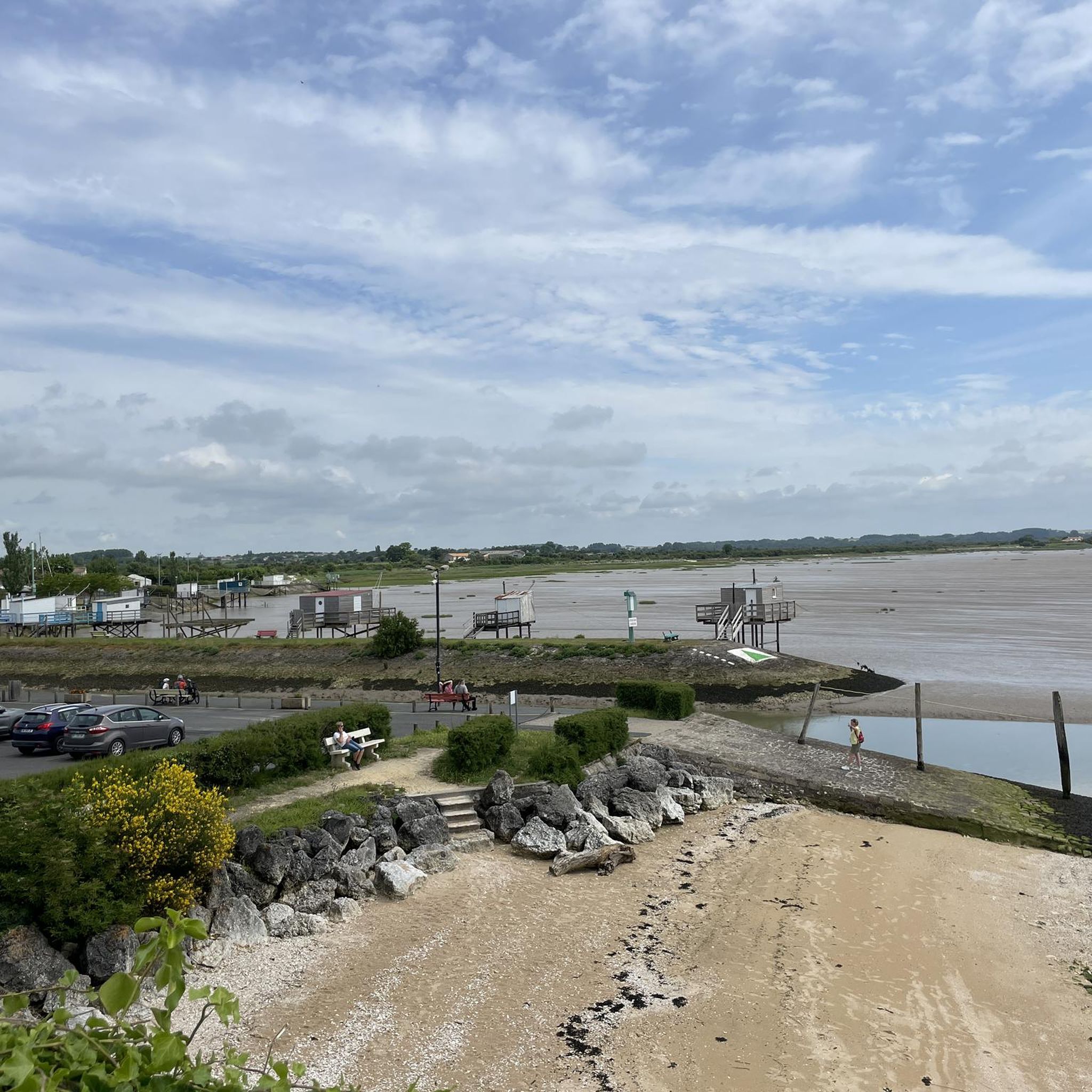
Large recreational and small-scale fishing port on the Gironde estuary.
0
0

On the beach of Royan (20,000 inhabitants). This is where the boat that takes you across the Gironde docks/departs.
0
0

The Terre-Nègre lighthouse is a landmark forming a cylindrical tower a little over 26 meters high. Located on the tip of Terre-Nègre, in the commune of Saint-Palais-sur-Mer, in Charente-Maritime, it is intended to mark the southern pass of the Gironde estuary and to signal the presence of a dangerous sandbank, the "Anglais bar". This building forms a tower-column 3.16 meters in diameter and 26.60 meters high. A spiral staircase with a central core of 143 steps leads to a summit platform equipped with a directional light. The tower is painted in two different colors to make it more visible: the upper part is red, the lower part is white. The base of the lighthouse is hidden by a building that once served as the keeper's accommodation. The installation of a beacon at this location was considered as early as 1763. De Kearney took over the beaconing plan four years later. Construction work on the tower began in 1770 and was completed in 1773, probably under the supervision of the Bordeaux engineer Claude Tardy. In 1807, the tower was raised. However, this work was considered insufficient by some of the estuary's navigators. In 1834, sailors from the nearby port of Royan sent a request to the Ministry of the Navy to study the possibility of equipping the tower with a light. However, this request was postponed the following year due to lack of sufficient funds. A new request from sailors prompted the lighthouse commission to experiment with a first light in 1836. Finally, on October 15, 1838, a fixed white 4th order light was permanently installed. The latter was replaced in 1856 by a fixed white light of the 4th order of a small dioptric model with a reinforced sector of the 5th order catoptric. It was equipped with new lights in 1899 and 1904. In 1939, it was electrified. During the German occupation, the lighthouse served as an observatory for the soldiers of the Wehrmacht. Damaged during the fighting of 1945 (presence of breaches at the top of the tower), it was restored in the immediate post-war period. In March 1947, the lighthouse was operational again. A light with 3 occultations — changing every 12 seconds — was installed. Its colors are white, red and green. Its current range is 18 miles. Listed as a Historic Monument since 2011, the lighthouse is not open to visitors. However, it can be admired from the outside and a pretty passage provides direct access to the coastal path.
0
0
Frequently Asked Questions
How many road cycling routes are available around Thaims?
There are over 110 road cycling routes available around Thaims, offering a wide variety of options for different skill levels and preferences.
What kind of terrain can I expect on road cycling routes in Thaims?
Road cycling routes around Thaims feature a landscape characterized by gentle undulations and open countryside. The elevations are generally low, with most climbs being gradual rather than steep, making it suitable for various fitness levels.
Are there easy road cycling routes suitable for beginners in Thaims?
Yes, Thaims offers a good selection of easy routes. Approximately 38 of the available routes are classified as easy. An excellent option for beginners is the St Romain de Benet Church – Pisany Market Halls loop from Grézac, which is an easy 27.9 miles (44.9 km) path.
What are some good options for longer road cycling tours around Thaims?
For those looking for longer rides, routes like the Les Halles de Cozes – Cozes Market Hall loop from Grézac offer a moderate challenge, covering 37.6 miles (60.6 km) and typically taking over 2 hours to complete.
Are there challenging routes for experienced road cyclists in Thaims?
While the region is known for its gentle terrain, there are a couple of routes classified as difficult for those seeking more of a challenge. The majority of routes are easy to moderate, with gradual climbs rather than steep ascents.
What are some scenic highlights or attractions I can see along the road cycling routes?
Many routes connect historic villages and rural points of interest. You can pass by landmarks such as the Saint-Romain Church of Saint-Romain-de-Benet, the Notre-Dame Church of Corme-Écluse, or the Maison Forte of Pisany. The Regulus Caves – Church of Arces loop from Grézac is a popular route that passes by the Church of Arces.
Are there loop road cycling routes available in Thaims?
Yes, many of the road cycling routes around Thaims are designed as loops, allowing you to start and end at the same point. Examples include the Regulus Caves – Church of Arces loop from Grézac and the Château de Châtenet Ruins loop from Thaims.
What do other road cyclists enjoy the most about road cycling in Thaims?
The road cycling routes in Thaims are highly rated by the komoot community, with an average score of 4.0 stars from over 10 reviews. Cyclists often praise the gentle terrain, the connection between historical sites like châteaux ruins and local market halls, and the experience of traversing open countryside.
Are there family-friendly road cycling routes in Thaims?
Given the region's gentle terrain and low elevations, many of the easy and moderate routes are suitable for families. Routes that connect historical churches and market halls, such as the St Romain de Benet Church – Pisany Market Halls loop from Grézac, offer pleasant rides without significant climbs.
What are some popular starting points for road cycling in the Thaims area?
Many popular routes, including the Regulus Caves – Church of Arces loop and the Château de Châtenet Ruins – Les Halles de Cozes loop, often start from Grézac, a nearby village. Thaims itself also serves as a starting point for routes like the Château de Châtenet Ruins loop.
What is the typical duration for road cycling routes in Thaims?
The duration of routes varies, but many popular tours range from 1 hour 55 minutes to over 2 hours. For instance, the Regulus Caves – Church of Arces loop from Grézac typically takes around 2 hours 11 minutes, while the Château de Châtenet Ruins – Les Halles de Cozes loop from Grézac is often completed in about 1 hour 55 minutes.
Most popular attractions around Thaims

Get inspired with the komoot mobile app


Explore more
Browse the best Road cycling routes in other regions.
