Attractions and Places To See around La Chapelle-Thouarault - Top 20
Best attractions and places to see around La Chapelle-Thouarault, a commune in the Ille-et-Vilaine department of Brittany, France, offer a blend of local heritage and natural landscapes. The area features historical landmarks such as the Église Notre-Dame-de-Montual and the 17th-century Manoir de Champ Menguy, known for its traditional earth construction. Visitors can explore local hiking trails like the "Balade de Cohan," which highlight rural scenery and historical elements. La Chapelle-Thouarault also provides access to regional attractions, including the Jardins de…
Last updated: August 30, 2026
The drawbridge at the Cicé lock
Highlight • Bridge
This allows you to reach Chavagne from the Vilaine towpath (and vice versa).
Note that this part of the Vilaine is …
Translated by Google •
Tip by

The Maltière Execution Hill
Highlight • Other
Translated by Google •
Tip by

Sign up now to discover places like this
Get recommendations on the best single tracks, peaks, & plenty of other exciting outdoor places.
Sign up for free
Catholic Church - St. Justine of Gévezé
Highlight • Other
Translated by Google •
Tip by

Waterwheel at Roazhon Park
Highlight • Monument
Translated by Google •
Tip by

Le Moulin de Champcors
Highlight • Monument
Translated by Google •
Tip by

Sign up for free to discover even more attractions around La Chapelle-Thouarault.
Sign up for free
Already have an account?
Start today with a free account
Your next adventure awaits.
Login or Signup



Tips from the Community

Hello everyone, The bridge has been dismantled for two years, undergoing repairs in the navigation workshops. I hope to see it again one day.
0
0

Using the power of moving water to drive a mill wheel is an ancient invention that dates back to pre-Christian times. Thanks to such a construction, human or animal muscle power could be easily replaced by a watercourse - natural or artificially created - in order to grind grain into corn, for example. There are essentially two different ways of driving watermills: either the water simply hits the blades of the water wheel from below to set it in motion; or the water is guided above the wheel and falls onto the blades; this type of construction is more efficient due to natural gravity.
0
0

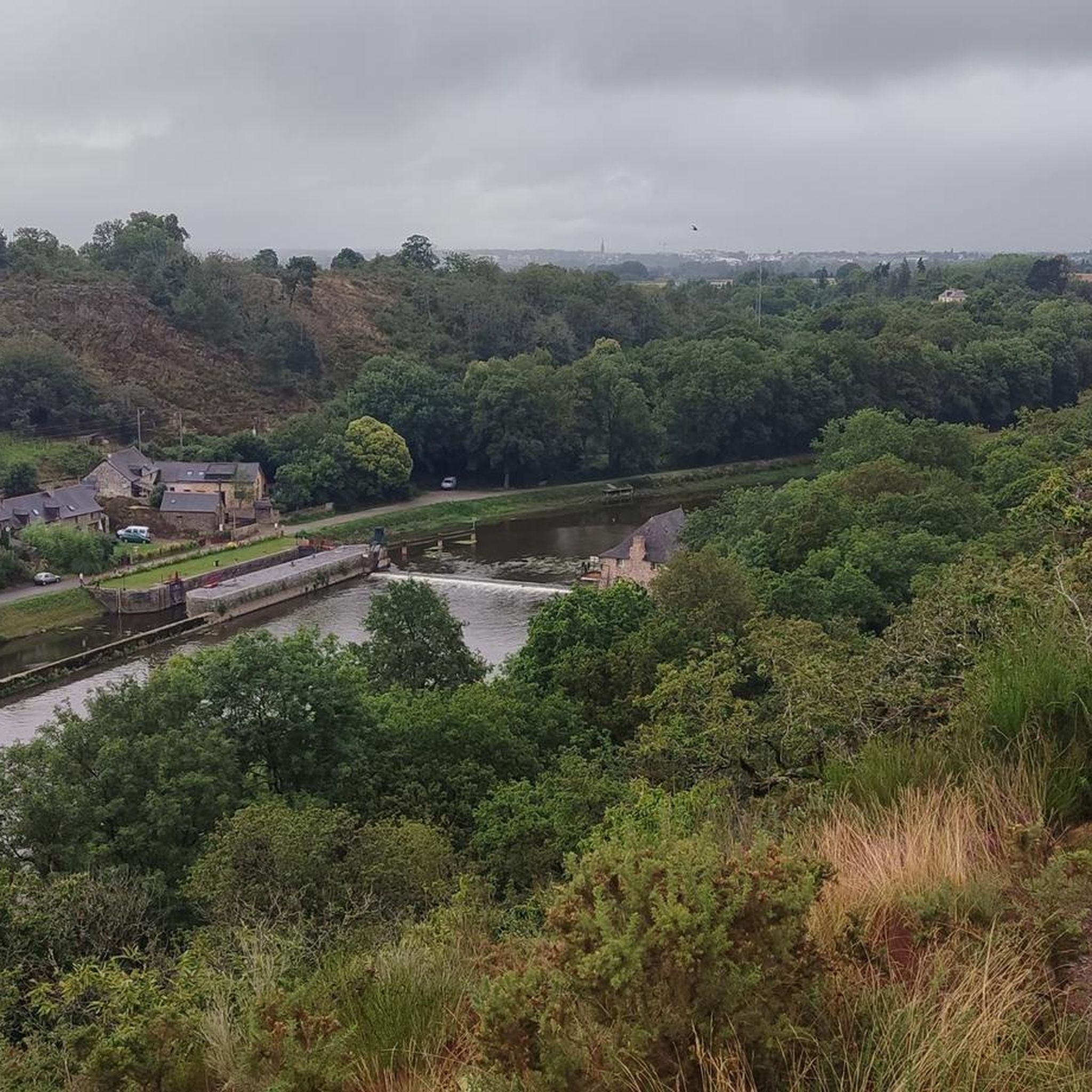
Cicé lock in Bruz. Possibility of crossing the Vilaine on foot or by bike.
0
0

Beautiful walk on the Vilaine passing through Roazhon Park!
0
0
The Champcors mill is a thousand-year-old water mill in Vilaine and the commune of Bruz producing flour from wheat mainly from Maine-et-Loire for bakers from Ille-et-Vilaine wanting flour made from traditional way and without the addition of chemicals. Having belonged to the Champion de Cicé family, one of whose representatives gave his name to one of the streets in Rennes, it has been run since 1953 by the Pivan family. In 2012, Emmanuel Pivan produced, after his father and grandfather, 700 tonnes of flour per year, according to him, less than a fifth of the production of a large flour mill. wiki-rennes.fr
0
0
The oldest remains of the parish church of Sainte-Justine de Gévezé date from the 12th century, notably a bay in the south wall of the nave. The Sainte-Justine Church was rebuilt in the 15th and 16th centuries, of which it retains some elements of its framework, or even gargoyles and crossettes with fantastic animal shapes. A tower had been built between 1614 and 1628. This one threatening to fall into ruins was rebuilt in the middle of the 19th century, in a different place: the bottom of the nave. The plans and specifications for this new porch bell tower were drawn up by Jacques Mellet who took delivery of the work in 1858. (wiki-rennes.fr)
0
0

Saint Justine is a 1st century martyr in Padua. Baptized in Padua by a disciple of Saint Peter, she remained firmly faithful to faith in Jesus Christ at the time of the persecutions. For her faith, she was pierced with a sword. The fame of his so lively faith spread throughout the Roman Empire, as far as Gaul, despite the hostile climate towards Christians. In Gévezé, the oldest remains of the church date from the 12th century, notably a bay in the south wall of the nave. The Sainte-Justine Church was rebuilt in the 15th and 16th centuries, of which it retains some elements of its framework, or even gargoyles and crossettes with fantastic animal shapes. A tower had been built between 1614 and 1628. This one threatening to fall into ruins was rebuilt in the middle of the 19th century, in a different place: the bottom of the nave. The Sait-Justine church housed two side altars dedicated to the Virgin and Saint Anne, made of stone and marble by the Rennes sculptor Bernard Dupont in 1637. They were demolished in 1783, by kind rationalist supporters of the Fraternal Republic and democratic.
1
0

Built in 1937 by the French soldiers to make it a shooting range, the Butte de la Maltière became in 1940 a very important place for the city of Saint-Jacques de la Lande and for its history. Indeed, on June 18, 1940 when the Germans arrived in Rennes - and therefore St-Jacques - they invaded the Butte de la Maltière and remained there until August 4, 1944, the day of the Liberation of Rennes. By taking control of St-Jacques, the Germans got into the habit of coming to shoot the resistance fighters who bothered them there. The first man shot was on July 17, 1940 and was called Marcel Brossier, sentenced to death for having cut a telephone cable. It was the same fate for 75 other resistance fighters, mostly from Ille-et-Vilaine. The shooting that most marked public opinion in Rennes and St-Jacques was that of December 30, 1942. On that day, 25 resistance fighters aged 19 to 43 were killed.
0
1
Frequently Asked Questions
What historical landmarks can I explore in La Chapelle-Thouarault?
Within La Chapelle-Thouarault, you can visit the Église Notre-Dame-de-Montual, a significant parish church. The Manoir de Champ Menguy, dating from the early 17th century, showcases traditional earth construction and features a square tower. The commune also boasts one of the oldest houses in the department, believed to be from 1520.
Are there any significant historical sites related to World War II nearby?
Yes, you can visit The Maltière Execution Hill. Originally built as a shooting range in 1937, it became a crucial site during WWII when German forces used it for executions of resistance fighters. It's a poignant reminder of the region's wartime history.
What natural features or green spaces can I find in La Chapelle-Thouarault?
La Chapelle-Thouarault offers a rural landscape with several local hiking trails. The Coulée verte, or 'green corridor,' is also indicated on local maps as a public green space for relaxation and enjoyment.
What kind of outdoor activities can I do near La Chapelle-Thouarault?
The area is excellent for outdoor activities, particularly hiking and cycling. You can explore local hiking trails like the 'Balade de Cohan' or the 'Balade de la Bonnemais'. For more options, check out the Hiking around La Chapelle-Thouarault guide, or consider cycling routes in the Cycling around La Chapelle-Thouarault guide.
Are there any easy walking trails suitable for families in the area?
Yes, the 'Balade de Cohan' is a 7.2 km loop that is considered easy and takes approximately 2 hours. It allows visitors to explore the rural landscape, historical elements like the church and earth houses, and offers views of the Montfort forest. Another easy option is the Sheep Pasture in Saint-Gilles loop from Rennes, which is just over 4 km.
Where can I see traditional mills or water-powered structures?
You can visit Le Moulin de Champcors, a thousand-year-old water mill on the Vilaine that still produces flour for local bakers. Another interesting spot is the Waterwheel at Roazhon Park, which showcases the ancient invention of using moving water to drive a mill wheel.
What are some notable religious sites or churches in the vicinity?
Besides the Église Notre-Dame-de-Montual in La Chapelle-Thouarault, you can also visit the Catholic Church - St. Justine of Gévezé. Its oldest remains date back to the 12th century, with significant rebuilds in the 15th and 16th centuries, featuring elements like gargoyles and crossettes.
Are there any unique bridges or waterways to see?
Yes, The drawbridge at the Cicé lock is a surprising feature that allows crossing of the Cicé lock. It connects Chavagne from the Vilaine towpath, offering a unique perspective on the local waterways.
What are some popular attractions slightly further afield but still easily accessible?
Within a short driving distance, you can visit the Jardins de Brocéliande (8km away) for a natural escape, or the capital city of Rennes (14km away) with its medieval center. Other options include Bécherel (20km), known as a 'City of Books,' and the magical Brocéliande forest near Paimpont (26km).
What do visitors particularly enjoy about the attractions around La Chapelle-Thouarault?
Visitors appreciate the blend of historical sites, such as ancient mills and significant landmarks, with the natural beauty of the area. The opportunity to explore local heritage through walking routes and discover unique structures like the drawbridge at Cicé lock is often highlighted.
Can I find any castles or châteaux in the surrounding region?
Yes, you can explore the town of Châteaugiron (28km away), which is known for its castle and towers. Further afield, the well-preserved medieval town of Dinan (39km) also boasts an imposing castle and the Basilica of Saint-Sauveur.
Most popular routes around La Chapelle-Thouarault
Most popular attractions around La Chapelle-Thouarault

Get inspired with the komoot mobile app


Explore more
Still not found the Highlight you’re looking for? See guides of the top attractions in other regions:
