Attractions and Places To See around Chérac - Top 20
Attractions and places to see around Chérac offer a blend of history, culture, and natural landscapes in the Charente-Maritime department of France. The village is situated atop a hill, providing views of the Charente river and surrounding vineyards, with a history tracing back to Roman times. Its location allows access to various sites within the wider Saintonge region, including historical monuments and religious heritage.
Best attractions and places to see around Chérac
- The most popular attractions is Abbaye de Fontdouce…
Last updated: October 5, 2026
Chaniers chain bin
Highlight • Structure
Tip by

Abbaye de Fontdouce
Highlight • Historical Site
Translated by Google •
Tip by

Sign up now to discover places like this
Get recommendations on the best single tracks, peaks, & plenty of other exciting outdoor places.
Saint-Martin Church
Highlight • Other
Translated by Google •
Tip by

Saint-Césaire Church
Highlight • Religious Site
Translated by Google •
Tip by
Le Moulin de la Baine
Highlight • Historical Site
Translated by Google •
Tip by

Sign up for free to discover even more attractions around Chérac.
Already have an account?
Start today with a free account
Your next adventure awaits.



Tips from the Community

The site of La Baine, in Chaniers, predates the current mill. 14th century: the first attested mills A document dated 1310 mentions cloth mills at La Baine. They were built on piles driven into the riverbed and were used, among other things, for fulling fabrics. These mills then belonged to the dean and chapter of the cathedral of Saintes. They had been destroyed a few years earlier by the Count of la Marche. In 1313, the chapter obtained authorization to rebuild two mills, a weir, and a fishery. 17th century: Colbert's royal mill It was in the 17th century that La Baine gained considerable importance. A complex of five wheat mills was rebuilt on a secondary branch of the Charente, which was not used for navigation. Around 1630, the mills belonged to the brothers Charles and Jacques Duval, who held the beneficial ownership, while the lordship of Chaniers was under the chapter of the Saint-Pierre de Saintes cathedral. Then came Jean-Baptiste Colbert, minister to Louis XIV and Secretary of State for the Navy. Around 1670, Colbert had the mill redeveloped and enlarged to considerably increase its production capacity. The new complex had seven water passages and thus became one of the most powerful mills in the region. Why was Colbert interested in La Baine? The reason was directly linked to the creation and development of the Rochefort arsenal. The mill primarily produced wheat and barley flour intended for the sustenance of the Royal Navy sailors. The grains arrived via the Charente aboard gabares (flat-bottomed barges). After delivering their cargo to the mill, the gabares departed with the flour destined, among other places, for Rochefort. The mill of La Baine was therefore part of a true royal industrial and logistical system organized around the Charente and Rochefort. 19th century: gradual transformation In the 19th century, milling activity continued. The old mills gradually became a true industrial establishment. In 1845, the site was operated by five different millers. From 1897, the complex was gradually brought together by Mr. Lardy, who modernized the facilities and introduced machinery. His son Rémy Lardy succeeded him. 20th century: the flour mill In the 1930s, the mill had become a true industrial flour mill. Its capacity reached about 50 quintals of wheat per day. In 1936, the hydraulic power was supplied by several wheels about 5 meters in diameter. The total water intake was about 4 meters, with a head of 1.50 meters. The facilities included, among other things: two double grinders; a double converter; a pair of millstones; a plansichter; five purifiers. Milling activity finally ceased in the mid-20th century, with sources placing the end of industrial activity around the years 1940-1960, depending on whether one refers to the flour mill or the complete disappearance of milling activity. Today The building has been preserved and transformed into a restaurant, while retaining remarkable elements of its industrial past, notably the wheel and part of the old machinery. The Moulin de la Baine is now located at 14 rue Colbert, 17610 Chaniers, directly above the Charente. A particularly interesting point The mill, the dam, and the locks form an inseparable historical ensemble. The current dam has, however, undergone modern transformations: a prefectural decree from 2012 classifies the hydraulic structure of the Moulin de La Baine as a Class D dam, among other things.
0
0
The Chaniers ferry (Charente-Maritime) is one of the last traditional river ferries still in operation in France. It allows crossing the Charente River between Chaniers and Courcoury, a few kilometers downstream from Saintes. A crossing used for centuries History of the Chaniers ferry The ferry crossing at Chaniers is very old: it dates back to the Middle Ages. In the mid-17th century, it was already an important crossing point on the Charente. It was not only used to cross the river: it also allowed residents to access the meadows on the other side, particularly for agricultural activities. In the early 20th century, the Chaniers ferry was part of a much larger network of crossings on the Charente. In 1909, thirteen ferries were still recorded in Charente-Inférieure, including the one in Chaniers. Ferries were essential at the time before the proliferation of bridges. Why "chain ferry"? The principle consists of holding the ferry on a chain connecting the two banks. The ferryman uses this chain to move the boat forward and keep it on its course despite the current. In Chaniers, the current ferry is motorized, unlike the ferry in Dompierre-sur-Charente, which is operated manually. The Tourist Office, however, still describes it as a "chain ferry," and the municipality as the traditional crossing method connecting Chaniers to Courcoury. The ferry today The crossing takes place between Le Communal in Chaniers and the Courcoury bank. It is free and can transport pedestrians, cyclists, and motorized vehicles. Its operation depends in particular on the flow of the Charente River. The municipality of Chaniers officially presents "the port of Chaniers and its chain ferry" as an element of its local heritage. Important point: I am correcting my previous message: the Chaniers ferry is not simply a "19th-century ferry." The crossing has been attested since the Middle Ages; it is its mode of operation and its equipment that have evolved over the centuries.
0
0

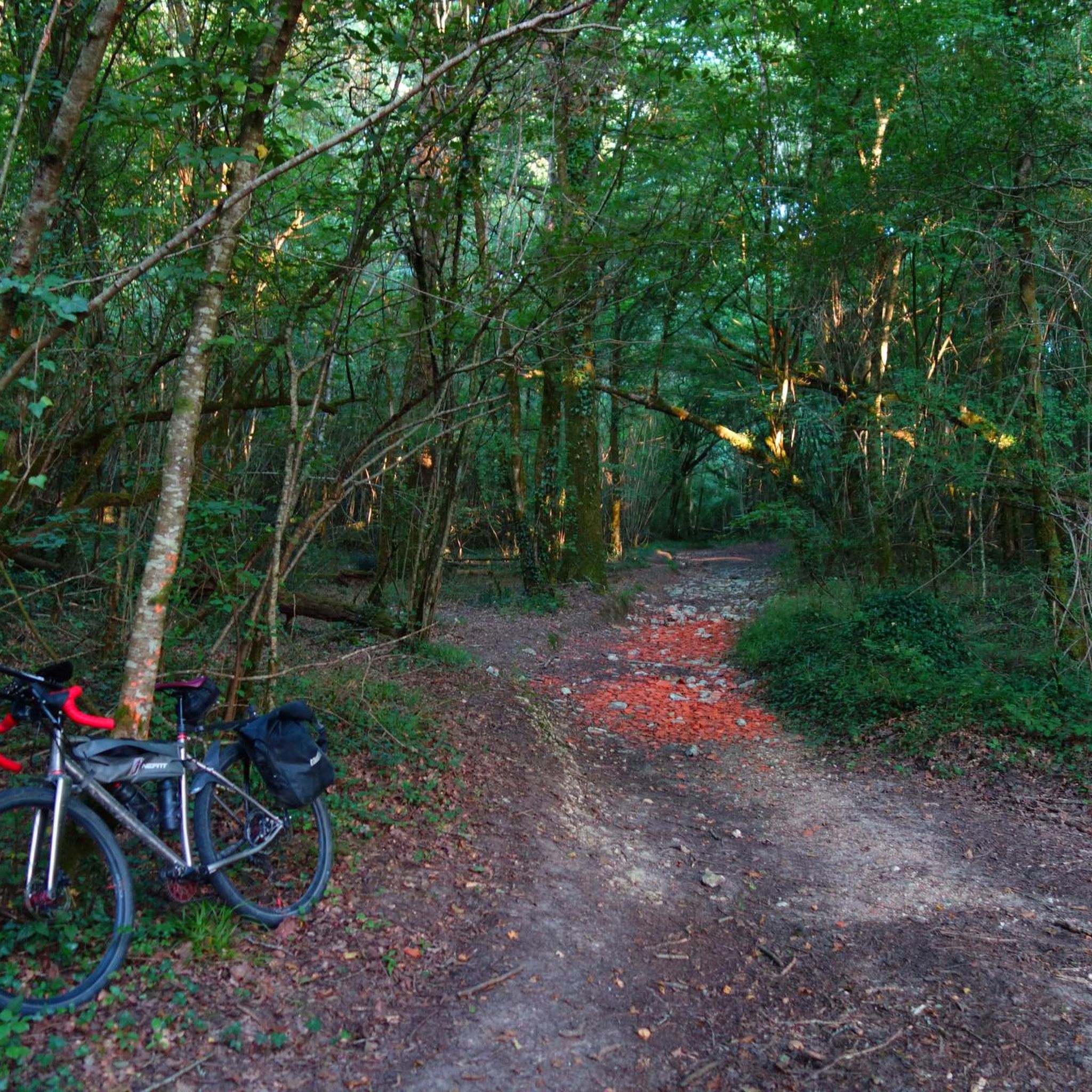
I really enjoyed this ride. I’m 46, I did it on a 40 year old road bike, it’s more suited to a cyclocross bike!
1
0

Magnificent We can also have a picnic
0
0

A must-see visit alongside this abbey on a magnificent circuit
0
0
A particularity is located in the gallery of arcature which overhangs the portal. Indeed it has three arched windows on one side of the central window and two semicircular on the other. Note that the two bays on the right occupy the same width as the three on the left. The bell tower, like many others in the region, has a pyramidal roof. Simple columns come to partition the two windows which cover each face. Inside the church, archival documents prove that the nave with two bays was originally vaulted with warheads. Unfortunately, this vault was destroyed during religious wars. Still according to archival documents, it would seem that at the beginning of the 20th century, a narthex, where the catechumens were held, leaned on its facade. Today, it has completely disappeared. The church was classified as a historic monument in 1913. The building underwent a complete restoration in 1935. To admire just next to the church a magnificent and majestic period residence.
0
0
Towards the end of the 12th century, an abbey church was built. At the beginning of the 13th century, attached to the west of the first Romanesque abbey, a Gothic-style cloister was gradually built. The abbey reached its peak from this period: in addition to its priories (la Grainetière in Vendée and la Tenaille near Pons), it owned land within a radius of 100 km, including saltworks on the coast. In the 15th century, Fontdouce obtained the title of royal abbey leading to a profound change in its mode of administration: the abbot was no longer elected by his peers within the community but was appointed by the king. It is often a great layman to whom the king grants the commendation, that is to say 80% of the income of the abbey. Then, the wars of religion, in the 16th century, accelerated its decline. The abbey church is ransacked: it will never be rebuilt. The years following the French Revolution also brought their share of destruction: several buildings, including the refectory, disappeared. The last monks were driven out in 1793 and the following year the site was sold as National Property to serve as agricultural property. The farmer who bought the place then built, on the remains of the conventual buildings, a house in the First Empire style. In the 1820s, Fontdouce entered the family of the current owners who, on December 16, 1986, had the Gothic parts, chapter house and parlor classified as historical monuments2. From 1970, the current owners undertook a series of excavations intended for the restoration of the Abbey of Fontdouce. They are gradually bringing the beautiful chapter house and the Gothic parlor back to life, the two superimposed Romanesque chapels and several other remains. These restoration works earned them third prize in the masterpiece in danger competition in 1979. In 1986, the site was entirely classified as a Historic Monument1. Today, Fontdouce remains a private property, focused on tourist and cultural activities, supported in its development actions by a team of enthusiasts grouped together within the Association Guillaume de Conchamp.
1
0

The Church of Saint-Martin de Coucoury was built around the 11th century. It is a pretty example of a Romanesque church.
1
0
Frequently Asked Questions
What historical and religious sites are there to visit near Chérac?
The region around Chérac is rich in history and religious heritage. You can visit the Abbaye de Fontdouce, a historical site founded around 1111, showcasing a blend of Romanesque and Gothic art. Other notable religious buildings include the 12th-century Saint-Césaire Church, a fine example of Saintonge Romanesque style, and the Saint-Martin Church, built around the 11th century. The village of Chérac itself has the historic Église Saint-Gervais et Saint-Protais with its Romanesque portal. Further afield, the towns of Saintes and Cognac offer extensive Roman and medieval history, including a Roman amphitheater in Saintes and the Royal Castle of Cognac.
Are there any family-friendly attractions around Chérac?
Yes, the Abbaye de Fontdouce is categorized as family-friendly and offers historical visits and walks in a wooded valley. Additionally, the Paléosite near Saint-Césaire (about 5 minutes from Chérac) is an interactive prehistory center designed to engage visitors of all ages with its activities.
What natural features and landscapes can I enjoy near Chérac?
Chérac is nestled in a picturesque landscape overlooking the Charente River and surrounded by vineyards, characteristic of the Cognac region. You can explore the beautiful Valleys of the Coran near Saint-Bris-des-Bois, known for its water mills, springs, and fountains. The area also features numerous windmills dotting the valleys and glens, and the Forêt de Pons, about 16 km away, offers natural beauty and outdoor opportunities.
What kind of outdoor activities, like hiking or cycling, can I do in the Chérac area?
The Chérac area is excellent for outdoor activities. For hiking, you can find routes like the 'Three Villages Trail' which is a moderate 18.7 km loop. There are many other options for hiking around Chérac. Cyclists can enjoy various road cycling routes, including an easy 28.7 km loop from Saint-Laurent-de-Cognac that offers views of the Charente River. For runners, there are also several running trails, such as a moderate 12.5 km loop from Saint-Sauvant.
Are there any castles or châteaux to visit in the vicinity of Chérac?
While the Château de La Dixmerie near La Chapelle-des-Pots is a private property and cannot be visited, there are other castles in the wider region. The Royal Castle of Cognac is a significant historical site in the town of Cognac. Pons features a prominent castle tower, and Jonzac also has a small castle. Additionally, Château de Richemont, about 6 km away, is noted for its natural beauty.
What are some picturesque villages or 'hidden gems' to discover near Chérac?
Beyond Chérac's own historic charm, the region is known for its picturesque villages. The medieval village of Saint-Sauvant, perched on a rocky outcrop, is particularly notable. The Valleys of the Coran, with its water mills and springs, offers a tranquil and scenic 'hidden gem' experience. Exploring the smaller communes will reveal ancient domains and logis, providing a glimpse into the area's rich past.
What is the best time of year to visit attractions around Chérac?
The Charente-Maritime region generally enjoys pleasant weather from spring through early autumn (April to October). This period is ideal for exploring historical sites, enjoying outdoor activities like hiking and cycling, and experiencing the vineyards. Summer months (July-August) are warmest and busiest, while spring and autumn offer milder temperatures and fewer crowds, perfect for comfortable exploration.
What do visitors enjoy most about the attractions around Chérac?
Visitors particularly appreciate the blend of historical depth and natural beauty. The Abbaye de Fontdouce is highly regarded for its historical significance and the beautiful walks in its wooded valley. The well-preserved Romanesque churches, like Saint-Martin Church and Saint-Césaire Church, are admired for their architecture. The scenic views of the Charente River and surrounding vineyards also contribute to a highly enjoyable experience, with the komoot community sharing over 50 upvotes and 10 photos for the area's highlights.
Are there opportunities for wine or cognac tasting near Chérac?
Absolutely. Chérac is situated in the heart of the Cognac region. The town of Cognac, just 9 km east, is world-renowned for its brandy. Here, you can visit numerous cognac houses such as Hennessy, Rémy Martin, Martell, and Baron Otard, which offer tours and tastings. The surrounding vineyards also provide opportunities to learn about local wine production.
Can I find any Roman historical sites near Chérac?
Yes, the town of Saintes, located about 16 km west-north-west of Chérac, boasts a rich Roman history. It features a remarkably well-preserved Roman amphitheater, which is a must-see for anyone interested in ancient Roman architecture and history. The town also has other Roman-era remnants to explore within its extensive old town.
What is the significance of the Charente River in the region?
The Charente River is a central natural feature of the region, offering picturesque views and influencing the landscape, particularly the surrounding vineyards. Chérac itself is perched on a hill overlooking the river. The river has historically been important for trade and transport, and today it provides scenic backdrops for walks and cycling routes, contributing significantly to the area's charm and natural beauty.

Get inspired with the komoot mobile app


Explore more
Still not found the Highlight you’re looking for? See guides of the top attractions in other regions:
