The best road cycling routes around Fruncé
4.5
(51)
624
riders
173
rides
Road cycling routes around Fruncé are situated in the Eure-et-Loir department of France. The region is characterized by a predominantly rural landscape, featuring agricultural fields, small villages, and historical landmarks such as churches and châteaux. Road cyclists can expect routes that often follow the banks of the Eure river, offering a mix of flat sections and gentle rolling hills. The terrain provides varied options for different skill levels, from easy loops to more challenging rides with moderate elevation gains.
Best…
Last updated: July 2, 2026
5.0
(1)
61
riders
138km
05:36
820m
820m
Hard road ride. Very good fitness required. Mostly well-paved surfaces and easy to ride.
11
riders
6.91km
00:18
30m
30m
Easy road ride. Great for any fitness level. Mostly well-paved surfaces and easy to ride.

Sign up for free
11
riders
98.2km
03:49
370m
370m
Moderate road ride. Good fitness required. Mostly well-paved surfaces and easy to ride.
9
riders
62.5km
02:28
250m
250m
Moderate road ride. Good fitness required. Mostly well-paved surfaces and easy to ride.
7
riders
37.3km
01:28
170m
170m
Easy road ride. Great for any fitness level. Mostly well-paved surfaces and easy to ride.
Get access to more routes and recommendations from other explorers.
Sign up for free
Already have an account?
Our route recommendations are based on thousands of hikes, rides, and runs completed by other people on komoot.
Start today with a free account
Your next adventure awaits.
Login or Signup


Tips from the Community

Magnificent ceiling with the possibility of lighting it up
0
0

According to tradition, the church choir covers the remains of an older building, possibly dating back to the 6th century, which was built to house the saint's body. According to current knowledge, the commune of Saint-Piat (Sanctus Piatus in Latin) officially appeared in 1087, mentioned in a charter of the Nottonville Priory (Eure-et-Loir), on which it depended. The current building was rebuilt during the time of Francis I, as suggested by the date 1535 engraved on two buttresses of the apse and the date 1542 engraved on a piece of wood from the vault. This is according to a study by the SAEL (Eure-et-Loir Archaeological Society). The three-sided apses, the dripstone towers (horizontal members projecting from a wall), and the sculpted roof structures are a testament to the importance of the reconstructions carried out in the department during the 16th century. The church of Saint-Piat is one of them. While the church has not been officially recognized, it nevertheless contains objects that have attracted attention both for their antiquity and quality, but not always for good reason. Their artistic value, far from attracting only religious or aesthetic interest, has also aroused a covetousness that, unfortunately, remains for some of them. Fortunately, those still in place are carefully cared for and offer the curious a story to discover, a beauty to slowly ponder as they progress toward the choir.
0
0


Unfortunately, the church was not accessible when I visited (mid-September 2024). You could only look in through a gate and the dance of death depictions on the left side were not really visible. In front of them were transparencies with skeleton drawings. Maybe those were the depictions...
0
0
Formerly La Loupe, Vaupillon and Saint Eliph formed only one parish called the Trinity of the Woods. The church contains a set of 3 painted stone altarpieces from the 17th century. One is dated 1646 and signed Delahays: it includes 3 sculptures: a trunk of grace, representation of the trinity in which God the father holds before him his son on the cross, the dove of the Holy Spirit hovering above his head You can also see a statue of the local saint in painted and gilded stucco and a Saint Sebastian in painted stucco, characteristic of the counter-reformation. A small chapel to the north was added in the 19th century which contains a pieta.
0
0

Of course there is the castle but the rest of the village is really worth a stop (church, wash house, half-timbered house, etc.)
0
0
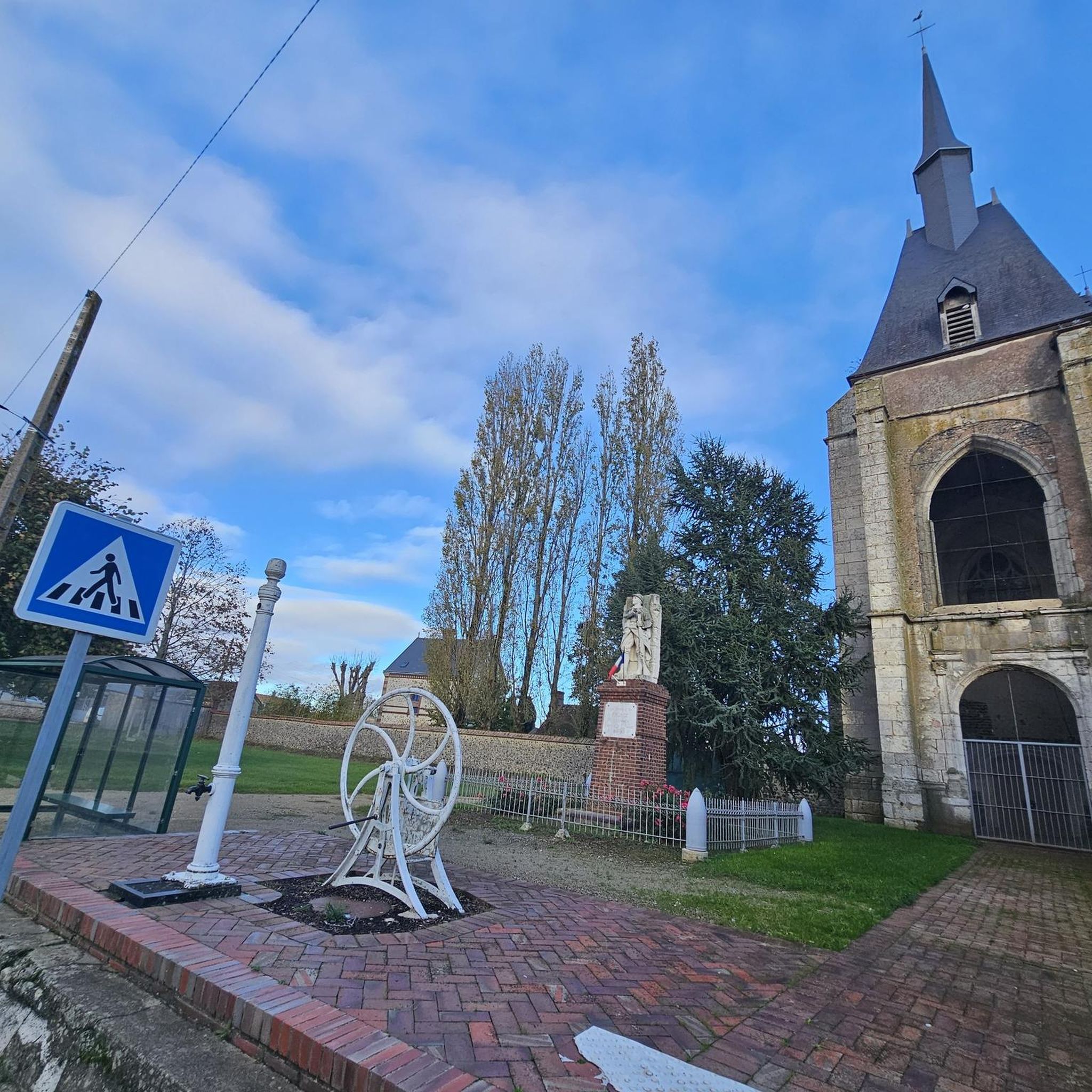
A modest place of worship, built in the middle of a tiny village, the Favril church was there as early as 1250. Under the reign of Saint Louis, Saint-Pierre du Favril was already there. This is confirmed by a register of the diocese of Chartres, drawn up in 1250, which mentions a parish church dedicated to Saint-Pierre au Favril (Faverilium). The text adds that there was a priest and 56 parishioners.
0
0
Frequently Asked Questions
How many road cycling routes are available around Fruncé?
There are over 180 road cycling routes around Fruncé, offering a wide variety of options for different skill levels and preferences. You'll find everything from short, easy loops to longer, more challenging rides.
What kind of terrain can I expect when road cycling near Fruncé?
The region around Fruncé is characterized by a predominantly rural landscape. Cyclists can expect routes that often follow the banks of the Eure river, offering a mix of flat sections and gentle rolling hills. The terrain provides varied options, from easy loops with minimal elevation to more challenging rides with moderate gains.
What are the difficulty levels of road cycling routes in the Fruncé area?
The routes around Fruncé cater to all abilities. There are 73 easy routes, 97 moderate routes, and 11 difficult routes, ensuring options for beginners, intermediate riders, and experienced cyclists looking for a challenge.
Are there any easy road cycling routes suitable for beginners around Fruncé?
Yes, there are many easy routes perfect for beginners. For instance, the Roadbike loop from Fruncé is a short 4.3-mile (6.9 km) trail that leads through the immediate Fruncé area and can be completed in about 18 minutes.
What are some challenging road cycling routes near Fruncé?
For experienced cyclists seeking a challenge, the Ponds of Fontenay sur Eure – Château de Frazé loop from Courville-sur-Eure is a difficult 86.1-mile (138.6 km) trail with significant elevation gain, traversing varied rural landscapes.
What historical landmarks or points of interest can I see while cycling around Fruncé?
Many routes pass by historical landmarks. You might encounter beautiful churches like the Saint-Georges Church of Saint-Georges-sur-Eure or the Orrouer Church. Some routes also lead past impressive structures such as the Château de Fontaine-la-Guyon.
What do other cyclists say about road cycling in Fruncé?
The road cycling routes around Fruncé are highly rated by the komoot community, with an average score of 4.4 stars from over 50 reviews. More than 600 road cyclists have used komoot to explore the varied terrain, often praising the scenic rural roads and charming villages.
Are there any routes that offer scenic views along the Eure river?
Yes, several routes offer picturesque views along the Eure river. A popular choice is the Orrouer Church – The banks of the Eure loop from Saint-Denis-des-Puits, a moderate route that provides scenic views and passes through charming villages.
Are there any road cycling routes that are particularly good for families?
While not explicitly labeled 'family-friendly,' the numerous easy routes with minimal elevation gain are well-suited for families. The Church of Saint Stephen – Château de Fontaine-la-Guyon loop from Saint-Germain-le-Gaillard is an easy 28.4-mile (45.6 km) route that could be a good option for a family outing.
Can I find cafes or places to stop for refreshments along the routes?
Yes, the rural landscape includes small villages where you can often find local establishments. For example, the Bar de la Rivière is a highlight that could serve as a convenient stop for refreshments during your ride.
What is the best time of year for road cycling around Fruncé?
Given the rural and agricultural nature of the Eure-et-Loir department, spring and autumn generally offer pleasant temperatures and beautiful scenery for road cycling. Summers can be warm, while winters might bring colder conditions, so checking local weather forecasts is always recommended.
Most popular attractions around Fruncé

Get inspired with the komoot mobile app


Explore more
Browse the best Road cycling routes in other regions.
