The best road cycling routes around Saint-Jean-De-Minervois
4.6
(114)
1,973
riders
87
rides
Road cycling routes around Saint-Jean-De-Minervois traverse a landscape characterized by extensive vineyards, rolling hills, and garrigue. The region is situated between the Minervois plain and the foothills, offering diverse terrain for cyclists. Routes often wind through areas known for their white limestone soils and proximity to the Haut-Languedoc Regional Natural Park. This varied topography provides a range of road cycling experiences.
Best road cycling routes around Saint-Jean-De-Minervois
- The most popular road cycling route is Col de Coulouma loop from Assignan…
Last updated: October 11, 2026
5.0
(2)
29
riders
60.7km
03:21
1,130m
1,130m
Hard road ride. Very good fitness required. Mostly well-paved surfaces and easy to ride.
4.8
(4)
46
riders
53.7km
02:24
540m
540m
Moderate road ride. Good fitness required. Mostly well-paved surfaces and easy to ride.

5.0
(1)
17
riders
21.6km
01:09
420m
420m
Moderate road ride. Good fitness required. Mostly well-paved surfaces and easy to ride.
5.0
(3)
27
riders
43.9km
02:22
450m
450m
Moderate road ride. Good fitness required. Some segments of this route may be unpaved and difficult to ride.
5.0
(2)
16
riders
34.7km
02:17
680m
680m
Moderate road ride. Good fitness required. Some segments of this route may be unpaved and difficult to ride.
Get access to more routes and recommendations from other explorers.
Already have an account?
Our route recommendations are based on thousands of hikes, rides, and runs completed by other people on komoot.
Start today with a free account
Your next adventure awaits.

Tips from the Community

Remarkable site, the village of Argens-Minervois, is built in an amphitheater on a promontory overlooking the Canal du Midi and the Aude river. Besides its old fortress (13th century), taken during the Albigensian Crusade by Simon de Montfort, visitors can consider various walks along the canal (locks), around the lake of Aiguilles, at Pech Laurier or at Mourrel Ferrat, an elysian (pre-Roman) site.
0
0
Remarkable site, the village of Argens-Minervois, is built in an amphitheater on a promontory overlooking the Canal du Midi and the Aude river. Besides its old fortress (13th century) taken during the crusade against the Albigensians by Simon de Montfort, visitors can consider various walks along the canal (locks), around the Aiguilles lake, at Pech Laurier or at Mourrel Ferrat, an Elysian (pre-Roman) site.
0
0

The former Saint-Pons Cathedral It is difficult to understand Saint-Pons-de-Thomières without stopping here. The building is the former abbey church of a Benedictine monastery founded in 936, around which the town developed. In 1318, the abbey became the seat of a new bishopric: the church then took on the status of a cathedral, which it retained until the Revolution. The Romanesque building, most of which dates back to the second half of the 12th century, still bears the traces of this turbulent history. Fortified in the Middle Ages, the cathedral was heavily damaged in 1567 during the Wars of Religion. Then, in the 18th century, its appearance was profoundly transformed: in 1716, the orientation of the choir was reversed and a new classical facade was built to the east. The medieval remains are particularly remarkable: the two crenellated towers on the north facade recall the defensive character of the building, while the former west facade preserves precious Romanesque reliefs depicting, in particular, the Last Supper, the Washing of the Feet, the Ascension and the Crucifixion. Inside, there are also marble decorations, choir stalls and an organ dating from 1772.
2
0
The church of the Nativity of Saint John the Baptist bears witness to the gradual shift of the religious heart of Saint-Jean-de-Minervois. For centuries, parish life was linked to the Saint-Jean de Dieuvaille chapel, now nicknamed "the church of the Hole", isolated in a canyon between the hamlets of Gimios and Barroubio. At the beginning of the 18th century, the current village became the new center of the community, around this current parish church.
2
0
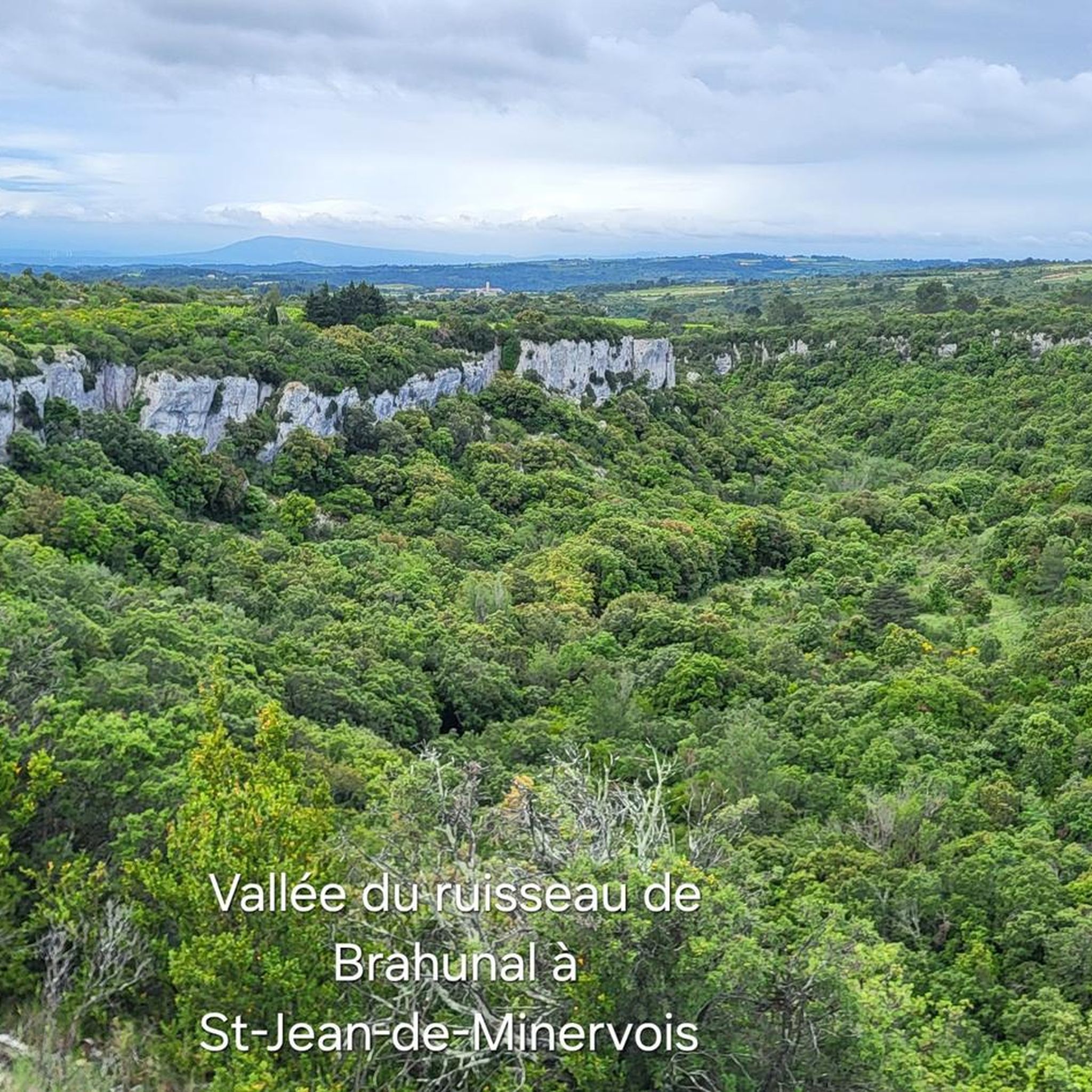
This lace reveals one of the most beautiful landscape profiles in the area. Behind this landscape of vineyards and wooded hills lies a spectacular geological history, still readable in the shapes of the relief. You are riding here on a remarkable site, the "Écailles de Tudéry" (Tudéry Scales). Under the effect of the titanic forces that gave birth to the Pyrenees, the Earth's crust broke and piled up. This tectonic overlap pushed and straightened the ancient secondary-era limestone strata to overlap with more recent tertiary terrains.
2
0
The Notre-Dame-de-la-Barthe church is intimately linked to the history of Saint-Chinian. Rebuilt between the end of the 16th and the end of the 17th century after the destructions of the Wars of Religion, it replaced the old parish church located outside the ramparts. Its bell tower occupies the site of the Némorouse tower, one of the old towers of the medieval fortifications, recalling the defensive past of the village. Inside, do not miss the remarkable 18th-century tribune organ, the work of Jean-Baptiste Lannes and later modified by Louis Peyssy and Jean-Baptiste Micot. Classified as a Historic Monument, it is among the most precious historical organs preserved in the Hérault.
2
0
Viewpoint over Azillanet ! A nice stop to enjoy a superb perspective over Azillanet, a village whose history dates back to at least the 9th century, when it was mentioned under the name of Azelanum.
2
0
The Saint-Laurent church catches the eye with its sober architecture and unique location. Built in 1678, it is adjacent to the site of the former fortress of Guillaume d'Azillanet, a medieval lord whose name remains attached to the village's history. Behind its stones lie several centuries of history: once fortified, Azillanet depended on the lords linked to the abbey of Caunes-Minervois before joining the royal domain. The village subsequently experienced the great upheavals of the Minervois, between the Albigensian Crusade, the Hundred Years' War, and the Wars of Religion.
2
0
Frequently Asked Questions
What kind of terrain can I expect when road cycling around Saint-Jean-De-Minervois?
The region offers a diverse landscape for road cyclists, characterized by extensive vineyards, rolling hills, and garrigue. You'll find routes winding through areas known for their white limestone soils, with varied topography ranging from moderate climbs to more challenging ascents, especially in the foothills and near the Haut-Languedoc Regional Natural Park.
Are there road cycling routes suitable for beginners or those looking for an easier ride?
Yes, while the region is known for its hilly terrain, there are routes suitable for various skill levels. Out of nearly 100 road cycling routes, 6 are classified as easy, and 52 are moderate, offering less strenuous options through the vineyards and countryside. For example, the Roadbike loop from Saint-Jean-de-Minervois is a moderate 39.3 km path with varied scenery.
What are some scenic highlights or landmarks I can see while road cycling in the area?
Road cycling routes often pass through picturesque vineyards and charming villages. You can explore historical sites like Minerve, a 'Most Beautiful Village' of France, known for its dramatic setting and ancient streets. Other natural features include the Gorges de la Cesse, where the Cesse river has carved natural bridges, and scenic viewpoints like the View of the Minerve bridges.
What is the best time of year for road cycling in Saint-Jean-De-Minervois?
The region generally enjoys a Mediterranean climate. Spring and autumn are often ideal, offering pleasant temperatures and beautiful scenery as the vineyards change color. Summers can be hot, so early morning or late afternoon rides are recommended during peak season. Winters are typically mild, allowing for cycling year-round, though some days may be cooler or wetter.
Are there any circular road cycling routes available?
Yes, many of the road cycling routes around Saint-Jean-De-Minervois are designed as loops, allowing you to start and end in the same location. Examples include the challenging Col de Coulouma loop from Assignan or the moderate Minerve – Giant Bicycle Sculpture loop from La Caunette, which takes you through charming village surroundings.
Are there any family-friendly road cycling options in the area?
While many routes involve hills, some of the easier or moderate loops might be suitable for families with older children who are comfortable with road cycling. It's best to check the elevation profiles and distances of specific routes to ensure they match your family's fitness level. The region's quiet country roads through vineyards can be enjoyable for a family ride.
What do other road cyclists say about their experience in Saint-Jean-De-Minervois?
The road cycling routes in Saint-Jean-De-Minervois are highly rated by the komoot community, with an average score of 4.6 stars from over 100 reviews. Cyclists often praise the varied terrain, the beauty of the vineyard landscapes, and the charming villages encountered along the way. Over 2000 road cyclists have used komoot to explore the area's diverse routes.
Can I find places to eat or stay near the cycling routes?
Yes, Saint-Jean-De-Minervois itself is a charming village with traditional stone houses, and nearby villages like Aigne and Minerve offer a warm atmosphere. You'll find local markets in towns like Saint-Chinian and Narbonne, and opportunities to discover local winemakers. While specific cafes or accommodations on routes aren't listed, the villages provide options for refreshments and stays.
Are there any particularly challenging road cycling routes for experienced riders?
Absolutely. The region's hilly terrain and proximity to the Haut-Languedoc Regional Natural Park provide ample challenges for experienced road cyclists. There are 40 routes classified as difficult, featuring significant elevation gain. A prime example is the Col de Coulouma loop from Assignan, a 59.4 km route with over 1100 meters of elevation gain.
Is public transport or parking available for accessing the road cycling routes?
While specific public transport links directly to trailheads are not detailed, the region is accessible by road. Parking is generally available in and around the villages, such as Saint-Jean-De-Minervois, Minerve, or other starting points for routes. It's advisable to check local parking regulations upon arrival.
Are there any natural features like gorges or rivers that can be seen from the road cycling routes?
Yes, the region is rich in natural beauty. While cycling, you might encounter views of the Gorges de la Cesse, where the Cesse river has carved natural bridges. The beautiful course of the Cesse river itself is a notable natural feature. You can also find highlights like the Marie Close fashion show (a gorge) and the Natural Tunnel of Minerve, adding to the scenic diversity.
Can I rent a bike in Saint-Jean-De-Minervois or nearby?
Specific bike rental services in Saint-Jean-De-Minervois are not detailed in the provided information. However, as a popular cycling destination, it is likely that bike rental options, including road bikes, may be available in larger nearby towns or through specialized tour operators in the wider Occitanie region. It's recommended to search for local rental shops in advance of your visit.
Most popular routes around Saint-Jean-De-Minervois
Most popular attractions around Saint-Jean-De-Minervois

Get inspired with the komoot mobile app


Explore more
Browse the best Road cycling routes in other regions.
