The best road cycling routes around Corancez
4.5
(177)
4,478
riders
602
rides
Road cycling routes around Corancez offer a tranquil experience through the green landscapes of Eure-et-Loir, France. The region is characterized by peaceful countryside, often featuring small watercourses and a patchwork of fields. Roads are generally quiet and mostly well-paved, providing a suitable environment for various cycling abilities. This area provides access to sections of the Véloscenic route, known for its flat and quiet roads.
Best road cycling routes around Corancez
- The most popular road cycling route is Lavoir de Soulaires…
Last updated: October 19, 2026
4.3
(3)
9
riders
Easy road ride. Great for any fitness level. Mostly well-paved surfaces and easy to ride.
5.0
(1)
7
riders
61.8km
02:23
190m
190m
Moderate road ride. Good fitness required. Mostly well-paved surfaces and easy to ride.

5.0
(1)
7
riders
56.5km
02:14
200m
200m
Moderate road ride. Good fitness required. Mostly well-paved surfaces and easy to ride.
8
riders
56.5km
02:16
210m
210m
Moderate road ride. Good fitness required. Mostly well-paved surfaces and easy to ride.
6
riders
33.9km
01:22
120m
120m
Easy road ride. Great for any fitness level. Mostly well-paved surfaces and easy to ride.
Get access to more routes and recommendations from other explorers.
Already have an account?
Our route recommendations are based on thousands of hikes, rides, and runs completed by other people on komoot.
Start today with a free account
Your next adventure awaits.



Tips from the Community

very nice pond to rest
0
0

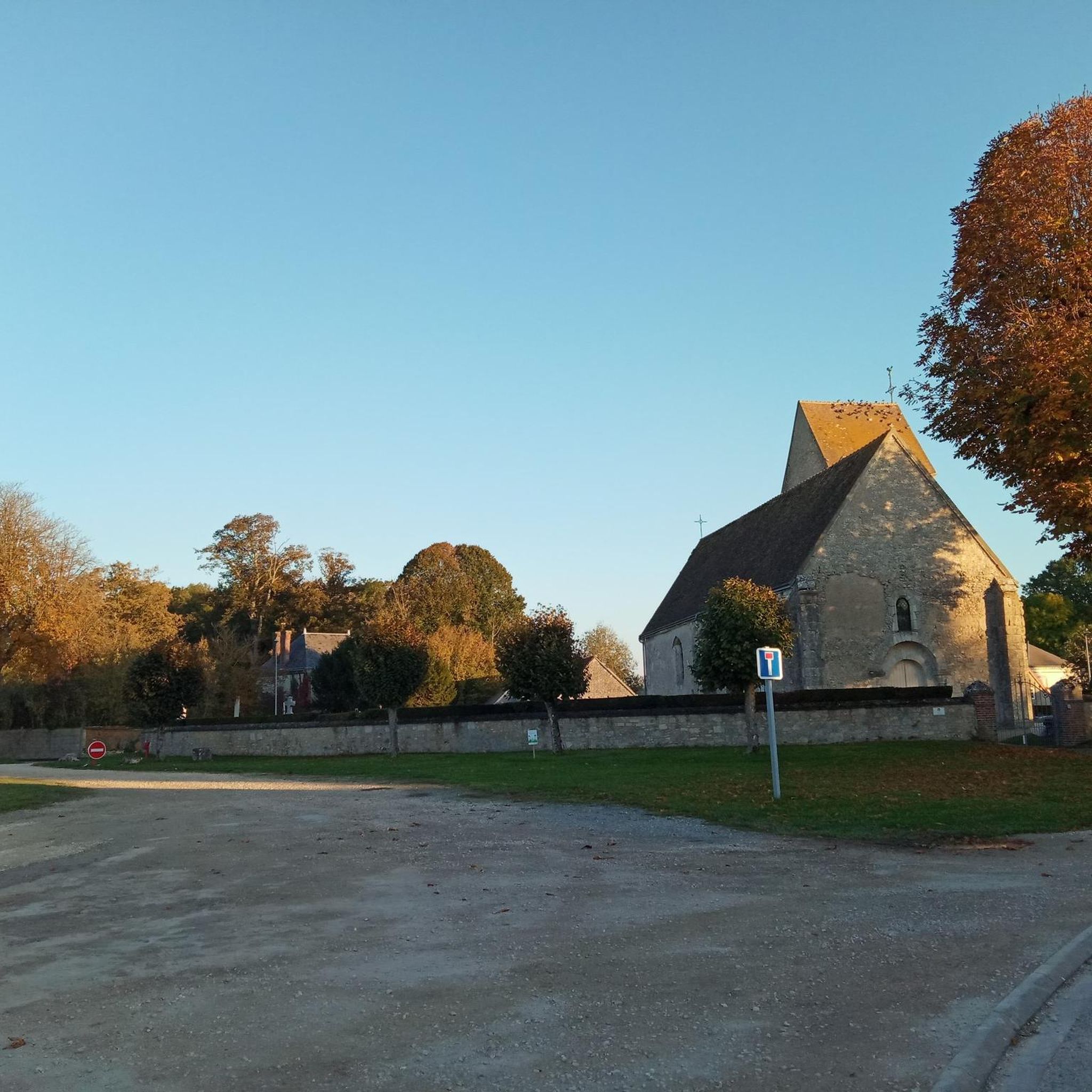
The main nave, ending in a semicircular apse, is preceded by a timber-framed porch and opens to the north onto a chapel through a wide archway. The timber-framed bell tower, clearly from the same period as the 17th-century wainscoting, rests on a base spanning the nave. A second nave is covered with quadripartite masonry vaults from different periods. Of a dressed stone tower, only the spiral staircase and the first level remain, built between the 11th and 13th centuries. The side aisle was built in the 14th century and enlarged in the 16th. 1660: Supposed collapse of the tower attached to the nave, of which only the first level remains. 1679: Paneling on the nave and probable construction of the small timber-framed spire. 19th century: Supposed construction of the timber-framed chapel. The church was under the jurisdiction of the chapter of Notre-Dame de Chartres (the chapter's name can be seen on the lock of the small door on the right and is painted on the walls of the capital with stars and the date 1733 L.M.M.P.).
0
0
According to tradition, the church choir covers the remains of an older building, possibly dating back to the 6th century, which was built to house the saint's body. According to current knowledge, the commune of Saint-Piat (Sanctus Piatus in Latin) officially appeared in 1087, mentioned in a charter of the Nottonville Priory (Eure-et-Loir), on which it depended. The current building was rebuilt during the time of Francis I, as suggested by the date 1535 engraved on two buttresses of the apse and the date 1542 engraved on a piece of wood from the vault. This is according to a study by the SAEL (Eure-et-Loir Archaeological Society). The three-sided apses, the dripstone towers (horizontal members projecting from a wall), and the sculpted roof structures are a testament to the importance of the reconstructions carried out in the department during the 16th century. The church of Saint-Piat is one of them. While the church has not been officially recognized, it nevertheless contains objects that have attracted attention both for their antiquity and quality, but not always for good reason. Their artistic value, far from attracting only religious or aesthetic interest, has also aroused a covetousness that, unfortunately, remains for some of them. Fortunately, those still in place are carefully cared for and offer the curious a story to discover, a beauty to slowly ponder as they progress toward the choir.
0
0
Before 528, the village of Saint-Prest was called Saint-Jean-sur-Eure. At that time, the Bishop of Chartres, Ethère, had a building built adjoining the southern flank of the parish church, including a "martyrium" to house the remains of holy martyrs (the legend of Saint-Prest), which were placed in ten sarcophagi. The most honored relics were those of a certain Priscus; following numerous miracles, the parish took the name of Saint-Prest. The current church's crypt is the apse of the 9th-century Carolingian church, which replaced a 6th-century sanctuary. Access to the 12th-century nave, on the west side, is through a beautiful Romanesque portal, carved from beautiful limestone, surmounted by a triple saw-tooth archivolt and framed by two small columns with capitals. On the right, a face would be that of Eve, and on the left would appear the tempting serpent.
0
0

This church in Meslay-Le-Vidame, whose architecture reflects the formal language of antiquity, was dedicated to the patron saint of Saint Etienne. He was one of the first seven deacons of the original Jerusalem church and, according to the biblical accounts in the New Testament, the first martyr (martyr) of early Christianity. The church commemorates his death on Boxing Day, December 26th. As the Acts of the Apostles recounts: When Stephen recounted his vision of the open heavens, "And he, full of the Holy Spirit, looked up into heaven and saw the glory of God, and Jesus standing at the right hand of God" (Chapter 7, Verse 55), the people were so outraged that they drove him out of the city and stoned him.
0
0

Unfortunately, the church was not accessible when I visited (mid-September 2024). You could only look in through a gate and the dance of death depictions on the left side were not really visible. In front of them were transparencies with skeleton drawings. Maybe those were the depictions...
0
0
Thivars is mentioned in 966 in the Chartres cartulary. In the 12th century, the church became the property of Josaphat Abbey. The current church was built in the 16th century: a date of 1545 is engraved on a cherub in the turret. It is a very high construction but very irregular, this comes from the fact that it belongs to several eras: ogival style in the windows, the entrance door is Romanesque (it may be the door of the first Romanesque church) . The choir was formerly separated from the nave by an iron grille which disappeared during the French Revolution. The ceiling has pretty paneling dating from 1645. The two side altars are dedicated: one to Notre Dame des Victoires and the other to Saint Joseph. Among the furniture we can note an interesting painting which represents Our Lord pronouncing on a coin. In 1940, two bombs fell less than 30 m from the church, destroying the stained glass windows on the south side which were replaced by grisailles in 1987. Three pretty stained glass windows light up this church: Nativity stained glass window installed by Mr Campin in 1955 Stained glass windows of the village's patron saints, Saint Radegonde and Saint Hilaire, installed in 1900 and 1987 respectively.
1
0

Porte de Boisville Its ogival portal opens into a thick quadrangular massif where there was a room for operating the portcullis. We can still see the groove in the thickness of the walls. On the left and right two small funnel-shaped spaces allowed the defenders to observe and repel the enemies who appeared on the bridge. The gate was topped by a building serving as a guardhouse which was demolished in 1761. The guarding of these doors and their keys was in the troubled times of the Hundred Years' War the subject of concern for the inhabitants and also a source of quarrels and trials between the city and the abbey. This gate is preceded by a bridge of 5 stone arches, the one adjoining the gate was built in 1774 and replaced a drawbridge which defended the entrance.
0
0
Frequently Asked Questions
How many road cycling routes are available around Corancez?
There are over 590 road cycling routes around Corancez, offering a wide variety of options for different skill levels. This includes more than 170 easy routes and over 400 moderate routes, ensuring there's something for everyone.
What is the typical cycling terrain like in the Eure-et-Loir region near Corancez?
The Eure-et-Loir region, including areas around Corancez, is characterized by peaceful countryside with mostly well-paved and quiet roads. The terrain is generally flat, making it suitable for leisure cycling and less strenuous rides. You'll often find yourself traversing green landscapes and patchwork fields, sometimes alongside small watercourses.
Are there road cycling routes suitable for beginners or families in Corancez?
Yes, Corancez and its surroundings offer many routes ideal for beginners and families. Over 170 easy routes are available, such as La fondation d'Aligre loop from Ver-lès-Chartres, which provides a relaxed ride through the peaceful rural landscape. These routes typically feature mostly flat and quiet roads, perfect for a leisurely outing.
What landmarks or attractions can I see along road cycling routes near Corancez?
While cycling around Corancez, you're close to the historic city of Chartres. A major highlight is the Chartres Cathedral, a UNESCO World Heritage site known for its Gothic architecture and stained-glass windows. The city itself, including Chartres, offers medieval buildings and rich history to explore. Some routes may also pass by charming local features like the Guillaume Gate or the Vegetable Market.
Can I access long-distance cycling routes like the Véloscenic from Corancez?
Yes, the Eure-et-Loir region, accessible from Corancez, is part of the Véloscenic route, a long-distance path connecting Paris to Mont-Saint-Michel. A 90 km section of this route passes through Eure-et-Loir via Chartres, utilizing mostly flat, quiet roads, greenways, and cycle paths. This makes it ideal for multi-day trips or extended day rides. You can find more information about this route on tourisme28.com.
What is the best time of year for road cycling in Corancez?
The Eure-et-Loir region is generally pleasant for cycling during spring, summer, and early autumn. These seasons offer mild weather and lush green landscapes, making for comfortable rides. The quiet country roads are particularly enjoyable when the weather is clement.
Are there circular road cycling routes available around Corancez?
Yes, many of the road cycling routes around Corancez are designed as loops, allowing you to start and finish at the same point. Examples include Lavoir de Soulaires – Half-timbered house loop from Gellainville and Fontenay-sur-Eure Church – Ponds of Fontenay sur Eure loop from Gellainville, which offer convenient circular journeys through the countryside.
What do other road cyclists enjoy about the routes around Corancez?
The road cycling routes around Corancez are highly rated by the komoot community, with an average score of 4.3 stars from over 150 reviews. Cyclists often praise the tranquil experience through green landscapes, the peaceful countryside, and the generally well-paved, quiet roads. The blend of serene natural features with access to historical attractions like Chartres is also a significant draw.
Is parking available for cyclists near the road cycling routes?
While specific parking details for every route starting point in Corancez are not always listed, the nearby city of Chartres offers various parking options. For routes starting from villages like Gellainville or Ver-lès-Chartres, you can typically find local parking in or near the village centers, which serve as convenient starting points for your ride.
Are there places to stop for refreshments or accommodation for cyclists in the area?
The region around Corancez, particularly the nearby city of Chartres, offers various options for refreshments and accommodation. Chartres has numerous cafes, restaurants, and hotels that cater to visitors. Smaller villages along the routes may also have local establishments where you can take a break and refuel during your ride.
Can I use public transport with my bike in the Eure-et-Loir region?
Public transport options for bikes can vary. While local buses might have restrictions, regional trains (TER) in France often allow bikes, sometimes with specific conditions or during off-peak hours. It's advisable to check the specific public transport provider's website for their current bike policies and schedules if you plan to combine cycling with public transport in the Eure-et-Loir region.
Are there any challenging road cycling routes with significant elevation gain around Corancez?
While the Eure-et-Loir region is generally known for its flat terrain, some routes offer moderate challenges. For instance, Lavoir de Soulaires – Half-timbered house loop from Gellainville, a 76.2 km route, includes around 280 meters of elevation gain, providing a more engaging ride for those seeking a bit more effort than purely flat paths.
Most popular attractions around Corancez

Get inspired with the komoot mobile app


Explore more
Browse the best Road cycling routes in other regions.
