The best road cycling routes around Coltainville
4.3
(250)
4,716
riders
612
rides
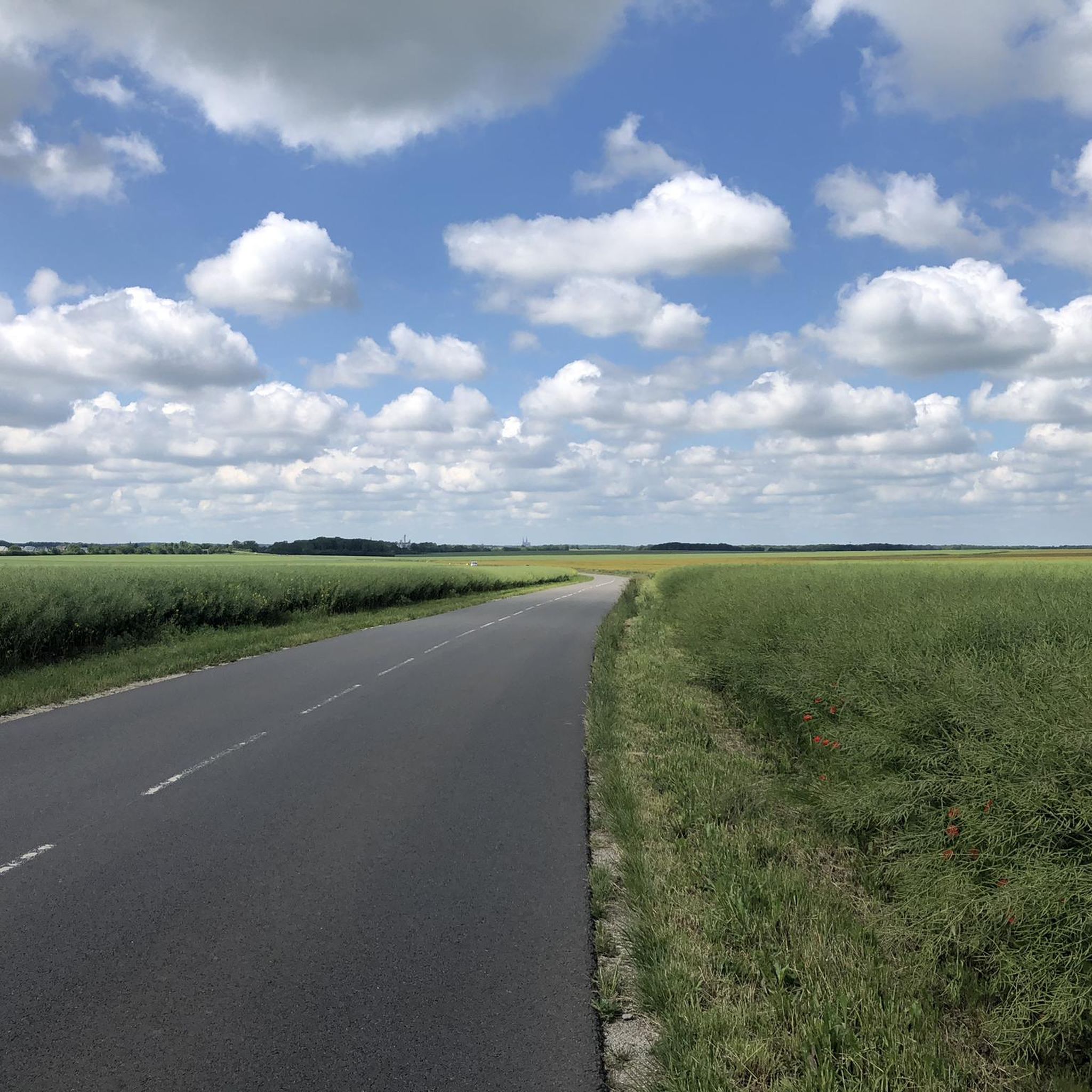
Road cycling routes around Coltainville traverse a landscape characterized by rolling hills and winding country lanes. The region features riverside paths along the Eure and passes by historic sites such as mills, castles, and churches. Elevation gains on routes are typically moderate, with many hills under 200 meters. This terrain provides varied cycling experiences across the area.
Best road cycling routes around Coltainville
- The most popular road cycling route is Eure Riverside Walk – Levesville loop from Jouy, a…
Last updated: July 7, 2026
34
riders
57.8km
02:20
250m
250m
Moderate road ride. Good fitness required. Mostly well-paved surfaces and easy to ride.
5.0
(1)
21
riders
56.4km
02:22
280m
280m
Moderate road ride. Good fitness required. Some segments of this route may be unpaved and difficult to ride.

Sign up for free
4.7
(3)
22
riders
23.7km
00:56
90m
90m
Easy road ride. Great for any fitness level. Mostly well-paved surfaces and easy to ride.
13
riders
40.0km
02:00
180m
180m
Moderate road ride. Great for any fitness level. Some segments of this route may be unpaved and difficult to ride.
12
riders
53.8km
02:09
270m
270m
Moderate road ride. Good fitness required. Mostly well-paved surfaces and easy to ride.
Get access to more routes and recommendations from other explorers.
Sign up for free
Already have an account?
Our route recommendations are based on thousands of hikes, rides, and runs completed by other people on komoot.
Start today with a free account
Your next adventure awaits.
Login or Signup



Tips from the Community

The church of Bleury, dedicated to Saint Martin, probably dates from the end of the Middle Ages. It was remodeled and enlarged in the 16th century by the addition of a large chapel on the north side. The nave ends with a semicircular apse. The chapel to the north is extended by a square bell tower which once opened onto the nave through an arch that is now blocked but still visible. The chapel opens onto the nave through two pointed arches made of recently rendered clotted stone. It communicated with the ground floor of the courtyard through an arch that is now closed. Another filled-in arch appears on the wall between the chapel and the lower room of the courtyard. The church is covered with a paneled roof. A single beam is sculpted, the penultimate one on the west side. It supported, with the beam resting on the facade wall, a recently demolished gallery. Some of the nave's semi-circular windows are late, and the pointed arch openings have Gothic tracery. The square bell tower has a saddleback roof. It is pierced with pointed arch openings. Access to the building is from the south, under a modern porch that houses a portal surmounted by a shield with three fleurs-de-lis. A stone cornice runs under the roof to the south, supported by unsculpted modillions. Two 18th-century altarpieces were included in the Supplementary Inventory of Historic Monuments on June 17, 1975. 16th-century wall paintings depict the Mass of Saint Gregory. They were discovered in 1881 and classified as Historic Monuments on November 17, 1908. Their preservation is currently threatened by infiltration due to the poor condition of the roof structure. The Sauvegarde de l’Art Français provided aid of 75,000 F in 1994, thus contributing to the repairs undertaken to restore the framework, which will allow the walls to be cleaned up.
0
0
According to tradition, the church choir covers the remains of an older building, possibly dating back to the 6th century, which was built to house the saint's body. According to current knowledge, the commune of Saint-Piat (Sanctus Piatus in Latin) officially appeared in 1087, mentioned in a charter of the Nottonville Priory (Eure-et-Loir), on which it depended. The current building was rebuilt during the time of Francis I, as suggested by the date 1535 engraved on two buttresses of the apse and the date 1542 engraved on a piece of wood from the vault. This is according to a study by the SAEL (Eure-et-Loir Archaeological Society). The three-sided apses, the dripstone towers (horizontal members projecting from a wall), and the sculpted roof structures are a testament to the importance of the reconstructions carried out in the department during the 16th century. The church of Saint-Piat is one of them. While the church has not been officially recognized, it nevertheless contains objects that have attracted attention both for their antiquity and quality, but not always for good reason. Their artistic value, far from attracting only religious or aesthetic interest, has also aroused a covetousness that, unfortunately, remains for some of them. Fortunately, those still in place are carefully cared for and offer the curious a story to discover, a beauty to slowly ponder as they progress toward the choir.
0
0
The town's monumental heritage is defined by the Church of Saint-Cyr and Sainte-Julitte. Built in the 12th century, the building underwent numerous modifications during the 13th, 15th, and 16th centuries. The apse sanctuary is lit by five 12th-century Romanesque windows, while the choir and nave date from the 13th century. Like some fifty churches around Chartres, the Huguenots set fire to the church of Jouy in 1568. However, the walls were not destroyed. Only the building's portal is listed as a Historic Monument by decree of December 30, 1913. This listing was motivated by the architecture of the portal, which features foliate capitals. Nevertheless, the church also has a rectangular tower, a polygonal staircase turret, and a wooden vaulted tower.
0
0
Before 528, the village of Saint-Prest was called Saint-Jean-sur-Eure. At that time, the Bishop of Chartres, Ethère, had a building built adjoining the southern flank of the parish church, including a "martyrium" to house the remains of holy martyrs (the legend of Saint-Prest), which were placed in ten sarcophagi. The most honored relics were those of a certain Priscus; following numerous miracles, the parish took the name of Saint-Prest. The current church's crypt is the apse of the 9th-century Carolingian church, which replaced a 6th-century sanctuary. Access to the 12th-century nave, on the west side, is through a beautiful Romanesque portal, carved from beautiful limestone, surmounted by a triple saw-tooth archivolt and framed by two small columns with capitals. On the right, a face would be that of Eve, and on the left would appear the tempting serpent.
0
0

Many centuries ago, our ancestors discovered the possibility of harnessing the power of the elements—which, while helpful and useful on the one hand, could also be a threat as untamed forces of nature—for various purposes, thus eliminating the need for human or animal muscle power. Mills like these are a good example of the human engineering skills of earlier generations: The heavy millstones used to grind grain or press oil, for example, could be powered by wind or—as in this case—water.
0
0
Thivars is mentioned in 966 in the Chartres cartulary. In the 12th century, the church became the property of Josaphat Abbey. The current church was built in the 16th century: a date of 1545 is engraved on a cherub in the turret. It is a very high construction but very irregular, this comes from the fact that it belongs to several eras: ogival style in the windows, the entrance door is Romanesque (it may be the door of the first Romanesque church) . The choir was formerly separated from the nave by an iron grille which disappeared during the French Revolution. The ceiling has pretty paneling dating from 1645. The two side altars are dedicated: one to Notre Dame des Victoires and the other to Saint Joseph. Among the furniture we can note an interesting painting which represents Our Lord pronouncing on a coin. In 1940, two bombs fell less than 30 m from the church, destroying the stained glass windows on the south side which were replaced by grisailles in 1987. Three pretty stained glass windows light up this church: Nativity stained glass window installed by Mr Campin in 1955 Stained glass windows of the village's patron saints, Saint Radegonde and Saint Hilaire, installed in 1900 and 1987 respectively.
1
0

it's a route with very few vehicles so you can relax more to have fun
0
0

Bench, greenery, river and shade for a bite to eat or a break.
0
0
Frequently Asked Questions
How many road cycling routes are available around Coltainville?
Coltainville offers a wide selection of road cycling routes, with over 600 options available. These routes cater to various skill levels, including nearly 150 easy rides, over 430 moderate routes, and a few more challenging options for experienced cyclists.
What kind of terrain can I expect on road cycling routes in Coltainville?
Road cycling around Coltainville is characterized by rolling hills and winding country lanes. You'll find riverside paths along the Eure, and routes often pass by historic sites such as mills, castles, and churches. Elevation gains are typically moderate, with many hills under 200 meters, providing a varied cycling experience.
Are there any easy road cycling routes suitable for beginners or families in Coltainville?
Yes, Coltainville has many easy road cycling routes. For instance, the Saint-Piat Mill – Lavoir de Soulaires loop from Jouy is an easy 23.5 km path with gentle gradients, offering views of local mills and historical wash houses. Another accessible option is the Saint-Piat Mill – Château de Maintenon loop from Jouy, a 21.1 km trail leading through historical sites.
What are some popular moderate road cycling routes in the Coltainville area?
Many cyclists enjoy the moderate routes around Coltainville. A popular choice is the Eure Riverside Walk – Levesville loop from Jouy, a 58.4 km trail featuring riverside scenery and rural areas. Another great option is the Esclimont Castle – Armenonville church loop from Champseru, a 50.8 km route with similar elevation gains.
What historical landmarks or natural features can I see while cycling in Coltainville?
The road cycling routes in Coltainville often pass by significant historical sites and natural beauty. You can explore charming Norman villages, old castles, and towns with typical stone houses. Notable attractions include the majestic Chartres Cathedral, the historic Guillaume Gate, and the picturesque Pont Rouge on the Louis XIV Canal. The region is also known for its rolling hills and riverside paths along the Eure.
What do other road cyclists say about the routes in Coltainville?
The road cycling routes in Coltainville are highly regarded by the komoot community, holding an average rating of 4.3 stars from over 200 reviews. Cyclists often praise the varied terrain, which includes rolling hills and winding country lanes, as well as the scenic riverside paths and historical sites encountered along the way.
Are there any circular road cycling routes around Coltainville?
Yes, many of the road cycling routes around Coltainville are designed as loops, offering convenient circular journeys. Examples include the Eure Riverside Walk – Levesville loop from Jouy and the Saint-Piat Mill – Lavoir de Soulaires loop from Jouy. These circular routes allow you to start and finish at the same point, making planning easier.
Where can I find places to eat or stay near the cycling routes in Coltainville?
The region around Coltainville, particularly the Eure-et-Loir department, features charming Norman villages and towns. Many of these offer local cafes, pubs, and accommodation options. While specific establishments are not listed here, exploring towns like Jouy or Champseru, which are starting points for several routes, will likely provide choices for refreshments and overnight stays.
What is the best time of year for road cycling in Coltainville?
The Eure-et-Loir region, where Coltainville is located, is generally pleasant for cycling. While specific seasonal details are not provided, spring and autumn typically offer mild temperatures and beautiful scenery, making them ideal for road cycling. Summer can also be enjoyable, though it's always wise to check local weather forecasts.
Are there any specific permits required for road cycling in the Coltainville area?
Generally, no specific permits are required for road cycling on public roads and designated cycling paths in the Coltainville area. However, it's always advisable to respect local regulations and private property signs, especially when venturing off main routes.
Can I find routes that pass through natural beauty spots or gardens in the Coltainville region?
Yes, the broader Eure-et-Loir region is known for its 'sites of natural beauty' and 'remarkable gardens.' While specific routes are not detailed, the area's rolling hills and riverside paths provide scenic natural backdrops. You might also find routes that pass near attractions like the Château de Sauvage or the Forêt de Rambouillet, offering a blend of nature and historical charm. For more inspiration on exploring the region's natural side, you can visit tourisme28.com.
Most popular routes around Coltainville
Most popular attractions around Coltainville

Get inspired with the komoot mobile app


Explore more
Browse the best Road cycling routes in other regions.
