The best road cycling routes around Ergué-Gabéric
4.2
(216)
5,899
riders
37
rides
Road cycling routes around Ergué-Gabéric traverse a landscape characterized by dense forests, open moors, and verdant valleys, bordered by the Odet and Jet rivers. The region features varied terrain, including the dramatic gorges of Stangala where the Odet River flows. Road cyclists can expect routes that wind through preserved natural zones and past historical sites. The area offers a network of paths suitable for two-wheelers, providing diverse riding experiences.
Best road cycling routes around Ergué-Gabéric
- The most popular road cycling…
Last updated: July 8, 2026
33
riders
Hard road ride. Very good fitness required. Mostly well-paved surfaces and easy to ride.
26
riders
Moderate road ride. Good fitness required. Mostly well-paved surfaces and easy to ride.

Sign up for free
4.0
(2)
26
riders
46.8km
02:11
480m
480m
Moderate road ride. Good fitness required. Mostly well-paved surfaces and easy to ride.
16
riders
23.4km
01:03
210m
210m
Easy road ride. Great for any fitness level. Mostly well-paved surfaces and easy to ride.
16
riders
69.3km
02:58
460m
460m
Moderate road ride. Good fitness required. Some segments of this route may be unpaved and difficult to ride.
Get access to more routes and recommendations from other explorers.
Sign up for free
Already have an account?
Our route recommendations are based on thousands of hikes, rides, and runs completed by other people on komoot.
Start today with a free account
Your next adventure awaits.
Login or Signup

Tips from the Community

The church mostly dates from the second half of the 16th century. The Saint Idunet statue is dated 1562. This saint is celebrated on October 19th and the pardon takes place on the third Sunday of October. The bells are dated 1602 and 1646. The cemetery, once attached to the church, has been moved, as well as the calvary dating from the 16th century.
0
0
The parish of Tourc’h was established as early as the 5th century. Tourc’h became a commune in 1790. The Gothic church of Saint-Cornély (15th-19th century) in the shape of a Latin cross (23 meters long and 20 meters wide) was built at the end of the 15th century. The bell tower dates from 1726 and was restored in 1930. The entire church and its enclosure have been listed as historical monuments since 1944. The stained glass window of the apse “the crucifixion” dates from 1551 and is classified. On the west facade, several coat-of-arms stones can be distinguished, including that of the Kerouet de Kerstrat family, representing a wild boar, the commune’s emblem. The nave was rebuilt in 1843 and the sacristy dates from 1930.
0
0

In 1239, Bishop Raynaud commissioned the construction of Saint-Corentin Cathedral. It was built on the foundations of a Romanesque cathedral. Construction lasted three centuries. In 1410, the choir vaults were completed and the windows were installed. In 1424, construction began on the nave and the two towers of the facade. The reconstruction was completed in 1515. The two towers were finally finished between 1854 and 1856. A distinctive feature is its kink in the main axis. The reason for this design element is unclear. Several theories exist. One suggests that it emphasizes the crucifix. Another posits that it is due to the stability of the foundation. Yet another suggests that the kink reflects the inclined head of the crucified Jesus. Following the completion of renovations in December 1999, the cathedral can now be admired as it was decorated at the end of the 15th century. The same colors as in the original, i.e., ochre yellow and ochre red, were used in lime plaster on the rib vaults. Numerous chapels are situated around the chancel, dating from various periods between the 13th and 16th centuries. Excerpts from https://de.wikipedia.org/wiki/Kathedrale_Saint-Corentin
3
0

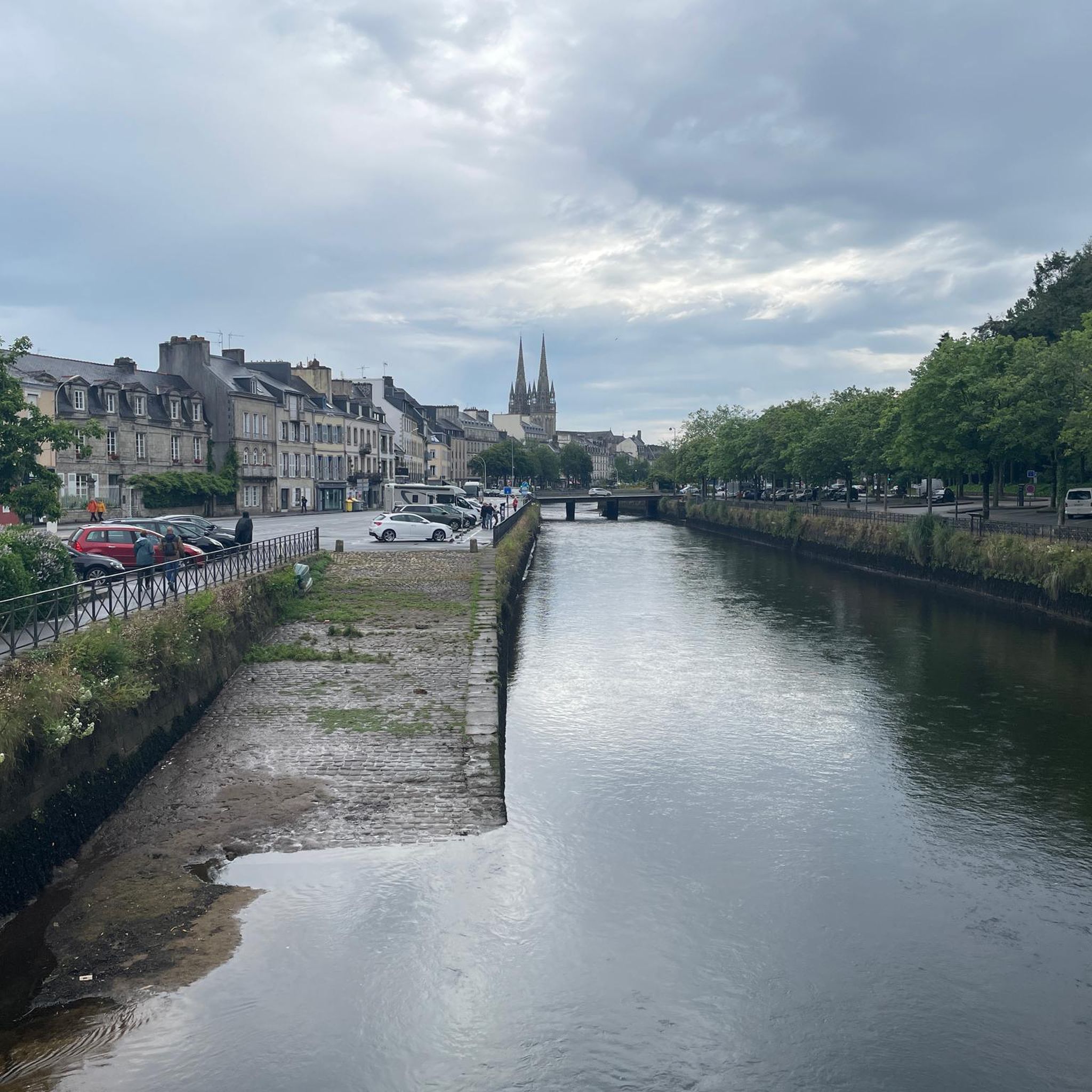
Saint-Corentin Cathedral - Quimper Saint-Corentin Cathedral was built on the foundations of a Romanesque church in Quimper, the capital of Cornouaille in Brittany. It is one of the three oldest Gothic cathedrals in Brittany, along with the cathedrals of Saint-Pol-de-Léon and Tréguier. Saint-Corentin Cathedral in Quimper is a historic building.
1
0

Not exactly a highlight for road cyclists. But still a beautiful building.
1
0

Built under Louis XIII, in the 17th century
0
0

Very interesting building on the water
0
0

In the middle of the city, the two towers of the cathedral rise up.
1
0
Frequently Asked Questions
How many road cycling routes are available in Ergué-Gabéric?
There are over 30 road cycling routes around Ergué-Gabéric, offering a diverse range of experiences for cyclists. These routes vary in difficulty, from easy rides to more challenging excursions.
What kind of terrain can I expect on road cycling routes in Ergué-Gabéric?
Road cycling routes in Ergué-Gabéric traverse a varied landscape, including dense forests, open moors, and verdant river valleys, particularly along the Odet and Jet rivers. You can expect routes that wind through preserved natural zones, such as the dramatic gorges of Stangala, and past historical sites. The terrain includes both flat sections and areas with significant elevation gain, catering to different fitness levels.
Are there road cycling routes suitable for beginners or families in Ergué-Gabéric?
Yes, Ergué-Gabéric offers several easy road cycling routes perfect for beginners or families. For example, the Manoir du Cleuyou loop from Arboretum et Landes de Kerho is an easy option, covering about 23 km with moderate elevation changes. In total, there are 7 easy routes available.
Are there challenging road cycling routes for experienced riders in Ergué-Gabéric?
Absolutely. For experienced riders seeking a challenge, Ergué-Gabéric offers routes with significant distance and elevation. A notable difficult route is the Rosporden Ponds – 2nd Pond, Rosporden loop from Arboretum et Landes de Kerho, which spans over 84 km with nearly 1000 meters of elevation gain. There are 2 difficult routes in the area.
What historical sites or landmarks can I see while road cycling in Ergué-Gabéric?
While road cycling in Ergué-Gabéric, you can encounter several historical and cultural points of interest. The region is home to the listed Historic Monument Manoir de Lezergué and the Saint Guinal church. Further afield, the sumptuous Kerdévot Chapel with its monumental calvary is a significant religious site. Routes like the Climb of Château de Trévarez – Châteauneuf-du-Faou loop from Arboretum et Landes de Kerho can lead you towards such historical landmarks.
Are there scenic viewpoints along the road cycling routes in Ergué-Gabéric?
Yes, the natural features of Ergué-Gabéric provide many scenic viewpoints. The dramatic gorges of Stangala, where the Odet River carves deep valleys, offer particularly stunning vistas. Routes often traverse wooded areas, open moors, and riverbanks, providing picturesque landscapes throughout your ride.
What do other cyclists say about road cycling in Ergué-Gabéric?
The road cycling routes in Ergué-Gabéric are highly rated by the komoot community, with an average score of 3.5 stars from several reviews. Cyclists often praise the varied terrain, from dense forests to open moors, and the opportunity to explore both natural beauty and historical sites.
Are there circular road cycling routes in Ergué-Gabéric?
Many of the road cycling routes in Ergué-Gabéric are designed as loops, allowing you to start and finish at the same point. Examples include the Quémé loop from Arboretum et Landes de Kerho and the Coray Church loop from Ergué-Gabéric, providing convenient options for exploring the region.
What is the best time of year for road cycling in Ergué-Gabéric?
While specific seasonal data isn't provided, Brittany generally offers pleasant cycling conditions from spring through early autumn. The region's natural beauty, with its forests and rivers, is particularly vibrant during these months. Checking local weather forecasts before your ride is always recommended.
Where can I find parking for road cycling routes in Ergué-Gabéric?
Many routes in Ergué-Gabéric, such as those starting from the Arboretum et Landes de Kerho, typically have designated parking areas nearby. For specific routes, it's advisable to check the route details on komoot, as starting points often indicate suitable parking options.
Are there cafes or places to stop along the road cycling routes in Ergué-Gabéric?
While specific cafes are not listed for each route, many routes pass through or near small towns and villages where you can find local establishments. The presence of an active cycling community, including clubs like the Cyclos Randonneurs Gabéricois, suggests that amenities for cyclists are generally accessible in the wider area.
Most popular routes around Ergué-Gabéric
Most popular attractions around Ergué-Gabéric

Get inspired with the komoot mobile app


Explore more
Browse the best Road cycling routes in other regions.
