Attractions and Places To See around Marcq - Top 20
Best attractions and places to see around Marcq are found in this vibrant commune within the Métropole Européenne de Lille, Hauts-de-France. Marcq offers a blend of historical landmarks, green spaces, and cultural attractions, known for its peaceful residential atmosphere and convenient access to Lille. The region features natural features near Marcq-en-Baroeul, including protected wetlands and expansive parks, alongside significant historical sites. This area provides a diverse range of experiences for visitors.
Best attractions and places to see around Marcq
- The most popular attractions is Montfort-l'Amaury Cemetery and Cloister, a historical site that features a cemetery with a cloister. It is notable for housing the graves of famous figures, including Maurice Ravel and Charles Aznavour.
- Another must-see spot is Saint Martin's Church, Beynes, a religious building located in Beynes. This church dates from the 13th century and has undergone various demolitions and reconstructions throughout its history, featuring a 14th-century polychrome stone statue of the Virgin and Child.
- Visitors also love Notre-Dame du Chêne Chapel, a religious building erected on an important pilgrimage site. The current building replaces a first chapel destroyed during the Revolution, and its name refers to an oak tree that once housed an image of the Virgin Mary.
- Marcq is known for its historical sites, religious buildings, and green spaces. The area offers a variety of attractions to see and explore, from ancient churches and castles to parks and cultural venues.
- The attractions around Marcq are appreciated by the komoot community, with 3 photos and 96 upvotes from visitors.
Last updated: June 22, 2026
Saint Martin's Church, Beynes
Highlight • Religious Site
Today located in the city center, you can stop there for a supply or simply catch your breath.
Translated by Google •
Tip by

Notre-Dame du Chêne Chapel
Highlight • Religious Site
This chapel is erected on an important place of pilgrimage, frequented in particular by Queen Marie-Antoinette. The current building replaces the first chapel destroyed during the Revolution.
Translated by Google •
Tip by

Sign up now to discover places like this
Get recommendations on the best single tracks, peaks, & plenty of other exciting outdoor places.
Sign up for free
Ruins of the Château de Beynes
Highlight • Castle
Translated by Google •
Tip by

Small round table
Highlight • Historical Site
An old table, called the "débotter" table, on which the king sat so that his large hunting boots could be put on, it also served as a snack table and also, and perhaps especially by climbing onto it by a circular bench, as an observatory in the center of a star.
The small table of Beynes seems the oldest, it is a large circular block, split in the middle and supported by four terminals. The large table is more ornate with the inscription "remade in 1783", and its top bears the indication of the roads, also serving as an orientation table. This assignment is unique, moreover the inscription "Route d'Auteuil" does not correspond to the star where it is, but to the Grand Rond. It is reasonable to think that the table from Ste Appoline (Plaisir) was brought there first, while the one from Beynes was being remade, then the tablets were reversed, and this is how the large table is in the small star and gives the orientations of the Grand Rond.
Translated by Google •
Tip by

Montfort-l'Amaury Cemetery and Cloister
Highlight • Historical Site
Translated by Google •
Tip by

Sign up for free to discover even more attractions around Marcq.
Sign up for free
Already have an account?
Start today with a free account
Your next adventure awaits.
Login or Signup


Tips from the Community

This small table is in the oldest large circle. A large table is located in the new small star. An old table, called the "débotter" table, on which the king sat so that his large hunting boots could be put on, it also served as a snack table and also, and perhaps especially by climbing onto it by a circular bench, as an observatory in the center of a star. The small table of Beynes seems the oldest, it is a large circular block, split in the middle and supported by four terminals. The large table is more ornate with the inscription "remade in 1783", and its top bears the indication of the roads, also serving as an orientation table. This assignment is unique, moreover the inscription "Route d'Auteuil" does not correspond to the star where it is, but to the Grand Rond. It is reasonable to think that the table from Ste Appoline (Plaisir) was brought there first, while the one from Beynes was being remade, then the tablets were reversed, and this is how the large table is in the small star and gives the orientations of the Grand Rond.
0
0

"Joseph-Maurice Ravel (* March 7, 1875 in Ciboure; † December 28, 1937 in Paris) was a French composer and, alongside Claude Debussy, the main representative of impressionism in music. His best-known work is the orchestral piece Boléro, which was originally conceived as ballet music." (Source: Wikipedia) There are numerous films with the Bolero on the video portal YouTube. I have selected a recording by the WDR (West German Radio) Symphony Orchestra as a suggestion for anyone who wants to listen to it. https://www.youtube.com/watch?v=cmNEvSFWftc
0
0
Many houses of worship in France bear the title “Notre-Dame” (in German “Our Lady”) and are therefore dedicated to the Blessed Mother Mary. Sometimes the specific patronage is made clear by an additional name, such as “Assumption of Mary” or “Immaculate Conception”. Here in Les Mesnuls, the church or chapel bears the suffix "Notre-Dame du Chêne", i.e. "to the oak". This means that it is not an event in the life of the Mother of God that is referred to in the patronage, but rather a tree that gave the immediate surroundings of the church a formative shape. In fact, you can see a tree on the left and right of the building.
0
0

Cemetery set with a magnificent Cloister. There are many famous stars there, Maurice Ravel among others. Diagonally opposite the Cloister, nestled in a corner near a discreet exit is the family vault of the unforgettable Charles Aznavour.
0
0

Church located in the Yvelines in Beynes, in the west of Paris. It dates from the 13th century and has seen various demolitions and reconstructions throughout history. Today located in the city center, you can stop there for a supply or simply catch your breath.
2
0

Super beautiful, and well highlighted by the municipality.
0
0

From the 8th century, Beynes is a land owned by the abbey of Saint-Germain-des-Prés. It is therefore monks who clear and cultivate the land of Beynes. They build a first place of worship, probably in wood. At the beginning of the 11th century, King Robert II the Pious (972 / 1031) gave the fiefdom of Beynes to Guillaume de Hainaut, first lord of the Montfort family. In 1072, it is attested that Beynes depends on the priory of Saint Laurent de Montfort-L'Amaury. In 1159, a papal bull from Pope Adrian IV, the only English pope in history, attests that King Robert the Pious granted the patronage of the church and the main tithe to Saint Magloire Abbey in Paris. The construction of the current church is dated from the middle of the 12th century, date of the appearance of the parish, consecrated to Saint Martin in 1183. The church has undergone various episodes of demolitions and alterations over the centuries, and appears to have been partly rebuilt in 1773, then remodeled and extended in the 1830s to 1880s. Subsequently, numerous consolidations and repairs took place. The choir, the oldest part, dates from the 12th century, while the nave and the side aisles on the basilica plan are from the 18th and 19th centuries. The Virgin and Child: polychrome stone statue from the 14th century, listed as a historical monument since 1907. The tabernacle: the 18th century sculpted wooden altar, surmounted by a 17th century altarpiece, has been listed as a historical monument since 1907. This tabernacle was sculpted by monks who reproduced certain elements of the portal of the Saint Gervais church from Paris. The two small wooden statues adorn the sides: Saint Vincent and Saint Nicolas. The capitals of the choir: vestiges of the primitive church of the 12th century have been updated: columns, Romanesque capitals, departure of a double roller arch and slightly broken Romanesque arcades.
1
0
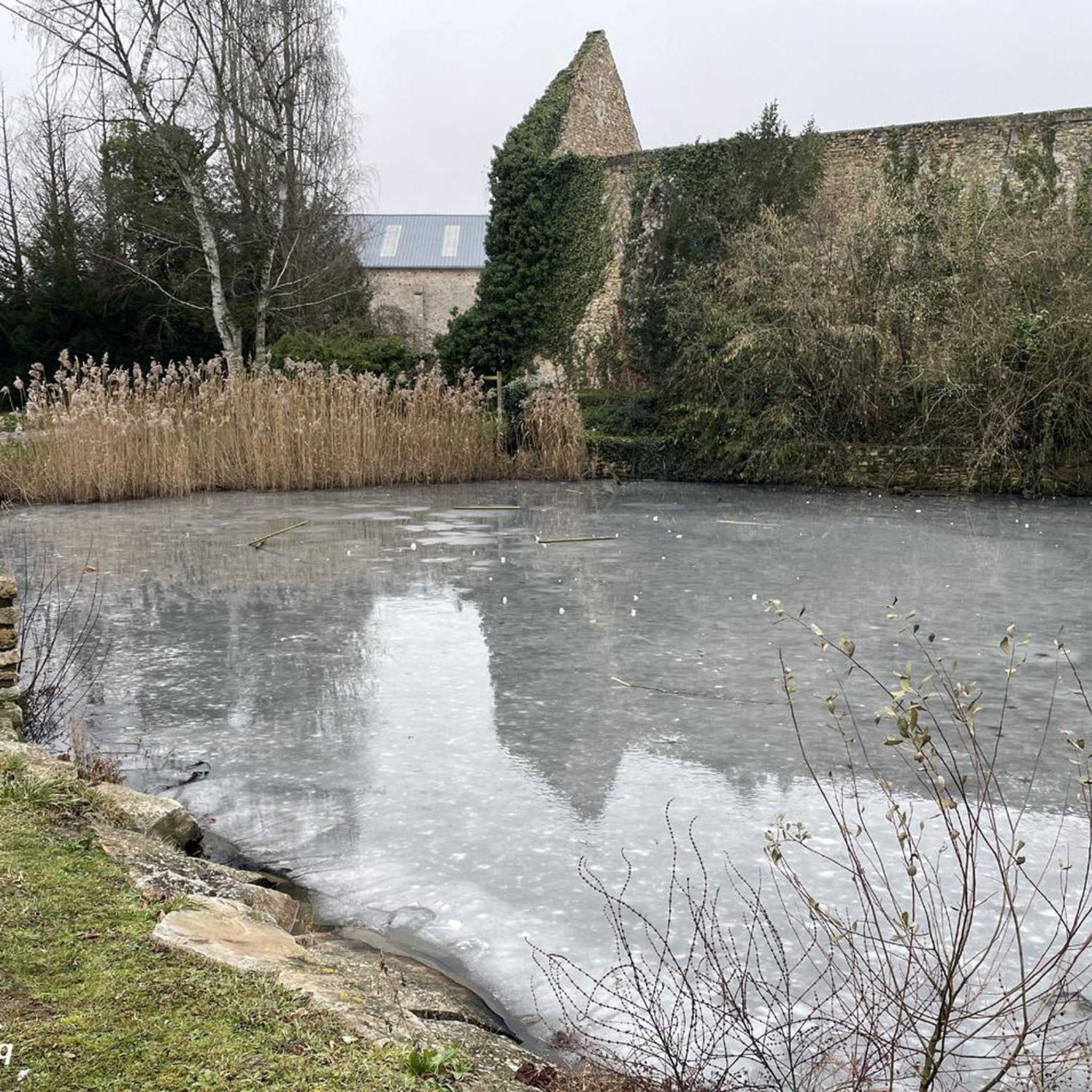
The castle of Beynes is installed in the bottom of a valley. Its construction dates back to the 11th century. It first had a military role at a time when the course of the Mauldre constituted a line of defense of the royal domain, to the west, in particular against the English during the Hundred Years' War. In the 15th century, the castle having lost its strategic importance due to the extension of the royal domain, Robert d'Estouteville, chamberlain of King Charles VII and owner of the premises, made it undergo some modifications, by demolishing the keep and adapting the nascent artillery fortifications. In the 16th century, in 1536, the estate was ceded to Diane de Poitiers (Madame de Valentinois) by Henri II, her royal lover2. She had a new dwelling built by Philibert Delorme, author of the Château des Tuileries, the Château d'Anet or part of that of Chenonceau. The castle is among the first listed with a framework that was a precursor to the principle of glued laminated timber, the technique of which was therefore invented by this great architect3,4. In the 17th century, in 1688, ladies of the high aristocracy gathered there around the mystical Madame Guyon. On October 4, they organized a meeting at the château between Madame Guyon and their spiritual director, the Abbé de Fénelon5. This one becomes one of the most fervent disciples of Madame Guyon6. In the 18th century, the ruins of the castle served for a time as the setting for the English park laid out by the Phélypeaux de Pontchartrain who then owned it. An estimate for its restoration is produced7, its cost probably convinces the owners to leave it as it is. Abandoned then dismantled, it even serves as a quarry for the construction of the village. In 1967, the Château de Beynes was bought by the municipality, which was responsible for saving the estate, which was then buried by vegetation. From 1995 to 1999, it was excavated and then benefited from reinforcement works. In 2014, all the remains were classified as historical monuments 8. At the beginning of June 2016, heavy rains caused the flooding of the moat9,10, and the collapse of a section of the wall. Work, in the form of a subsidized and sponsored volunteer site, is underway to stop its deterioration and allow its access to the public11.
0
0
Frequently Asked Questions
What historical landmarks can I explore in and around Marcq-en-Baroeul?
Marcq-en-Baroeul and its vicinity offer several significant historical sites. You can visit the impressive Château de la Fontaine, a 19th-century architectural marvel that now serves as a cultural center. The historic Hippodrome des Flandres is also notable. Nearby, don't miss the Saint Martin's Church, Beynes, dating back to the 13th century, or the Ruins of the Château de Beynes, a fortified castle with a rich history. The Montfort-l'Amaury Cemetery and Cloister is also a historical site featuring the graves of famous figures.
Are there any notable religious sites in the area?
Yes, Marcq-en-Baroeul features the Saint-Vincent-de-Paul Church. Additionally, the Saint Martin's Church, Beynes, is a 13th-century religious building with a 14th-century polychrome stone statue of the Virgin and Child. Another significant site is the Notre-Dame du Chêne Chapel, built on an important pilgrimage site where an oak tree once housed an image of the Virgin Mary.
Where can I find green spaces and natural features in Marcq-en-Baroeul?
Marcq-en-Baroeul boasts several beautiful green spaces. The Parc du Sart and Parc du Petit Prince are popular for recreation and offer peaceful retreats. For nature enthusiasts, the Marais de la Marque is a protected wetland area, ideal for birdwatching and enjoying diverse avian species.
What cultural activities and venues are available in Marcq-en-Baroeul?
The commune is well-equipped with cultural facilities. You can enjoy performances at its three theaters (Théâtre Charcot, Théâtre Colisée Lumière, and Théâtre de la Rianderie), explore exhibitions at two galleries, catch a film at Cinéma Le Pont des Arts, or visit the media library and conservatory. The Château de la Fontaine also hosts art exhibitions and events.
Are there family-friendly attractions around Marcq-en-Baroeul?
Absolutely! The Parc du Petit Prince is an expansive and verdant jewel perfect for families. Many historical and religious sites are also considered family-friendly, including Saint Martin's Church, Beynes, Notre-Dame du Chêne Chapel, and the Montfort-l'Amaury Cemetery and Cloister.
What outdoor activities can I do near Marcq-en-Baroeul?
The area around Marcq-en-Baroeul is excellent for outdoor activities. You can find numerous routes for hiking, road cycling, and gravel biking. For detailed routes and guides, explore the Hiking around Marcq guide, the Road Cycling Routes around Marcq guide, or the Gravel biking around Marcq guide.
Are there hiking trails near the attractions?
Yes, there are several hiking trails nearby. For example, you can find a moderate 14 km loop that connects Saint Martin's Church, Beynes with the Ruins of the Château de Beynes. For more options, including easy and difficult trails, consult the Hiking around Marcq guide.
What is the best time to visit Marcq-en-Baroeul for outdoor activities?
While specific seasonal events are not detailed, the Hauts-de-France region generally offers pleasant weather for outdoor activities from spring through early autumn (April to October). This period is ideal for exploring green spaces, historical sites, and enjoying cycling or hiking routes.
What do visitors enjoy most about the attractions around Marcq?
Visitors appreciate the blend of historical depth and natural beauty. Sites like the Montfort-l'Amaury Cemetery and Cloister are noted for their magnificent cloisters and the presence of famous graves. The historical significance and architectural details of places like Saint Martin's Church, Beynes, and the unique story behind Notre-Dame du Chêne Chapel are also highly valued.
Are there any castles or châteaux to visit in the vicinity?
Yes, Marcq-en-Baroeul is home to the stunning Château de la Fontaine. Nearby, you can also explore the classical French architecture of Château du Vert-Bois, which houses collections of 18th-century art. Don't forget the historical Ruins of the Château de Beynes, offering a glimpse into medieval fortifications.
What is the significance of the 'Small round table' highlight?
The Small round table is a historical site, believed to be an ancient 'débotter' table where kings would sit to have their hunting boots put on, or for snacks. It also served as an observatory in the center of a star-shaped clearing. The one near Beynes is considered the oldest, a large circular block supported by four terminals.
Is there a UNESCO World Heritage site near Marcq-en-Baroeul?
Yes, although located in the nearby commune of Croix (approximately 5.6 km away), the Villa Cavrois is an unmissable UNESCO World Heritage site in the vicinity of Marcq-en-Baroeul, known for its modernist architecture.
Most popular attractions around Marcq

Get inspired with the komoot mobile app


Explore more
Still not found the Highlight you’re looking for? See guides of the top attractions in other regions:
