Attractions and Places To See around Fleury - Top 20
Best attractions and places to see around Fleury include a rich collection of historical sites and architectural marvels, primarily centered around the city of Metz. This region is characterized by its significant Roman and medieval heritage, with structures that reflect centuries of history. Visitors can explore impressive religious buildings, ancient fortifications, and engineering feats, offering a glimpse into the area's past. The landscape is shaped by the Moselle river, which has played a crucial role in the development and defense…
Last updated: June 22, 2026
Gorze–Metz Roman Aqueduct (Jouy-aux-Arches)
Highlight • Monument
All boards are in French, English and German.
Translated by Google •
Tip by

Moyen Bridge
Highlight • Other
Translated by Google •
Tip by

Sign up now to discover places like this
Get recommendations on the best single tracks, peaks, & plenty of other exciting outdoor places.
Sign up for free
Saint-Étienne Cathedral
Highlight • Religious Site
Translated by Google •
Tip by
Porte des Allemands and Metz Cathedral
Highlight • Historical Site
Translated by Google •
Tip by

Porte des Allemands
Highlight • Historical Site
Translated by Google •
Tip by
Sign up for free to discover even more attractions around Fleury.
Sign up for free
Already have an account?
Start today with a free account
Your next adventure awaits.
Login or Signup

Tips from the Community

It's called the "Lantern of God" because St. Stephen's Church in Metz has almost three times the window area of Chartres Cathedral. Many great artists have attempted to design it – for the 800th anniversary, it will be a woman for the first time.
14
0
Built between 1220 and 1522, it is the result of the merging of two separate churches. With its 42-meter-high nave, it is one of the largest Gothic buildings in Europe. Its 6,500 square meters of stained-glass windows have earned it the nickname "Lantern of the Lord." Created in the 16th and 18th centuries by Hermann von Münster, Thiébault de Lixheim, Valentin Bousch, Jacques Villon, and Marc Chagall, these masterpieces of fire and light are a true encyclopedia of glass art.
14
0

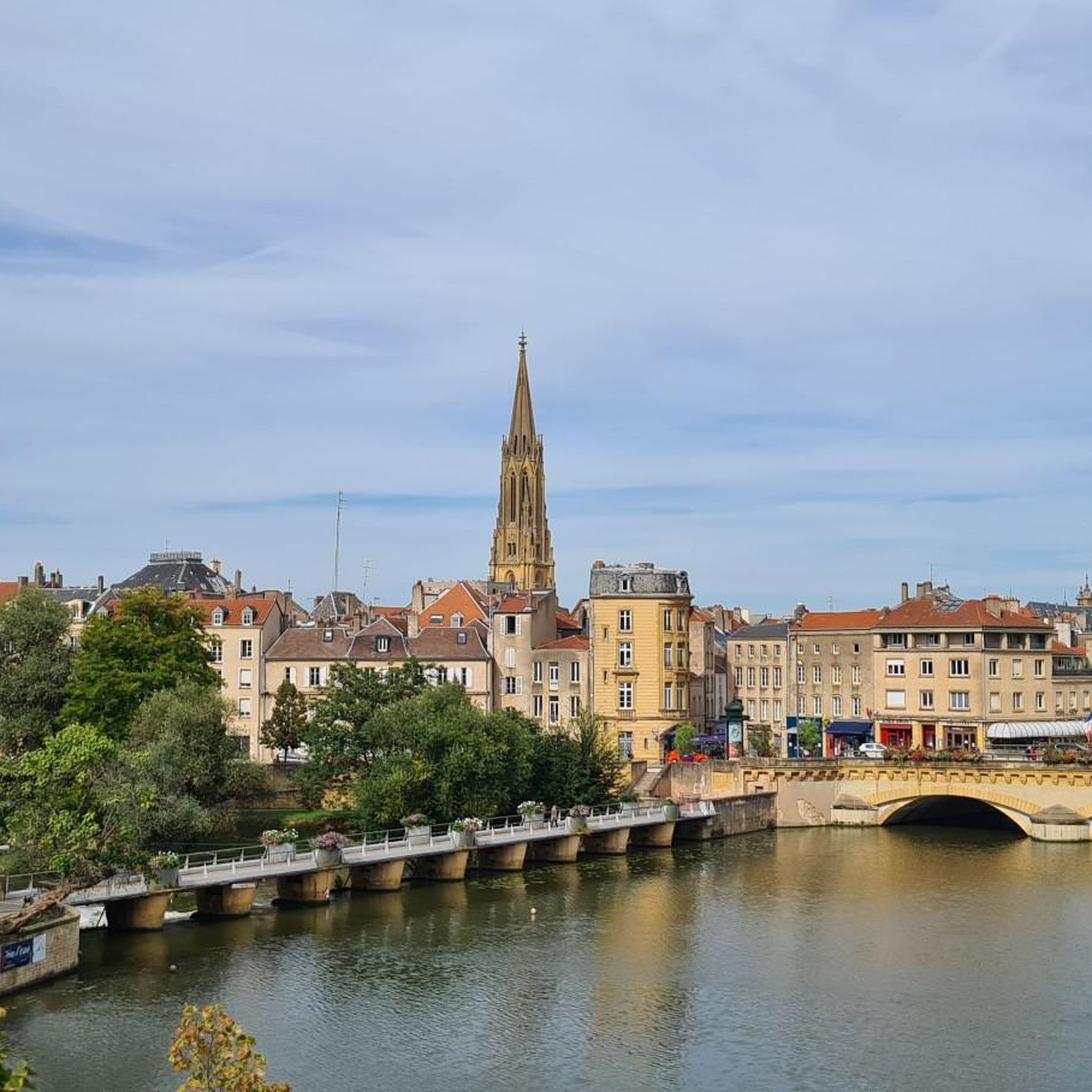
A bridge over the Moselle River offers beautiful views of the Moselle Island. At night, the arches beneath the bridge are illuminated in colorful lights, a beautiful eye-catcher.
5
0
Of the original 17 city gates, only the German Gate in the east remains. Named after the former hospital of the Teutonic Order, which stood nearby, it was built as an entrance to the city on a bridge over the Seuille River. A medieval structure straight out of a picture book.
6
1

Always worth a bike tour! In the old town area, however, you should keep an eye on the ground. The cobblestones are very rough in places and have deep, wide cracks.
1
0

In the evening the bridge is illuminated and looks very beautiful
2
0

Beautiful Roman aqueduct on the edge of the cycle path towards Metz.
6
0
The aqueduct connecting Gorze to Metz is a Roman aqueduct built at the beginning of the second century. Divodurum (Metz) is the capital of the Mediomatris, at the crossroads of the south-north and east-west axes, i.e. on the Roman roads from Lyon to Trier and from Reims to Strasbourg. The city, which had about 20,000 inhabitants in the second century, needed a supply of spring water to supply the fountains, the three Roman baths, the public latrines and the craftsmen. The exact distribution points are not known because no trace remains (Wikipedia).
4
0
Frequently Asked Questions
What historical sites can I visit around Fleury?
The area around Fleury is rich in history, primarily centered near Metz. You can explore the impressive Gorze–Metz Roman Aqueduct (Jouy-aux-Arches), a testament to Roman engineering that once supplied Metz with water. Another significant site is the Porte des Allemands, a preserved medieval city gate that served as a bridge over the Seille river and showcases military architecture.
Are there any notable religious buildings to visit?
Yes, the magnificent Saint-Étienne Cathedral in Metz is a must-see. Built between the 13th and 16th centuries, this Gothic cathedral is renowned for its uniform style, the largest surface area of windows in France, and some of the highest vaults among French churches. Visitors often highlight the beautiful Chagall windows.
What are some family-friendly attractions around Fleury?
Many of the historical sites are suitable for families. The Gorze–Metz Roman Aqueduct (Jouy-aux-Arches) and the Porte des Allemands offer engaging historical exploration. The Saint-Étienne Cathedral is also considered family-friendly, allowing children to marvel at its grand architecture and stained glass.
What outdoor activities can I do near these attractions?
The region offers various outdoor activities, especially around the Moselle river. You can find numerous routes for running, mountain biking, and gravel biking. For example, there are running loops like 'La Seille loop from Fleury' and MTB trails such as 'Seille spillway – Mountain biking in Sud Messin – Verny loop from Fleury'. You can explore more options on the Running Trails around Fleury, MTB Trails around Fleury, and Gravel biking around Fleury guide pages.
Are there specific routes for running near Fleury?
Yes, there are several running routes available. You can find options like the 'Running loop from Pournoy-la-Grasse' (difficult, 11.1 km) or the 'La Seille loop from Fleury' (moderate, 12.3 km). For a comprehensive list, check the Running Trails around Fleury guide.
Where can I go mountain biking around Fleury?
Mountain biking enthusiasts have several trails to choose from. Options include the 'Chesny Riding School – Seille spillway loop from Chesny' (easy, 27.7 km) and the 'Mountain biking in Sud Messin – Verny loop from Fleury' (easy, 20.6 km). More details and routes are available on the MTB Trails around Fleury guide page.
What kind of natural features can I expect to see?
The landscape around Fleury is significantly shaped by the Moselle river. While the primary attractions are historical and architectural, the river provides scenic views and opportunities for riverside strolls. The area also features wetlands and ponds, contributing to diverse natural settings, particularly in the broader region of Fleury d'Aude (Occitanie), which boasts beaches and the Gouffre de l'Œil Doux.
What do visitors enjoy most about the attractions around Fleury?
Visitors frequently appreciate the rich historical significance and architectural beauty of the sites. The Gorze–Metz Roman Aqueduct is praised as an impressive example of Roman engineering, while the Saint-Étienne Cathedral is admired for its Gothic grandeur and stunning windows. The city of Metz itself is often highlighted as an ideal destination for its beautiful old town, diverse architecture, and pleasant Moselle promenades.
Are there any bridges of historical interest?
Yes, the Moyen Bridge in Metz is a notable historical bridge. Built between 1282 and 1312, it offers lovely views of the Temple Neuf and the island of Petit-Saulcy. Its original name, 'Moyen Pont des Morts', reflects its financing through the Metz hospital using clothes of the deceased.
What is the best time to visit Fleury for sightseeing?
While specific seasonal data isn't provided, historical sites and architectural marvels like those around Fleury are generally enjoyable year-round. Spring and autumn offer pleasant weather for exploring on foot, while summer allows for longer daylight hours. Winter visits can be charming, especially if you enjoy fewer crowds, though some outdoor activities might be weather-dependent.
Can I find gravel biking routes in the area?
Absolutely. The region around Fleury offers several gravel biking opportunities. Routes include 'Fort de Queuleu – Seille spillway loop from Pournoy-la-Grasse' (moderate, 36.5 km) and 'The Moselle at Metz – View of the River Moselle loop from Metz' (easy, 24.6 km). For more options, refer to the Gravel biking around Fleury guide.
Most popular attractions around Fleury

Get inspired with the komoot mobile app


Explore more
Still not found the Highlight you’re looking for? See guides of the top attractions in other regions:
