The best cycling routes around Mailly-Maillet
4.7
(44)
441
riders
115
rides
Touring cycling around Mailly-Maillet features routes through the gently rolling terrain of Northern France, characterized by agricultural fields and scattered woodlands. The area's landscape includes numerous historical sites, often connected by quiet country roads suitable for cycling. Elevations are generally moderate, providing varied riding experiences without extreme climbs.
Best touring cycling routes around Mailly-Maillet
- The most popular touring cycling route is Parc Mémorial de Thiepval — loop from Newfoundland Memorial, a 15.1 miles (24.4 km) trail that takes 1…
Last updated: May 21, 2026
5.0
(1)
2
riders
24.4km
01:38
270m
270m
Moderate bike ride. Good fitness required. Mostly paved surfaces. Suitable for all skill levels.
4.5
(4)
14
riders
146km
08:37
820m
820m
Hard bike ride. Very good fitness required. Mostly paved surfaces. Suitable for all skill levels.

Sign up for free
8
riders
58.7km
04:17
530m
530m
Hard bike ride. Very good fitness required. Mostly paved surfaces. Suitable for all skill levels.
5.0
(1)
5
riders
53.9km
03:25
470m
470m
Hard bike ride. Very good fitness required. Mostly paved surfaces. Suitable for all skill levels.
9
riders
41.3km
03:29
460m
460m
Hard bike ride. Very good fitness required. Mostly paved surfaces. Suitable for all skill levels.
Get access to more routes and recommendations from other explorers.
Sign up for free
Already have an account?
Our route recommendations are based on thousands of hikes, rides, and runs completed by other people on komoot.
Start today with a free account
Your next adventure awaits.
Login or Signup


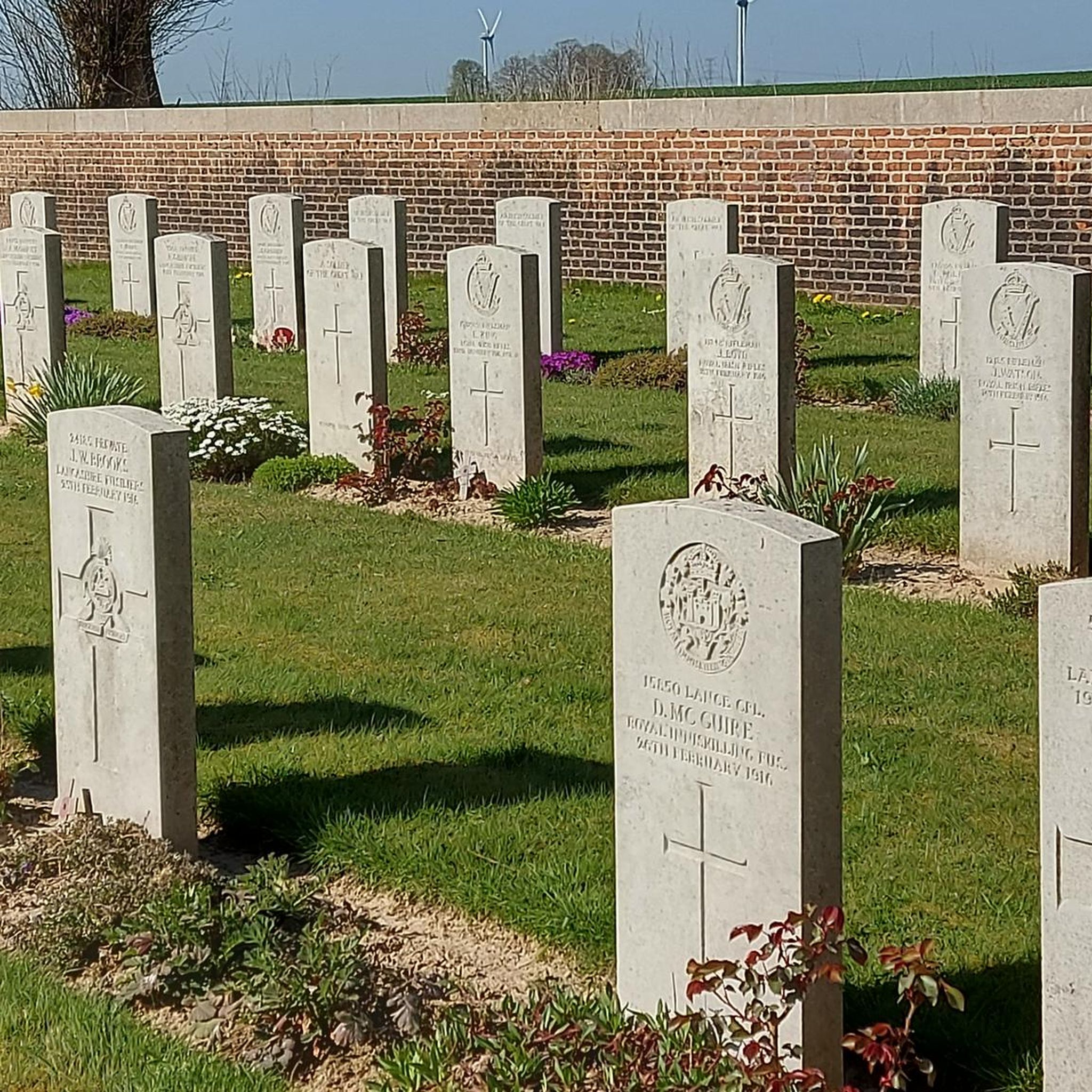


Tips from the Community

The Pipers Memorial in Longueval is a special tribute to all pipers who died during the First World War, regardless of their regiment or origin. It was unveiled on 20 July 2002 and stands in the village square, just off the Rue de Bazentin. The bronze statue, designed by Andy De Comyn, shows a piper in full uniform climbing out of a trench playing—a powerful symbol of courage and moral support for troops under fire. Plaques around the plinth list the regiments that lost pipers, and the memorial also remembers heroes such as Piper James Richardson VC, who led his battalion into the attack with his music and was later killed trying to retrieve his bagpipes. It is a rare monument that honours not only military valour but also cultural identity and tradition. A place where music and memory come together in stone and bronze.
8
0
The Mémorial à la 18e Division britannique consists of a stone obelisk with bronze plaques on each side. These plaques commemorate the officers, non-commissioned officers and men of the division and record the battles in which the division fought. Interestingly, the 18th British Division played a crucial role in the Battle of the Somme, suffering significant losses but making important territorial gains.
6
0
Officially part of the Historial de la Grande Guerre, the Thiepval Museum is located near the impressive Thiepval Memorial and offers an in-depth look at the Battle of the Somme of 1916. Opened in 2016 to mark the centenary of this bloody battle, the museum comprises seven thematic areas, each highlighting a different aspect of the war. One of the highlights is the 60-metre-long panoramic comic strip by artist Joe Sacco, which vividly depicts the events of 1 July 1916. Visitors will gain insight not only into the military strategies, but also into the human suffering and the culture of remembrance surrounding the missing of the Somme.
5
0
The Tour d'Ulster, also known as the Helen Tower or Tour de Belfast, is a British war memorial. It was built in 1921 to commemorate the soldiers of the 36th Ulster Division who died during the Battle of the Somme in World War I. The tower is a replica of a neo-Gothic tower in Clandeboye Park, near Belfast, where the 36th Division trained. An interesting anecdote is that the 36th Ulster Division was the first to attack during the Battle of the Somme on 1 July 1916, but suffered heavy losses from both German and British artillery fire. The division lost over 5,500 men in just a few hours. The Tour d'Ulster has a cafeteria where you can enjoy a cup of tea, scones or Tayto chips, a specialty from Northern Ireland. It is a nice place to relax.
6
0
The Cratère de Lochnagar, an impressive war memorial, was created by a huge mine blown up by the British Royal Engineers on 1 July 1916, as part of the Battle of the Somme. The explosion marked the beginning of the battle and left a crater 90 metres in diameter and 25 metres deep. Interestingly, the crater was named after Lochnagar Street, the trench from which the tunnel was dug. The crater is now a preserved site of remembrance and a religious service is held there every year on 1 July in memory of those who died.
8
0
The Tyneside Monument commemorates the soldiers of the Tyneside Irish and Tyneside Scottish Brigades who fought in the First World War. The monument was erected in memory of the men who died during the Battle of the Somme. An interesting anecdote is that the Tyneside Brigades suffered heavy losses on 1 July 1916, the first day of the Battle of the Somme. Many of the soldiers came from the same communities, which had a great impact on their home front.
1
0
An interesting anecdote is that the monument was inaugurated in 1932 by the Prince of Wales and the French President Albert Lebrun. The monument consists of a series of arches supported by sixteen massive square pillars, on which the names of the missing soldiers are engraved. At the foot of the monument is a Franco-British military cemetery with 600 graves: 300 French and 300 British soldiers.
6
0
The Parc Mémorial de Thiepval is an impressive war memorial that commemorates the 72,337 missing British and South African soldiers who died during the Battle of the Somme in World War I. Designed by Sir Edwin Lutyens, the memorial is considered one of the greatest British monumental works of the twentieth century. The park also includes a visitor centre, opened in 2004, and the Jardins de la Paix, where visitors can reflect and enjoy the serene surroundings. Every year on 1 July, remembrance ceremonies are held to honour the victims of the Battle of the Somme.
8
0
Frequently Asked Questions
How many touring cycling routes are available around Mailly-Maillet?
There are over 100 touring cycling routes in the Mailly-Maillet area, offering a wide variety of experiences. These routes are highly rated by the komoot community, with an average score of 4.6 stars.
What is the general difficulty level of touring cycling routes in Mailly-Maillet?
The routes around Mailly-Maillet cater to various skill levels. You'll find a good mix, with approximately 30 easy routes, over 70 moderate routes, and about 15 more challenging options for experienced touring cyclists. The terrain is generally gently rolling, characterized by agricultural fields and scattered woodlands.
Are there any long-distance touring cycling routes for experienced riders?
Yes, for experienced touring cyclists looking for a significant challenge, the area offers extensive routes. One notable option is the Parc de la Bassure – The Citadel loop from Beaumont-Hamel, which spans 85.4 miles (137.5 km) and explores the wider region with varied terrain and elevation changes.
What kind of historical sites can I expect to see along the touring cycling routes?
Mailly-Maillet is rich in historical significance, particularly related to World War I. Many routes pass by significant memorials and sites. For example, the Parc Mémorial de Thiepval — loop from Newfoundland Memorial takes you past important historical landmarks. You can also explore sites like the Newfoundland Memorial, Thiepval Memorial, and the Ulster Tower.
Are there circular touring cycling routes available?
Yes, many touring cycling routes in Mailly-Maillet are designed as loops, allowing you to start and end at the same point. Examples include the Ulster Tower – Lochnagar Crater loop from Beaumont-Hamel and the Touttencourt Church – Château de Vadencourt loop from Warloy-Baillon.
What are some natural attractions or unique geological features to see?
Beyond historical sites, the region features unique natural and man-made craters from its wartime past. You can visit the Lochnagar Crater, the Hawthorn Ridge Crater, and the La Boisselle Mine Crater, which are significant historical and geological points of interest.
What is the best time of year for touring cycling in Mailly-Maillet?
The gently rolling terrain and open agricultural fields make touring cycling enjoyable during most of the year. Spring and autumn offer pleasant temperatures and beautiful scenery, while summer provides longer daylight hours. The quiet country roads are generally accessible, but checking local weather forecasts is always recommended.
Are there any routes that pass through woodlands or offer varied scenery?
While the area is known for its open agricultural fields, routes often incorporate scattered woodlands and quiet country roads, providing varied scenery. The Newfoundland Memorial – Mailly Wood cemetery loop from Beaumont-Hamel, for instance, offers a mix of historical landscapes and natural elements.
What are the typical distances for touring cycling routes in this area?
Route distances vary significantly to suit different preferences. You'll find shorter loops around 15 miles (24 km), such as the Parc Mémorial de Thiepval — loop from Newfoundland Memorial, as well as longer excursions exceeding 80 miles (130 km) for more ambitious riders.
Can I find places to stop for refreshments or food along the routes?
Given the region's rural character and the presence of small villages, you can often find local cafes, bakeries, or small shops in the towns and villages along or near the touring cycling routes. Planning your stops in advance, especially on longer rides, is advisable.
What makes touring cycling in Mailly-Maillet unique?
Touring cycling in Mailly-Maillet offers a unique blend of history and serene countryside. The routes traverse gently rolling terrain, connecting numerous significant World War I historical sites via quiet country roads. It's an opportunity to reflect on the past while enjoying the peaceful agricultural landscapes of Northern France.
Most popular routes around Mailly-Maillet
Most popular attractions around Mailly-Maillet

Get inspired with the komoot mobile app


Explore more
Browse the best Cycling routes in other regions.
