The best road cycling routes around Logron
4.6
(52)
496
riders
236
rides
Road cycling routes around Logron traverse a landscape characterized by gentle undulations and open countryside, often featuring agricultural fields and rural roads. The region's terrain is generally flat to gently rolling, with modest elevation gains suitable for various fitness levels. Road cyclists can expect routes that connect small towns and villages, often passing historical landmarks like châteaux and churches.
Best road cycling routes around Logron
- The most popular road cycling route is Château de Châteaudun – Church of Bonneval loop…
Last updated: May 21, 2026
12
riders
66.3km
02:42
310m
310m
Moderate road ride. Good fitness required. Mostly well-paved surfaces and easy to ride.
5
riders
53.3km
02:09
190m
190m
Moderate road ride. Good fitness required. Mostly well-paved surfaces and easy to ride.

Sign up for free
5.0
(1)
5
riders
51.3km
02:02
240m
240m
Moderate road ride. Good fitness required. Mostly well-paved surfaces and easy to ride.
4
riders
55.5km
02:15
310m
310m
Moderate road ride. Good fitness required. Mostly well-paved surfaces and easy to ride.
4
riders
Easy road ride. Great for any fitness level. Mostly well-paved surfaces and easy to ride.
Get access to more routes and recommendations from other explorers.
Sign up for free
Already have an account?
Our route recommendations are based on thousands of hikes, rides, and runs completed by other people on komoot.
Start today with a free account
Your next adventure awaits.
Login or Signup



Tips from the Community

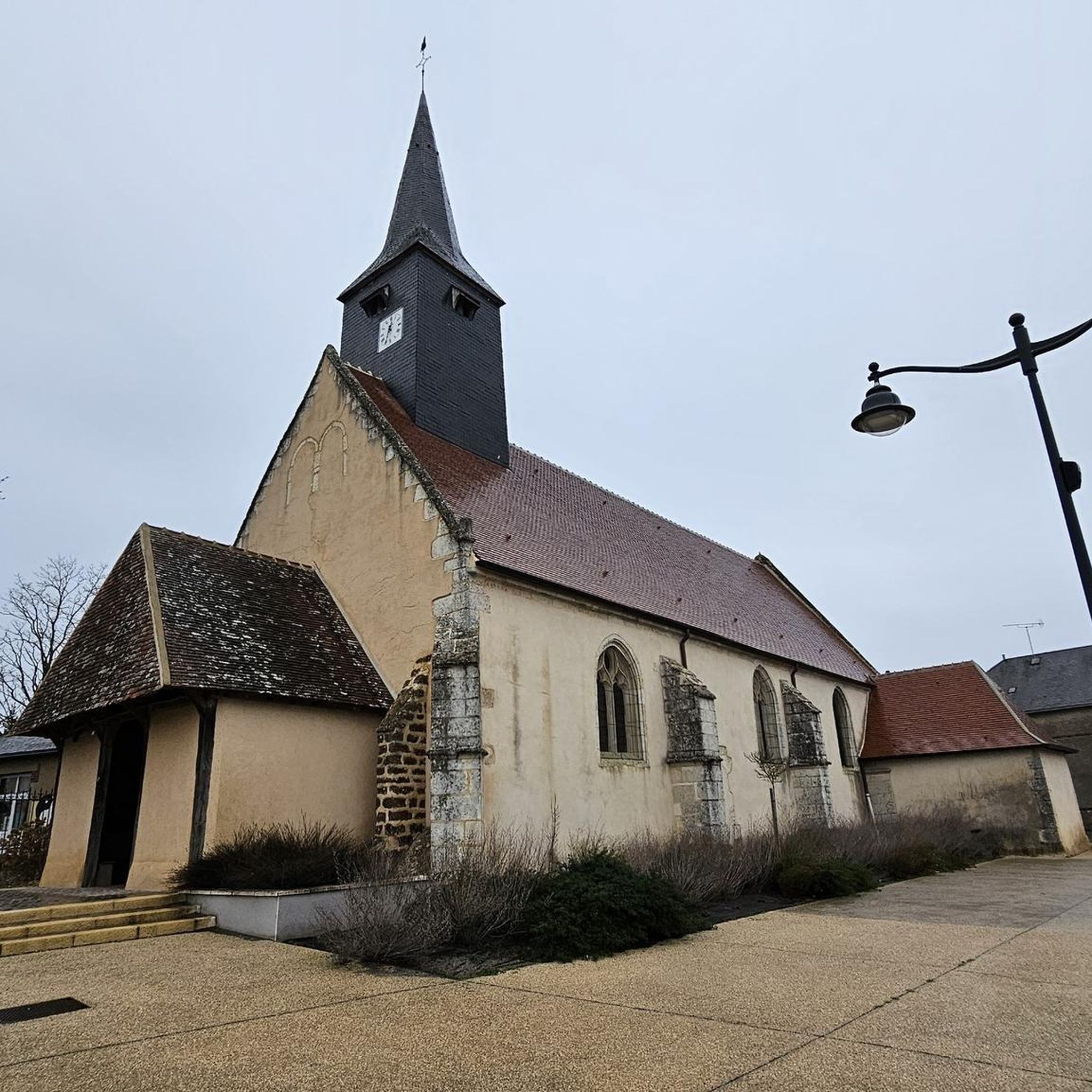
Placed under the patronage of Saint Hilaire, this parish was given by Gannelon de Montigny, lord of the place, to the abbey of Marmoutier around 1042. Its reconstruction probably dates from this period; it then became a priory. The church has a rectangular nave ending in a choir with a flat chevet. An examination of the masonry easily reveals two distinct periods of construction: the Romanesque period and the Renaissance. Built of flint rubble with rendering, the western part of the building appears to date from the 11th or 12th century. A limestone cornice supported by rather crude corbels underlines the base of the roof. To the south, two narrow Romanesque windows flared inwards light the nave. To the north, the bays were later reworked and enlarged. On this same side, a Romanesque doorway was walled up; It allowed the church to connect with a building whose traces of detachment remain. The bell tower was built to the north of the Romanesque nave, extending the western façade. The absence of a connection between the east and west walls of the bell tower and the north wall of the nave clearly indicates that it is an entirely later construction. However, its crowning is much later, as evidenced by its cornice, whose molding is in the classical style. Flanked by obliquely angled buttresses, it is covered with a saddleback roof. The eastern half of the church appears to be an extension built during the Renaissance period. Its ogee-shaped cornice and the decoration of the eastern gable, as well as the moldings of the buttress bands, attest to this dating. A vast rectangular choir then appears to have replaced a semicircular Romanesque apse; the eastern gable and the southern and northern façades were then pierced with networked bays. In the lower part of the north façade, projecting ashlars appear to have supported the roof of a lean-to building. To the south, a sacristy was built in the 19th century. Inside, the entire building is covered with a paneled vault with exposed tie beams and kingposts. The 18th-century high altar is surmounted by an Assumption of the Virgin inspired by Murillo's. For the restoration of the roofs and façades, the Sauvegarde de l'Art Français (French National Art Protection Agency) awarded a grant of €30,490 in 2001.
0
0
The Church of Saint Sauveur La Trinité, probably built in the 12th century, is notable for its Romanesque windows with columns and capitals. On its walls, alternating with the consecration crosses, one can admire a Stations of the Cross in blue enamel on earthenware. The choir is lit by five Romanesque windows decorated with stained glass depicting Our Lord and the four Evangelists.
0
0

The imposing structure known as the "Château de Chateaudun" that reveals itself to visitors here is, of course, also available in other sports in the komoot system. For the corresponding hiking highlight, you'll find further relevant information and additional photos under the tips. If you're interested, see =>> https://www.komoot.com/de-de/highlight/936307
0
0

The Henri Ey Hospital Center is a departmental public health establishment, specialized in psychiatry, which provides a mission of prevention and reception, care, aftercare and reintegration in mental health in Eure-et-Loir. It provides care in adult, child and adolescent psychiatry, as well as a medico-social activity in the field of geriatrics and psychological and mental disabilities.
0
0
The Saint-Lubin church, built on a sloping site, is a vast building with juxtaposed constructions, bearing witness to renovations and additions up to the 19th century, the oldest distinguished by the presence of grison, the most recent by limestone and flint. The sanctuary was ceded in 1077 by the monks of Saint-Denis de Nogent-le-Rotrou to the monks of the Saint-Père de Chartres abbey. Built in the 11th-12th century, the nave extended by a semi-circular apse is the oldest part of the church, in Romanesque style. In the thickness of the north walls of the nave are still visible the grison bonds which bear witness to the original openings. The building was considerably enlarged in the 15th and 16th centuries by the construction of a large transept, formed of two chapels, and a south aisle forming an alignment of gables attached to the slopes decorated with leafy motifs and finished with chimeras. The construction of the north aisle, just begun, was not finished. On the outside, on the west wall of the chapel, we can see the beginning of a first bay (stone arch and walls removed that remained unfinished). On the gable of the north transept, the walled door can be seen from the pointed arch and the ornate pinnacles, characteristic of the end of the 15th century. In the center, two animals present a coat of arms. On each side of the door, niches with canopies once housed statues. Above, we can still see a coat of arms presented by two bearded figures and probably surmounted by God the Father. According to local tradition, all or part of the extensions were due to the generosity of Florimont Robertet, who owned the barony of Brou from 1509 until his death in 1527, and it was because of this that the work was interrupted. Occupied by the revolutionaries, the building became a ten-day temple in 1794; it was finally returned to worship in 1802. Burnt down by lightning in 1813, the upper part of the bell tower, which was a slender spire, was replaced by the construction of a square limestone tower pierced with louvers. On the southern part of the bell tower, a turret provides access to the bells. In the southern part of the nave, a door, now blocked and highlighted by a basket-handle arch topped with a pinnacle, provided access to the cemetery that once surrounded the church. The building can boast of having preserved very uniform oak furniture, most of which was made in the second half of the 18th century.
0
0

Porte de Boisville Its ogival portal opens into a thick quadrangular massif where there was a room for operating the portcullis. We can still see the groove in the thickness of the walls. On the left and right two small funnel-shaped spaces allowed the defenders to observe and repel the enemies who appeared on the bridge. The gate was topped by a building serving as a guardhouse which was demolished in 1761. The guarding of these doors and their keys was in the troubled times of the Hundred Years' War the subject of concern for the inhabitants and also a source of quarrels and trials between the city and the abbey. This gate is preceded by a bridge of 5 stone arches, the one adjoining the gate was built in 1774 and replaced a drawbridge which defended the entrance.
0
0

Bonneval, nicknamed the little Venice of Beauce
0
0
Frequently Asked Questions
How many road cycling routes are available around Logron?
There are over 230 road cycling routes in the Logron area, offering a wide range of options for cyclists of all levels. This includes approximately 95 easy routes, 135 moderate routes, and 8 more challenging options.
What kind of terrain can I expect on road cycling routes near Logron?
Road cycling routes around Logron are characterized by generally flat to gently rolling terrain, with modest elevation gains. You'll typically ride through open countryside, agricultural fields, and rural roads, connecting small towns and villages.
Are there any easy or beginner-friendly road cycling routes in Logron?
Yes, Logron offers many easy routes suitable for beginners. One popular option is the Bonneval – Saint Mamert Church loop from Flacey, an easy 17.1-mile (27.5 km) path that provides a relaxed ride through charming villages and countryside.
What historical sites or landmarks can I see along the road cycling routes?
Many routes pass by historical landmarks. For instance, the Château de Châteaudun – Church of Bonneval loop from Logron takes you past the impressive Château de Châteaudun. Other routes might lead you past the historic town of Bonneval or Alluyes Castle.
Are there any circular road cycling routes around Logron?
Yes, many routes in the Logron area are designed as loops, allowing you to start and end in the same location. Examples include the Château de Châteaudun – Church of Bonneval loop from Logron and the Alluyes Castle – Notre-Dame Church of Yèvres loop from Yèvres.
What do other cyclists say about road cycling in Logron?
The road cycling routes in Logron are highly regarded by the komoot community, with an average rating of 4.6 stars from over 40 reviews. Cyclists often praise the well-maintained rural roads, the peaceful agricultural landscapes, and the opportunity to connect charming villages.
What is a good moderate-difficulty road cycling route in the area?
For a moderate challenge, consider the Saint Hilaire Church – Montigny Castle loop from Marboué. This 31.8-mile (51.3 km) route offers a balanced ride through varied scenery, including historical points of interest.
Are there opportunities to stop for refreshments or cafes along the routes?
While specific cafes are not listed for every route, many routes connect small towns and villages where you can typically find local bakeries, cafes, or small shops to refuel and take a break. Planning your stops in advance, especially in smaller hamlets, is always a good idea.
What is the best time of year for road cycling in Logron?
The spring and autumn months generally offer the most pleasant conditions for road cycling in Logron, with milder temperatures and beautiful scenery. Summer can also be enjoyable, but it's advisable to start earlier in the day to avoid the midday heat.
How long do typical road cycling routes around Logron take to complete?
Route durations vary significantly based on distance and your cycling pace. For example, the Château de Châteaudun – Church of Bonneval loop from Logron, at 41.2 miles (66.3 km), typically takes around 2 hours 41 minutes, while shorter routes like the Alluyes Castle – Notre-Dame Church of Yèvres loop from Yèvres (24.2 miles / 39.0 km) can be completed in about 1 hour 31 minutes.
Is public transport accessible near the road cycling routes in Logron?
While Logron is primarily a rural area, some larger towns connected by the routes may have regional bus or train services. It's recommended to check local public transport schedules for specific starting points if you plan to use it to access the routes.
Most popular attractions around Logron

Get inspired with the komoot mobile app


Explore more
Browse the best Road cycling routes in other regions.
