The best road cycling routes around Droisy
4.2
(39)
490
riders
227
rides
Road cycling around Droisy, located in the Haute-Savoie department of France, offers diverse landscapes for cyclists. The region features Alpine terrain with mountain ranges, lakes, and valleys. Cyclists can find varied routes, from demanding mountain climbs to gentler paths, including specific ascents like the Côte de Droisy. This area provides a range of elevation profiles suitable for different fitness levels.
Best road cycling routes around Droisy
- The most popular road cycling route is Marcilly-sur-Eure – Eure Valley Greenway loop from…
Last updated: July 2, 2026
13
riders
Easy road ride. Great for any fitness level. Mostly well-paved surfaces and easy to ride.
5.0
(1)
11
riders
51.3km
02:02
190m
190m
Moderate road ride. Good fitness required. Some segments of this route may be unpaved and difficult to ride.

Sign up for free
4.0
(3)
7
riders
28.1km
01:22
170m
170m
Easy road ride. Great for any fitness level. Mostly well-paved surfaces and easy to ride.
7
riders
32.6km
01:25
260m
260m
Easy road ride. Great for any fitness level. Mostly well-paved surfaces and easy to ride.
8
riders
74.4km
02:59
260m
260m
Moderate road ride. Good fitness required. Mostly well-paved surfaces and easy to ride.
Get access to more routes and recommendations from other explorers.
Sign up for free
Already have an account?
Our route recommendations are based on thousands of hikes, rides, and runs completed by other people on komoot.
Start today with a free account
Your next adventure awaits.
Login or Signup


Tips from the Community


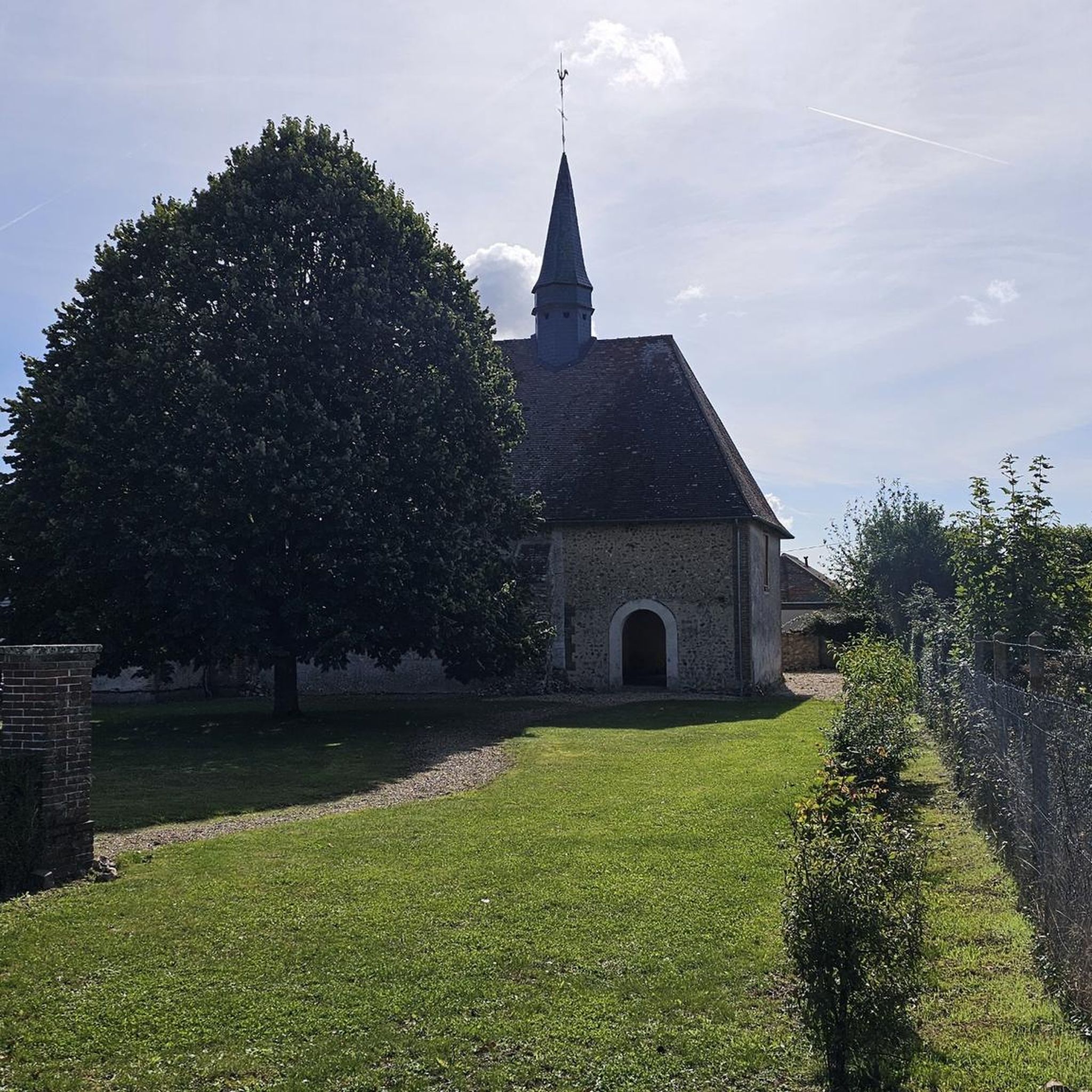
The construction of the original church of Sorel dates back to the 10th century. In 1113, this church was destroyed during the siege of the fortress of Sorel by the troops of Henry VIII of England coming from Normandy. Its identical reconstruction was unfortunately halted by a fire in 1134. The current church was rebuilt starting in the 13th century, with the chevet completed in the 15th century, and the first two bays of the nave and the northern seigneurial chapel in the 16th century. The bell tower was built in the 17th century by blinding a window. The building is constructed of flint, lime, and white stone on a sandstone base. The upper part is made of Vernon stone. The tiled roof is supported by a beautiful rafter frame whose tie beams are decorated with chimera heads, also called "howling devils." In the choir, the 19th-century altar recalls medieval sculptures. An interesting collection of stained-glass windows dating from 1850. After extensive renovations, masses have been celebrated again since 2007.
0
0
The first mention of the existence of the Church of Saint-Martin de Nonancourt is a 12th-century charter, but the original building probably dates back to the 7th or 8th century. The bell tower that now occupies the middle of the façade dates from the reconstructions of 1204. During the Hundred Years' War, the church was largely destroyed, like many buildings in the region. The side aisles, nave, and choir were rebuilt in the 16th century. The Chapel of the Virgin, also known as the Chapel of the Rosary, was also added. The Church of Saint-Martin contains numerous works of art, some of which are listed: neo-Gothic and Renaissance furnishings, including the centerpiece, the pulpit, a veritable wooden lacework; a variety of statuary, a 16th-century organ case and finally an enigmatic fresco discovered during recent works in 2001. The stained-glass windows of the church constitute a truly remarkable collection, both in terms of their number (26 in total) and their quality. The lower windows of the nave are the oldest pieces, dating from the 1500s, while the upper windows date from the 1520s and 1530s.
0
0


A very beautiful greenway It's an old railway line that has been covered over; it used to go all the way to Dreux. We love going there for cycling, and it's also ideal for walking and rollerblading.
0
0
The parish, dedicated to Saint Germain, dates back to Merovingian times. Emma, daughter of Leutgarde and Thibaut-le-tricheur, having married William Ironarm, Count of Poitiers, founded the Abbey of Bourgueil, which she endowed with her Normandy possessions, inherited from her mother, widow of William Longsword. Coudres and Marcilly-la-campagne were included in this endowment. The two Marcillys had the same lords for a long time. Around 1060, Teudon, Lord of Marcilly, approved the gift of the land of Les Loges to the Abbey of Saint Père de Chartres by Robert des Loges. In 1107, Foulques de Marcilly, the second of the name, founded the Abbey of Breuil Benoit (near Marcilly-sur-Eure). By the Treaty made in 1194 between Philip Augustus and Richard the Lionheart, Marcilly was part of the King of France's estates, on the border with Normandy. We were ROYAL! In 1226, Fulk IV, Lord of Marcilly, gave the Monks of Saint Taurin an annuity on his mills in Marcilly. During the 15th-century invasion, the King of England granted Jean Yprès on August 27, 1419, all the lands that belonged to Fulk of Marcilly, "in default," that is, devoted to France. The coat of arms of the House of Marcilly was a chevron, but the color, as well as that of the background of the shield, are unknown. At the 1470 watch, Jehan Tailleman, Lord of Marcilly-la-campagne, appeared naked. Aged 90, he could not wear a harness, and his fiefdom was very small. It is discharged, on condition of providing a vougier. (13th century weapon, made of a sharp and asymmetrical blade fixed to the end of a handle)
0
0
Built in the 15th century on the foundations of a chapel whose origins can be traced back to a papal bull from Pope Alexander in 1142, Saint Apollonia was worshipped there.
0
0
The Notre-Dame Priory, founded around 1128 by Rahier de Muzy, was dependent on Coulombs Abbey and housed a community of Benedictines. This community was apparently never very large, as Eudes Rigaud's repeated visits in the 13th century only recorded four monks. In 1255, the monks no longer lived together at the priory due to lack of space. By 1269, the buildings were in too poor condition to accommodate the archbishop. Adjoining the convent buildings, the choir of the parish church of Saint John the Baptist was used by the monks. This 12th-century church, built "in a single heap," underwent several embellishments in the 18th century, but on July 21, 1794, it was probably converted into a saltpeter works, along with the entire priory. The church reopened for worship on March 22, 1795. A campaign of renovations restored the buttresses of the west facade with bricks at the end of the 19th century. The bell tower, damaged in 1944 during the fighting on the Avre, was restored in 1959. The monument was closed for another period from 1939 to 1950. The bells were electrified in 1985. Heating was installed in 1990. A restoration project for the entire building was adopted by the municipality in 2003. The roofing work—repairing the roof box—and the complete restoration of the north facade—raising the apron of the openings by approximately 40 centimeters, repairing all the buttresses and old lime plaster—were completed in 2006. The Church of St. John the Baptist has been listed on the supplementary list of historic monuments since December 2005. A competition to select a master glassmaker was held in April 2009. The winning candidate, Coline Fabre, was entrusted with the task of creating The stained-glass windows throughout the building. Four bays were installed in the spring of 2010 and eight in the summer of 2014, so that all bays on the north, east, and south facades were fitted with stained-glass windows. Rehabilitation work on the east and west facades and the installation of the stained-glass windows on the west facade began on November 20, 2018, and was completed at the end of June 2019. The stained-glass windows were inaugurated on September 13, 2019. Since February 2021, the bells have once again rung daily at 12:00 p.m. and 7:00 p.m.
0
0
Frequently Asked Questions
How many road cycling routes are available around Droisy?
There are over 220 road cycling routes around Droisy, offering a wide variety of options for different skill levels. The komoot community has highly rated these routes, with an average score of 4.2 stars.
What kind of terrain can I expect when road cycling near Droisy?
The region around Droisy, nestled in Haute-Savoie, offers diverse terrain. You'll find stunning Alpine landscapes with majestic mountain ranges, pristine lakes like Lake Annecy and Lake Geneva, and lush valleys. Routes range from demanding mountain climbs, such as the notable Côte de Droisy with its 12 hairpin turns, to more gentle lakeside paths.
Are there any challenging climbs for experienced road cyclists in the Droisy area?
Yes, experienced cyclists seeking a challenge will find the Côte de Droisy particularly rewarding. This climb spans 6 km with an average gradient of 6.9% and a total ascent of 414 meters. The Haute-Savoie region is renowned for its legendary mountain passes, offering thrilling experiences through forests and mountain pastures.
What are some popular circular road cycling routes near Droisy?
Many routes around Droisy are designed as loops. For example, the Marcilly-sur-Eure – Eure Valley Greenway loop from Marcilly-la-Campagne is a popular 37.2-mile (59.8 km) trail. Another favorite is the Eure Valley Greenway – Anet Castle loop from Marcilly-la-Campagne, a moderate 31.2-mile (50.2 km) path.
Are there any easy or family-friendly road cycling routes around Droisy?
Yes, the region offers routes suitable for beginners and families. Portions of 'La Belle Via' cycle route, which traverses Haute-Savoie, are designed for non-motorized vehicles, providing easy and safe greenways. An example of an easy route is the Eglise de la Madeleine – Tour Grise (Verneuil-sur-Avre) loop from Tillières, which is 17.4 miles (28.0 km) long.
What kind of landmarks or points of interest can I see along road cycling routes near Droisy?
Road cycling routes around Droisy often pass by historical and natural attractions. You might encounter castles such as Château de Condé-sur-Iton or Chambray Castle. Other notable sites include Escorpain Castle and The Donjon of Gilles. The historic center of Nonancourt is also accessible on some routes.
What do other road cyclists enjoy most about cycling in Droisy?
The komoot community rates road cycling in Droisy highly, with an average score of 4.2 stars from over 20 reviews. Cyclists often praise the varied terrain, from challenging mountain climbs to scenic lakeside paths, and the opportunity to explore the stunning Alpine landscapes and charming villages of Haute-Savoie.
Are there any less crowded road cycling trails around Droisy?
While popular routes can see more traffic, the Côte de Droisy climb is known for its quiet roads, even being manageable in winter. The region's extensive network of routes means you can often find less-traveled paths, especially away from the most famous lakeside loops.
What is the best season for road cycling in Droisy?
The warmer months typically offer the best conditions for road cycling in Droisy, allowing full access to mountain passes. However, some lower-elevation climbs like the Côte de Droisy can be accessible even in winter, provided there isn't heavy snow or ice, offering a unique off-season experience.
Are there any specific long-distance cycling routes that pass through or near Droisy?
Yes, 'La Belle Via' cycle route traverses Haute-Savoie, offering majestic views of lakes, mountains, and villages. This route includes picturesque, traffic-free greenways, making it an excellent option for longer rides. You can find more information about this route on France Vélo Tourisme.
Can I find routes with significant elevation gain for a challenging workout?
Absolutely. Haute-Savoie is known for its mountainous terrain, and many routes around Droisy offer significant elevation gains. Some routes can feature up to 3,000 feet of elevation gain or more, requiring very good fitness for experienced cyclists. The Côte de Droisy itself provides a substantial climb.
Are there any routes that offer scenic viewpoints?
The Alpine landscapes of Haute-Savoie naturally provide numerous scenic viewpoints. Routes along Lake Annecy and Lake Geneva offer incredibly scenic views of the water and surrounding mountains. Mountain climbs, including the Côte de Droisy, often reward cyclists with panoramic vistas from higher elevations.
Most popular attractions around Droisy

Get inspired with the komoot mobile app


Explore more
Browse the best Road cycling routes in other regions.
